Editorial Team
7 min read
Registry records connect Alice Huang’s family and associates to financing arrangements covering hundreds of AI servers and modules in China. Lettall’s filings show how leases freed cash while increasing financial exposure, but neither set of documents establishes prohibited chip transfers.
Companies connected to Chinese businesswoman Alice Huang’s family and associates used AI equipment in China to secure financing, a report examining Chinese central-bank credit-registry filings found. Huang is the former CEO and controller of Megaspeed, a Singapore cloud-computing company and major overseas buyer of Nvidia processors.
Megaspeed denies wrongdoing and says Huang left in August 2025. A separate company profile reports that she transferred her ownership to Singapore-registered Swiftdata in late 2023. The disclosed historical connections cannot all be read as evidence of her present ownership or control.
The distinction matters as Megaspeed faces US scrutiny over suspected diversion of restricted technology. Financing documents can show who funded equipment and where it was declared to be located; they do not, by themselves, establish which chips it contained or how and when it entered China.
Her affair with Jensen Huang, CEO of AI-chip supplier Nvidia, intensified scrutiny of those business links. He resigned earlier in November before being reinstated 11 days later, the registry report says.
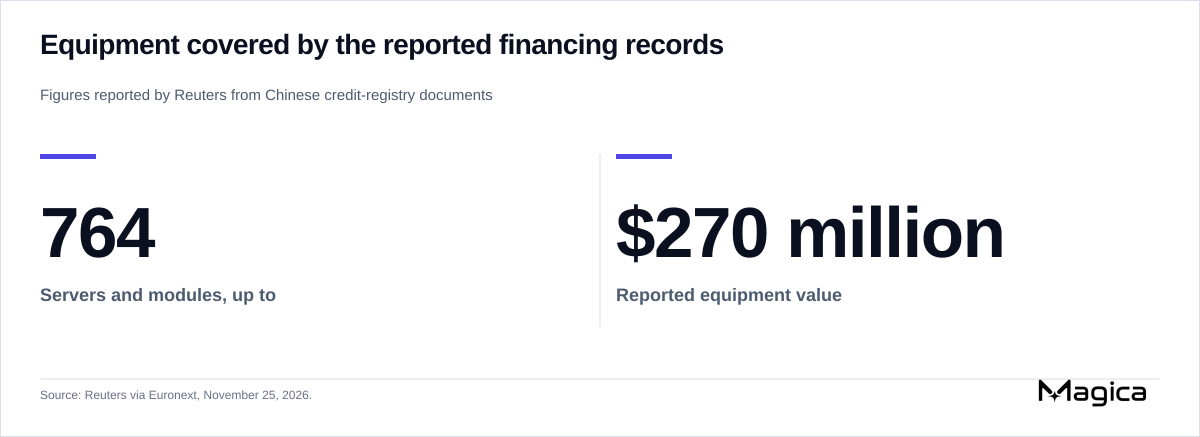
Financing records covered up to 764 AI servers and modules valued at $270 million—not necessarily new spending or distinct purchases. Source: Reuters via Euronext.
The report identifies Century Litong, an Nvidia preferred cloud partner that rents computing capacity, as a central lessee. Five leasing arrangements between May and December 2024 covered up to 512 servers with a declared value of 1.42 billion yuan, reported as $200 million. Four listed equipment at Shanghai’s Yangtze River Delta AI supercomputing centre.
One transaction described 128 servers with eight graphics processors apiece—1,024 chips altogether—and values of up to $450,000 per server. Another involved 128 servers worth $57 million financed by an arm of AVIC, China’s state-backed aviation and defence conglomerate. A separate inventory at the Shanghai facility listed more than 10,000 Nvidia ConnectX-7 networking cards and 730 BlueField-3 units, which connect computers for AI workloads.
The mechanism extended beyond Shanghai. Wuhu Century Longteng, majority-owned through investment vehicles by Huang’s sister Huang Yu until early 2026, pledged 252 AI computing modules for a $70 million Ping An Bank loan in April 2026. Those documents did not disclose the equipment’s location.
These are financing records, rather than a clean tally of new hardware purchases. The report explicitly cautions that the dollar figures describe assets covered by arrangements, not necessarily new spending or distinct purchases. The Wuhu loan amount also should not be read as a separately established purchase price.
Century Litong began in 2023 as a subsidiary of Shanghai Century Longteng. An investment company linked to Huang Yu and Kang Wei, Alice Huang’s husband and an investment executive, previously held shares in that parent alongside a Shanghai state-backed investment fund. A 2022 government announcement identified Kang as Century Longteng’s executive director, according to the report.
Century Longteng is now wholly controlled by Century Huatong, the gaming company that developed the Shanghai complex. Century Huatong also owns 70% of a company where Alice Huang previously served as a director and has a stake in gaming firm 7Road Holdings, whose former overseas subsidiary was renamed Megaspeed in 2023, the report says.
Century Litong itself passed into different ownership. Jiangsu Lettall Electronic, a manufacturer of television metal components and electronic parts that entered AI computing services in 2023, invested that year and took full ownership by mid-2024. The historical family connections therefore do not establish that Alice Huang currently owns or controls Century Litong.
The Shanghai site brings another important qualification. Tencent, the Chinese technology group that holds roughly 10% of Century Huatong, announced a strategic partnership with Shanghai’s Songjiang district government in 2020 to develop the AI centre. But Tencent told the report it never owned or operated the project and that its name and trademarks had previously been used without authorisation. Its Century Huatong investment was for gaming, it said, and it denied any commercial relationship with Megaspeed or its subsidiaries. The records do not establish that Tencent bought, rented or operated the identified servers.
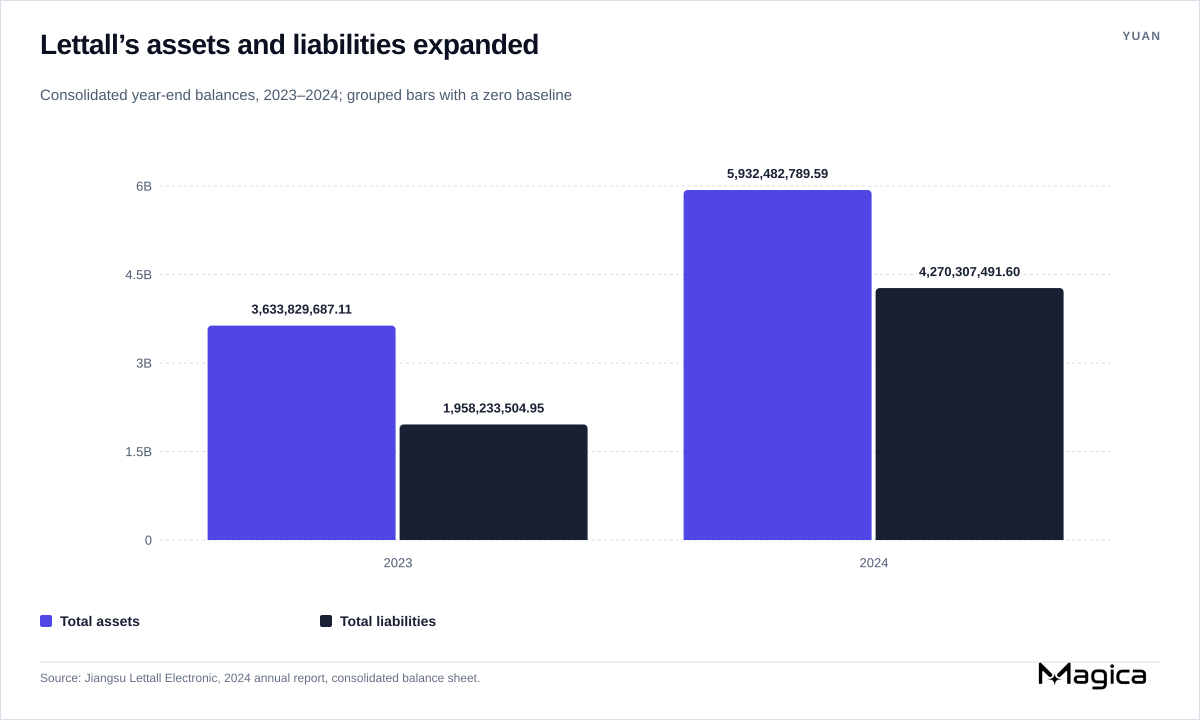
Lettall’s company-reported consolidated assets and liabilities increased in 2024. The balances cover manufacturing and computing operations. Source: Jiangsu Lettall Electronic 2024 annual report.
Lettall’s auditor’s response to an exchange inquiry, dated July 4, 2025, explains the financing sequence. Century Litong generally prepaid 30%–50% to reserve servers. For some equipment, a financing lessor subsequently bought the assets from the supplier and leased them to Century Litong, with a low-price purchase option at the end.
When lessors paid the supplier in November and December 2024, the supplier returned 447 million yuan of Century Litong’s prepayments. That money subsequently went toward debt repayment and purchases, the response says. Leasing thus released cash already committed to equipment while creating continuing rental obligations. Lettall also provided guarantees for Century Litong’s equipment-leasing agreements, according to the financing report.
The business gave its parent an important source of earnings. Lettall’s 2024 annual report records computing-business revenue of 455.2 million yuan and net profit of 142.3 million yuan, against a manufacturing loss of 115.7 million yuan. Even with computing’s contribution, profit attributable to the listed company’s shareholders fell 38.8% to 24.6 million yuan.
The balance sheet shows the cost of expansion. Group liabilities reached 4.27 billion yuan against assets of 5.93 billion yuan at December 31, 2024. Dividing the filing’s unrounded liabilities by assets gives a ratio of approximately 72%, up from 54% at the end of 2023, when liabilities were 1.96 billion yuan and assets 3.63 billion yuan.
Annual financial expenses rose to 56.0 million yuan from 13.5 million yuan. Lettall attributed that increase mainly to amortisation of financing costs on computing leases. It warned that higher leverage increased financial risk; its 2025 plan called for expanding computing resources without raising the liabilities-to-assets ratio further.
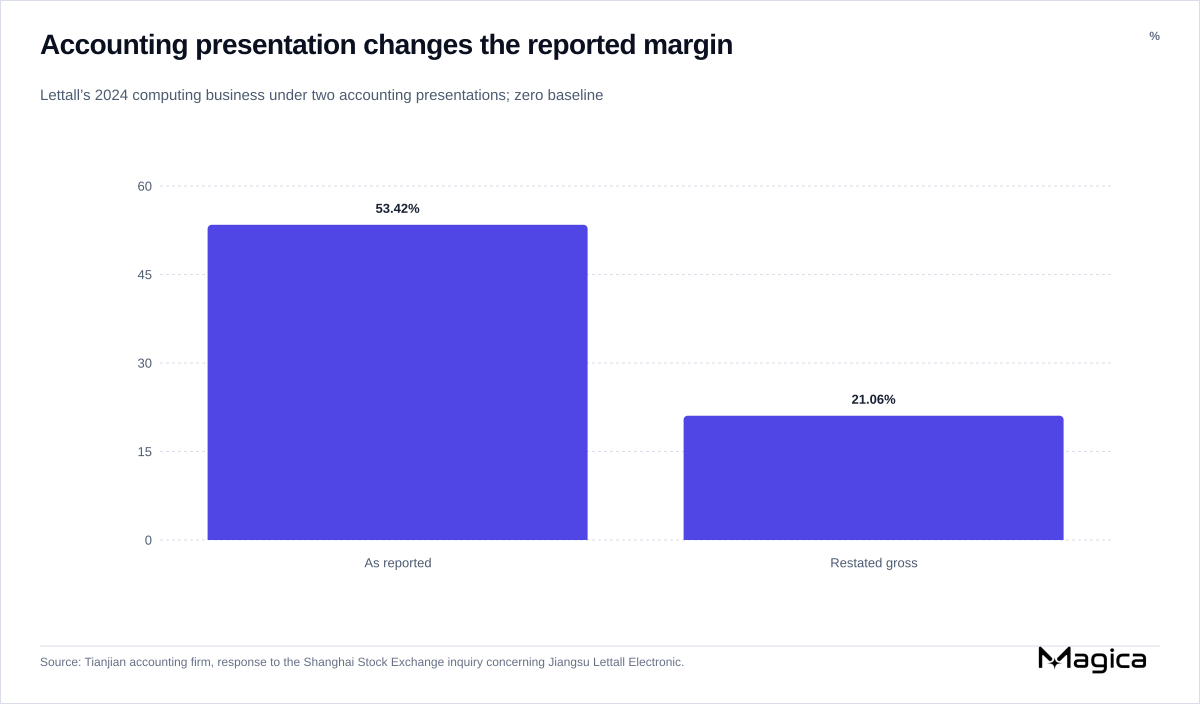
Lettall’s company-reported 2024 computing gross margin was 53.42%, compared with 21.06% when net-accounted activities were restated gross in the inquiry response. Source: Jiangsu Lettall Electronic inquiry response.
The headline margins need qualification. The computing business reported a 53.42% gross margin, but the inquiry response says its combined margin would be 21.06% if activities accounted for on a net basis were restated gross. Computing rental alone had a 34.93% margin. Those accounting differences make the segment’s reported margin a poor standalone measure of returns on buying and leasing servers.
Overseas operations also tied up money despite using equipment owned by partners. The inquiry response records 821.6 million yuan of prepaid overseas cloud-service fees at the end of 2024. The corresponding equipment was in Malaysian data centres, and the business rented capacity from suppliers before subleasing it to customers. Its prepayments were to be offset against service charges over 36 months. Customer deposits helped fund overseas prepayments; a $70 million supplier refund in December 2024 was passed back to customers.
This was not the only route available to customers. The response says overseas customers chose the intermediary for channel and funding reasons but could also purchase cloud capacity directly from suppliers. Its comparison with other listed computing businesses acknowledges that business mix and server models affect margins.
Lettall’s annual report separately warned that more entrants could erode its early advantage and profitability, while interruptions to GPU supplies could constrain expansion.
The US investigation began before the latest public scrutiny. In a November 17 statement, the Justice and Commerce departments said Commerce opened its Megaspeed investigation in 2024 over potential export-control violations. Investigators requested Nvidia sales records in May 2025; Nvidia put Megaspeed on its “no sell” list the following month.
US investigators and Singaporean law-enforcement officials conducted an on-site end-use check in June 2025 and interviewed then-CEO Alice Huang, the departments said. Justice subsequently took the lead in the criminal investigation. The registry report says Commerce added Megaspeed to its trade blacklist on November 23, 2026.
Nvidia, Century Litong, Century Huatong, Lettall and AVIC did not respond to the report’s requests for comment; Alice Huang, Huang Yu and Kang could not be reached. Lettall’s auditor concluded that the transactions it reviewed had commercial substance. That accounting conclusion does not establish export compliance.
Establishing a prohibited transfer would require evidence connecting specific chips, their shipment dates and routes, and the applicable restrictions. The disclosed records document how costly computing equipment supported financing in China. They leave that crucial chain of provenance unproven.
Authors allege NVIDIA distributed pirated books through BitTorrent and to business partners including Adobe. The court allowed the amended pleading, but transfers of the authors’ own works remain unproven.
Malaysia will advise data centres against hosting or serving seven US-blacklisted entities. The move targets access to local computing infrastructure while Malaysian reexport checks and the terms of the advisory remain unresolved.
Nutanix CEO Rajiv Ramaswami, a former VMware operating chief, plans to step down after six years. An April 2027 deadline and conditional $5 million award frame a handoff of a profitable subscription business still expanding in external storage and enterprise AI.
Goldman Sachs expects US data centers to add 52 GW of power capacity in 2028, nearly three times its 2026 forecast. Roughly half of the projected capacity has yet to start construction, leaving its bullish power and gas outlook dependent on delivery and actual electricity use.
Asian semiconductor shares sank after Nvidia gave back part of a historic rally. Its financial ties to customers put borrowing constraints alongside doubts about AI returns, while prospective US tariffs added another risk.
The Commission’s Quantum Act proposal lays groundwork for a fund reportedly targeting up to €50 billion in AI and quantum investments. Europe already has public quantum investment and scale-up financing; the new fund’s capital, terms and additional reach remain unsettled.
Huawei has linked domestic chip-design tools on a real project, according to Chinese EDA specialist Phlexing. The reported advance could reduce dependence on restricted foreign software, but does not establish manufacturing independence or competitive production costs.
Zipher’s Series A brings total funding to $53 million. The startup says its agents can rewrite and run enterprise data workloads, but expansion beyond its initial Databricks focus and savings after fees remain tests of the business.
A proposed loan to the automated-factory startup backed by Donald Trump Jr.’s investment firm raises questions about production capacity, taxpayer exposure and the Pentagon’s lending mandate. Officials say discussions are early and dispute the reported $15 billion figure.
President Donald Trump said a pardon for reinstated Nvidia CEO Jensen Huang was possible but probably unnecessary. Congressional hearings will scrutinize chip exports and the government’s role in his return, as tighter restrictions outlast the market rally.
OpenAI says proteins based on GPT-6.2 designs bound to five targets in laboratory tests. The results suggest general-purpose models can take on parts of protein design, while specialist screening and evidence beyond binding remain essential.
Attorney General Todd Blanche defended an interagency security judgment backing Jensen Huang’s return to Nvidia, but withheld details as chip-diversion allegations and demands for congressional testimony remained unresolved.
Anthropic is rolling out a beta that installs Claude artifacts as Mac and Windows apps. They gain desktop permissions and their own windows, but still depend on a Claude account, connectivity and plan limits.
South Korea has increased rewards for reporting college entrance exam cheating amid concerns about AI-assisted misconduct. Cheaters who confess and identify accomplices can receive the full reward and reduced penalties, while the extent of AI use remains unproven.
Jensen Huang disputes that Trump alone secured his reinstatement, while acknowledging government security assurances. Nvidia's independent investigation is continuing despite his return.
New York has enacted a five-year moratorium on toys containing AI companions, with penalties up to $15,000 per day for each violation. The ban starts after this holiday season, and its scope depends on a statutory definition of simulated relationships.

Meta is putting Muse in Instagram messages and prompting users to organize saved posts. The integration widens access to an existing agent as Meta pursues transaction revenue, with compute costs and permission controls still consequential.
Anthropic's Skills over MCP beta lets service providers deliver and update workflow instructions through their connections to Claude. Skills and server instructions already existed; the change ties their delivery to the service, with deployment restrictions and approval controls that matter for business use.
Dell lifted its fiscal 2027 revenue outlook by $10 billion after a record quarter. AI servers led the expansion, but traditional servers and higher infrastructure margins also drove a sharp shift in its earnings mix.
Two independent amateur searches used OpenAI tools to build software for public telescope data. One flagged 49 possible planets; professional scrutiny has begun, but neither search has confirmed a new planet.