Editorial Team
6 min read
Zipher’s Series A brings total funding to $53 million. The startup says its agents can rewrite and run enterprise data workloads, but expansion beyond its initial Databricks focus and savings after fees remain tests of the business.
Zipher, a startup that automates how enterprise data-processing tasks run, announced a $45 million Series A on November 24, 2026, bringing its cumulative funding to $53 million. It is selling companies a way to delegate infrastructure decisions to agents that work within a budget and performance requirements—and says the funding will help it expand beyond its initial Databricks customer base.
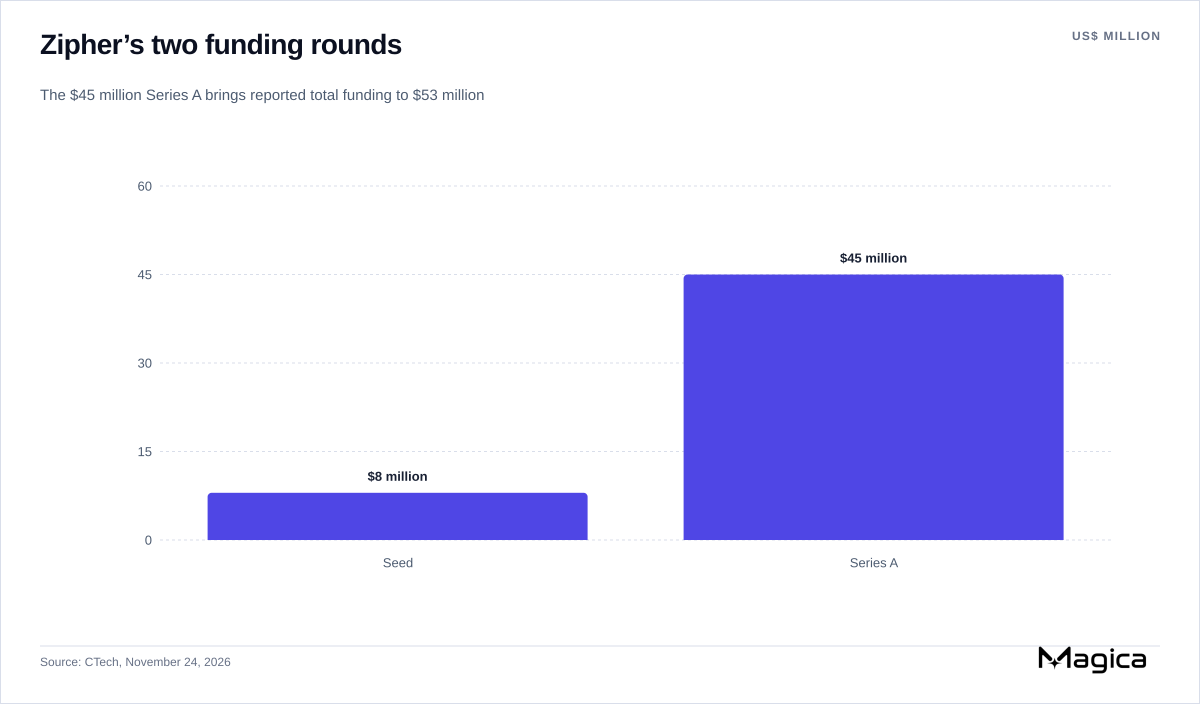
Zipher’s $45 million Series A follows an $8 million seed round, bringing total funding to $53 million. Source: CTech.
The latest financing is a $45 million Series A co-led by Maor Investments and Glilot Capital, with existing investor TLV Partners participating, according to the funding report. TLV led an $8 million seed round in August 2024.
Zipher was founded in 2024 by CEO Dan Coster, who previously led a big-data analytics unit in Israel’s military intelligence Unit 8200, and CTO Yoav Gill Ben Ephraim. In a November 24 interview, Coster said his co-founder had led Payoneer’s data-platform team, experience that supplied the problem they set out to solve. Both are Unit 8200 alumni, according to Zipher’s announcement.
Headquartered in New York with offices in Tel Aviv, the company employs 40 people, the funding report says. Coster said in that report that it began selling near the end of 2025. The financing is therefore backing a business with roughly a year of commercial history.
Zipher says the money will fund research and development, U.S. enterprise sales and expansion into Europe, the Middle East and Africa, Latin America, and Asia-Pacific.
The investors are backing a shift in what customers delegate. Glilot says it invested through Glilot+, its early-growth fund; its stated thesis is that enterprises will increasingly buy completed workloads delivered within time and budget constraints. That is an investor expectation, not an established description of how most enterprises buy infrastructure today.
Zipher says in its announcement that customers supply code, a budget and a service-level agreement, or SLA, defining required performance and reliability. Its agents analyze each workload and its dependencies, select a processing engine using current capacity and load, allocate resources and schedule execution. They can also rewrite the framework, code and syntax.
The proposed shift is operational authority: Zipher says the software applies decisions autonomously instead of leaving recommendations for a data team to implement. Rewriting a task makes preserving its results and meeting reliability requirements essential to judging any savings.
The announcement says the platform supports workloads on AWS, Azure and Google Cloud and integrates with workflow tools including dbt, Databricks Workflows, Apache Airflow and Azure Data Factory, as well as infrastructure-management tools such as Terraform.
That cloud coverage should be distinguished from support for different data platforms. In the November 24 interview, Coster said Zipher initially designed its agents for Databricks customers and would use the funding to expand to platforms including Snowflake, Amazon EMR and BigQuery. Databricks is thus both an initial platform for Zipher’s business and one of the established data platforms against which its capabilities must be assessed.
Coster said in a separate interview that Zipher aims to solve a problem Snowflake and Databricks do not address. Automated infrastructure management already has precedents.
Snowflake, an enterprise data platform, introduced Adaptive Compute in June 2025, then in private preview. It described automatic resource sizing and sharing, query routing and management of concurrency and multi-cluster configurations. That announcement does not establish equivalence with Zipher’s workload rewriting or engine selection, but it narrows the novelty claim: customers already have platform vendors pursuing autonomous resource management.
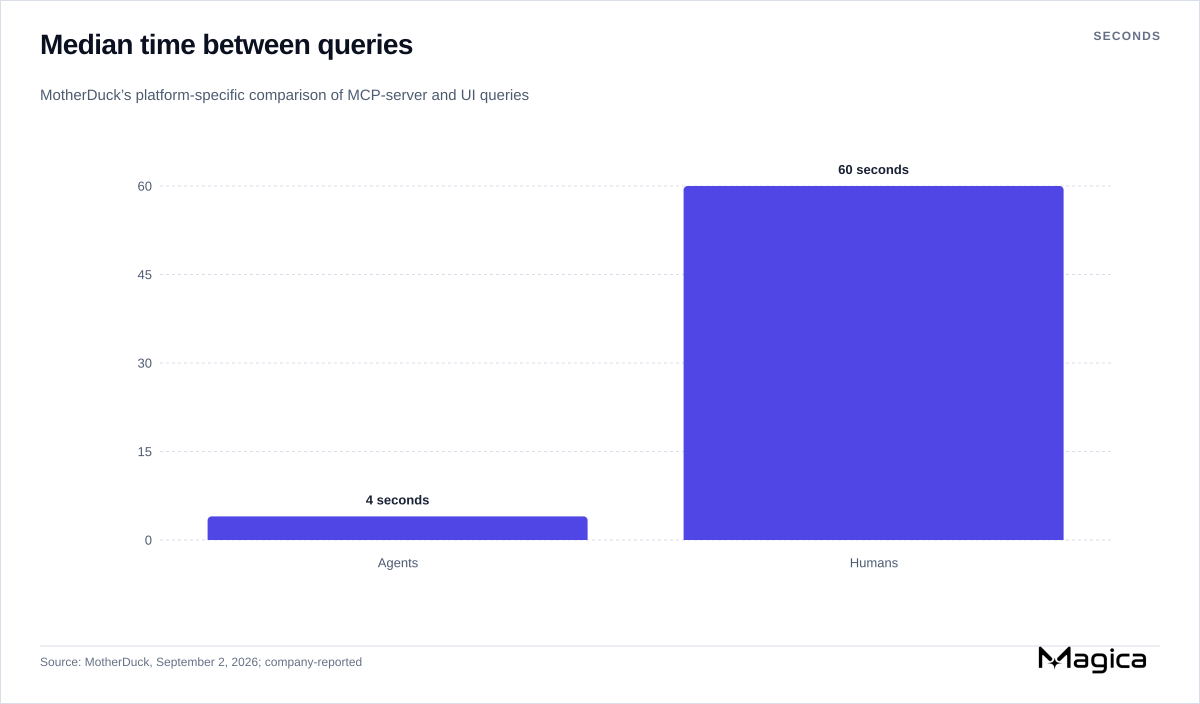
Company-reported: MotherDuck measured median query intervals of 4 seconds for agents and 60 seconds for humans in a two-week comparison of MCP-server and UI queries. Source: MotherDuck.
There is evidence behind the premise that agents change demand. In a September 2, 2026 analysis of its query history, analytics provider MotherDuck reported that agents ran 29 times as many queries as humans in the preceding month.
That is a platform-specific observation, not an industry-wide ratio or a per-agent productivity measure. Its methodology classifies user-interface queries as human and queries through its agent-facing MCP server as agent-generated. It describes a two-week comparison window while the volume claim refers to a month.
The analysis offers a more useful operational distinction: the median interval between agent queries was four seconds, compared with 60 seconds for humans. The median agent query scanned 7,000 rows, against 200,000 for humans. More queries therefore need not mean proportionally more data processed; many agent requests are small exploratory or metadata queries.
MotherDuck argues that these bursts create two competing costs: keeping a cluster running between bursts wastes resources, while starting fresh compute for every query loses the benefits of cached data. It points to scaling, local execution and caching as responses. Those are alternatives customers must weigh alongside an additional management layer such as Zipher.
Zipher’s own announcement claims 40–60% cost-efficiency gains and up to 80% better SLA adherence among its Fortune 500 customers, with results typically appearing within two weeks. It does not publish the sample size, measurement period, calculation method or comparison configuration behind those figures. The SLA figure also lacks a definition showing whether it measures a relative improvement or a change in percentage points.
The more concrete example is car-rental company Hertz. In Zipher’s announcement, Gaurav Rastogi, Hertz’s senior director for enterprise data analytics and BI platforms, reports compute-cost reductions of 25–40%, depending on the workload, while maintaining consistent performance through seasonal peaks. That is a named customer’s account supplied in a vendor announcement. It measures compute costs, whereas Zipher’s broader claim uses the less specific term “cost-efficiency”; the two ranges cannot be treated as the same benchmark.
The funding coverage and announcement do not disclose Zipher’s fees or a customer calculation of savings after those charges. Nor do they supply a controlled comparison with the same workloads and reliability requirements using the underlying platform’s own optimization features.
The announcement describes production use at Hertz; Coster’s funding interview also mentions development environments. Neither breaks down deployments by workload, leaving the mix of uses unspecified.
The next decision for enterprise buyers is how much execution authority to delegate, on which platforms and under what safeguards. Evidence that would resolve it includes completed deployments beyond Databricks, checks that rewritten workloads preserve their results, and comparable costs after fees while meeting the same reliability targets. The new financing gives Zipher resources to broaden its reach; repeatable deployment economics will determine how persuasive that expansion is.
Authors allege NVIDIA distributed pirated books through BitTorrent and to business partners including Adobe. The court allowed the amended pleading, but transfers of the authors’ own works remain unproven.
Malaysia will advise data centres against hosting or serving seven US-blacklisted entities. The move targets access to local computing infrastructure while Malaysian reexport checks and the terms of the advisory remain unresolved.
Nutanix CEO Rajiv Ramaswami, a former VMware operating chief, plans to step down after six years. An April 2027 deadline and conditional $5 million award frame a handoff of a profitable subscription business still expanding in external storage and enterprise AI.
Goldman Sachs expects US data centers to add 52 GW of power capacity in 2028, nearly three times its 2026 forecast. Roughly half of the projected capacity has yet to start construction, leaving its bullish power and gas outlook dependent on delivery and actual electricity use.
Asian semiconductor shares sank after Nvidia gave back part of a historic rally. Its financial ties to customers put borrowing constraints alongside doubts about AI returns, while prospective US tariffs added another risk.
The Commission’s Quantum Act proposal lays groundwork for a fund reportedly targeting up to €50 billion in AI and quantum investments. Europe already has public quantum investment and scale-up financing; the new fund’s capital, terms and additional reach remain unsettled.
Huawei has linked domestic chip-design tools on a real project, according to Chinese EDA specialist Phlexing. The reported advance could reduce dependence on restricted foreign software, but does not establish manufacturing independence or competitive production costs.
A proposed loan to the automated-factory startup backed by Donald Trump Jr.’s investment firm raises questions about production capacity, taxpayer exposure and the Pentagon’s lending mandate. Officials say discussions are early and dispute the reported $15 billion figure.
Registry records connect Alice Huang’s family and associates to financing arrangements covering hundreds of AI servers and modules in China. Lettall’s filings show how leases freed cash while increasing financial exposure, but neither set of documents establishes prohibited chip transfers.
President Donald Trump said a pardon for reinstated Nvidia CEO Jensen Huang was possible but probably unnecessary. Congressional hearings will scrutinize chip exports and the government’s role in his return, as tighter restrictions outlast the market rally.
OpenAI says proteins based on GPT-6.2 designs bound to five targets in laboratory tests. The results suggest general-purpose models can take on parts of protein design, while specialist screening and evidence beyond binding remain essential.
Attorney General Todd Blanche defended an interagency security judgment backing Jensen Huang’s return to Nvidia, but withheld details as chip-diversion allegations and demands for congressional testimony remained unresolved.
Anthropic is rolling out a beta that installs Claude artifacts as Mac and Windows apps. They gain desktop permissions and their own windows, but still depend on a Claude account, connectivity and plan limits.
South Korea has increased rewards for reporting college entrance exam cheating amid concerns about AI-assisted misconduct. Cheaters who confess and identify accomplices can receive the full reward and reduced penalties, while the extent of AI use remains unproven.
Jensen Huang disputes that Trump alone secured his reinstatement, while acknowledging government security assurances. Nvidia's independent investigation is continuing despite his return.
New York has enacted a five-year moratorium on toys containing AI companions, with penalties up to $15,000 per day for each violation. The ban starts after this holiday season, and its scope depends on a statutory definition of simulated relationships.

Meta is putting Muse in Instagram messages and prompting users to organize saved posts. The integration widens access to an existing agent as Meta pursues transaction revenue, with compute costs and permission controls still consequential.
Anthropic's Skills over MCP beta lets service providers deliver and update workflow instructions through their connections to Claude. Skills and server instructions already existed; the change ties their delivery to the service, with deployment restrictions and approval controls that matter for business use.
Dell lifted its fiscal 2027 revenue outlook by $10 billion after a record quarter. AI servers led the expansion, but traditional servers and higher infrastructure margins also drove a sharp shift in its earnings mix.
Two independent amateur searches used OpenAI tools to build software for public telescope data. One flagged 49 possible planets; professional scrutiny has begun, but neither search has confirmed a new planet.