Editorial Team
6 min read
Goldman Sachs expects US data centers to add 52 GW of power capacity in 2028, nearly three times its 2026 forecast. Roughly half of the projected capacity has yet to start construction, leaving its bullish power and gas outlook dependent on delivery and actual electricity use.
Goldman Sachs, the Wall Street bank and brokerage whose research team has tracked AI’s effects on electricity markets, forecasts that 52 gigawatts of new US data-center power capacity could enter service in 2028. Roughly half of that forecast depends on projects that had not begun construction when its November 24 note was issued.
The bank's latest outlook supports its bullish view of Henry Hub, the US natural-gas price benchmark, for 2028–2030. For utilities and gas suppliers, the consequential question is how much of the planned computing infrastructure becomes an operating load, and when.
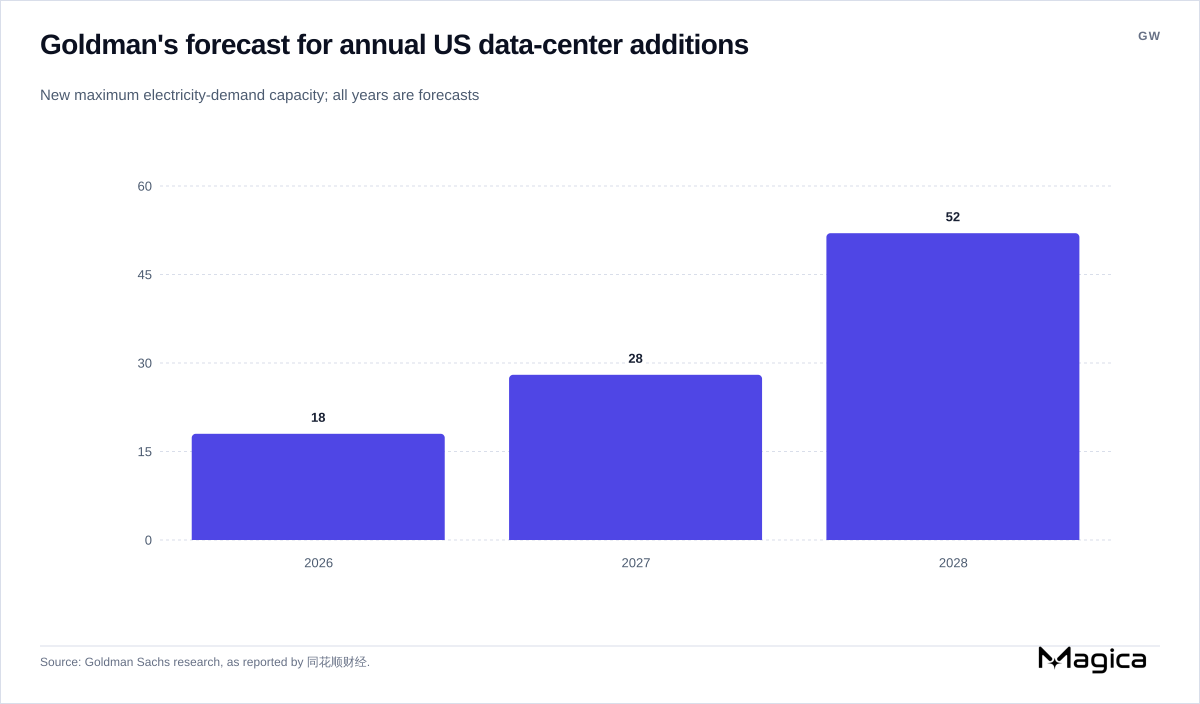
Goldman Sachs’ company-reported forecasts put annual additions at 18, 28 and 52 GW. These measure maximum electricity-demand capacity, not annual electricity consumption. Chart: Magica. Source: 同花顺财经.
A detailed account of the research puts Goldman's projected annual additions on a much steeper path than the recent historical pace:
| Period | New US data-center power capacity |
|---|---|
| 2021–2024 annual average, as reported in the analysis | About 4 GW |
| 2025 estimate | About 10 GW |
| 2026 forecast | 18 GW |
| 2027 forecast | 28 GW |
| 2028 forecast | 52 GW |
The 2028 projection is about 2.9 times the 2026 forecast, calculated by dividing 52 by 18. These figures describe additions to maximum electricity demand capacity, rather than annual electricity consumption or new power-plant generating capacity. The same account says Goldman raised its forecast for total US data-center capacity at the end of 2027 from 90 GW to 92 GW; adding the projected 52 GW would put the end-2028 total at about 144 GW.
Authors allege NVIDIA distributed pirated books through BitTorrent and to business partners including Adobe. The court allowed the amended pleading, but transfers of the authors’ own works remain unproven.
Goldman attributes the acceleration to more buildings, larger buildings and greater power density. In the detailed account, its breakdown of the roughly 34 GW increase in annual additions between 2026 and 2028 assigns about 16 GW to more buildings, 9.5 GW to higher power density and 9 GW to larger buildings. This means that counting new sites alone would miss much of the projected expansion.
The bank also estimates an existing demand effect. In its latest note, Goldman said US data-center power capacity and demand had increased nearly 30% year to date, contributing more than a third of total US electricity-demand growth. Those are the bank's estimates, rather than a measure of how much of the 2028 pipeline will ultimately operate.
The 52 GW projection already incorporates historical delays and cancellations. According to the detailed account, Goldman models project schedules using projects under construction and others meeting key conditions involving financing, permits, grid agreements, land and water rights. Its model assumes roughly 60% of scheduled capacity reaches commercial operation on time over a one-year horizon, falling to about 50% over two years.
Even after those adjustments, approximately 26 GW within the 2028 forecast had not begun construction. That is half the projected total. The corresponding figure for 2027 was about 5 GW, making the later year more exposed to decisions that remain ahead.
The exposure is geographically concentrated. About 35 GW of the projected 2028 additions falls within PJM, the regional power market that includes Virginia; ERCOT in Texas; and MISO in the Midwest. Delays or shortages in these markets would therefore have an outsized effect on the national forecast.
Goldman identifies power supplied behind the utility meter, modular delivery and faster construction as possible ways to improve completion rates. Its note also flags potential policy shifts after November’s Democratic midterm victories as a risk to the upside outlook. The detailed account identifies community opposition in Virginia and Arizona as another possible source of delays beyond those captured by historical adjustments. The historical completion assumptions should therefore not be applied as a second discount to the published 52 GW forecast.

Goldman Sachs’ company-reported analysis puts unstarted shares at 55% in PJM, 45% in ERCOT and 40% in MISO. These apply to expected 2028 additions after historical delay and cancellation adjustments. Chart: Magica. Source: 同花顺财经.
The detailed account says Goldman's existing 2027–2035 gas model assumed data centers would add 18 GW of average electricity demand annually, corresponding to roughly 28 GW of maximum power capacity. The 2027 construction forecast is close to that capacity baseline; 52 GW in 2028 would substantially exceed it.
That creates potential upside for gas demand if the facilities open on schedule and servers bring their electricity loads up. An energy-market account, which quotes Goldman through the earlier linked report, emphasizes gas-fired generation as a source of dependable electricity for the buildout. But a capacity forecast alone cannot establish the amount of additional gas burned: server installation, utilization and the electricity supply serving each facility remain part of that calculation.
A separate federal assessment illustrates the distinction. In December 2024, the US Department of Energy released a study by Lawrence Berkeley National Laboratory, funded through the department’s Industrial Efficiency and Decarbonization Office. It estimated annual US data-center electricity consumption at 176 terawatt-hours, or 4.4% of national electricity use, in 2023 and projected 325–580 TWh, or approximately 6.7%–12%, in 2028. The federal assessment measures energy used over a year across the sector. It cannot be compared directly with Goldman's forecast of capacity added in one year and predates the latest outlook.
Gas is only one possible response to that demand. The department’s 2024 announcement set out options including onsite generation and storage, demand flexibility, next-generation geothermal, advanced nuclear and more efficient semiconductors. It also called for work on electricity rate structures to preserve affordability. Those were proposed tools for meeting demand, rather than evidence that enough alternative supply would be ready in 2028.
Goldman's own earlier work provides a caution against treating construction as proof of sustained demand. In a February 2025 global outlook, its research team anticipated tighter data-center occupancy through late 2026, followed by moderation from 2027 as supply increased and AI-driven demand growth slowed. It also identified permitting, transmission constraints and supply-chain bottlenecks as obstacles to bringing new capacity online. The bank said slower adoption or monetization of AI could weaken demand, while efficiency improvements that reduced capital spending could ease the risk of excess data-center supply.
That earlier analysis covered the global market and is not directly comparable with the new US forecast. It nevertheless shows why opening buildings and filling them with paying computing workloads are separate tests.
For the unfinished 26 GW in the 2028 projection, the immediate decisions concern permits, construction and power arrangements. After facilities receive electricity, measured load will show whether server deployment and use justify the capacity built. Until those steps are visible, the 52 GW forecast identifies an upside risk for gas markets without establishing a corresponding volume of gas consumption or a specific price increase.
Malaysia will advise data centres against hosting or serving seven US-blacklisted entities. The move targets access to local computing infrastructure while Malaysian reexport checks and the terms of the advisory remain unresolved.
Nutanix CEO Rajiv Ramaswami, a former VMware operating chief, plans to step down after six years. An April 2027 deadline and conditional $5 million award frame a handoff of a profitable subscription business still expanding in external storage and enterprise AI.
Asian semiconductor shares sank after Nvidia gave back part of a historic rally. Its financial ties to customers put borrowing constraints alongside doubts about AI returns, while prospective US tariffs added another risk.
The Commission’s Quantum Act proposal lays groundwork for a fund reportedly targeting up to €50 billion in AI and quantum investments. Europe already has public quantum investment and scale-up financing; the new fund’s capital, terms and additional reach remain unsettled.
Huawei has linked domestic chip-design tools on a real project, according to Chinese EDA specialist Phlexing. The reported advance could reduce dependence on restricted foreign software, but does not establish manufacturing independence or competitive production costs.
Zipher’s Series A brings total funding to $53 million. The startup says its agents can rewrite and run enterprise data workloads, but expansion beyond its initial Databricks focus and savings after fees remain tests of the business.
A proposed loan to the automated-factory startup backed by Donald Trump Jr.’s investment firm raises questions about production capacity, taxpayer exposure and the Pentagon’s lending mandate. Officials say discussions are early and dispute the reported $15 billion figure.
Registry records connect Alice Huang’s family and associates to financing arrangements covering hundreds of AI servers and modules in China. Lettall’s filings show how leases freed cash while increasing financial exposure, but neither set of documents establishes prohibited chip transfers.
President Donald Trump said a pardon for reinstated Nvidia CEO Jensen Huang was possible but probably unnecessary. Congressional hearings will scrutinize chip exports and the government’s role in his return, as tighter restrictions outlast the market rally.
OpenAI says proteins based on GPT-6.2 designs bound to five targets in laboratory tests. The results suggest general-purpose models can take on parts of protein design, while specialist screening and evidence beyond binding remain essential.
Attorney General Todd Blanche defended an interagency security judgment backing Jensen Huang’s return to Nvidia, but withheld details as chip-diversion allegations and demands for congressional testimony remained unresolved.
Anthropic is rolling out a beta that installs Claude artifacts as Mac and Windows apps. They gain desktop permissions and their own windows, but still depend on a Claude account, connectivity and plan limits.
South Korea has increased rewards for reporting college entrance exam cheating amid concerns about AI-assisted misconduct. Cheaters who confess and identify accomplices can receive the full reward and reduced penalties, while the extent of AI use remains unproven.
Jensen Huang disputes that Trump alone secured his reinstatement, while acknowledging government security assurances. Nvidia's independent investigation is continuing despite his return.
New York has enacted a five-year moratorium on toys containing AI companions, with penalties up to $15,000 per day for each violation. The ban starts after this holiday season, and its scope depends on a statutory definition of simulated relationships.

Meta is putting Muse in Instagram messages and prompting users to organize saved posts. The integration widens access to an existing agent as Meta pursues transaction revenue, with compute costs and permission controls still consequential.
Anthropic's Skills over MCP beta lets service providers deliver and update workflow instructions through their connections to Claude. Skills and server instructions already existed; the change ties their delivery to the service, with deployment restrictions and approval controls that matter for business use.
Dell lifted its fiscal 2027 revenue outlook by $10 billion after a record quarter. AI servers led the expansion, but traditional servers and higher infrastructure margins also drove a sharp shift in its earnings mix.
Two independent amateur searches used OpenAI tools to build software for public telescope data. One flagged 49 possible planets; professional scrutiny has begun, but neither search has confirmed a new planet.