Editorial Team
7 min read
Finland has recognised Tesla’s provisional Dutch approval after changes to branding and speed controls. Drivers remain responsible, and the national decision does not commit Finland to backing EU-wide authorisation.
Finland has cleared Tesla Assisted Driving, the US automaker’s system for steering, accelerating and braking under human supervision, for use on its roads. Previously called Full Self-Driving (Supervised), the system can operate without continuous physical contact with the controls. Drivers must still monitor traffic and intervene when needed. The clearance lets Tesla offer it to Finnish customers while EU-wide authorisation remains undecided.
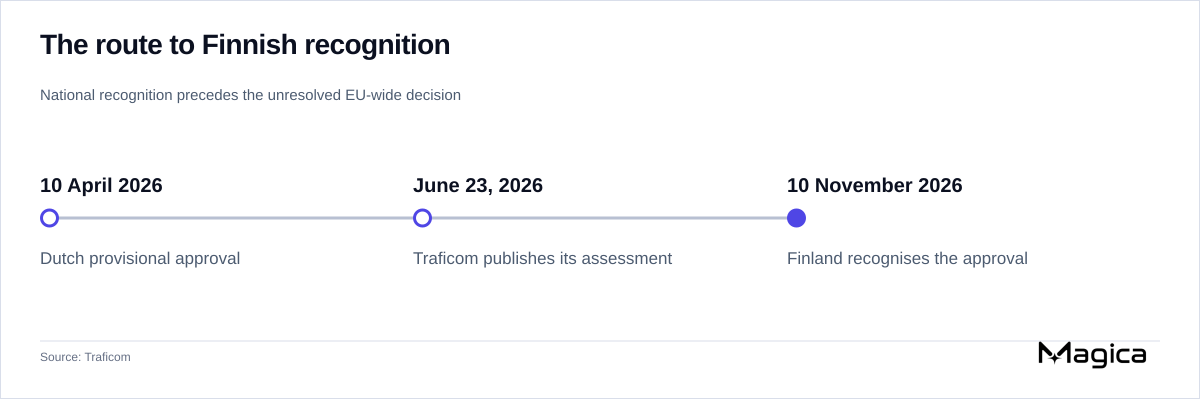
Finland recognised the Dutch provisional approval while EU-wide authorisation remained unresolved. Source: Traficom. Source: Traficom.
The Finnish Transport and Communications Agency, Traficom, said in its November 11 announcement that it recognised the Dutch provisional type-approval on November 10, 2026. Tesla can begin offering the system immediately.
The distinction between national access and European authorisation matters commercially. Nearly a dozen countries, including Slovakia and Belgium, have provisionally approved the technology, according to a report on the clearance, but Tesla has yet to secure backing from any of the EU’s largest member states. A qualified majority is needed for approval across the bloc; rejection would invalidate the national approvals already granted.
The route began with provisional approval from RDW, the Dutch vehicle type-approval authority, on April 10. In its June assessment, Traficom explained that the procedure accommodates technology that does not fit established requirements, provided the applicant demonstrates at least equivalent safety and environmental protection. Traficom has authority to recognise that approval in Finland and represents the country in the European committee process. It had already issued permits allowing Tesla’s own drivers to test the system in Finland for several years.
The immediate Finnish market is limited. Jukka Juhola, a senior specialist at Traficom involved in its earlier assessment, put the compatible fleet at 8,000–9,000 Teslas, or around 0.3% of all cars on Finnish roads, in the report on the decision. He cited that small share as one reason the agency felt able to proceed. Those are compatible vehicles, rather than a count of customers using the feature. In June, Traficom said Tesla had not initiated an equivalent approval procedure for older cars.
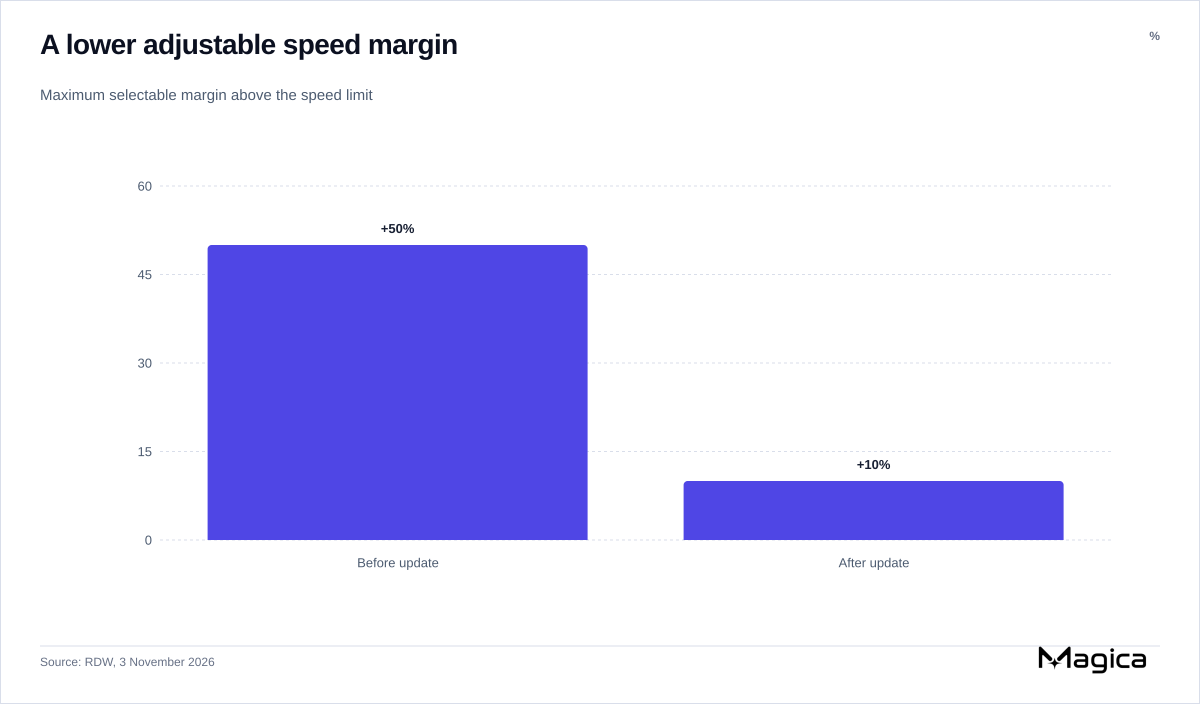
RDW says the maximum selectable speed margin falls from +50% to +10%, with a 0% startup default. Drivers must still obey the speed limit. Source: RDW.
Traficom says references to self-driving have been removed from the system’s name and Finnish- and Swedish-language marketing and user guidance. The agency presents the change as a way to make the product’s actual role clearer. The Finnish-language account of the decision describes driving without touching the wheel or accelerator, while stressing that responsibility remains with the driver.
The revisions also reach beyond branding. In a November 3 explanation, RDW said the adjustable speed margin was being reduced from a maximum of 50% above the limit to 10%. At startup it defaults to zero deviation, with other speed-related functions also switched off. RDW said the update applies to Tesla models equipped with Assisted Driving and hardware version 4.0 or higher, and would be delivered over the air by Tesla. It found no adverse or unintended effects from the changes and said the existing approval remained valid on the same conditions and for the same use.
Traficom says information about the system’s selected speed settings has been expanded and clarified. The remaining ability to select a margin does not excuse speeding: the driver must obey the limit and receives any fine.
Hands-free assistance itself is not unprecedented. Traficom’s June assessment noted that existing legislation already allowed approval of systems permitting drivers to take their hands off the wheel in motorway conditions. Tesla’s application also involved contextual speed selection—adapting to other traffic when the detected limit is uncertain or inaccurate—and an integrated system operating as a single entity, rather than separate parallel functions. These features help explain its use of the exemption procedure.
Traficom wants Finnish owners to become familiar with the system before the most difficult winter conditions arrive. That timing also highlights its limitations: snow, slush or dirt covering the cameras can restrict operation, as can unusually complex traffic conditions.
Traficom’s guidance says drivers must anticipate errors and intervene when necessary, including before the system requests physical control. Ice, deep snow, slush and strong crosswinds may warrant keeping hands on the wheel to shorten the response time. The system monitors driver attentiveness, but active human monitoring and intervention remain its primary means of managing risk, the agency said in June.
That earlier assessment also relayed Tesla’s owner-manual warnings that the vehicle could suddenly make unexpected manoeuvres or mistakes and that the system was an early-access feature requiring particular caution. Traficom examined overtaking on Finnish two-way roads, where bends and changes in elevation can obstruct camera visibility, and whether drivers could regain steering control quickly on slippery roads at higher speeds. It also examined vehicle wear, noting that Tesla’s maintenance programme did not include regular condition inspections.
For owners, activation normally requires no modification inspection if the car has not been modified. Traficom says changes affecting the system, such as unusual tyre sizes or a lowered suspension, may require one; the manufacturer is best placed to explain their effect.
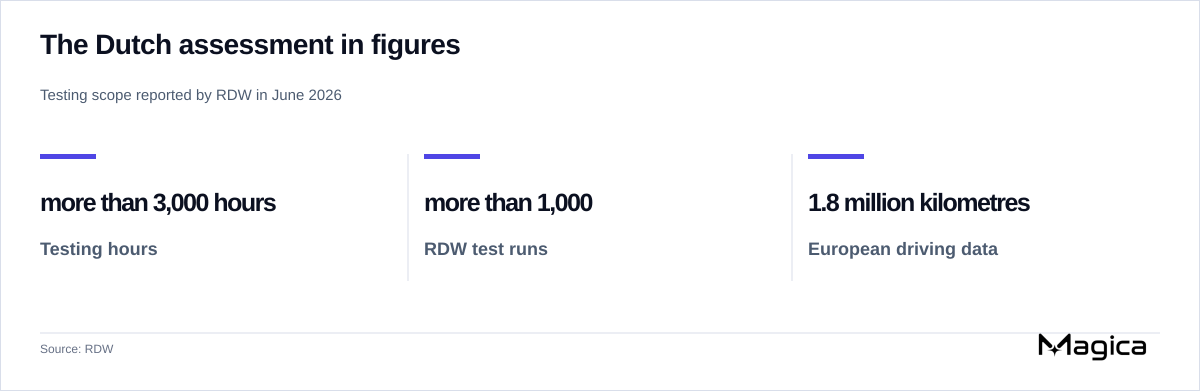
RDW’s assessment included extensive testing and European driving data. These figures do not establish a measured reduction in Finnish crashes. Source: RDW.
The Dutch approval has a testing record behind it. In its June explanation of the assessment, RDW said testing covered more than 3,000 hours on tracks and public roads, including extreme weather. Its own tests comprised more than 1,000 runs; the assessment also used data from 1.8 million kilometres driven in Europe with FSD Supervised. RDW said it independently reviewed Tesla’s statistical analysis and compared European test-vehicle data with data from recent Tesla models without the system.
RDW said its assessment lasted more than 18 months and concluded that, with continuous strict driver monitoring, the system was at least as safe as other driver assistance systems. It also reported that, by June 17, nearly 40,000 equipped Teslas had driven approximately 24 million kilometres in the Netherlands since approval, without relevant incidents. Those were the authority’s reported deployment figures at that date; the statement did not define “relevant incidents” or give a comparable incident rate for vehicles without the system.
The testing and deployment figures therefore do not establish a measured reduction in Finnish crashes. Traficom sees potential to reduce accidents caused by human error when assistance is used correctly and with appropriate technical limits. RDW has also increased mandatory reporting from annually to monthly and says it can investigate or impose measures on Tesla as operating and safety data accumulate.
Traficom expects further changes before EU-wide approval, aimed at helping drivers stay alert without significantly changing how the system is used. Its June assessment had anticipated an October decision; the agency now expects one during the coming winter. The report on the clearance identifies December as the next scheduled meeting at which a vote could occur, rather than a confirmed approval date.
Final authorisation requires a successful vote in the European Commission’s Technical Committee – Motor Vehicles. Traficom says approval would take approximately three weeks to become effective across the EU after a successful vote.
Finland’s recognition does not bind its vote. The agency will continue following discussions about the system’s features before deciding its position.
The decision would also reach beyond Tesla. Traficom’s June explanation said that EU authorisation of an exemption for new technology requires established legislation to be adapted, a process it estimated would take around two years. The technology covered by the exemption would then be available to all manufacturers. The next vote therefore concerns both Tesla’s continued market access and the route by which comparable systems could follow.
ByteDance is reportedly accelerating plans to combine its Spell project with Doubao. Existing travel bookings reveal a transaction-fee business, while the phone assistant's history shows how access to other apps can constrain execution.
The Office for Students wants more AI-free assessment and better AI skills teaching, backed by existing quality rules. Its research raises doubts about unsupervised coursework, but universities say assessment reform is already under way.
Grok Bot can connect to internal MCP servers through Tailscale without exposing them to the public internet. User-based authorization preserves network controls, but administrators must configure how narrowly the assistant can reach into their systems.
Daylight’s Goldman Sachs Alternatives-led Series B backs security agents supported by human engineers. The young company reports rapid growth, but has not disclosed the economics behind its automation promise.
Primordial Labs raised $18 million to widen deployment of Anura, its military command software. Existing contracts and demonstrations give it a foothold, but integration counts do not establish sustained use or lower operating costs.
Northwestern Polytechnical University bought two Nvidia H200 processors for 874,700 yuan and awarded five contracts for rented Nvidia computing, procurement records show. Separate US restrictions on the defense-linked institution remained in place despite January’s conditional opening for H200 exports to China.
The North Dakota Republican says allegations involving a suspected Chinese intelligence operative make Huang vulnerable to coercion. Nvidia’s board is backing its founder while independent directors investigate, with investors facing both security and leadership risks.
Scott Bessent says Washington and Beijing are establishing a channel for serious AI incidents, following their September agreement. Its usefulness depends on unresolved reporting procedures and participation by the companies that detect model failures.
Coframe's $25 million Series A backs AI agents that build and test websites and ads. Its offering combines automation with human expertise and customer approvals, while its claimed gains lack comparable measurement detail.
Alibaba’s Qwen4-Max preview gives developers a fixed model to test through November 25. API access requires Token Plan, while claimed coding gains remain unquantified in the launch materials.
Railway estimates stolen customer keys generated about $740,000 in unauthorized AI spending after an October intrusion. Secrets from up to about 100,000 workspaces could have been decrypted, and the company says it will cover losses providers decline to refund.
Anthropic expects retail investors worldwide to receive up to 20% of its IPO, potentially $12.9 billion at the proposed upper price. Access through six brokerage channels depends on demand and broker rules, while a separate technology-company investment would help finance vast infrastructure commitments and founders and a special trust retain control.
Anthropic's seven founders plan equal IPO share sales worth about $250 million each at the proposed midpoint. Their sales make up 2.9% of the public offering, while the company seeks much larger financing under a structure that limits public investors' voting influence.
Nvidia’s independent directors retained Wachtell Lipton partner Joon H. Kim for an investigation into reports of a foreign intelligence effort targeting co-founder and CEO Jensen Huang. The board previously expressed confidence in Huang; the appointment provides no findings or timetable.
RRE Ventures led the funding for Graphon’s enterprise memory infrastructure. The startup is pitching connected, persistent context across different agents, but benchmark gains leave deployment costs and commercial scale unresolved.
Goldman Sachs, a lead bank on Anthropic’s IPO, reportedly forecasts $685 billion in annual revenue by 2030. The Claude developer has substantial cash reserves and rapidly growing sales, but rising compute costs, competitive pricing and delivery risks complicate the enterprise growth case.
Memories Upload pays contributors for accepted first-person video and sells annotated data to robotics developers. Its million-hour collection claim leaves open how much footage improves robot performance, while contributors surrender ownership without royalties.
OpenAI has acquired AI travel concierge Odessia and is bringing its founder, former Sonder chief Francis Davidson, into its travel effort. The standalone service has closed, leaving its future role alongside ChatGPT’s existing travel partners unclear.
Anthropic says expected advances from future models have triggered its research-acceleration threshold. An outside assessment finds faster progress but does not certify compliance with that threshold, while the voluntary policy leaves consequential decisions about safeguards and continued development with the company.
OpenAI’s free business-profile beta adds branded agents for eligible U.S. ecommerce and online service firms. The agents can also serve as paid-ad destinations, while OpenAI controls distribution and businesses bear responsibility for outputs.