Editorial Team
4 min read
Unions withdrew objections to Google’s proposed $10 million purchase of Spirit Airlines data after securing employee-record exclusions and independent privacy review. The agreement follows earlier passenger-data protections; court approval and verification remain ahead.
Google’s proposed purchase of bankrupt Spirit Airlines’ business data for AI training has cleared a labor obstacle. Unions secured limits on which employee records can be sold and a role in selecting an independent reviewer of the de-identified data.
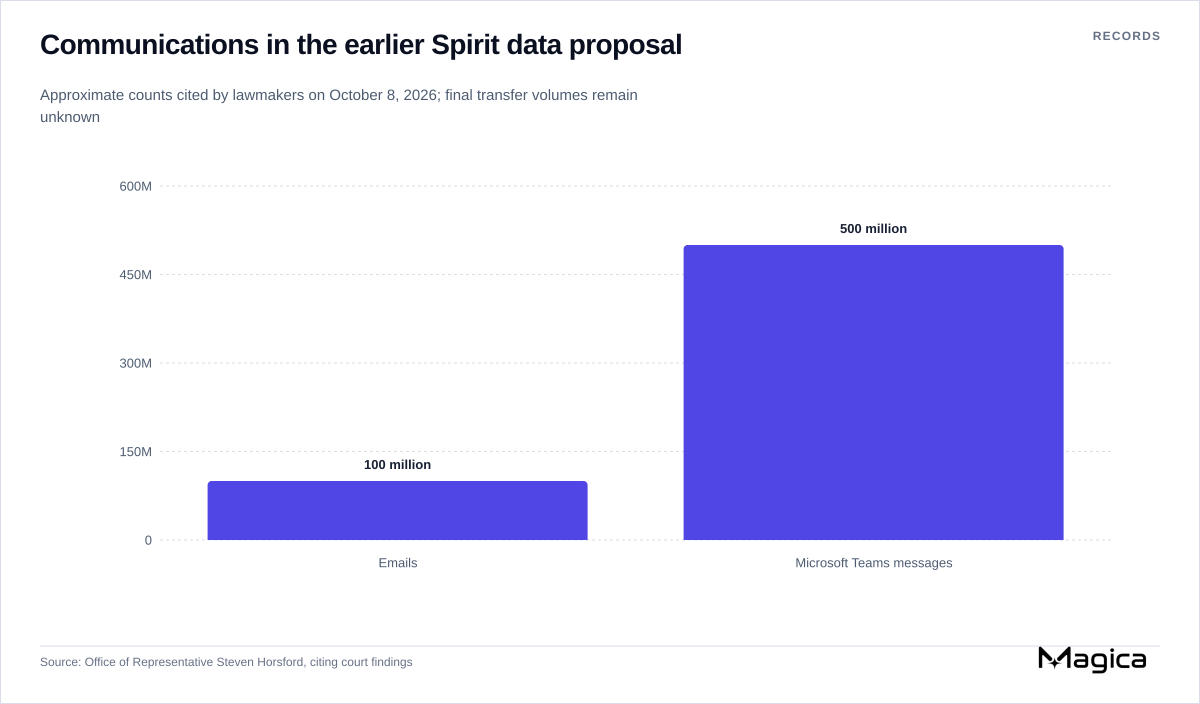
Lawmakers cited approximately 100 million emails and 500 million Microsoft Teams messages in the earlier proposal. Final transfer volumes remain unknown. Graphic: Magica; source: Representative Steven Horsford’s office. Source: Office of Representative Steven Horsford.
Alphabet’s Google won an August auction for Spirit’s data as the airline liquidated assets after halting operations in May. The $10 million package covers emails, spreadsheets, calendars and marketing, productivity and operations data, according to the November 10 account of the agreement. Spirit said the labor resolution supported its effort to maximize value for creditors.
The Association of Flight Attendants-CWA (AFA), which represents Spirit cabin crew and says it has more than 55,000 flight attendant members overall, challenged the sale in August. A bankruptcy court then postponed an approval hearing. The union’s concern went beyond names and email addresses: it said the sale agreement required links across datasets to remain intact, potentially allowing information about individuals or small groups to be reconstructed, according to the account of the August objection.
Unions representing pilots, machinists, flight controllers and other workers joined AFA’s objections in September. AFA’s described the agreement as a worker-privacy victory. It said the coalition’s objections had delayed approval and that the unions wanted protections extended through employment contracts and legislation.
JetBrains IDEs 2026.3 bundle Air for running coding agents and reviewing their changes, while the standalone Air app is in maintenance mode. Existing provider subscriptions remain usable, but billing, security controls and execution options vary by integration.

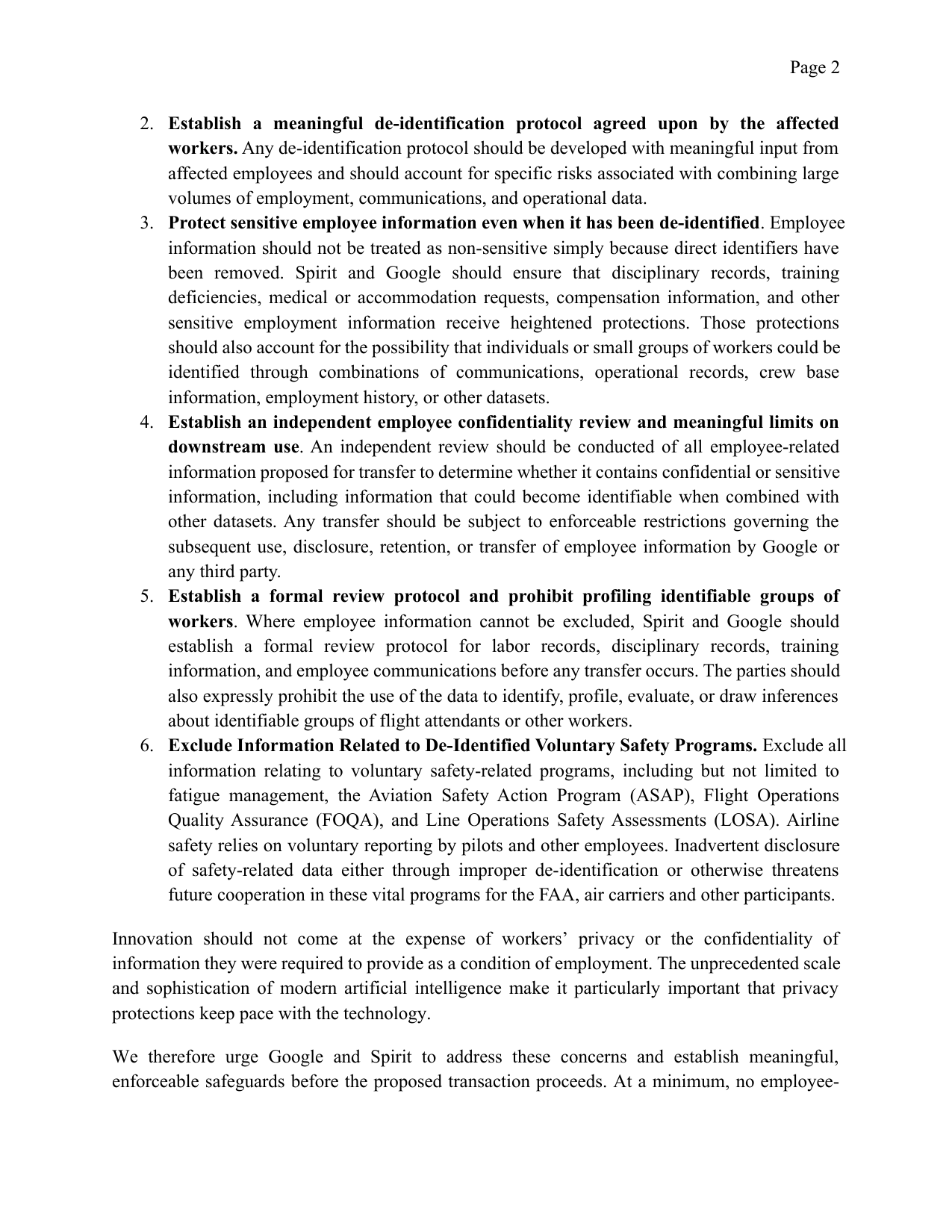
Page 2 of the October 8 congressional letter published by Representative Steven Horsford’s office requests worker-data safeguards before transfer; it predates the November union agreement. Source: Office of Representative Steven Horsford.
The stakes were unusually broad workplace records, created or supplied because people worked for Spirit. An October 8 congressional statement, citing court findings, put the proposed archive at approximately 100 million emails and 500 million Microsoft Teams messages, alongside employment records. Those are figures for the earlier proposal, not a count of what Google will ultimately receive.
The statement accompanied a letter from 121 lawmakers seeking safeguards before transfer. It warned that removing direct identifiers did not necessarily prevent identification through patterns and connections across records.
Passenger privacy had already received separate attention. The November 10 account said a privacy ombudsman had recommended approval the previous month after excluding passenger personal information from 97 million Spirit customers. It also recounted Google’s October statement that it did not want personal information and that such information would be excluded or de-identified by an independent third party before receipt. That was Google’s stated position, rather than a finding that processing had been completed.
The employee agreement adds exclusions and verification to that earlier position. AFA’s detailed list of materials outside the sale, which it identifies as part of the bill of sale, includes medical and disability data, drug and alcohol testing records, disciplinary and grievance files, bank and payroll records, identification documents, biometric data and recordings of flight attendants. It also excludes multiple aviation-safety datasets, including confidential safety-program materials, fatigue reports and flight-crew operational communications.
A report on the revised terms describes the exclusions as encompassing a decade of payroll records and employee tax forms, along with timecard information dating back to 2012.
For data remaining in the sale, AFA says an independent verification agent will review the de-identified records and will be selected in consultation with the unions. Google must keep the data confidential, process it securely and refrain from trying to re-identify it.
The revised proposal names Tonic AI Inc. as the company to perform de-identification, according to an account of a notice filed in the U.S. Bankruptcy Court for the Southern District of New York. Preparing the data and independently reviewing the result are separate steps; the accounts of the agreement do not establish that either has been completed.
The November 10 account placed court approval in the following week. Resolving union objections therefore clears an obstacle to the transaction rather than completing it.
The account of the revised court proposal also describes a right for Google to withdraw if search-term exclusions reduce the volume it is buying. The accessible text ends before stating the full condition, leaving the threshold unclear.
The next decisions concern court approval and whether the archive left after exclusions and privacy processing satisfies the sale’s terms. The $10 million bid prices the proposed transaction; neither the earlier message counts nor the separate passenger figure establishes the size or value per record of the final dataset.
Amazon’s shares and convertible notes could be worth $271.8 billion at the top of Anthropic’s proposed IPO range. Existing accounting gains, a 12% ownership cap and Anthropic’s computing commitments shape what that paper value means.
Nvidia chief Jensen Huang argued in May 2025 that US chip restrictions were strengthening Chinese rivals. Filings show a substantial commercial stake, but lost sales and market share alone cannot establish whether the controls failed their security purpose.
Reported demand has Anthropic’s bankers considering a price above its filed $70–$78 range. The combined financing could exceed $100 billion, but existing cash, uneven operating results and long-term computing commitments complicate the valuation test.
The British AI chip designer has secured private and UK government backing before its planned 2027 commercial launch, putting a multibillion-dollar valuation on its promise of faster, cheaper inference.
Zhang Yiming reportedly told staff that ByteDance needs years to challenge leading US AI labs, even as the TikTok parent prepares a personal agent for release within weeks. Its consumer reach and video strengths have yet to translate into frontier language models.
Helsing has unveiled a military intelligence platform promising European control over data, models and operations. Germany's evaluation of roughly 30 European systems makes procurement and demonstrated performance the next tests.
Public safety leaders warn that synthetic voices and background sounds make hoax emergency calls harder to assess. A voluntary survey exposes preparedness gaps, but does not establish a national AI-swatting rate or measure growth over time.
Fortinet's November security disclosures include AI-assisted findings, but some affected software branches still await fixes. Earlier testing put token costs at about $540 per true positive, excluding the broader work of reviewing findings and securing customer deployments.
Tamil Nadu told the Madras High Court that accounts containing about 2.22 million rupees had been frozen after its library-procurement order, while a criminal case was still being prepared. The dispute tests safeguards ordered in 2024; AI involvement remains unconfirmed.
Baird cut Nvidia to Neutral and its price target to $200 from $500. Its case combines slower forecast AI spending growth with China-linked inventory exposure and uncertainty over founder and CEO Jensen Huang’s tenure.
ByteDance is reportedly accelerating plans to combine its Spell project with Doubao. Existing travel bookings reveal a transaction-fee business, while the phone assistant's history shows how access to other apps can constrain execution.
The Office for Students wants more AI-free assessment and better AI skills teaching, backed by existing quality rules. Its research raises doubts about unsupervised coursework, but universities say assessment reform is already under way.
Finland has recognised Tesla’s provisional Dutch approval after changes to branding and speed controls. Drivers remain responsible, and the national decision does not commit Finland to backing EU-wide authorisation.
Grok Bot can connect to internal MCP servers through Tailscale without exposing them to the public internet. User-based authorization preserves network controls, but administrators must configure how narrowly the assistant can reach into their systems.
Daylight’s Goldman Sachs Alternatives-led Series B backs security agents supported by human engineers. The young company reports rapid growth, but has not disclosed the economics behind its automation promise.
Primordial Labs raised $18 million to widen deployment of Anura, its military command software. Existing contracts and demonstrations give it a foothold, but integration counts do not establish sustained use or lower operating costs.
Northwestern Polytechnical University bought two Nvidia H200 processors for 874,700 yuan and awarded five contracts for rented Nvidia computing, procurement records show. Separate US restrictions on the defense-linked institution remained in place despite January’s conditional opening for H200 exports to China.
The North Dakota Republican says allegations involving a suspected Chinese intelligence operative make Huang vulnerable to coercion. Nvidia’s board is backing its founder while independent directors investigate, with investors facing both security and leadership risks.
Scott Bessent says Washington and Beijing are establishing a channel for serious AI incidents, following their September agreement. Its usefulness depends on unresolved reporting procedures and participation by the companies that detect model failures.