Editorial Team
6 min read
ByteDance is reportedly accelerating plans to combine its Spell project with Doubao. Existing travel bookings reveal a transaction-fee business, while the phone assistant's history shows how access to other apps can constrain execution.
ByteDance, the owner of TikTok and Chinese short-video app Douyin, is accelerating work on a personal AI agent it plans to integrate with Doubao, its consumer AI chatbot, according to a company source cited in an October 12 report. The initiative builds on Spell, an internal project begun in April 2026.
The commercial question is already visible in Doubao's travel services: can a conversational assistant reliably carry users from a request to a completed purchase? Booking integrations give ByteDance a role in transactions, but outside providers supply much of the service. Its earlier phone assistant also encountered limits when operating another company's app.
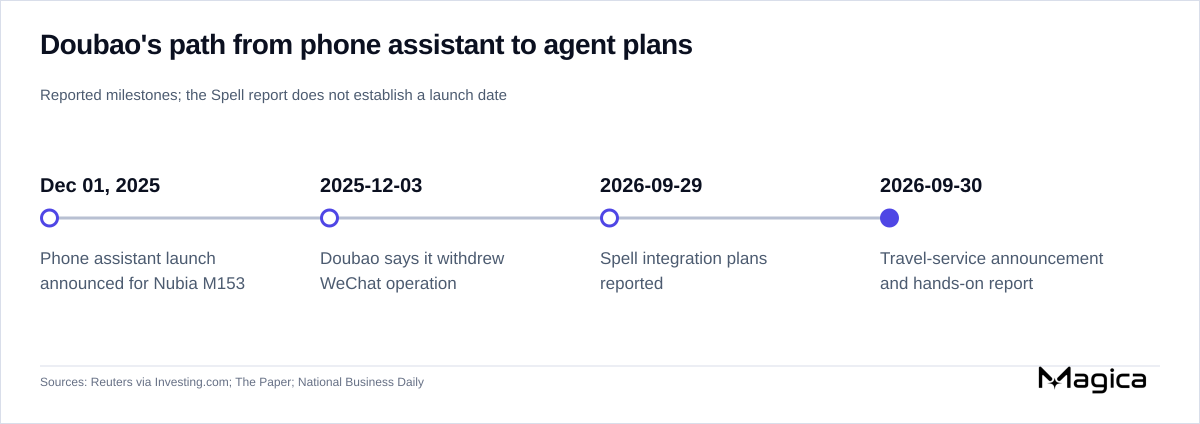
Magica timeline of reported milestones, December 2025–September 2026. The Spell integration report did not establish a launch date. Source: Reuters via Investing.com.
An unidentified person familiar with the plans said in a September 29 report that internal testing began in April 2026 under the Spell codename. The phone assistant team initially led the project, but the phone's release and other factors delayed an external introduction. The planned product would be jointly handled by the Spell project and Doubao's conversation team.
The source attributed faster release preparations to attention around overseas personal assistants. The October account put the acceleration ahead of the early October National Day holiday. These accounts describe a development plan, without establishing a firm public launch date or final product specification. Spell was the project's internal codename, rather than a confirmed consumer brand.
The relevant precedent is already inside ByteDance. On December 1, 2025, the company said it was launching a voice assistant powered by its Doubao large language model on phone maker ZTE's Nubia M153 prototype, with functions including finding content and booking tickets. ByteDance said it had no plans to develop its own smartphones and was discussing deployment with multiple manufacturers, according to reporting on that announcement.
That rollout built on an established audience. The same report cited AI product tracker Aicpb.com's estimate of 159 million monthly active Doubao users in October 2025. It also identified Huawei and Xiaomi's phone AI features as competing offerings: task execution was already a field of competition before the Spell plans emerged.
A September 29 account said the phone assistant's consumer version arrived in September 2026 on the Nubia NaviX Ultra, emphasizing everyday usability and stability. It described Spell and the planned assistant as an extension of capabilities accumulated on the phone into an independent application form. That history narrows the novelty: ByteDance is trying to carry an existing task-execution effort into another product setting.
The phone effort also exposed an access constraint. On December 3, 2025, Doubao said through its official WeChat account that it had withdrawn the phone assistant's ability to operate WeChat after login problems. A report on that response said multiple users had confirmed abnormal exits or an inability to log in when the assistant operated the messaging app on the M153. This historical setback does not establish the planned agent's current limitations, but it shows why operating across apps requires more than a capable model.
On September 30, Doubao announced support for flight bookings, train tickets, ride-hailing and navigation. A homepage travel entry brought those services together. However, hands-on reporting on the update found that most of the functions had already been connected to Doubao and were newly being presented together.
The tests also showed how much execution depends on partners. Baidu Maps supplied map capabilities, while a navigation request prompted a recommendation to open the installed Amap application. Caocao Mobility supplied ride-hailing; users could authorize password-free payments and call a car within Doubao. The report said Caocao was then the only connected ride-hailing provider, following an initial September 9 rollout in Beijing, Hangzhou and Suzhou.
Flight Manager supplied bookable flights and fare options, while High-speed Rail Manager supplied the train-booking interface, including seat selection and passenger details. Third-party authorization could be completed inside Doubao, allowing those services to be used without installing the corresponding provider's app.
Hotels supplied a connection to ByteDance's own commerce ecosystem. The tests found hotel cards leading to merchant pages and group-buying vouchers; linking a Douyin account allowed group purchases to be completed within Doubao.
These are concrete steps beyond answering a travel question. They also expose the distinction between controlling the user's point of entry and controlling delivery. Doubao can assemble recommendations and booking interfaces, while transport operators and other partners supply the underlying service. The travel tests demonstrate integrations; they do not establish what additional autonomy or reliability the Spell-based product will deliver.
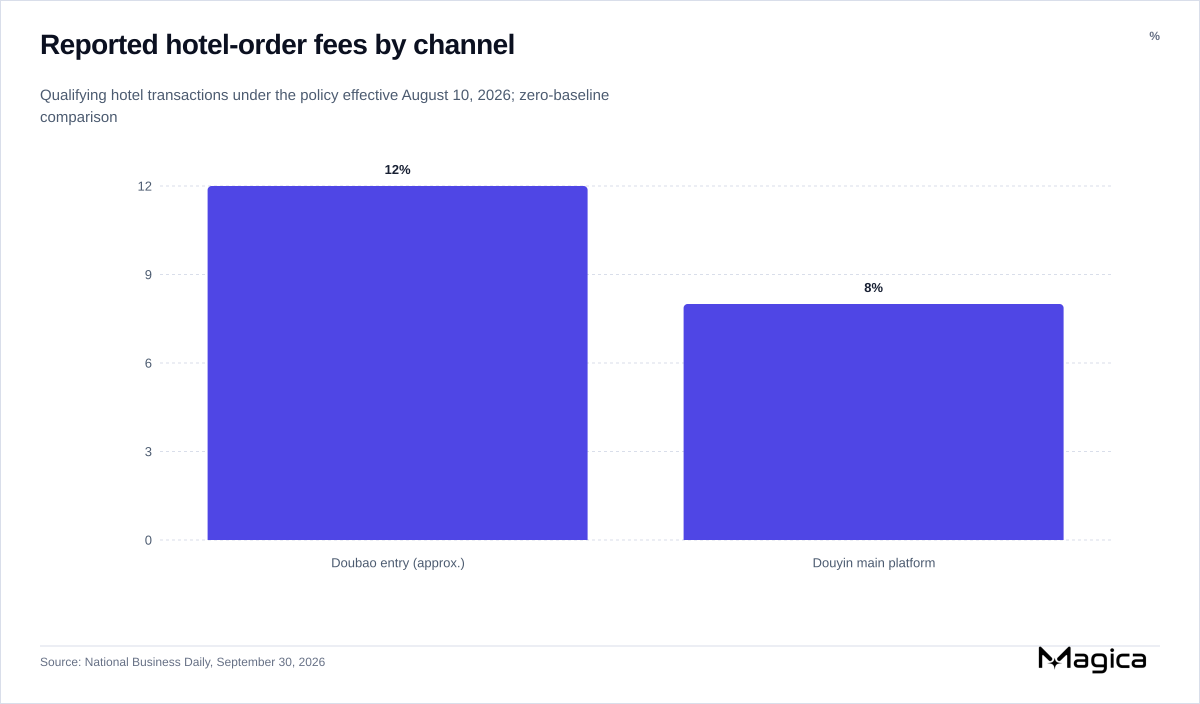
Magica chart using National Business Daily reporting: qualifying hotel orders carried approximately 12% combined fees through the Doubao entry, versus 8% on Douyin's main platform. Source: National Business Daily.
The same September 30 report described a fee policy effective August 10 for hotel orders completed through the Doubao entry into Douyin's merchant system: an 11.4% software service fee plus a 0.6% payment processing fee, approximately 12% combined. It put the comparable hotel-category rate on Douyin's main platform at 8%.
That is a four-percentage-point difference between the reported channel rates. It shows why gaining the booking entry point matters commercially, even before a new assistant's pricing is known. The figures concern qualifying hotel transactions; they are not a disclosed price for using Spell or a measure of ByteDance's profit.
The report also provides a limit on claims about consumer costs. Its August 11 hotel checks had found many room types priced 50–60 yuan higher through Doubao links than on Douyin. In its September retest, the prices had converged. The earlier gap therefore does not establish that Doubao users consistently pay more, or that the fee difference caused the observed prices.
ByteDance faces competitors with their own routes from conversation into action. The September 30 account described Meta's Muse, launched September 8, as a personal agent able to handle bookings, price comparisons and forms across platforms. That helps explain why the development sources treated overseas assistants as a spur to faster release preparations.
The same account said Alibaba's Qwen assistant announced a faster push into personal agents on September 22, including access to health and exercise data with user authorization, plus financial-data and institutional-agent integrations. Tencent's Xiaowei, an AI assistant built into its WeChat messaging service, had entered limited testing in June. Tencent customer service said it could operate native WeChat functions such as changing settings, sending messages and making calls. The report also cited media reporting that Tencent's Yuanbao AI assistant planned a personal agent, with its form and timing unsettled.
The launch questions remain specific: which functions the Spell-based product adds, which apps it can operate, where user authorization and confirmation are required, how failed bookings or payments are handled, which providers participate, and what users or merchants pay. The development reports provide no published task-success benchmark or final pricing. A release would need to make those details visible before the project's promise can be measured against the services Doubao already offers.
The Office for Students wants more AI-free assessment and better AI skills teaching, backed by existing quality rules. Its research raises doubts about unsupervised coursework, but universities say assessment reform is already under way.
Finland has recognised Tesla’s provisional Dutch approval after changes to branding and speed controls. Drivers remain responsible, and the national decision does not commit Finland to backing EU-wide authorisation.
Grok Bot can connect to internal MCP servers through Tailscale without exposing them to the public internet. User-based authorization preserves network controls, but administrators must configure how narrowly the assistant can reach into their systems.
Daylight’s Goldman Sachs Alternatives-led Series B backs security agents supported by human engineers. The young company reports rapid growth, but has not disclosed the economics behind its automation promise.
Primordial Labs raised $18 million to widen deployment of Anura, its military command software. Existing contracts and demonstrations give it a foothold, but integration counts do not establish sustained use or lower operating costs.
Northwestern Polytechnical University bought two Nvidia H200 processors for 874,700 yuan and awarded five contracts for rented Nvidia computing, procurement records show. Separate US restrictions on the defense-linked institution remained in place despite January’s conditional opening for H200 exports to China.
The North Dakota Republican says allegations involving a suspected Chinese intelligence operative make Huang vulnerable to coercion. Nvidia’s board is backing its founder while independent directors investigate, with investors facing both security and leadership risks.
Scott Bessent says Washington and Beijing are establishing a channel for serious AI incidents, following their September agreement. Its usefulness depends on unresolved reporting procedures and participation by the companies that detect model failures.
Coframe's $25 million Series A backs AI agents that build and test websites and ads. Its offering combines automation with human expertise and customer approvals, while its claimed gains lack comparable measurement detail.
Alibaba’s Qwen4-Max preview gives developers a fixed model to test through November 25. API access requires Token Plan, while claimed coding gains remain unquantified in the launch materials.
Railway estimates stolen customer keys generated about $740,000 in unauthorized AI spending after an October intrusion. Secrets from up to about 100,000 workspaces could have been decrypted, and the company says it will cover losses providers decline to refund.
Anthropic expects retail investors worldwide to receive up to 20% of its IPO, potentially $12.9 billion at the proposed upper price. Access through six brokerage channels depends on demand and broker rules, while a separate technology-company investment would help finance vast infrastructure commitments and founders and a special trust retain control.
Anthropic's seven founders plan equal IPO share sales worth about $250 million each at the proposed midpoint. Their sales make up 2.9% of the public offering, while the company seeks much larger financing under a structure that limits public investors' voting influence.
Nvidia’s independent directors retained Wachtell Lipton partner Joon H. Kim for an investigation into reports of a foreign intelligence effort targeting co-founder and CEO Jensen Huang. The board previously expressed confidence in Huang; the appointment provides no findings or timetable.
RRE Ventures led the funding for Graphon’s enterprise memory infrastructure. The startup is pitching connected, persistent context across different agents, but benchmark gains leave deployment costs and commercial scale unresolved.
Goldman Sachs, a lead bank on Anthropic’s IPO, reportedly forecasts $685 billion in annual revenue by 2030. The Claude developer has substantial cash reserves and rapidly growing sales, but rising compute costs, competitive pricing and delivery risks complicate the enterprise growth case.
Memories Upload pays contributors for accepted first-person video and sells annotated data to robotics developers. Its million-hour collection claim leaves open how much footage improves robot performance, while contributors surrender ownership without royalties.
OpenAI has acquired AI travel concierge Odessia and is bringing its founder, former Sonder chief Francis Davidson, into its travel effort. The standalone service has closed, leaving its future role alongside ChatGPT’s existing travel partners unclear.
Anthropic says expected advances from future models have triggered its research-acceleration threshold. An outside assessment finds faster progress but does not certify compliance with that threshold, while the voluntary policy leaves consequential decisions about safeguards and continued development with the company.
OpenAI’s free business-profile beta adds branded agents for eligible U.S. ecommerce and online service firms. The agents can also serve as paid-ad destinations, while OpenAI controls distribution and businesses bear responsibility for outputs.