Editorial Team
5 min read
Baird cut Nvidia to Neutral and its price target to $200 from $500. Its case combines slower forecast AI spending growth with China-linked inventory exposure and uncertainty over founder and CEO Jensen Huang’s tenure.
Brokerage Baird downgraded Nvidia on Wednesday, November 11, citing risks to AI infrastructure spending, China-linked sales and the tenure of Jensen Huang, the chipmaker’s founder and chief executive. The 60% target cut combines a weaker growth forecast with uncertainty over which orders Nvidia can fulfill.
Nvidia supplies chips used to train and run AI models in data centres, making infrastructure spending and export restrictions material to its business. That role is described in an account of the leadership investigation. The downgrade concerns both customers’ willingness to spend and Nvidia’s ability to convert demand into revenue.
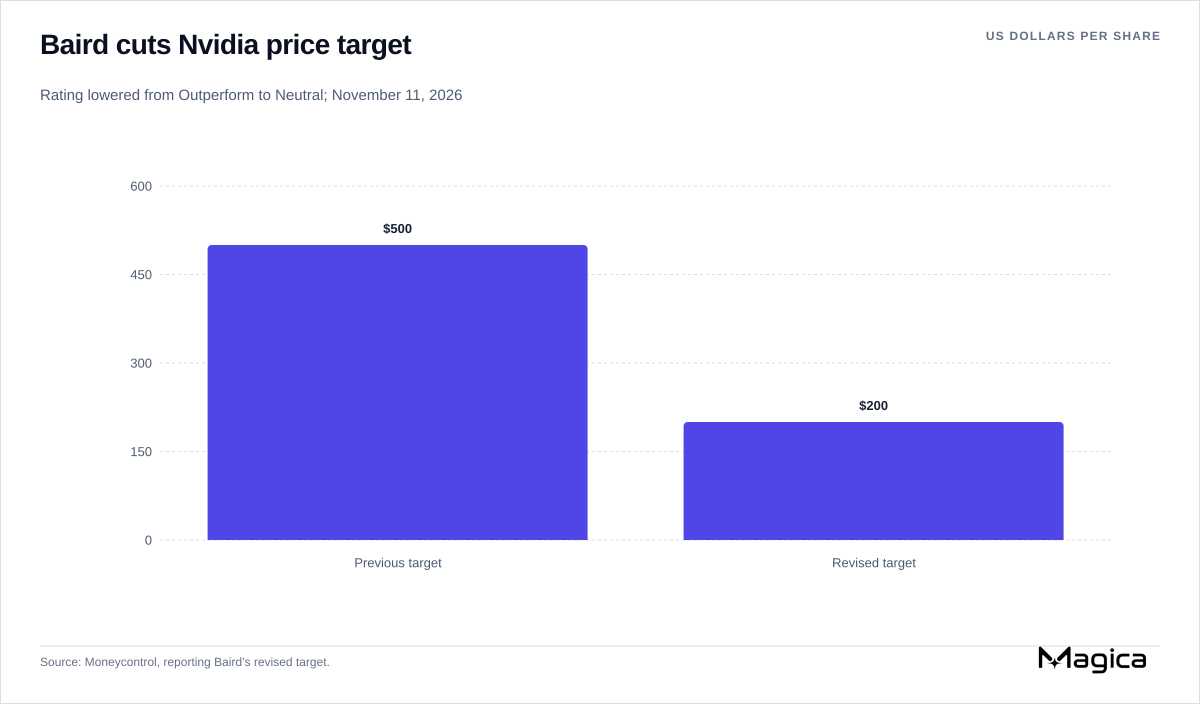
Baird cut its Nvidia price target from $500 to $200. These are analyst targets, not observed share prices. Source: Moneycontrol.
Baird analyst Tristan Gerra reversed his earlier Outperform recommendation, setting a Neutral rating and a $200 target, down from $500, according to the downgrade report. These are the brokerage’s investment judgments, rather than company guidance. The same report puts Nvidia shares 29% below their October 6 high; that market decline is a separate measure from the target reduction.
Gerra warned that supply constraints, softer demand and limited visibility could delay projected data-centre growth in 2027. Baird expects growth in AI spending by hyperscalers—large cloud infrastructure buyers—to slow to 40% or lower in 2027, and warned that 10–30% of channel orders could face pre-emptive cuts.
Neither figure establishes a decline in total spending or completed order cancellations. The account supplies no spending baseline or detailed method for estimating the share of orders at risk. Its description of strong demand for Nvidia’s H300 chips also limits a broad demand-collapse interpretation: appetite for a particular chip can remain strong while spending growth slows or supply delays deliveries.
JetBrains IDEs 2026.3 bundle Air for running coding agents and reviewing their changes, while the standalone Air app is in maintenance mode. Existing provider subscriptions remain usable, but billing, security controls and execution options vary by integration.

In reported excerpts from his note, Gerra flagged a new ban on H200 exports to China and estimated a possible $5 billion write-down. He said he believed low-level shipments were reaching Asian warehouses, with some inventory awaiting Chinese demand. The write-down is his estimate, not a charge announced by Nvidia.
Gerra also cited export restrictions affecting Southeast Asian data centres, possible U.S. Department of Justice action against Megaspeed, and potential adjustments by other regional operators exposed to Chinese demand. The excerpts do not establish completed enforcement action. His warning rests partly on demand exposure he described as historically higher than Wall Street expected and often unquantified.
Nvidia’s earlier experience shows why access to a market matters even when chips have buyers. In its May 28, 2025 earnings release, the company said an April 9 U.S. licensing requirement for exports of H20 products into China led to a $4.5 billion charge for excess inventory and purchase obligations. Nvidia said H20 was designed primarily for the China market.
For that first fiscal quarter of 2026, which ended April 27, 2025, Nvidia reported $4.6 billion in H20 sales before the restriction and said it could not ship an additional $2.5 billion in H20 revenue. Its non-GAAP gross margin was 61.0%; excluding the charge, the company said it would have been 71.3%, a difference of 10.3 percentage points. It also forecast about $8 billion in lost H20 revenue in the following quarter. That was an outlook issued in May 2025, not a current estimate.
The financial hit coexisted with growth: Nvidia reported total quarterly revenue of $44.1 billion, up 69% from a year earlier, including $39.1 billion in data-centre revenue, up 73%. These historical results demonstrate the scale of the business and the cost of export disruption. They do not establish its current growth rate or validate Gerra’s separate H200 estimate.
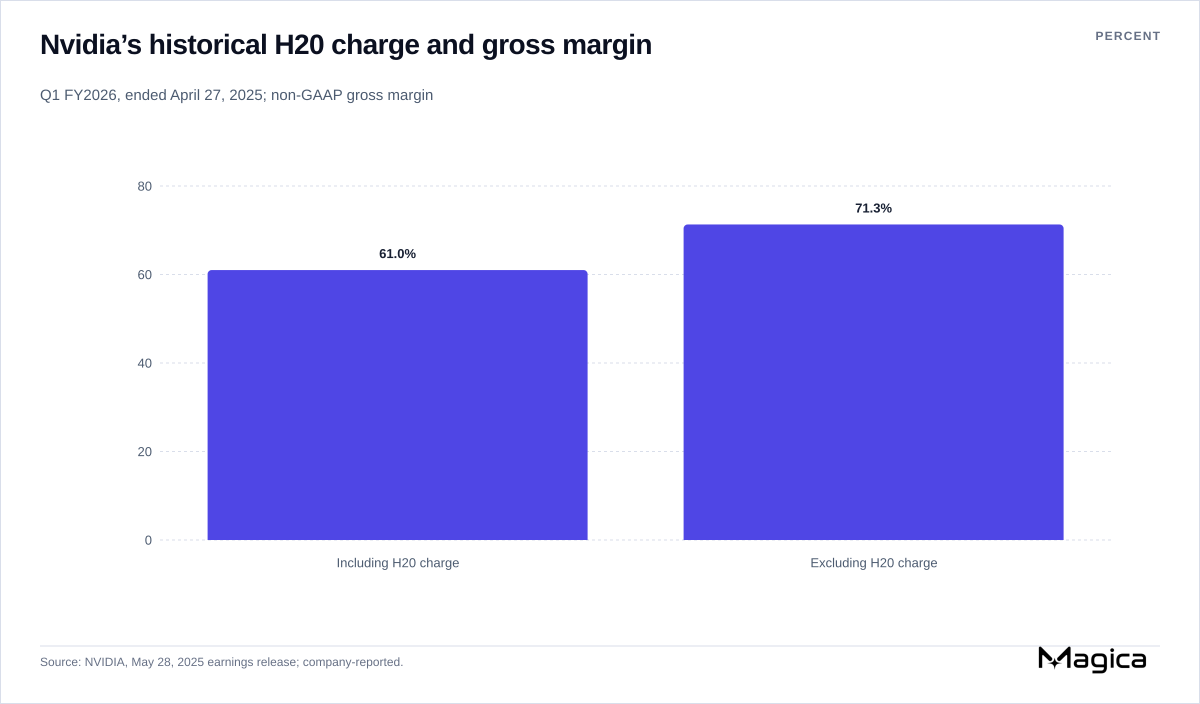
Company-reported historical figures: Nvidia’s Q1 FY2026 non-GAAP gross margin was 61.0%, or 71.3% excluding the H20 charge. Both figures describe the quarter ended April 27, 2025. Source: Nvidia.
The leadership risk concerns an unresolved investigation. The account of Gerra’s note says Huang acknowledged an affair in an employee email on Sunday and that Nvidia’s board opened an independent investigation into reports that the woman involved was a Chinese government spy. The board said it hired law firm Wachtell, Lipton, Rosen & Katz. The account identifies inquiry leader Joon Kim as a former acting U.S. Attorney for the Southern District of New York. Those reported allegations are not findings of the inquiry.
China’s Foreign Ministry rejected the spying allegations on Monday, calling them a smear campaign, according to the separate account. That denial also leaves the underlying claims disputed.
Gerra said his Neutral rating would remain until uncertainty cleared over U.S. government action following an upcoming congressional hearing, government investigations, the revenue effects of channel adjustments and possible charges, and Huang’s continued tenure. The report does not announce a leadership departure. His note’s title also expressed confidence in the company’s longer-term prospects.
The next evidence must distinguish orders merely delayed from orders lost, quantify any inventory charge and establish the investigations’ findings. Until then, strong chip demand and a large potential market do not settle how much revenue Nvidia can deliver—or who will lead it.
Amazon’s shares and convertible notes could be worth $271.8 billion at the top of Anthropic’s proposed IPO range. Existing accounting gains, a 12% ownership cap and Anthropic’s computing commitments shape what that paper value means.
Nvidia chief Jensen Huang argued in May 2025 that US chip restrictions were strengthening Chinese rivals. Filings show a substantial commercial stake, but lost sales and market share alone cannot establish whether the controls failed their security purpose.
Reported demand has Anthropic’s bankers considering a price above its filed $70–$78 range. The combined financing could exceed $100 billion, but existing cash, uneven operating results and long-term computing commitments complicate the valuation test.
The British AI chip designer has secured private and UK government backing before its planned 2027 commercial launch, putting a multibillion-dollar valuation on its promise of faster, cheaper inference.
Zhang Yiming reportedly told staff that ByteDance needs years to challenge leading US AI labs, even as the TikTok parent prepares a personal agent for release within weeks. Its consumer reach and video strengths have yet to translate into frontier language models.
Helsing has unveiled a military intelligence platform promising European control over data, models and operations. Germany's evaluation of roughly 30 European systems makes procurement and demonstrated performance the next tests.
Public safety leaders warn that synthetic voices and background sounds make hoax emergency calls harder to assess. A voluntary survey exposes preparedness gaps, but does not establish a national AI-swatting rate or measure growth over time.
Fortinet's November security disclosures include AI-assisted findings, but some affected software branches still await fixes. Earlier testing put token costs at about $540 per true positive, excluding the broader work of reviewing findings and securing customer deployments.
Tamil Nadu told the Madras High Court that accounts containing about 2.22 million rupees had been frozen after its library-procurement order, while a criminal case was still being prepared. The dispute tests safeguards ordered in 2024; AI involvement remains unconfirmed.
Unions withdrew objections to Google’s proposed $10 million purchase of Spirit Airlines data after securing employee-record exclusions and independent privacy review. The agreement follows earlier passenger-data protections; court approval and verification remain ahead.
ByteDance is reportedly accelerating plans to combine its Spell project with Doubao. Existing travel bookings reveal a transaction-fee business, while the phone assistant's history shows how access to other apps can constrain execution.
The Office for Students wants more AI-free assessment and better AI skills teaching, backed by existing quality rules. Its research raises doubts about unsupervised coursework, but universities say assessment reform is already under way.
Finland has recognised Tesla’s provisional Dutch approval after changes to branding and speed controls. Drivers remain responsible, and the national decision does not commit Finland to backing EU-wide authorisation.
Grok Bot can connect to internal MCP servers through Tailscale without exposing them to the public internet. User-based authorization preserves network controls, but administrators must configure how narrowly the assistant can reach into their systems.
Daylight’s Goldman Sachs Alternatives-led Series B backs security agents supported by human engineers. The young company reports rapid growth, but has not disclosed the economics behind its automation promise.
Primordial Labs raised $18 million to widen deployment of Anura, its military command software. Existing contracts and demonstrations give it a foothold, but integration counts do not establish sustained use or lower operating costs.
Northwestern Polytechnical University bought two Nvidia H200 processors for 874,700 yuan and awarded five contracts for rented Nvidia computing, procurement records show. Separate US restrictions on the defense-linked institution remained in place despite January’s conditional opening for H200 exports to China.
The North Dakota Republican says allegations involving a suspected Chinese intelligence operative make Huang vulnerable to coercion. Nvidia’s board is backing its founder while independent directors investigate, with investors facing both security and leadership risks.
Scott Bessent says Washington and Beijing are establishing a channel for serious AI incidents, following their September agreement. Its usefulness depends on unresolved reporting procedures and participation by the companies that detect model failures.