Editorial Team
6 min read
Zhang Yiming reportedly told staff that ByteDance needs years to challenge leading US AI labs, even as the TikTok parent prepares a personal agent for release within weeks. Its consumer reach and video strengths have yet to translate into frontier language models.
ByteDance, the Chinese technology company behind TikTok, is preparing a personal AI agent while its co-founder warns that matching the leading US model developers remains a multiyear project. The contrast puts a near-term product launch alongside a much less certain research timetable.
Zhang Yiming, ByteDance’s co-founder and former chief executive, told its AI staff at a recent all-hands meeting that the company could compete at the cutting edge with AI developers Anthropic and OpenAI, but would need until at least 2029 or 2030, according to an account relaying an unnamed-source report about the meeting. The same reporting describes plans to release an agent similar to Meta’s Muse in the coming weeks.
Zhang founded ByteDance in 2012 and used AI recommendation engines to build the news service Toutiao and video app TikTok. He announced his handoff of the CEO role to Rubo Liang in 2021, with a shift toward longer-term strategy. His reported intervention now concerns research priorities as well as the next consumer product.
The accounts of the meeting share a single underlying report based on unnamed sources; they do not constitute separate confirmations. ByteDance did not respond to the original request for comment, according to the available accounts. The timetable is therefore a reported internal assessment, not a public launch commitment or a guarantee of eventual parity.
ByteDance already has Doubao, described in the reporting as China’s most popular ChatGPT-style chatbot. Yet its Seed language-model effort reportedly has neither released a model ranking among the world’s best on benchmarks nor made its model weights available to outside developers. Its last major language-model update was Seed 2.1 in June.
Those are distinct measures of progress: a popular application demonstrates demand, while benchmark performance and access to model weights concern capability and external scrutiny. The available accounts do not supply benchmark scores or a common evaluation method that would quantify the current gap.
Zhang reportedly identified data as a central concern, saying Seed’s pre-training datasets were orders of magnitude smaller than those used by frontier rivals. No comparable dataset counts were disclosed in the accounts, so that description cannot responsibly be converted into a precise ratio.
He also reiterated that ByteDance should avoid distillation—using a larger model’s outputs to teach another model—and focus on longer-term goals. The stance comes amid criticism from White House officials and Anthropic’s chief executive of alleged reliance by other Chinese labs on leading American models. Those criticisms concern competitors; they do not establish misconduct by ByteDance.
Seed reportedly employs roughly 1,000 researchers and engineers under Wu Yonghui, recruited from Google DeepMind in 2025, with preferential equity packages for the unit. It established a dedicated safety and alignment team in October, described in the accounts as a first among China’s major AI labs. Staffing, incentives and governance show how the company is organizing the effort; none supplies a measure of frontier performance.
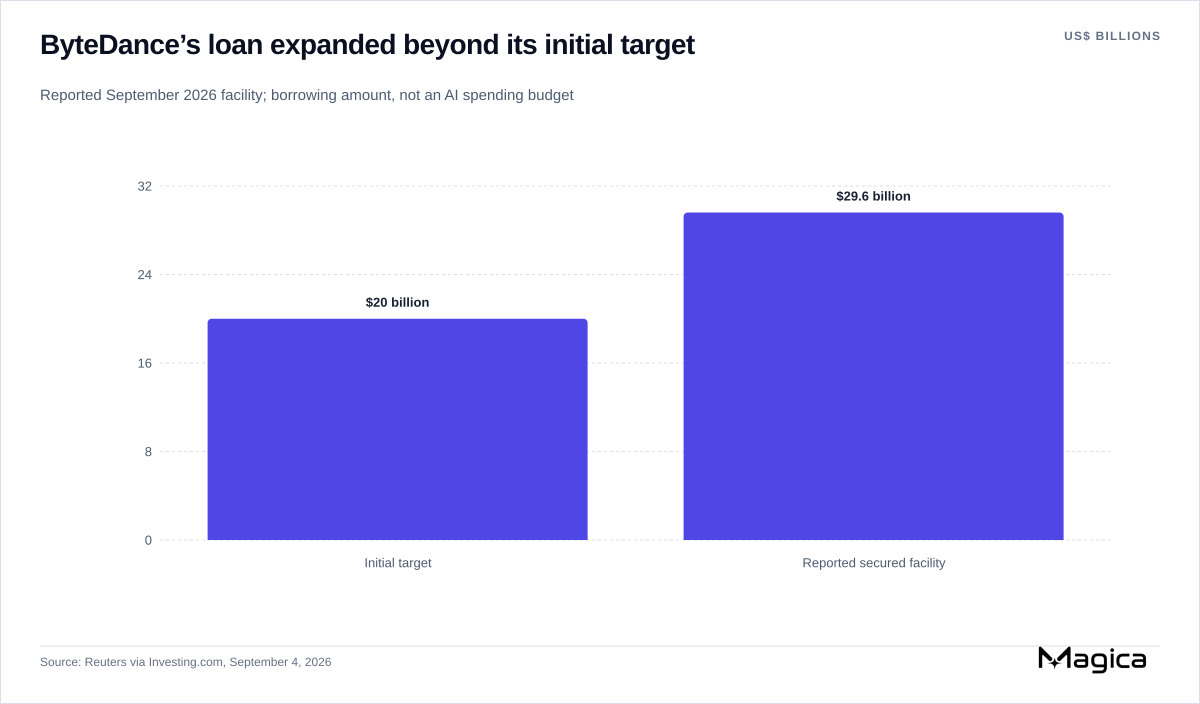
ByteDance’s loan facility expanded from an initial $20 billion target to $29.6 billion, according to Reuters. These are borrowing amounts, not an AI spending budget. Source: Reuters via Investing.com.
The strongest counterweight to the language-model shortfall is video. ByteDance’s Seedance models turn its large video pool into a commercial video-generation platform. The reports describe an existing competitive strength, including an opportunity after OpenAI discontinued its Sora video product.
The accounts also cite spending of as much as $70 billion, but describe its scope differently: the infrastructure account frames it as AI infrastructure, while another account ties it to making Seedance China’s leading video AI platform. They provide no common spending period. The figure indicates reported ambition rather than a sufficiently specified budget for comparison with rivals.
There is firmer detail on financing. A September report based on people with direct knowledge said ByteDance had secured a $29.6 billion loan from nearly 30 banks, coordinated by Citigroup and JPMorgan, with signing expected shortly. The dollar-denominated facility was unsecured, requiring no asset or share collateral, and had an initial three-year term with options to extend for two more years.
The facility grew from a $20 billion target after strong lender demand—a 48% increase in the proposed borrowing amount. Chinese banks subscribed to more than 60% of the total, one source said. The lack of collateral reflects lenders’ confidence in ByteDance’s creditworthiness; it is not a measure of its models’ performance.
ByteDance told lenders the money was for general corporate purposes; the sources said it would mainly support AI plans. One source said the loan would fund projects outside China and that ByteDance had binding agreements to buy capacity from data centers under construction in Southeast Asia. Contracted capacity is distinct from completed infrastructure.
The September financing report also described June talks to buy inference chips from Shanghai-based Iluvatar CoreX and consideration of a similar deal with Baidu. Inference runs models to produce outputs; it is separate from the pre-training data problem. Neither the loan amount nor the reported spending plan establishes the forthcoming agent’s cost per task.
Meta, the company behind Facebook, Instagram and WhatsApp, introduced Muse in September. The meeting accounts describe it as a voice-based assistant with an animated avatar, with distribution through smart glasses and a forthcoming Muse Charm device. Whether ByteDance plans accompanying hardware remains unknown.
The competitive standard extends beyond an avatar. In its product announcement, Meta says Muse operates with a dedicated virtual computer and browser, works across connected apps, and handles tasks such as email and travel booking. Meta says it seeks approval before actions such as sending an email or making a purchase. Users can choose which services to connect and revoke access, Meta says. These are company descriptions, rather than independent evidence of reliability.
Meta says Muse is rolling out in the US on iOS, Android and the web, with AI glasses to follow. It describes most uses as free, with subscriptions for people who want to do more, but specifies no subscription prices in the announcement. ByteDance will therefore face an existing free offering as well as a competing interface.
A separate account of Muse’s reception puts downloads above 10.4 million by mid-October and relays Meta CEO Mark Zuckerberg’s statement that its family of apps reaches 3.64 billion daily users. The latter figure covers Meta’s apps, not Muse’s active users; downloads do not establish continuing use or profitability. The account also relays a warning from investor Gene Munster of Deepwater Asset Management about Muse’s cash consumption, without providing a cost estimate.
For ByteDance, the next material evidence will be a released product: its supported tasks, permissions, availability, price and reliability. The available reporting leaves those details unresolved. A launch could establish a foothold in personal agents while the harder question—whether Seed can close its underlying model gap—remains open on Zhang’s much longer timetable.
JetBrains IDEs 2026.3 bundle Air for running coding agents and reviewing their changes, while the standalone Air app is in maintenance mode. Existing provider subscriptions remain usable, but billing, security controls and execution options vary by integration.

Amazon’s shares and convertible notes could be worth $271.8 billion at the top of Anthropic’s proposed IPO range. Existing accounting gains, a 12% ownership cap and Anthropic’s computing commitments shape what that paper value means.
Nvidia chief Jensen Huang argued in May 2025 that US chip restrictions were strengthening Chinese rivals. Filings show a substantial commercial stake, but lost sales and market share alone cannot establish whether the controls failed their security purpose.
Reported demand has Anthropic’s bankers considering a price above its filed $70–$78 range. The combined financing could exceed $100 billion, but existing cash, uneven operating results and long-term computing commitments complicate the valuation test.
The British AI chip designer has secured private and UK government backing before its planned 2027 commercial launch, putting a multibillion-dollar valuation on its promise of faster, cheaper inference.
Helsing has unveiled a military intelligence platform promising European control over data, models and operations. Germany's evaluation of roughly 30 European systems makes procurement and demonstrated performance the next tests.
Public safety leaders warn that synthetic voices and background sounds make hoax emergency calls harder to assess. A voluntary survey exposes preparedness gaps, but does not establish a national AI-swatting rate or measure growth over time.
Fortinet's November security disclosures include AI-assisted findings, but some affected software branches still await fixes. Earlier testing put token costs at about $540 per true positive, excluding the broader work of reviewing findings and securing customer deployments.
Tamil Nadu told the Madras High Court that accounts containing about 2.22 million rupees had been frozen after its library-procurement order, while a criminal case was still being prepared. The dispute tests safeguards ordered in 2024; AI involvement remains unconfirmed.
Unions withdrew objections to Google’s proposed $10 million purchase of Spirit Airlines data after securing employee-record exclusions and independent privacy review. The agreement follows earlier passenger-data protections; court approval and verification remain ahead.
Baird cut Nvidia to Neutral and its price target to $200 from $500. Its case combines slower forecast AI spending growth with China-linked inventory exposure and uncertainty over founder and CEO Jensen Huang’s tenure.
ByteDance is reportedly accelerating plans to combine its Spell project with Doubao. Existing travel bookings reveal a transaction-fee business, while the phone assistant's history shows how access to other apps can constrain execution.
The Office for Students wants more AI-free assessment and better AI skills teaching, backed by existing quality rules. Its research raises doubts about unsupervised coursework, but universities say assessment reform is already under way.
Finland has recognised Tesla’s provisional Dutch approval after changes to branding and speed controls. Drivers remain responsible, and the national decision does not commit Finland to backing EU-wide authorisation.
Grok Bot can connect to internal MCP servers through Tailscale without exposing them to the public internet. User-based authorization preserves network controls, but administrators must configure how narrowly the assistant can reach into their systems.
Daylight’s Goldman Sachs Alternatives-led Series B backs security agents supported by human engineers. The young company reports rapid growth, but has not disclosed the economics behind its automation promise.
Primordial Labs raised $18 million to widen deployment of Anura, its military command software. Existing contracts and demonstrations give it a foothold, but integration counts do not establish sustained use or lower operating costs.
Northwestern Polytechnical University bought two Nvidia H200 processors for 874,700 yuan and awarded five contracts for rented Nvidia computing, procurement records show. Separate US restrictions on the defense-linked institution remained in place despite January’s conditional opening for H200 exports to China.
The North Dakota Republican says allegations involving a suspected Chinese intelligence operative make Huang vulnerable to coercion. Nvidia’s board is backing its founder while independent directors investigate, with investors facing both security and leadership risks.
Scott Bessent says Washington and Beijing are establishing a channel for serious AI incidents, following their September agreement. Its usefulness depends on unresolved reporting procedures and participation by the companies that detect model failures.