Editorial Team
7 min read
Jason Clinton is urging network isolation as AI accelerates vulnerability discovery. The PHP emergency illustrates the immediate repair problem, while Anthropic's own security work shows that finding flaws does not automatically reduce risk.
Jason D. Clinton, deputy chief information security officer at Anthropic, the developer of the Claude AI models, has urged operators to isolate critical systems from outside networks, warning that an approaching surge in vulnerabilities could exceed their capacity to patch. Clinton previously headed Chrome infrastructure security at Google, protecting the browser's backend systems, as a May 2025 interview profile explains.
His warning identifies a consequential limit to AI-assisted security: faster discovery can create an urgent repair backlog. The question for infrastructure operators is whether they can protect systems during the interval between a flaw becoming exploitable and a fix reaching the equipment that depends on it.

NSA’s October 21 PHP advisory urged immediate patching. Credit: NSA. Source: National Security Agency.
In a post on X, Clinton wrote:
The vulnerability tsunami is coming in just a few months and there won’t be enough time to patch critical infrastructure. Network isolation described below (air-gaps and data diodes!) needed now!
That is a forecast and a call for defensive action, rather than a measured estimate of how many systems will fail. The post supplies no vulnerability count, patching-capacity estimate or method for its timetable.
Its timing also requires care. The archived post metadata dates it to August 20, 2026. An October 23 report describes the warning as a Thursday-evening post. Those records do not establish a consistent date for the prediction, so the phrase “a few months” cannot safely be treated as a countdown beginning with that report.
The October reporting nevertheless describes a concrete pressure on defenders. Researchers used AI to help identify severe flaws in PHP, a programming language used to run websites, with vulnerabilities announced on October 21. It attributes to researchers at security platform Wiz the assessment that the flaws had existed for decades and that demonstrating exploitability required an exceptionally complex sequence of steps.
That distinction matters: the reported advance was the ability to expose and demonstrate old weaknesses, rather than evidence that AI had newly created those weaknesses.
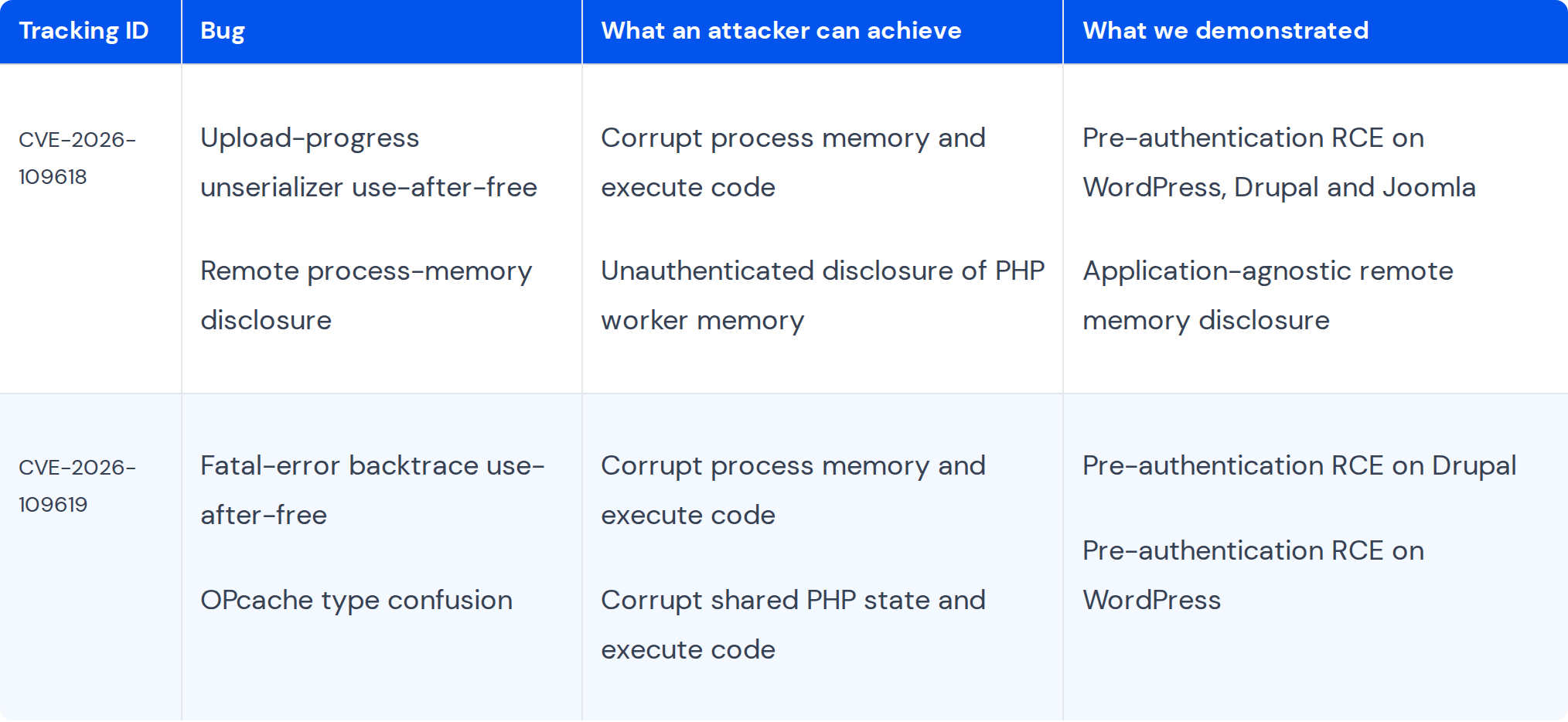
Wiz Research’s company-reported PHP2Shell demonstrations include remote code execution and memory disclosure. These are research demonstrations, not counts of compromised websites. Credit: Wiz Research. Source: The Guardian.
The US National Security Agency, whose remit includes cybersecurity for government and national security systems, says in its October 21 advisory that the vulnerabilities, collectively called PHP2Shell, could let attackers control affected web servers without prior access or authentication. It locates the flaws in PHP itself, rather than in a hosted application's configuration. That access could enable data theft, service disruption or further movement into a network.
The agency says PHP released a patch that day, while additional software vendors might release their own updates later. It calls for an inventory of affected services, replacement of end-of-life services incompatible with patching, and taking a system offline if an immediate update is not feasible.
This is the practical gap behind Clinton's warning. A patch being available upstream does not establish that every dependent software package or deployed service has been repaired. The agency's recommendations already contemplate systems for which an immediate update is unavailable or impractical.
The October report cites Matthew Prince, chief executive of security provider Cloudflare, saying it saw thousands trying to exploit the flaws in the ten hours before disclosure, tens of thousands in the following 45 minutes, and hundreds of thousands within two hours, rising to millions by his post. These are the company's observations of attempted exploitation, not a count of successful compromises or a rate measured over equal time intervals.
The scale of disruption is less firmly established than some coverage suggests. A separate account, citing the Daily Star, says 70% of the world's websites experienced outages. The October report instead describes an expert estimate that 70% were at risk of hacking. Exposure and an outage are different outcomes; these accounts do not establish a global outage affecting that share of websites.
Clinton's employer is a participant in the response, giving its warning both technical relevance and an institutional stake. In its October 8 Cyber Mission announcement, Anthropic described two efforts: a Critical Infrastructure Defense Program supplying Claude models, on-site engineers and threat research through established providers, and OSS Scanner, a free, opt-in vulnerability scanning service for open-source projects.
The company said its earlier Project Glasswing work had scanned hundreds of widely used open-source projects, with people reviewing many potential vulnerabilities before reporting them privately to maintainers. Yet it acknowledged that this work had not achieved a sufficient reduction in cyber risk: verifying, prioritizing and fixing findings remained difficult, and months often passed between discovery and repair. It had merged Glasswing into an expanded Cyber Verification Program giving more defenders access to its most capable models.
The industrial program starts with operational technology: the controllers, software and networks behind power grids, water utilities, factories and transport. Anthropic says this equipment is built to last decades, often cannot be taken offline for patching, and requires specialized work because proprietary systems and risky changes can turn a repair into a plant shutdown. In rare cases, it says, safely applying a fix could take decades. These constraints extend beyond finding a software defect.
The program relies on existing expertise rather than replacing it. Founding partners include industrial equipment manufacturer Rockwell Automation, industrial security specialists Dragos and Nozomi Networks, and consulting and security providers including Accenture and CrowdStrike. Anthropic says several partners are already using Claude to fix vulnerabilities and help customers, but describes the initial cohort as a way to learn which approaches are practical. It also says a government defense program launched in June had offered models and technical support to more than half of US states; that is a claim about offers of assistance, not a measure of repaired systems.
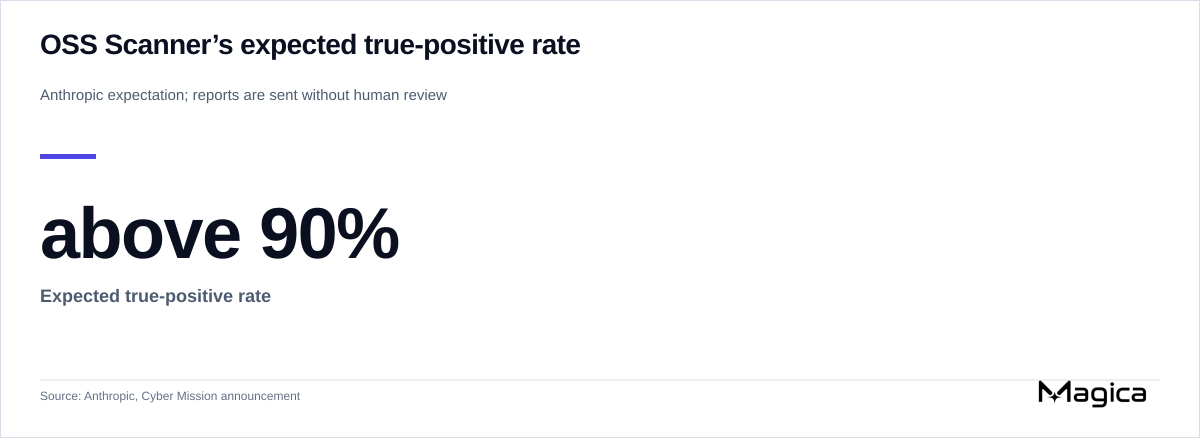
Anthropic’s company-reported expectation is a true-positive rate above 90%. Its announcement supplies no evaluation sample or method and warns that reports can contain errors. Source: Anthropic.
OSS Scanner illustrates the tradeoff between speed and verification. Anthropic says the service was inspired by Google's existing OSS-Fuzz project. Its reports include an exploit proof of concept, an explanation and a suggested fix where available, but are generated by models and sent without human review. The company warns that reports can contain errors, including incorrect severity ratings. It expects a true-positive rate above 90%; the announcement gives no evaluation sample or method for that expectation.
Anthropic says the service is intended for projects able to handle the findings; others continue to receive human-verified disclosures. It says triage and patching remain mostly manual and plans to automate more of that work. Free scans therefore address access to discovery tools, while leaving maintainers responsible for evaluating and deploying repairs.
The company says its Defender Advantage Fund supports pilot programs and keeps OSS Scanner free. It gives no program budget or industrial deployment prices in the announcement, leaving the cost of delivering the promised assistance unclear. Its stated expectation that AI will favor defense in two years is a forecast, not a demonstrated outcome. Clinton had already advocated defensive AI for operational networks and remediation in his May 2025 interview; the current warning accompanies a longer-running effort to deploy those tools.
The immediate decision is already concrete for affected PHP operators: apply available updates, identify dependent services that still need attention, and assess whether exposed systems must go offline. Clinton's broader appeal for isolation extends the concern to critical infrastructure before every weakness can be repaired.
The next test for Anthropic and its partners is whether their work shortens the time from a verified finding to a safely deployed repair. The company promises to expand its infrastructure program and share lessons, including failures. Deployment times, remaining exposure, maintainer workload and successful compromises would show more than a rising count of discovered bugs. The available evidence establishes urgent patching needs and attempted exploitation; it does not quantify the worldwide shortfall in repair capacity that Clinton predicts.
Police are investigating a top tax-accountant exam scorer's admission of AI-assisted cheating, while the government reviews national qualification tests held in 2026 and prepares stronger controls.
An early tally puts Japanese listed companies’ first-half net profit growth at 43.2%, led by manufacturers. Filings show AI component demand alongside currency benefits and non-AI earnings gains, while procurement delays and canceled infrastructure reservations expose the costs of expansion.
TSMC plans to back promising chip startups through a new investment arm, alongside separate commitments to OpenAI and Anthropic. The strategy reaches toward future customers and the AI developers shaping chip demand, but the investment rights remain unclear.
Nidus has raised $30 million across pre-seed and seed rounds to automate wire processing in existing U.S. defense factories. Its founders bring manufacturing and government-deployment experience, but customer access and proprietary data still need to translate into measurable production gains.
Nebuly is funding US and European expansion for its AI business-value platform. Adjustable assumptions and private deployment are part of its pitch, but rivals offer similar measurement tools and verified customer returns remain undisclosed.
Han Won-seok says he used a miniature camera, generative AI and a smartphone in tax accountant and CPA exams. His confession puts scrutiny on exam security after proctors reported no suspicious behavior.
Thousands protested against proposed AI data centres in Scotland as ministers prepare new planning guidance, putting public participation and the scale of electricity demand at the centre of the dispute.
Uber is notifying drivers after a breach at AI infrastructure provider Fireworks exposed personal and driver’s license information. Three reported state counts add up to about 7,870 people. Fireworks has since disclosed wider data exposure, but the precise connection used to reach Uber’s records remains unexplained.
Jensen Huang’s reported resignation puts Nvidia’s financing and advocacy for American open models under scrutiny. Researcher Nathan Lambert warns of a loss of support, while Nvidia’s commercial incentives and continuing model work complicate that forecast.
Altimeter and Atreides want Nvidia's board to leave Jensen Huang's return open while it investigates recent events. Their letter backs interim leadership and acknowledges that directors can ultimately reject his reinstatement.
Elon Musk says Nvidia risks losing supply arrangements made personally by former CEO Jensen Huang. No affected supplier is named. Nvidia’s filing documents both $95.2 billion in commitments and limits to the protection those arrangements provide.
The former Anthropic and OpenAI researcher says a pretraining-efficiency slide helped drive his resignation, turning an investor selling point into an argument for a development pause.
Anthropic’s IPO has reportedly attracted orders for six times the available shares at proposed terms targeting a roughly $1.4 trillion valuation. The sale would add to substantial existing cash reserves as the Claude developer balances costly capacity shortages against long-term computing commitments.
Former Nvidia CEO Jensen Huang portrayed his relationship with a customer’s executive as routine business, according to reviewed messages and unnamed sources. A board inquiry faces questions about his disclosures amid separate concerns over chip exports and alleged spying.
Apple has detailed how Secure Exclaves isolate background camera and microphone processing from the main operating system and verify visible indicators before releasing full sensor data. The design aims to keep raw ambient sensing data beyond the main operating system’s reach, but its formal verification remains incomplete.
Charta Health is expanding its insurer tools with a $55 million Series B. Its promise of billing accuracy across payers and providers faces a harder test: showing that better coding reduces disputes rather than simply changes payments.
Operand has raised $31 million across seed and Series A funding for AI due diligence software aimed at private equity firms. Its pitch is to reconstruct businesses from public records and internet traces, but evidence of accuracy and deal-level economics remains limited.
Caitlin Kalinowski resigned over the deliberation and oversight behind OpenAI’s Pentagon agreement. The company says its safeguards prohibit domestic surveillance and autonomous weapons, leaving a dispute over how those limits were established and will be enforced.
The startup formerly known as QuilrAI pairs enterprise AI agents with Guardian agents and charges by agents under management. Its expansion pitch faces established alternatives and unanswered questions about security performance and cost.
Luminal’s Standard Capital-led Series A backs software for running AI models more efficiently on existing GPUs and alternative chips. Its reported processing volume leaves revenue and comparable customer savings unresolved.