Editorial Team
5 min read
The former Anthropic and OpenAI researcher says a pretraining-efficiency slide helped drive his resignation, turning an investor selling point into an argument for a development pause.
AI-safety advocate Jacob Coxon, a former pretraining researcher at Anthropic who previously trained AI models at rival developer OpenAI, says a slide from the company’s initial public offering roadshow shows accelerating pretraining efficiency and was a major factor in his decision to leave. His reading turns a potential advantage for the AI developer into an argument for slowing its work.
Anthropic is the AI research company behind Claude, its family of models and applications. Founded in 2021, it describes responsible development of advanced AI as its mission in its IPO prospectus. Coxon’s warning challenges how the developer should act on progress, rather than disputing that efficiency has improved.
In a November 13 post and accompanying conversation, Coxon described an IPO roadshow slide plotting pretraining compute efficiency over time. He said the vertical axis used a logarithmic scale and characterized the gains as superexponential: improvements accelerating beyond a constant exponential rate.
Pretraining is the stage in which a model learns from large amounts of data. Better compute efficiency means requiring less computation to reach a given level of performance. That measures the resources needed to produce a capability, rather than the cost of running the resulting model for users. The reported chart supplies no customer pricing or deployment-cost comparison.
Coxon extends his interpretation to Mythos, an Anthropic AI model described in the report of his comments as a major capability advance in the spring. He argues that it belongs to a continuing efficiency trend rather than representing an isolated breakthrough, and says Anthropic could already reproduce it using substantially less compute than the original training required.
That is Coxon’s claim about what the chart implies. The available reporting supplies neither a numerical reduction for retraining Mythos nor the underlying measurements needed to reproduce his assessment. His further claim that algorithmic improvements are close to being automated is a forecast, not a demonstrated result in the supplied evidence.
Police are investigating a top tax-accountant exam scorer's admission of AI-assisted cheating, while the government reviews national qualification tests held in 2026 and prepares stronger controls.
Coxon worked at OpenAI from 2023 until May 2026, then joined Anthropic and resigned on September 8 after roughly four months, according to the account of his departure. His relevant authority comes from working on model training at both developers. He is now arguing publicly for a pause, rather than speaking on Anthropic’s behalf.
The account says he forfeited unvested equity by leaving and had raised concerns about rapid progress toward self-improving AI before his latest comments. That gives the dispute a personal financial dimension, although forfeited equity does not establish that his technical interpretation is correct.
The account describes an offering of approximately $64 billion, but that is not all money for Anthropic. Its November 10 IPO prospectus proposes about 801.4 million company shares and 23.6 million shares from existing holders, priced at $70–$78 each. At the upper price, multiplication puts the combined offering at $64.35 billion, of which about $62.5 billion would be gross proceeds for Anthropic, before fees and excluding any additional underwriter purchases. The company would receive none of the selling holders’ proceeds.
For prospective investors, efficiency could mean reaching an existing performance target with fewer resources or using the same resources to pursue a more capable model. Those are different economic choices. A pretraining-efficiency curve alone establishes neither lower total spending nor cheaper service for customers.
Coxon wants frontier model development paused in 2027 so competitors can catch up. In his November 13 post, he argues that this would make human-level intelligence a commodity and would hurt OpenAI and Anthropic. Those are his predictions about competition and capabilities. His proposal depends on rivals being able to reproduce the capabilities and on the scope of the pause; the post does not set out an enforcement mechanism or show that competitors have the necessary computing resources.
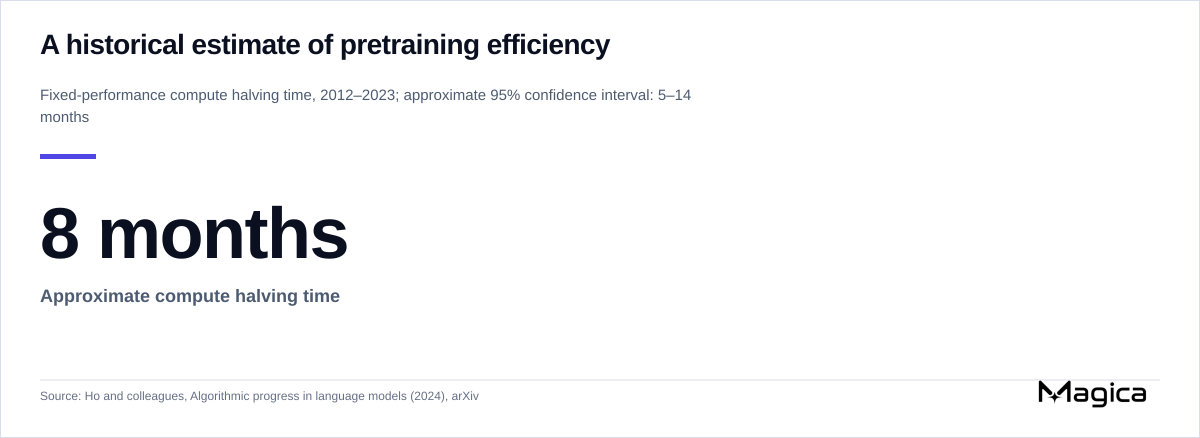
Ho and colleagues estimated that compute requirements at fixed benchmark performance halved about every eight months. This historical finding does not independently verify Anthropic’s current trajectory. Source: Algorithmic progress in language models.
A 2024 study by Anson Ho and colleagues examined more than 200 language-model evaluations on Wikitext and Penn Treebank spanning 2012–2023. It estimated that computation required to reach a fixed performance threshold halved approximately every eight months, with a 95% confidence interval of roughly five to 14 months.
The authors also found that increased compute contributed more to overall performance improvement during that period than algorithmic progress did. They cautioned that the benchmark data were noisy.
That provides precedent for substantial efficiency improvements alongside expanding compute use. It is not a like-for-like test of Anthropic’s slide: the study covers different historical models and benchmarks, and does not verify accelerating gains at one company or an imminent transition to automated AI research.
The key missing evidence is the slide’s measurement method: the performance target held constant, the models and dates compared, the computation counted, and the underlying data. Those details would allow scrutiny of both the size of the efficiency gains and whether their rate is accelerating.
Separate evidence would be needed to connect those gains to reliable automation of algorithmic research. For investors, the unresolved question is how much those gains change the resources needed for future models. For Coxon’s pause proposal, it is whether competitors could catch up under a workable set of rules—and whether that would deliver the safety and competitive benefits he predicts. The reported chart does not settle either question.
An early tally puts Japanese listed companies’ first-half net profit growth at 43.2%, led by manufacturers. Filings show AI component demand alongside currency benefits and non-AI earnings gains, while procurement delays and canceled infrastructure reservations expose the costs of expansion.
TSMC plans to back promising chip startups through a new investment arm, alongside separate commitments to OpenAI and Anthropic. The strategy reaches toward future customers and the AI developers shaping chip demand, but the investment rights remain unclear.
Nidus has raised $30 million across pre-seed and seed rounds to automate wire processing in existing U.S. defense factories. Its founders bring manufacturing and government-deployment experience, but customer access and proprietary data still need to translate into measurable production gains.
Nebuly is funding US and European expansion for its AI business-value platform. Adjustable assumptions and private deployment are part of its pitch, but rivals offer similar measurement tools and verified customer returns remain undisclosed.
Han Won-seok says he used a miniature camera, generative AI and a smartphone in tax accountant and CPA exams. His confession puts scrutiny on exam security after proctors reported no suspicious behavior.
Thousands protested against proposed AI data centres in Scotland as ministers prepare new planning guidance, putting public participation and the scale of electricity demand at the centre of the dispute.
Uber is notifying drivers after a breach at AI infrastructure provider Fireworks exposed personal and driver’s license information. Three reported state counts add up to about 7,870 people. Fireworks has since disclosed wider data exposure, but the precise connection used to reach Uber’s records remains unexplained.
Jensen Huang’s reported resignation puts Nvidia’s financing and advocacy for American open models under scrutiny. Researcher Nathan Lambert warns of a loss of support, while Nvidia’s commercial incentives and continuing model work complicate that forecast.
Altimeter and Atreides want Nvidia's board to leave Jensen Huang's return open while it investigates recent events. Their letter backs interim leadership and acknowledges that directors can ultimately reject his reinstatement.
Elon Musk says Nvidia risks losing supply arrangements made personally by former CEO Jensen Huang. No affected supplier is named. Nvidia’s filing documents both $95.2 billion in commitments and limits to the protection those arrangements provide.
Anthropic’s IPO has reportedly attracted orders for six times the available shares at proposed terms targeting a roughly $1.4 trillion valuation. The sale would add to substantial existing cash reserves as the Claude developer balances costly capacity shortages against long-term computing commitments.
Jason Clinton is urging network isolation as AI accelerates vulnerability discovery. The PHP emergency illustrates the immediate repair problem, while Anthropic's own security work shows that finding flaws does not automatically reduce risk.
Former Nvidia CEO Jensen Huang portrayed his relationship with a customer’s executive as routine business, according to reviewed messages and unnamed sources. A board inquiry faces questions about his disclosures amid separate concerns over chip exports and alleged spying.
Apple has detailed how Secure Exclaves isolate background camera and microphone processing from the main operating system and verify visible indicators before releasing full sensor data. The design aims to keep raw ambient sensing data beyond the main operating system’s reach, but its formal verification remains incomplete.
Charta Health is expanding its insurer tools with a $55 million Series B. Its promise of billing accuracy across payers and providers faces a harder test: showing that better coding reduces disputes rather than simply changes payments.
Operand has raised $31 million across seed and Series A funding for AI due diligence software aimed at private equity firms. Its pitch is to reconstruct businesses from public records and internet traces, but evidence of accuracy and deal-level economics remains limited.
Caitlin Kalinowski resigned over the deliberation and oversight behind OpenAI’s Pentagon agreement. The company says its safeguards prohibit domestic surveillance and autonomous weapons, leaving a dispute over how those limits were established and will be enforced.
The startup formerly known as QuilrAI pairs enterprise AI agents with Guardian agents and charges by agents under management. Its expansion pitch faces established alternatives and unanswered questions about security performance and cost.
Luminal’s Standard Capital-led Series A backs software for running AI models more efficiently on existing GPUs and alternative chips. Its reported processing volume leaves revenue and comparable customer savings unresolved.