Editorial Team
10 min read
Anthropic’s IPO has reportedly attracted orders for six times the available shares at proposed terms targeting a roughly $1.4 trillion valuation. The sale would add to substantial existing cash reserves as the Claude developer balances costly capacity shortages against long-term computing commitments.
Anthropic’s initial public offering has attracted orders for about six times the shares available, according to a report citing people familiar with the matter. The demand gives the developer of the Claude family of artificial intelligence models a strong starting point for its sale. It does not settle the final price, allocations or the economics of the computing capacity the money will help finance.
Chief executive Dario Amodei, who co-founded Anthropic in January 2021 after serving as vice president of research at AI research lab OpenAI, is pitching financial restraint as he markets the offering. In a Friday investor interview, he said Anthropic wants to “underpromise and overdeliver” and described matching computing purchases to uncertain demand as its “deepest business dilemma.”
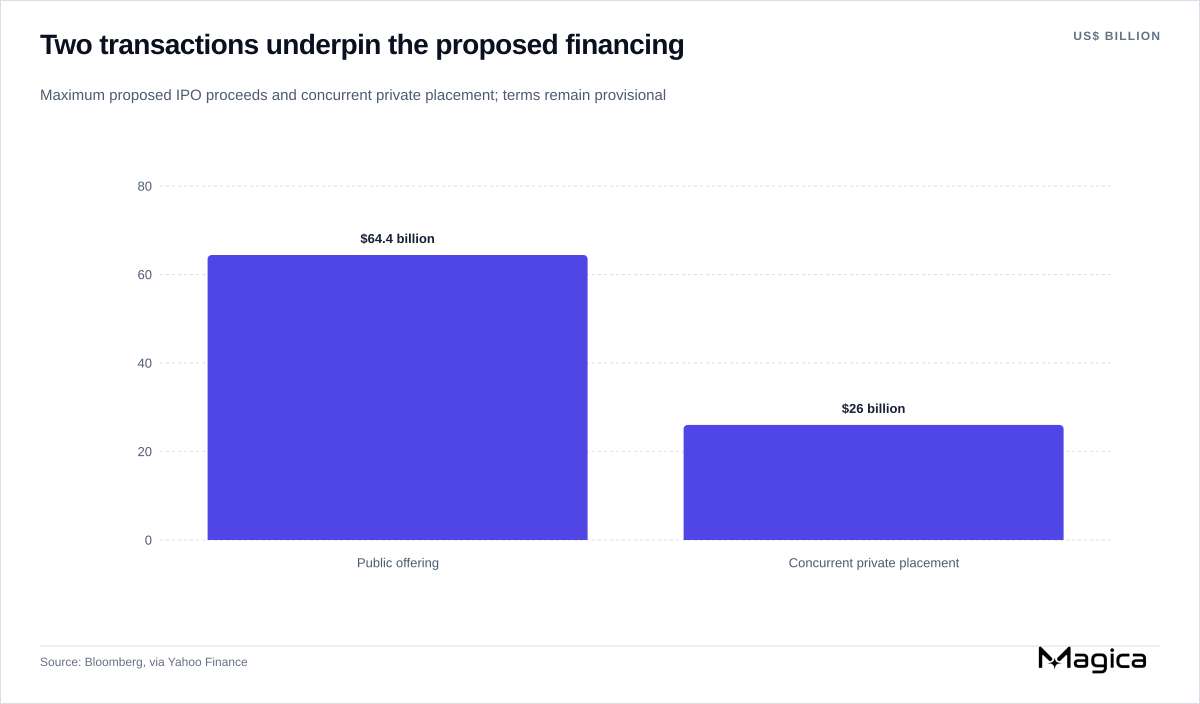
The proposed financing comprises two transactions. Gross proceeds include shares sold by existing stockholders and differ from net proceeds to Anthropic. Source: Yahoo Finance — IPO demand report.
The reported demand remains provisional. People familiar with the process said bankers had told prospective buyers that existing backers would receive priority and that some investors would get smaller allocations than expected. The terms and level of demand could change; Anthropic did not immediately respond to the report’s request for comment. Orders at the proposed terms are evidence of interest, rather than completed purchases or a guarantee of trading performance.
The report also described some investors offering portions of their IPO allocations to other prospective buyers to collect additional fees and reduce risk before trading begins. Others were marketing pre-IPO stakes through special-purpose vehicles. The reported activity shows that demand for access can coexist with investors seeking to redistribute their exposure.
The company is targeting a fully diluted valuation of approximately $1.4 trillion. That is below expectations among some investors that it might seek as much as $2 trillion, according to the account of Friday’s interview and offering plans. The difference is between proposed terms and investor hopes, rather than a decline from an established public trading valuation.
That account places the sale amid rising borrowing costs, political opposition to US data-center development and turmoil at Nvidia, a chip supplier and prospective investor in Anthropic. Those conditions qualify the picture of buoyant demand for the shares.
The prospectus sets an estimated price range of $70 to $78 for 825 million Class A shares. At the upper end, those shares would bring approximately $64.4 billion, with another $26 billion coming through a concurrent private placement that is conditional on the IPO’s completion. The combined $90.4 billion headline therefore includes two distinct transactions.
Nor would all the public offering’s proceeds go to Anthropic. The company is selling roughly 801.4 million shares, while selling stockholders are offering roughly 23.6 million. At the $74 midpoint, Anthropic estimates its own net proceeds from the IPO and private placement at $84.6 billion, after estimated offering expenses and underwriting charges and assuming no exercise of the underwriters’ additional-share option.
The money is intended for general corporate purposes, including computing infrastructure and hiring, rather than being entirely earmarked for capacity. Anthropic also expects to use $3.8 billion for tax withholding and remittance associated with settling employee restricted stock units, based on the midpoint price.
Amodei’s remarks on the timing put valuation discipline ahead of choosing a particular market window. He said the advice that resonated with him was to avoid having the company valued above its worth. The interview itself was part of the sales process: his questioner, Jamie Dimon, is chief executive of JPMorgan Chase, which is leading US retail share sales for the IPO.
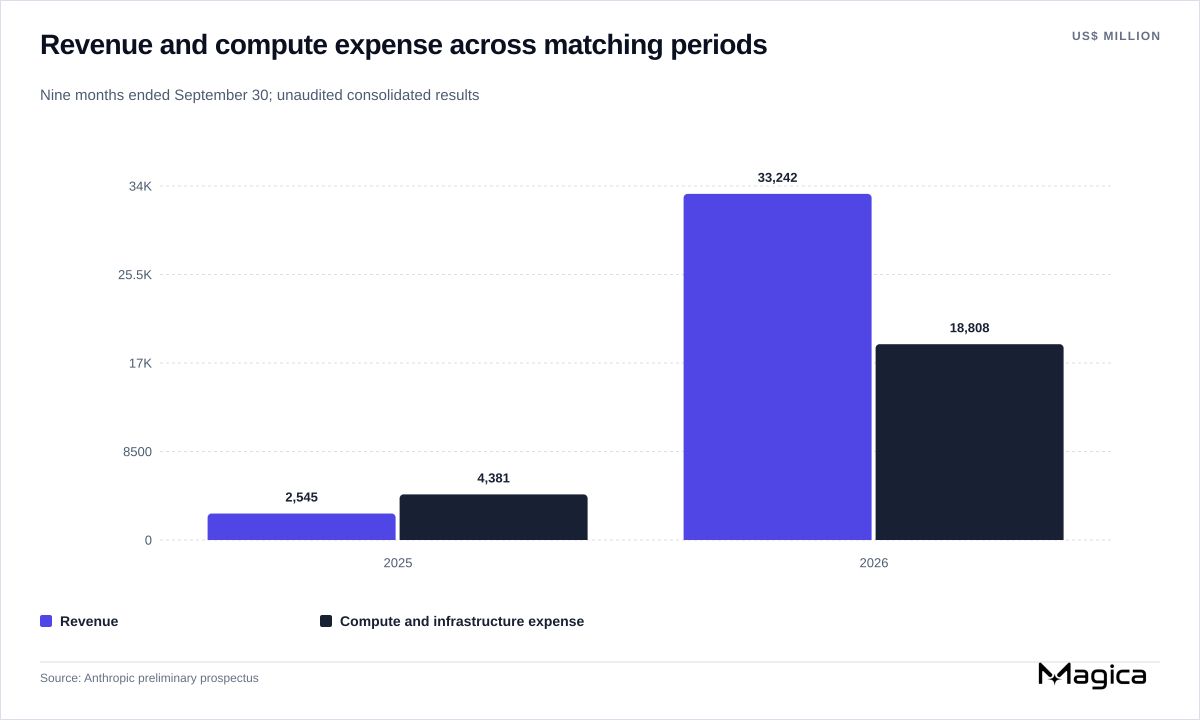
Company-reported revenue and compute and infrastructure expense for matching nine-month periods, from unaudited results. The gap between the bars is not operating profit. Source: Anthropic prospectus.
Anthropic researches advanced AI and sells access to Claude through models, a platform and applications. Its enterprise strategy embeds the technology in business workflows and products built by developers. The filing dates Claude’s commercial launch to the first quarter of 2023. It is a Delaware public benefit corporation, legally required to balance shareholder interests with the interests of people materially affected by its conduct and its stated purpose of responsible AI development for humanity’s long-term benefit.
Its financial statements show how quickly that business has expanded. The following figures cover the same nine-month period in each year and come from the prospectus’s unaudited interim results:
| Measure | Nine months ended Sept. 30, 2025 | Nine months ended Sept. 30, 2026 |
|---|---|---|
| Revenue | $2.545 billion | $33.242 billion |
| Compute and infrastructure expense | $4.381 billion | $18.808 billion |
| Operating loss | $5.224 billion | $1.260 billion |
Revenue grew about thirteenfold, reducing compute and infrastructure expense from 172% of revenue to 57%. The operating loss narrowed, although the year-earlier period included a $1.5 billion litigation-settlement charge absent from the 2026 period.
The company generated $6.6 billion of cash from operating activities in the first nine months of 2026, compared with using $2.0 billion a year earlier. The filing attributes that improvement primarily to better results after adjusting for noncash items, while noting that collections and vendor-payment timing affect cash flow. Separately, investing activities used $36.5 billion, primarily reflecting purchases of short-term investments alongside equipment and leased-asset prepayments and capital spending. That investing total is therefore not a measure of infrastructure spending alone.
That operating progress needs to be distinguished from the $104.0 billion net loss reported for the same period. The net loss included $94.3 billion in changes in the fair value of convertible notes, derivative liabilities and simple agreements for future equity, primarily driven by higher valuations of outstanding convertible notes as Anthropic’s enterprise valuation increased. The net loss is consequently a poor substitute for a measure of cash consumption.
The company’s newer $81 billion revenue run rate, measured on Oct. 31, also requires care. It annualizes consumption fees from a trailing 28-day period and subscription fees from a month. It is neither revenue already earned over a year nor a forecast. Anthropic warns that consumption can fluctuate, run-rate growth is expected to slow, and the metric includes some customers whose access is subsequently restricted or terminated for violating its policies or commercial terms.
Amodei said Anthropic generally buys less computing capacity in advance than its growth projections might support, then adds capacity when demand exceeds expectations. More cash, he said, creates a buffer between spending commitments and uncertain demand.
The filing describes the trade-off: Anthropic has significantly underestimated its computing needs in the past, leaving it capacity constrained and affecting product development and deployment. In the first nine months of 2026, its compute expense included $6.5 billion under short-term commitments, which it says currently cost significantly more than comparable capacity secured under multiyear agreements.
Anthropic is also moving from cloud-only arrangements toward a hybrid system that includes directly leased chips in dedicated facilities operated on its behalf. It says its architecture spans Amazon Web Services’ Trainium chips, Google’s tensor processing units, and Nvidia and AMD graphics processing units. Multiple hardware sources offer alternatives, but the filing warns that facility completion, hardware integration and access to energy and water can delay usable capacity. Cash alone does not guarantee timely delivery.
The proposed financing would supplement a large balance sheet. The liquidity disclosures show Anthropic held $95.6 billion in cash and cash equivalents and $36.3 billion in short-term investments at Sept. 30, with another $14.8 billion available under its credit facility. Available credit is borrowing capacity, rather than cash already held.
Across the contractual obligations table, short-term and subsequent commitments, and leases not yet commenced, Anthropic reports approximately $900.9 billion in obligations, substantially all related to compute and infrastructure. About $451.6 billion is expected to be incurred before Dec. 31, 2030, with substantially all the remainder between 2031 and 2045. The total is not an immediate cash bill.
Approximately $186.2 billion relates to arrangements with exercisable termination rights or conditions before commencement, including counterparties securing financing, facilities or regulatory approvals. Separately, the company estimates another $150 billion to $175 billion of payments under arrangements without fixed dollar commitments; those estimates are excluded from the $900.9 billion total and depend on deployment and other conditions.
The nearer-term figure is more directly relevant to the proposed financing: Anthropic expects approximately $70.7 billion of aggregate contractual obligations to be paid in the 12 months after Sept. 30, 2026. About $4.2 billion of that amount involves arrangements subject to conditions or termination rights before commencement. Its existing resources and ongoing customer receipts make a direct comparison between that payment schedule and IPO proceeds an incomplete funding calculation.
The underlying mismatch is contractual. Anthropic says much of its consumption-based revenue has no long-term customer commitment, while multiyear computing agreements include minimum purchases and take-or-pay terms that can require payment regardless of usage. It needs both sufficient customer demand and infrastructure delivered in time to serve it.
The financing also binds Anthropic more closely to its suppliers. The $26 billion placement includes approximately $10 billion each from Google and Nvidia. Google’s purchase funds part of previously committed investment obligations. Cloud providers and chipmakers thus have stakes in both Anthropic’s equity and the infrastructure it buys. The filing also identifies Google, alongside OpenAI, as a competitor with substantial resources and an existing customer base. A financing partner can simultaneously strengthen Anthropic’s capacity and compete for its customers.
Competition extends beyond those two model developers. The filing warns of pricing pressure from models with publicly available weights, which customers can run and modify, and from companies bundling AI into existing software. Large customers can also develop capabilities internally. Anthropic says newer Claude versions reduce customers’ costs per task through price cuts and efficiency gains while preserving its margins. Its ability to keep doing so matters when rivals can subsidize AI products or compete on distribution as well as model capability.
Anthropic expects to price the offering Wednesday, with trading scheduled to begin Thursday, Nov. 19, under the Nasdaq symbol ANT, according to the interview report citing the company’s IPO website. The immediate test is whether reported demand converts into purchases at the final terms.
Public investors will have limited power over that strategy. The prospectus gives a company formed by the co-founders a special Class F share carrying 50.1% of voting power on matters submitted to stockholders generally. Separately, the Long-Term Benefit Trust—intended as an independent body of financially disinterested trustees—will generally elect and remove a majority of the authorized board through Class T stock. Those arrangements place control with the founders and a mission-focused trust even as public investors supply capital.
After pricing, the central question will be whether contracted capacity arrives at a cost and pace that customer spending can support. Revenue recognized over full reporting periods, cash generation and reliance on expensive short-term compute will help show whether Anthropic is closing that gap. The IPO can enlarge its financial buffer; it cannot resolve the forecasting problem Amodei describes.
Police are investigating a top tax-accountant exam scorer's admission of AI-assisted cheating, while the government reviews national qualification tests held in 2026 and prepares stronger controls.
An early tally puts Japanese listed companies’ first-half net profit growth at 43.2%, led by manufacturers. Filings show AI component demand alongside currency benefits and non-AI earnings gains, while procurement delays and canceled infrastructure reservations expose the costs of expansion.
TSMC plans to back promising chip startups through a new investment arm, alongside separate commitments to OpenAI and Anthropic. The strategy reaches toward future customers and the AI developers shaping chip demand, but the investment rights remain unclear.
Nidus has raised $30 million across pre-seed and seed rounds to automate wire processing in existing U.S. defense factories. Its founders bring manufacturing and government-deployment experience, but customer access and proprietary data still need to translate into measurable production gains.
Nebuly is funding US and European expansion for its AI business-value platform. Adjustable assumptions and private deployment are part of its pitch, but rivals offer similar measurement tools and verified customer returns remain undisclosed.
Han Won-seok says he used a miniature camera, generative AI and a smartphone in tax accountant and CPA exams. His confession puts scrutiny on exam security after proctors reported no suspicious behavior.
Thousands protested against proposed AI data centres in Scotland as ministers prepare new planning guidance, putting public participation and the scale of electricity demand at the centre of the dispute.
Uber is notifying drivers after a breach at AI infrastructure provider Fireworks exposed personal and driver’s license information. Three reported state counts add up to about 7,870 people. Fireworks has since disclosed wider data exposure, but the precise connection used to reach Uber’s records remains unexplained.
Jensen Huang’s reported resignation puts Nvidia’s financing and advocacy for American open models under scrutiny. Researcher Nathan Lambert warns of a loss of support, while Nvidia’s commercial incentives and continuing model work complicate that forecast.
Altimeter and Atreides want Nvidia's board to leave Jensen Huang's return open while it investigates recent events. Their letter backs interim leadership and acknowledges that directors can ultimately reject his reinstatement.
Elon Musk says Nvidia risks losing supply arrangements made personally by former CEO Jensen Huang. No affected supplier is named. Nvidia’s filing documents both $95.2 billion in commitments and limits to the protection those arrangements provide.
The former Anthropic and OpenAI researcher says a pretraining-efficiency slide helped drive his resignation, turning an investor selling point into an argument for a development pause.
Jason Clinton is urging network isolation as AI accelerates vulnerability discovery. The PHP emergency illustrates the immediate repair problem, while Anthropic's own security work shows that finding flaws does not automatically reduce risk.
Former Nvidia CEO Jensen Huang portrayed his relationship with a customer’s executive as routine business, according to reviewed messages and unnamed sources. A board inquiry faces questions about his disclosures amid separate concerns over chip exports and alleged spying.
Apple has detailed how Secure Exclaves isolate background camera and microphone processing from the main operating system and verify visible indicators before releasing full sensor data. The design aims to keep raw ambient sensing data beyond the main operating system’s reach, but its formal verification remains incomplete.
Charta Health is expanding its insurer tools with a $55 million Series B. Its promise of billing accuracy across payers and providers faces a harder test: showing that better coding reduces disputes rather than simply changes payments.
Operand has raised $31 million across seed and Series A funding for AI due diligence software aimed at private equity firms. Its pitch is to reconstruct businesses from public records and internet traces, but evidence of accuracy and deal-level economics remains limited.
Caitlin Kalinowski resigned over the deliberation and oversight behind OpenAI’s Pentagon agreement. The company says its safeguards prohibit domestic surveillance and autonomous weapons, leaving a dispute over how those limits were established and will be enforced.
The startup formerly known as QuilrAI pairs enterprise AI agents with Guardian agents and charges by agents under management. Its expansion pitch faces established alternatives and unanswered questions about security performance and cost.
Luminal’s Standard Capital-led Series A backs software for running AI models more efficiently on existing GPUs and alternative chips. Its reported processing volume leaves revenue and comparable customer savings unresolved.