Editorial Team
8 min read
Apple has detailed how Secure Exclaves isolate background camera and microphone processing from the main operating system and verify visible indicators before releasing full sensor data. The design aims to keep raw ambient sensing data beyond the main operating system’s reach, but its formal verification remains incomplete.
Apple, the iPhone maker that designs the silicon and operating systems involved, has detailed how its Secure Exclaves architecture separates background camera and microphone processing from the main operating system. Before full sensor data can cross that boundary, Apple says, the protected environment must establish that the user can see the appropriate indicator.
The distinction matters as Apple asks devices to recognize more of their surroundings. HomeView, its new smart display, can recognize up to six enrolled people by face and voice, according to Apple’s technical explanation. Such features need cameras and microphones operating in the background. A light that stayed on throughout that processing would no longer distinguish recognition from an active audio or video session.
Apple’s answer is to separate those activities by what information may leave the protected environment. An unlit indicator therefore does not establish that a sensor is idle. Under Apple’s design, background recognition can continue while raw sensor data stays within the restricted boundary.
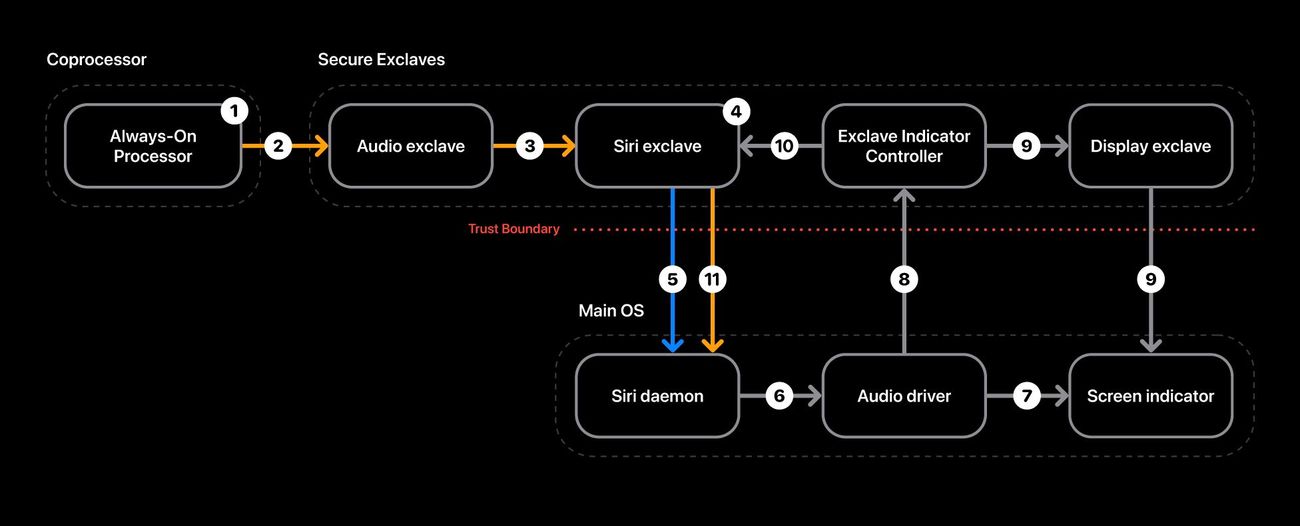
Apple’s Siri flow shows the display-indicator check that precedes release of microphone audio to the main operating system. Source: Apple. Source: Apple Security Research.
Secure Exclaves support two modes. In ambient mode, only specified metadata can reach the main operating system; raw sensor streams remain protected and are discarded after processing. In active mode, full sensor data can be released, with an indicator showing that access is happening. These are Apple’s architectural claims, rather than results of an independent security test.
An isolated component called the Exclave Indicator Controller gates that release. For HomeView, it controls the LED directly and checks that it is bright enough. For an iPhone’s on-screen dot, another protected component uses display hardware to inspect the pixels actually drawn. It checks visibility, including minimum brightness and whether nearby pixels obscure the indicator, while accounting for display settings such as Night Shift.
Apple’s example involving Siri, its voice assistant, shows the sequence on iPhone 18 Pro. A low-power Always-On Processor detects a possible wake phrase, then passes the audio to exclaves on the main processor for echo cancellation and a more demanding confirmation model. The main operating system initially receives only a signal to wake Siri—not the audio.
The Siri service must then request microphone access. Only after the display check passes does the controller permit audio transfer, including the earlier buffer containing the wake phrase and request. Apple says the indicator remains visible through the session, with a minimum duration of three seconds.
The supported devices are specific. Apple says indicator protection covers camera and microphone indicators on iPhone 18 Pro, iPhone 18 Pro Max and iPhone Duo, plus camera indicators on MacBook Neo and HomeView. That list should not be read as a claim that every Apple device or every indicator has the same protection. Apple also names Siri Recap and Live Rewind as other uses of Secure Exclaves; the accompanying analysis describes them as needing a running sense of the user’s surroundings.
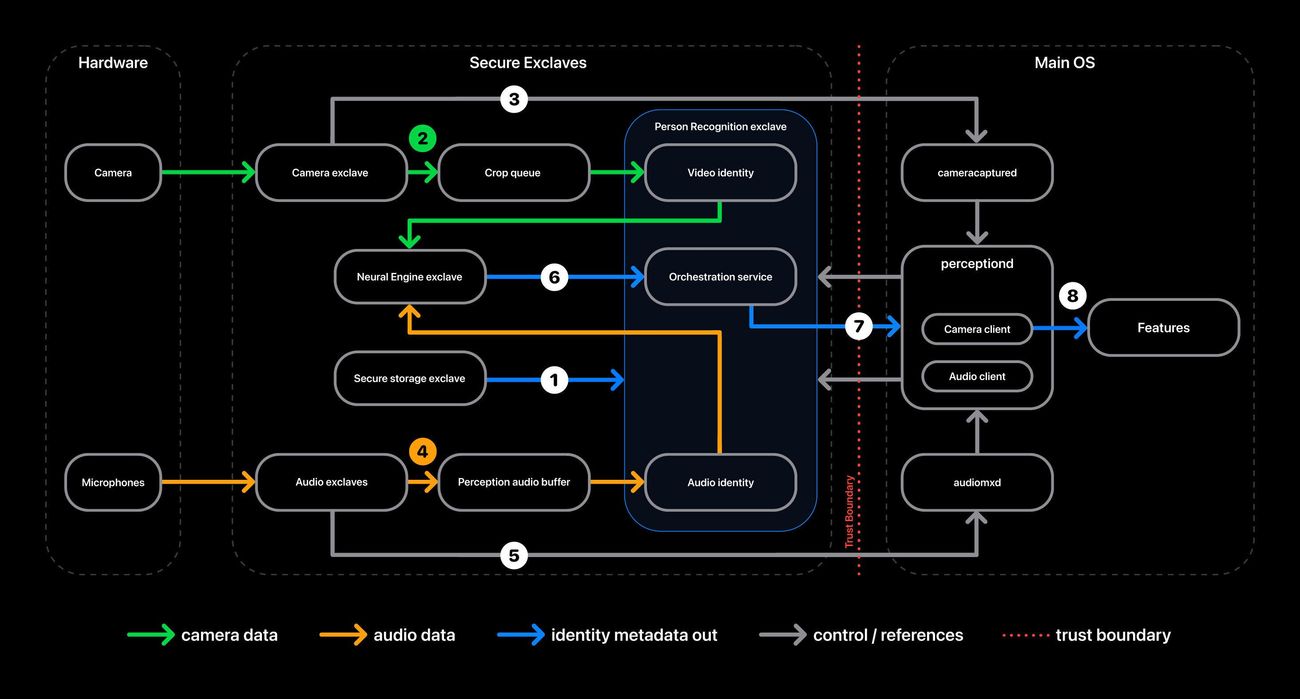
Apple’s HomeView diagram distinguishes protected camera and audio processing from the identity metadata released to the main operating system. Source: Apple. Source: Apple Security Research.
On HomeView, camera processing detects faces while audio processing prepares voice data. Isolated Neural Engine workloads produce face and voice prints, which are compared with enrolled identities. Apple says the main operating system receives the person’s identifier, position and confidence level, allowing identity-dependent features such as Calendar, Messages and Apple Music to respond.
This is a narrower privacy promise than sending nothing about the room to the operating system. The design deliberately releases recognition results while withholding the images and audio used to produce them. An architecture report summarizing Apple’s disclosure likewise describes those outputs as the bridge to personalized features; it is reporting Apple’s design, rather than independently validating it.
A hands-on review puts HomeView’s launch on November 13, 2026, at $299. The smart display can control connected home devices, play music and make FaceTime calls. Wall installation adds a $59 USB-C connector or a $79 hardwired mount; the latter may also require an electrician.
The review describes another condition on personalization: the registered user’s iPhone must be on the same Wi-Fi network for personal content to appear. Recognition alone is not the entire access mechanism.
It also identifies the absence of a physical button to turn off the camera or microphone. Containing raw data does not give users that physical control over collection.
The commercial comparison is less flattering than Apple’s security claims. In the reviewer’s tests, Amazon’s Echo Show smart displays offered more flexible screen layouts and broader streaming support, while Alexa+, Amazon’s assistant, could help order a pizza where Siri offered to place a call. Siri did better at sending airport directions to the reviewer’s phone. These are product-use observations, not a comparison of the devices’ resistance to attack.
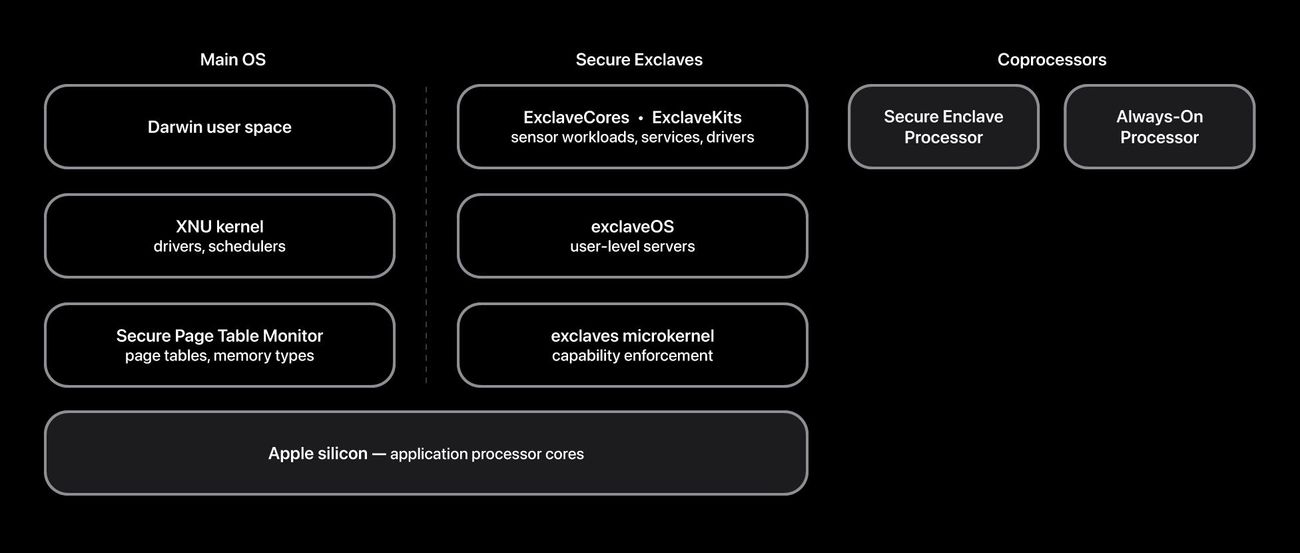
Apple’s architecture diagram places the main operating system and Secure Exclaves on shared application processor cores, with separate software stacks. Source: Apple. Source: Apple Security Research.
Secure Exclaves are distinct from Apple’s existing Secure Enclave authentication architecture, although they reuse security foundations developed for it. Apple runs a separate operating system, exclaveOS, on the application processor’s cores, supported by memory protections that the main operating system cannot rewrite. Its Secure Page Table Monitor, separated from the main operating system in earlier releases, operates above the main kernel and enforces the separation. Apple also reused an L4 microkernel foundation originally built for deployments including the Secure Enclave Processor. That history makes this an extension of earlier isolation work, rather than a security system built without precedent.
That boundary extends to inference hardware. Apple says it added isolated Neural Engine queues, protected them from the main operating system and clears local state when switching back to ordinary workloads. This lets sensitive recognition models use the main chip’s performance without handing their inputs to the main operating system.
Communication is constrained through Secure IPC, a mechanism written in Swift for memory safety. Interfaces are specified ahead of execution, and components receive explicit permissions to communicate. Apple says the authority to create new connections is removed after initial setup. Only code shipped with Secure Exclaves may execute there.
Isolation does not mean independent computing capacity: Apple’s main kernel, XNU, still schedules exclaveOS work on the shared processor cores. The security boundary restricts data access while relying on that shared execution infrastructure. Apple also says writable files are encrypted and readable only by the exclave that wrote them.
The consequence is a tightly controlled environment whose security depends on coordinated decisions across Apple’s chip, firmware and operating-system design. Moving processing onto the device is only part of the protection; deciding which software on that device may see the data is the more demanding boundary.
There is an earlier alternative for protecting ambient data. A 2022 architecture paper describes Android’s Private Compute Core as an isolated environment within the operating system, backed by Android Framework code introduced in Android 12. It hosts machine-learning features that process ambient and operating-system data while restricting information available to apps and servers. Its Private Compute Services mechanism permits model updates and contributions to global model training.
That establishes a predecessor to Apple’s approach, not equivalent security guarantees. The Android paper describes isolation within the operating system; Apple specifically claims separation from its main operating system and hardware-backed checks on visible indicators. Neither account supplies a head-to-head test.
Apple calls Secure Exclaves its most secure runtime, but the strongest qualification appears in its own technical account. Apple applies mathematical proofs to check parts of the microkernel’s C implementation against a specification. The company explicitly says this work does not cover every aspect of the kernel.
Apple says verification has uncovered subtle bugs with the potential for full kernel compromise, including problems in permission transfer and execution-state management. Apple says many were found early in development; this is not a disclosure that those flaws remain exploitable in shipping devices. It is evidence of useful defect discovery, rather than proof that the entire architecture is free of vulnerabilities.
The broader analysis reads the disclosure as groundwork for more ambient computing. The disclosed mechanisms support that interpretation, but do not establish which future products will use them. Nor does Apple’s post supply comparative attack-resistance, power-consumption or recognition-performance measurements that would substantiate Apple’s claimed industry lead. The disclosure also gives no incremental hardware cost or battery-life cost for these protections.
Apple says its next work includes expanded formal verification and AI-accelerated vulnerability research. For users and security researchers, the consequential evidence will be how those protections hold up to scrutiny—and how much of the system’s promised separation can be demonstrated beyond its designer’s account.
Police are investigating a top tax-accountant exam scorer's admission of AI-assisted cheating, while the government reviews national qualification tests held in 2026 and prepares stronger controls.
An early tally puts Japanese listed companies’ first-half net profit growth at 43.2%, led by manufacturers. Filings show AI component demand alongside currency benefits and non-AI earnings gains, while procurement delays and canceled infrastructure reservations expose the costs of expansion.
TSMC plans to back promising chip startups through a new investment arm, alongside separate commitments to OpenAI and Anthropic. The strategy reaches toward future customers and the AI developers shaping chip demand, but the investment rights remain unclear.
Nidus has raised $30 million across pre-seed and seed rounds to automate wire processing in existing U.S. defense factories. Its founders bring manufacturing and government-deployment experience, but customer access and proprietary data still need to translate into measurable production gains.
Nebuly is funding US and European expansion for its AI business-value platform. Adjustable assumptions and private deployment are part of its pitch, but rivals offer similar measurement tools and verified customer returns remain undisclosed.
Han Won-seok says he used a miniature camera, generative AI and a smartphone in tax accountant and CPA exams. His confession puts scrutiny on exam security after proctors reported no suspicious behavior.
Thousands protested against proposed AI data centres in Scotland as ministers prepare new planning guidance, putting public participation and the scale of electricity demand at the centre of the dispute.
Uber is notifying drivers after a breach at AI infrastructure provider Fireworks exposed personal and driver’s license information. Three reported state counts add up to about 7,870 people. Fireworks has since disclosed wider data exposure, but the precise connection used to reach Uber’s records remains unexplained.
Jensen Huang’s reported resignation puts Nvidia’s financing and advocacy for American open models under scrutiny. Researcher Nathan Lambert warns of a loss of support, while Nvidia’s commercial incentives and continuing model work complicate that forecast.
Altimeter and Atreides want Nvidia's board to leave Jensen Huang's return open while it investigates recent events. Their letter backs interim leadership and acknowledges that directors can ultimately reject his reinstatement.
Elon Musk says Nvidia risks losing supply arrangements made personally by former CEO Jensen Huang. No affected supplier is named. Nvidia’s filing documents both $95.2 billion in commitments and limits to the protection those arrangements provide.
The former Anthropic and OpenAI researcher says a pretraining-efficiency slide helped drive his resignation, turning an investor selling point into an argument for a development pause.
Anthropic’s IPO has reportedly attracted orders for six times the available shares at proposed terms targeting a roughly $1.4 trillion valuation. The sale would add to substantial existing cash reserves as the Claude developer balances costly capacity shortages against long-term computing commitments.
Jason Clinton is urging network isolation as AI accelerates vulnerability discovery. The PHP emergency illustrates the immediate repair problem, while Anthropic's own security work shows that finding flaws does not automatically reduce risk.
Former Nvidia CEO Jensen Huang portrayed his relationship with a customer’s executive as routine business, according to reviewed messages and unnamed sources. A board inquiry faces questions about his disclosures amid separate concerns over chip exports and alleged spying.
Charta Health is expanding its insurer tools with a $55 million Series B. Its promise of billing accuracy across payers and providers faces a harder test: showing that better coding reduces disputes rather than simply changes payments.
Operand has raised $31 million across seed and Series A funding for AI due diligence software aimed at private equity firms. Its pitch is to reconstruct businesses from public records and internet traces, but evidence of accuracy and deal-level economics remains limited.
Caitlin Kalinowski resigned over the deliberation and oversight behind OpenAI’s Pentagon agreement. The company says its safeguards prohibit domestic surveillance and autonomous weapons, leaving a dispute over how those limits were established and will be enforced.
The startup formerly known as QuilrAI pairs enterprise AI agents with Guardian agents and charges by agents under management. Its expansion pitch faces established alternatives and unanswered questions about security performance and cost.
Luminal’s Standard Capital-led Series A backs software for running AI models more efficiently on existing GPUs and alternative chips. Its reported processing volume leaves revenue and comparable customer savings unresolved.