Editorial Team
6 min read
Jensen Huang’s reported resignation puts Nvidia’s financing and advocacy for American open models under scrutiny. Researcher Nathan Lambert warns of a loss of support, while Nvidia’s commercial incentives and continuing model work complicate that forecast.
AI chipmaker Nvidia’s founder and departing chief executive Jensen Huang’s reported resignation threatens a source of funding and political protection for American open models, argues researcher Nathan Lambert, co-founder and executive director of Trillium Labs and previously a senior research scientist at the Allen Institute for AI.
Trillium Labs was established to foster the open science of frontier AI. Lambert’s analysis therefore comes from inside the movement he advocates for. His research record includes coauthorship of the OLMo open-language-model research and Tülu 3 work on post-training, which adapts models after their initial training. He also led Hugging Face’s reinforcement-learning-from-human-feedback team before working at the Allen Institute from 2023 to 2026. That experience helps explain his technical authority and professional stake in the argument.
The immediate trigger is a November 12 report that Huang resigned as Nvidia CEO after admitting an affair with an executive alleged to be a Chinese spy. The report says chief financial officer Colette Kress became interim CEO, leaving her approach to open models unclear.
For developers and enterprises using open-weight models—models whose weights are available to download—the stakes extend beyond getting another model release. Lambert sees the ability to own and adapt intelligence, particularly through enterprise post-training, as a promising business. He also says the size of that downstream market remains unresolved.

Magica timeline of the Nemotron 3 and Trillium Labs announcements and the subsequent report of Huang’s departure. Announcement dates do not establish delivery of every planned model. .
Police are investigating a top tax-accountant exam scorer's admission of AI-assisted cheating, while the government reviews national qualification tests held in 2026 and prepares stronger controls.
Huang’s support combined products, investment and lobbying. The November 12 report put Nvidia’s pending acquisition of model-sharing platform Hugging Face at about $13 billion. It also described a $6 billion agreement for a non-exclusive license to coding-model developer Poolside’s technology and investments in Reflection AI and Thinking Machines Lab.
Those arrangements represent different forms of support: an acquisition still awaiting completion, a technology license and startup investments. They do not establish that Nvidia will maintain the same pace of future financing under new leadership.
There is nevertheless a commercial reason to continue. As large customers develop their own chips, a broader population of enterprises, governments and model developers offers Nvidia more buyers for its graphics processors. Lambert acknowledges that incentive, as does the November 12 reporting. Supporting customers that own their models can reduce Nvidia’s dependence on a small number of powerful AI laboratories.
There is also an existing product strategy. Nvidia announced Nemotron 3, a family of open models, data and libraries for AI agents, in December 2025 under Huang. Nano was available at that announcement; Super and Ultra were then scheduled for the first half of 2026. Those historical plans alone do not establish subsequent delivery. The November 12 report describes later Nemotron work on long-running AI agents and reasoning, and cites an unidentified company insider who does not expect the leadership change to affect development.
Nvidia’s announcement also describes open and proprietary models working together: developers could route tasks between proprietary models used for leading reasoning capabilities and customizable open models used to lower costs. On that account, open models can win useful workloads without replacing the strongest proprietary model in every application.
Lambert’s economic concern is that openness at the model level does not automatically create competition in the infrastructure needed to run it. He argues that scarce computing capacity can leave providers serving open models with high inference margins, preserving advantages for closed laboratories with greater scale and tighter integration across models and infrastructure.
A November 13 analysis offers a partial counterweight: custom chips from Google, Amazon, Microsoft and OpenAI, alongside AMD and Broadcom deals, give customers more options. It also relays Anthropic’s claim that its Mythos model helped run certain workloads on AMD chips in about three days, compared with six to 12 months previously. That is a company-reported result for unspecified workloads, not a general migration benchmark. The analysis cautions that alternatives do not solve the immediate computing shortage, particularly for smaller players that depend on Nvidia’s widely supported hardware.
The same analysis cites research firm SemiAnalysis’s figure of $530 billion in Nvidia off-balance-sheet commitments and guarantees, including memory purchases and data-center backstops. That reported total spans infrastructure obligations; it is neither money already spent nor a budget devoted to open models. Its relevance is the financing role Nvidia has assumed alongside selling chips; replacing a processor supplier and replacing a financial backer are different tasks.
Nor does financing guarantee a competitive model. Lambert cites semiconductor analyst Dylan Patel’s argument that leading researchers are concentrated at major labs, while other talent is scattered among many startups. Lambert himself says Nvidia’s Nemotron effort has not yet achieved its ambition.
He sees Thinking Machines Lab’s Inkling 2 Small as a promising Western open-weight release, but judges it substantially behind Kimi K3.1 Pro. Those are Lambert’s comparative assessments, without a common benchmark comparison supplied in his essay. He also describes a prospective Thinking Machines funding round at a $40 billion valuation as supposedly settled. That is an unconfirmed valuation claim, not an amount raised or proof that the lab can finance sustained competition with closed frontier developers.
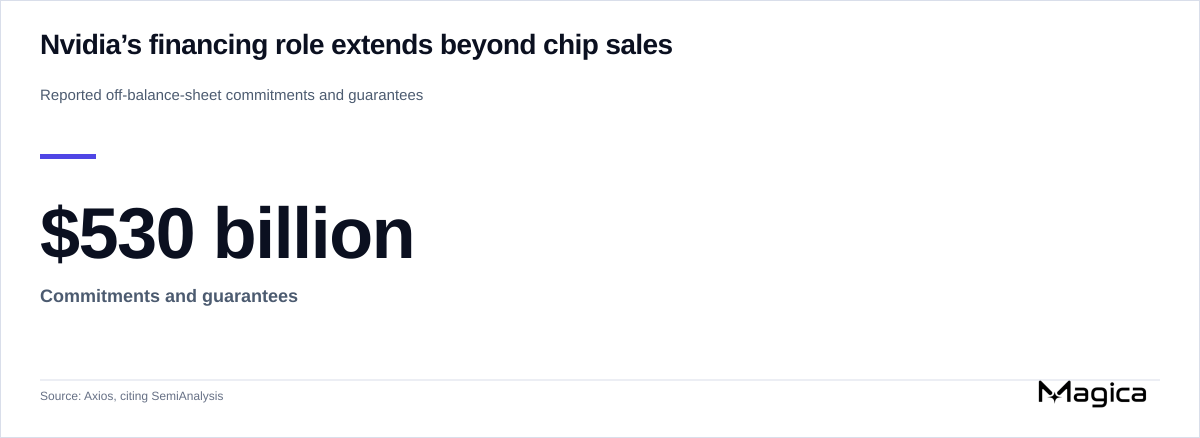
Magica graphic using Axios reporting that cites SemiAnalysis: $530 billion in Nvidia commitments and guarantees, including memory purchases and data-center backstops. This is neither money already spent nor an open-model funding budget. Source: Axios.
Lambert also fears losing an executive able to intervene when open models face political pressure. The November 12 report says Huang wrote an open letter signed by 25 companies urging Washington against excessive restrictions on open-weight models. It links the letter to debate over allegations that Chinese laboratories were taking intellectual property from American developers, including Anthropic and OpenAI. That context matters: the dispute involves competing claims about protection, safety and access to models, alongside the commercial interests of open- and closed-model providers.
Lambert’s warning about future state and national regulation is a forecast, not evidence that new restrictions have already been adopted. His proposed response is coalition building and a leading American open-model organization with enough talent, resources and institutional support to endure crises. He identifies large cloud companies as potential allies, leaving room for sponsorship beyond Nvidia.
The practical questions now are narrower than whether open models can survive at all: how Kress approaches the pending Hugging Face acquisition, whether Nvidia sustains startup financing, and who can organize political support beyond one founder. Continued Nemotron development would answer one product question. It would not, by itself, settle who supplies the capital and influence on which Lambert believes the wider ecosystem depends.
An early tally puts Japanese listed companies’ first-half net profit growth at 43.2%, led by manufacturers. Filings show AI component demand alongside currency benefits and non-AI earnings gains, while procurement delays and canceled infrastructure reservations expose the costs of expansion.
TSMC plans to back promising chip startups through a new investment arm, alongside separate commitments to OpenAI and Anthropic. The strategy reaches toward future customers and the AI developers shaping chip demand, but the investment rights remain unclear.
Nidus has raised $30 million across pre-seed and seed rounds to automate wire processing in existing U.S. defense factories. Its founders bring manufacturing and government-deployment experience, but customer access and proprietary data still need to translate into measurable production gains.
Nebuly is funding US and European expansion for its AI business-value platform. Adjustable assumptions and private deployment are part of its pitch, but rivals offer similar measurement tools and verified customer returns remain undisclosed.
Han Won-seok says he used a miniature camera, generative AI and a smartphone in tax accountant and CPA exams. His confession puts scrutiny on exam security after proctors reported no suspicious behavior.
Thousands protested against proposed AI data centres in Scotland as ministers prepare new planning guidance, putting public participation and the scale of electricity demand at the centre of the dispute.
Uber is notifying drivers after a breach at AI infrastructure provider Fireworks exposed personal and driver’s license information. Three reported state counts add up to about 7,870 people. Fireworks has since disclosed wider data exposure, but the precise connection used to reach Uber’s records remains unexplained.
Altimeter and Atreides want Nvidia's board to leave Jensen Huang's return open while it investigates recent events. Their letter backs interim leadership and acknowledges that directors can ultimately reject his reinstatement.
Elon Musk says Nvidia risks losing supply arrangements made personally by former CEO Jensen Huang. No affected supplier is named. Nvidia’s filing documents both $95.2 billion in commitments and limits to the protection those arrangements provide.
The former Anthropic and OpenAI researcher says a pretraining-efficiency slide helped drive his resignation, turning an investor selling point into an argument for a development pause.
Anthropic’s IPO has reportedly attracted orders for six times the available shares at proposed terms targeting a roughly $1.4 trillion valuation. The sale would add to substantial existing cash reserves as the Claude developer balances costly capacity shortages against long-term computing commitments.
Jason Clinton is urging network isolation as AI accelerates vulnerability discovery. The PHP emergency illustrates the immediate repair problem, while Anthropic's own security work shows that finding flaws does not automatically reduce risk.
Former Nvidia CEO Jensen Huang portrayed his relationship with a customer’s executive as routine business, according to reviewed messages and unnamed sources. A board inquiry faces questions about his disclosures amid separate concerns over chip exports and alleged spying.
Apple has detailed how Secure Exclaves isolate background camera and microphone processing from the main operating system and verify visible indicators before releasing full sensor data. The design aims to keep raw ambient sensing data beyond the main operating system’s reach, but its formal verification remains incomplete.
Charta Health is expanding its insurer tools with a $55 million Series B. Its promise of billing accuracy across payers and providers faces a harder test: showing that better coding reduces disputes rather than simply changes payments.
Operand has raised $31 million across seed and Series A funding for AI due diligence software aimed at private equity firms. Its pitch is to reconstruct businesses from public records and internet traces, but evidence of accuracy and deal-level economics remains limited.
Caitlin Kalinowski resigned over the deliberation and oversight behind OpenAI’s Pentagon agreement. The company says its safeguards prohibit domestic surveillance and autonomous weapons, leaving a dispute over how those limits were established and will be enforced.
The startup formerly known as QuilrAI pairs enterprise AI agents with Guardian agents and charges by agents under management. Its expansion pitch faces established alternatives and unanswered questions about security performance and cost.
Luminal’s Standard Capital-led Series A backs software for running AI models more efficiently on existing GPUs and alternative chips. Its reported processing volume leaves revenue and comparable customer savings unresolved.