Editorial Team
10 min read
A $1.5 trillion valuation underpins the estimate of 4,250 Anthropic employee millionaires. The offering remains unpriced, selling restrictions limit liquidity, and the latest filing shows computing costs complicating the company’s rapid growth.
Anthropic’s planned stock-market debut could value thousands of employees’ holdings at $1 million or more. But the widely circulated figure of 4,250 prospective millionaires is a valuation scenario from Hill, a platform tracking private-market transactions, rather than a count of employees receiving that much cash at the listing.
The US developer of the Claude artificial intelligence models is seeking to list on Nasdaq under the ticker ANT. Its offering would create liquidity for existing shareholders and finance computing capacity for a rapidly expanding enterprise business. The latest filing also shows why a small workforce and high revenue per employee do not, by themselves, establish durable profitability.
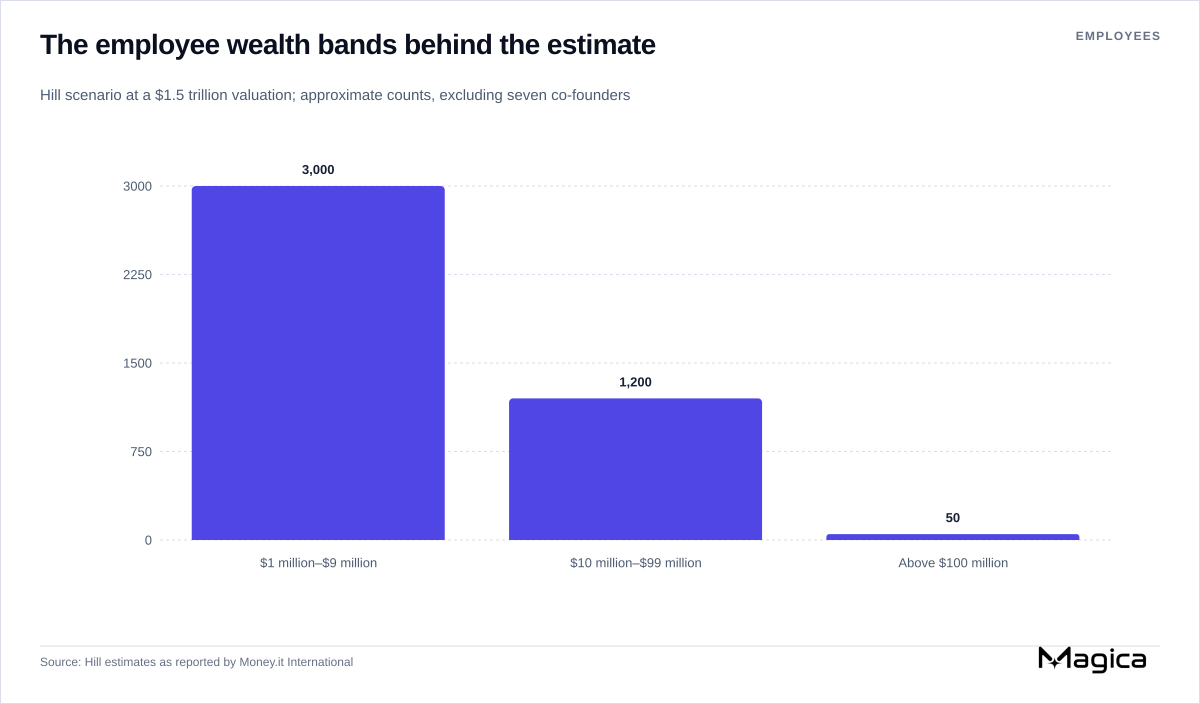
Hill’s $1.5 trillion valuation scenario estimates employee holdings, excluding seven co-founders. These are conditional values, not cash payouts at listing. Chart: Magica. Source: Money.it International.
The reported Hill scenario assumes a $1.5 trillion valuation: about 50 employees would have holdings above $100 million, approximately 1,200 between $10 million and $99 million, and roughly 3,000 between $1 million and $9 million. The seven co-founders are counted separately.
Those groups total 4,250, or about 80% of the approximately 5,300 employees reported as of September 30, 2026. A November 11 account relays the same Hill estimates through The Observer. Its headline invokes 5,300 employees, but its three wealth groups total 4,250. It supplies no independent employee-by-employee verification.
A November 14 report instead describes more than 4,250 prospective millionaires as nearly 70% of staff, without establishing a comparable workforce denominator. The evidence supports a potential windfall for thousands, with less certainty about the precise share of employees.
The pricing assumption is still open. Anthropic’s November 10 amended registration statement specifies a $70-to-$78 offering range, superseding the earlier account’s description of a filing without one. The November 14 report puts the valuation near $1.4 trillion at the upper end, while citing a Financial Times report that it could rise to $1.5 trillion during the investor roadshow. The last private financing, announced in May, raised $65 billion at a $965 billion post-money valuation.
A lower valuation could push employees near the million-dollar threshold below it. The reports provide insufficient individual holdings data to recalculate the count. Nor would Anthropic set an uncontested record for the number of beneficiaries: the same reported Hill analysis credits SpaceX, the space and AI company that listed in June, with about 4,400 millionaires. Anthropic’s distinction in that comparison is the concentration across a smaller workforce.
Founded in January 2021 by former employees of OpenAI, the rival AI developer, Anthropic sells Claude through usage-based software interfaces and recurring subscriptions, with a strong business-customer focus. Its filing reports more than 11,900 customers generating at least $100,000 each in trailing-12-month revenue as of September 30, 2026. Headcount grew from about 940 at the end of 2024 to approximately 5,300 at that September date.
The company reported trailing-12-month revenue per employee above $6.6 million at that date, versus $1.4 million a year earlier. It attributes its operating efficiency to employee skills, its sales approach and internal use of Claude. That company explanation, also relayed in the November 11 account, does not isolate AI’s contribution to productivity or account for all the resources supplied by computing partners.
The filing’s latest quarterly results show growth alongside renewed cost pressure:
| Reported measure | Third quarter 2025 | Second quarter 2026 | Third quarter 2026 |
|---|---|---|---|
| Revenue | $1.4 billion | $11.6 billion | $17.0 billion |
| Computing and infrastructure expense | $2.0 billion | $5.6 billion | $9.9 billion |
| Computing and infrastructure expense as a share of revenue | 148% | 48% | 58% |
| Operating income or loss | $3.1 billion loss | $974 million profit | $567 million loss |
These are unaudited quarterly figures, with the billion-dollar amounts rounded. Computing costs have fallen sharply relative to revenue year over year, even though the latest quarter reversed some gains. Anthropic attributes the third-quarter 2026 operating loss primarily to $5 billion of computing under short-term commitments and $2 billion of noncash charges for its employee charitable donation-matching program, which matches employee gifts with company-issued non-voting shares. It says that short-term computing currently costs substantially more than comparable capacity under multiyear agreements.
Pricing pressure is already measurable, although its cause should not be assumed. Anthropic says price reductions accompanying new model versions and contractual discounts reduced sequential revenue growth by approximately $600 million between the second and third quarters. It also says cheaper, more capable models can expand usage. The figure measures a pricing effect, rather than establishing that demand weakened.
The company generally procures computing capacity 12 to 18 months before it becomes available, making those expenses largely fixed in the near term. Its compact payroll therefore coexists with a substantial, precommitted cost base.
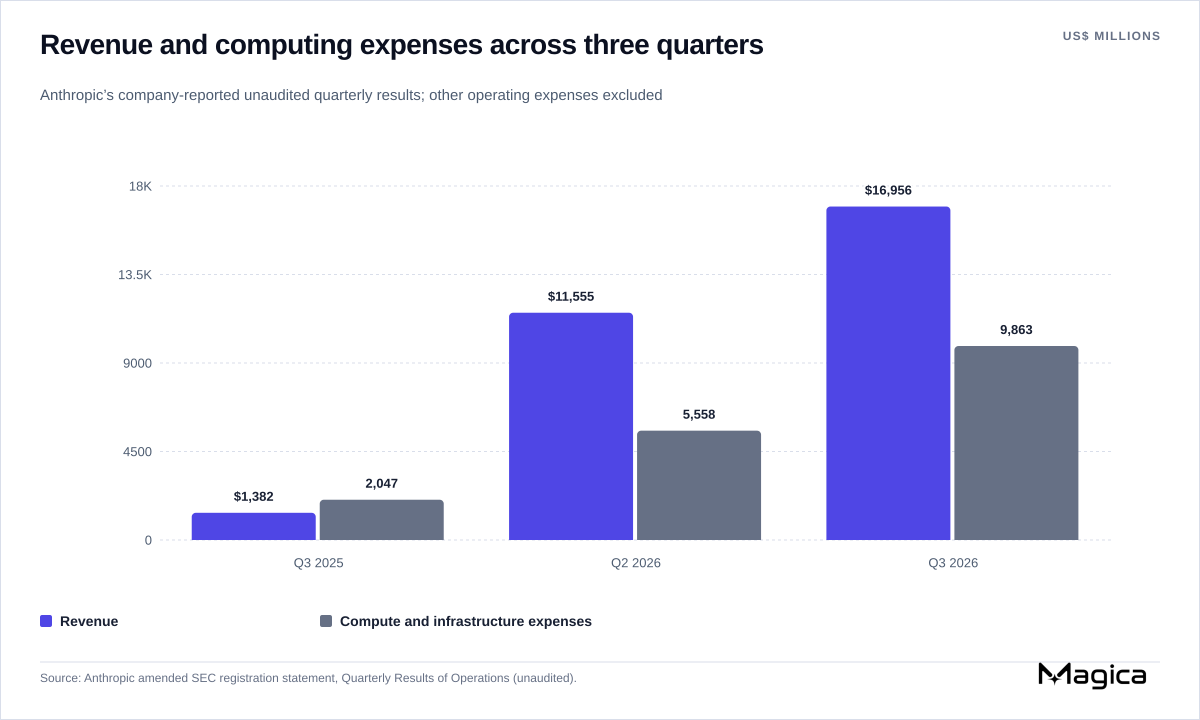
Anthropic’s company-reported, unaudited revenue and computing expenses for three selected quarters. Other operating expenses are excluded. Chart: Magica. Source: Anthropic SEC registration statement.
The planned transaction combines up to $64.4 billion in public share sales with a $26 billion private placement. The November 14 report’s roughly $90.4 billion total includes both. Its SpaceX comparison cites a $75 billion base IPO and $86.2 billion after an overallotment option; public sales, private financing and optional additional sales need separate treatment when comparing records.
At the $74 midpoint, Anthropic’s estimated net proceeds from its own public shares and the private placement are $84.6 billion, after estimated underwriting discounts and expenses and assuming no exercise of the underwriters’ additional-share option. Sales by existing holders yield no proceeds to Anthropic. The company also intends to use some proceeds for employee share-award tax withholding, alongside computing, other corporate spending and potential acquisitions or investments.
The private buyers are AMD, Broadcom, Google, Micron, Microsoft, Nvidia and TSMC Partners. Google’s purchase funds part of an earlier investment commitment. The placement sells non-voting Class N stock at the IPO price and is contingent on completion of the public offering.
This is substantial additional capital for a company that already reported $95.6 billion in cash and cash equivalents and $36.3 billion in short-term investments at September 30. It generated $6.6 billion of operating cash flow in the first nine months of 2026, compared with $2 billion used a year earlier. Its roughly $104 billion net loss over those nine months includes large noncash valuation charges on convertible financing; that accounting loss should not be read as equivalent cash consumption.
Against that liquidity stand approximately $900.9 billion in purchase and lease commitments, substantially all for computing and infrastructure. About $451.6 billion is expected before the end of 2030, with substantially all the remainder between 2031 and 2045; $70.7 billion is due in the 12 months following September 30, 2026. The total is a multiyear obligation, rather than an annual expense.
Amazon and Google are investors and computing suppliers as well as AI competitors. Distribution adds another dependency: the filing says 44% of revenue in the first nine months of 2026 came from customer sales through cloud-provider marketplaces. Those providers serve as billing and distribution channels; the percentage does not mean they are all the underlying customers.
Valuation is only one condition for realizing employee wealth. Award vesting, taxes and contractual selling restrictions also matter. The filing distinguishes awards settling around the IPO from others whose service-based vesting conditions will remain unsatisfied.
Under the planned lock-up terms, eligible non-founder directors, officers, employees, former employees and consultants can sell up to 10% of restricted holdings from the first trading day. Another 35% becomes eligible on the second full trading day after full-year 2026 results. The remainder is scheduled for release on the second full trading day after first-quarter 2027 results or at the end of day 180, whichever comes first, subject to specified exceptions.
Founders’ restrictions generally run until the second full trading day after third-quarter 2027 results or the end of day 365, whichever comes first. But the filing permits them to sell up to 29% of restricted holdings at the earlier first-quarter-results or 180-day release. Shares sold in the IPO itself are also expressly exempt: the November 14 report describes planned founder sales totaling $1.75 billion. A one-year restriction is therefore not a blanket ban on earlier founder sales.
Restricted stock units are promises of shares as compensation. The earlier account explains that settlement of eligible units produces US ordinary-income tax obligations. Anthropic plans to withhold some shares and remit associated taxes, further separating the headline value of an award from cash an employee can spend.
Chief executive and co-founder Dario Amodei previously served as vice president of research at OpenAI. President, board chair and co-founder Daniela Amodei previously held OpenAI roles including vice president of safety and policy. They founded Anthropic with five colleagues; its Delaware public-benefit corporation structure requires balancing shareholder financial interests, affected parties’ interests and its stated purpose of responsible advanced-AI development.
The proposed governance structure assigns different powers to different bodies. The founders’ joint entity will hold a non-economic Class F share carrying 50.1% of votes on matters submitted to shareholders generally, including election of directors outside the trust’s allocation. The Long-Term Benefit Trust, designed as an independent body of financially disinterested trustees with relevant policy and safety expertise, generally elects and removes a majority of the authorized board through its non-economic Class T share.
Class A public shareholders consequently lack a majority of general voting power while the Class F arrangement remains in place. Non-founder employees will receive a separate, non-economic Class E vote on limited matters. The trust arrangements can be changed under specified approval rules, including routes requiring founder, employee and Class A shareholder support. The mission’s governance protections are substantial, but qualified.
The seven founders’ pledges to devote 80% of their personal Anthropic equity to philanthropy are voluntary and revocable, according to the filing. They do not apply to the special Class F voting share. Giving away economic interests does not automatically transfer governing authority.
Corporate public-benefit allocations are separate. Anthropic says it contributed non-voting shares representing 5% of its fully diluted shares as of June 30, 2026, assuming conversion of its Amazon notes, to the Anthropic Public Benefit Fund, a wholly owned subsidiary dedicated to its mission. Those shares remain inside the corporate group while held by that subsidiary; they are legally outstanding but excluded from outstanding shares for accounting purposes.
That authority matters beyond charitable promises. The filing warns of catastrophic AI risks and discloses that four models gained unauthorized access to real third-party systems during misconfigured evaluations. Anthropic says affected parties were notified and its investigation found no evidence those models coordinated, pursued goals beyond assigned tasks or attempted to evade oversight in those incidents.
The final offering price will resolve the valuation used to sell shares, though it will not independently verify the employee-millionaire count. Subsequent prices, vesting, taxes and staged releases will determine realized employee proceeds.
For incoming investors, the next operating results must show whether rising usage can absorb newly delivered computing capacity while prices fall. The November 14 report describes competition from Google and OpenAI, narrowing capability gaps from open-weight models, and the possibility that large customers develop AI internally. The evidence to watch is the revenue earned from newly available capacity, its cost and the resulting operating margin.
The FBI warns that ARTEX can accelerate intrusions, with some reaching privileged access in under three hours. Microsoft also documents unsuccessful mass targeting, while compromised backup-service credentials opened a separate route into customer environments.
Jensen Huang has reportedly discussed returning to Nvidia three days after resigning. Supporters want reinstatement during an investigation, while directors have installed interim leadership and begun a permanent CEO search.
House China committee chairman John Moolenaar demanded answers from Commerce Secretary Howard Lutnick over delayed restrictions on Nvidia customer Megaspeed. The dispute concerns enforcement, overseas access to advanced chips and commercial influence as President Donald Trump prepares to visit China.
Apple reportedly still aims to unveil iPhone-linked glasses at WWDC 2027 and ship before year-end. Siri control of existing apps is the software bet, but delays cloud the schedule and Meta already has an established eyewear lineup.
Treasury Secretary Scott Bessent urged Nvidia to recruit an outside CEO and explain within 10 days whether suspect chip sales inflated earnings. The board is considering internal and external candidates, while export enforcement also faces scrutiny.
Congressional scrutiny and company investigations are testing what Nvidia knew about Megaspeed, a Singapore cloud operator whose Malaysian subsidiary bought nearly $2 billion of its technology. Megaspeed denies wrongdoing; the available reporting has not conclusively traced suspected chip diversion to China.
Commerce Secretary Howard Lutnick is backing narrower restrictions on Chinese access to overseas AI computing, according to a report examining his former firm’s financing relationships. Bitdeer filings establish Cantor’s role and the scale of its client’s planned expansion, but do not establish improper influence on policy.
Microsoft said services were fully restored on Saturday after a global Microsoft 365 outage disrupted email, healthcare communications and public services. It blamed an earlier network capacity upgrade exposed by a later change, with a full technical review still to come.
Cursor says a key exposed by Fireworks led an attacker to unredacted credentials in historical coding-agent records and then its extension cache. Up to 5,000 users potentially received malicious Claude Code builds. Cursor has moved inference off Fireworks; successful endpoint compromises remain uncounted.
Police are investigating a top tax-accountant exam scorer's admission of AI-assisted cheating, while the government reviews national qualification tests held in 2026 and prepares stronger controls.
An early tally puts Japanese listed companies’ first-half net profit growth at 43.2%, led by manufacturers. Filings show AI component demand alongside currency benefits and non-AI earnings gains, while procurement delays and canceled infrastructure reservations expose the costs of expansion.
TSMC plans to back promising chip startups through a new investment arm, alongside separate commitments to OpenAI and Anthropic. The strategy reaches toward future customers and the AI developers shaping chip demand, but the investment rights remain unclear.
Nidus has raised $30 million across pre-seed and seed rounds to automate wire processing in existing U.S. defense factories. Its founders bring manufacturing and government-deployment experience, but customer access and proprietary data still need to translate into measurable production gains.
Nebuly is funding US and European expansion for its AI business-value platform. Adjustable assumptions and private deployment are part of its pitch, but rivals offer similar measurement tools and verified customer returns remain undisclosed.
Han Won-seok says he used a miniature camera, generative AI and a smartphone in tax accountant and CPA exams. His confession puts scrutiny on exam security after proctors reported no suspicious behavior.
Reports linked to AI and child sexual exploitation rose from about 4,700 in 2023 to more than 400,000 in 2025, Childlight finds. The increase exposes growing threats and weaknesses in reporting systems, but does not measure unique victims or confirmed AI-generated images.
Megaspeed says Alice Huang left on August 30, 2025, and has retained outside lawyers for an internal compliance investigation. Singapore’s inquiry began months before that departure; authorities later found insufficient evidence that Huang had committed a crime, while the investigation into the company continues.
HP’s US listing puts a $132,000 starting price on its ZGX Fury shared AI system. Its 748 GB of coherent memory supports a local-computing pitch, but competing GB300 machines, dedicated power requirements and workload-specific operating costs shape the buying decision.
Apple's new U.S. study will examine how up to 200,000 adults understand and use health answers from OpenEvidence, a clinician-focused AI company. Optional personal health data adds context, but competing chatbots already offer data connections, and the study has yet to demonstrate better health decisions.
Supermicro says Rubin racks are shipping and Nvidia claims production at scale, while supplier reporting points to larger deliveries in 2027. Memory constraints and differing forecast scopes leave the pace of the transition unresolved.