Editorial Team
7 min read
Supermicro says Rubin racks are shipping and Nvidia claims production at scale, while supplier reporting points to larger deliveries in 2027. Memory constraints and differing forecast scopes leave the pace of the transition unresolved.
Server maker Supermicro says it has begun shipping chip supplier Nvidia’s Vera Rubin NVL72 AI racks, but forecasts for the platform’s expansion into 2027 differ. Server manufacturer Quanta Computer expects larger volumes early next year; research firm TrendForce has forecast a later ramp tied to memory yields and cooling readiness.
Those accounts must also be weighed against Nvidia’s own production claims. They describe different stages and scopes: chip and system manufacturing, individual suppliers’ deliveries, and the mix of Nvidia’s high-end GPU shipments. Together, they establish neither a blanket postponement nor a settled timetable for broad customer deployment.

Supermicro’s illustration of its Vera Rubin NVL72 infrastructure offering, accompanying its company-reported September 23 shipment announcement. Image: Supermicro. Source: Supermicro.
Rubin succeeds Blackwell in Nvidia’s AI computing lineup. The chip supplier’s January 5 announcement described a six-chip platform spanning processing, networking and infrastructure, and identified it as the company’s third generation of rack-scale architecture. The Vera Rubin NVL72 combines 72 Rubin graphics processors with 36 Vera central processors.
That announcement said Rubin was in full production and partner products would become available in the second half of 2026. In a May 31 update, Nvidia said Taiwanese server makers and global supply-chain partners were manufacturing Rubin-based systems at scale. These are company statements about production, rather than independently documented customer installation totals.
Supermicro’s September 23 release said it was shipping NVL72 racks integrated with its data center infrastructure and direct liquid-cooling systems.
A September 24 report carried Supermicro’s announcement and said it followed a shipment announcement from Foxconn, another manufacturer. The report nevertheless described fourth-quarter volumes as uncertain. It cited assessments from Taiwanese AI suppliers that shipments would remain small that quarter before entering volume delivery in the first quarter of 2027, following a pattern they compared with the preceding GB300 generation of Blackwell systems.
That account also said cable-free compute trays had shortened assembly from hours to minutes, but cited reports of inadequate chip cooling capacity as a possible obstacle to larger deliveries. Assembly speed and cooling readiness are separate questions. The report supplied no shipment count establishing the scale of Supermicro’s initial deliveries.
Quanta, a manufacturer that designs and builds computers and servers for global brands and cloud operators, offers a more recent customer-level view. A November 13 account of its outlook describes small-volume Rubin shipments beginning in the fourth quarter of 2026, with larger volumes expected in early 2027. Customers were adopting the platform on different schedules as they moved from GB300 systems.
TrendForce’s September 21 public research summary is more cautious. It attributes a Rubin delay to upstream readiness, including HBM4 memory yields and cooling design, and forecasts gradual volume growth and a rise to the leading shipment share after the first half of 2027.
The summary estimates that Blackwell will account for nearly 80% of Nvidia’s high-end GPU shipments in 2026. That denominator is Nvidia’s own high-end GPU shipments, not the entire AI server market. Blackwell remains a material existing alternative during the forecast transition. The assessment places Rubin Ultra, a subsequent platform, in 2028, initially at a small share.
Quanta’s expected increase in deliveries and TrendForce’s forecast of a change in Nvidia’s shipment mix are not identical measures. Their dates differ, and the research assessment is older. The available accounts do not establish whether conditions improved between the reports, or how Quanta’s ramp would translate into Nvidia-wide volumes.
HBM is the high-bandwidth memory used alongside the AI processors. TrendForce identifies HBM4 manufacturing yields as a key shipment constraint and says Nvidia is evaluating a move from 12-layer to eight-layer HBM4/4e stacks to improve yields and accelerate supply. The summary describes an option under evaluation, rather than a finalized specification change.
A September 29 follow-up assessment explains the trade-off. Eight-layer stacks use fewer memory dies, allowing a given quantity of memory bits to support more GPUs and reducing cost per stack. But the base-die cost is spread over less memory capacity. TrendForce forecasts an eight-layer price premium of roughly 10%–20% per gigabit over 12-layer products in 2027. Easing a supply constraint therefore need not mean cheaper memory per unit of capacity.
The constraint extends beyond Rubin: TrendForce says HBM and conventional DRAM compete for limited advanced-process and wafer capacity, while newer products need time to improve yields and output. Both GPU and application-specific chip vendors are considering less HBM per device as supply and system costs tighten.
The firm also forecasts a 121% year-on-year rise in HBM’s blended average selling price in 2027, reflecting supply constraints, a growing share of higher-priced HBM4 and the gradual arrival of HBM4e in the second half of that year. That market-average forecast is not a like-for-like price increase for an unchanged memory product. Using fewer dies per device would not necessarily reverse rising memory costs.
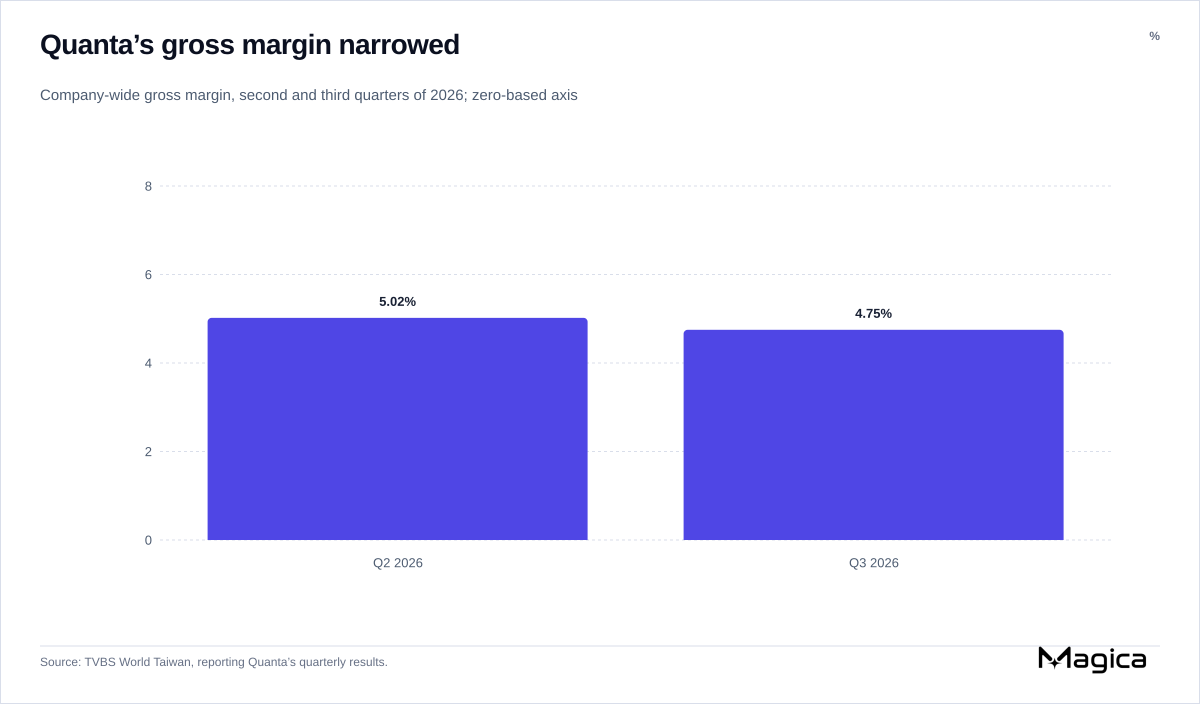
Quanta’s company-reported gross margin fell from 5.02% in Q2 to 4.75% in Q3 2026. These company-wide figures do not isolate Rubin systems. Source: TVBS World Taiwan.
Quanta’s results show the scale of the business entering this transition. Third-quarter revenue reached NT$1.12 trillion, up 125.2% year on year, while net profit attributable to shareholders rose 73% to NT$28.42 billion, according to the November account. These are company-wide figures, rather than Rubin sales. Quanta also expects fourth-quarter notebook shipments to fall by a double-digit percentage from the preceding quarter, making AI servers a source of growth as its PC business weakens.
Quanta expects fourth-quarter AI server revenue to rise even if high-density rack shipments decline slightly from the third quarter: higher prices for the new systems should offset fewer racks.
Yet Quanta’s third-quarter gross margin fell to 4.75% from 5.02% in the preceding quarter as expensive processors and memory took a larger share of server revenue. It is discussing arrangements in which customers supply more components directly, reducing the cash Quanta must commit to inventory. It is targeting a broadly stable fourth-quarter operating margin. The issue is who finances costly parts as well as who assembles the finished rack.
Nvidia’s proposed customer payoff is lower computing cost. Its January announcement claims up to tenfold lower inference cost per token than Blackwell for mixture-of-experts models. That is a vendor performance claim for a particular workload class, not a measurement of buyers’ total installed costs.
Deployment also extends beyond the server. In the September report, Supermicro said it had spent years building its liquid-cooling technology, manufacturing capacity and deployment teams. Its cooling system carries heat from cold plates through distribution equipment to cooling towers. It offered integrated designs from 5 megawatts to gigawatt scale, with one 16-rack configuration containing 1,152 Rubin GPUs and 331 terabytes of HBM4. Those are vendor-described configurations, not evidence of installed customer capacity.
Quanta expects to double AI server production capacity by the end of 2026 relative to the end of 2025, led by expansion in California and Thailand. It also said it had seen no customer order adjustments linked to concerns about US data center investment. Those statements support continued manufacturing demand, but do not establish how much of that capacity will produce Rubin systems.
The evidence needed next is sustained rack-delivery counts, confirmed memory configurations and completed customer deployments, alongside workload-specific costs after installation. Those measures would show how Nvidia’s production claims translate into usable supply—and whether an early-2027 supplier ramp can coexist with a later shift in Nvidia’s overall shipment mix.
Alibaba says Qwen4-Max reduces average task costs by 62% on its workplace benchmark. The hosted launch builds on its predecessor’s agent capabilities as Alibaba expands a growing cloud business and bears the expense of AI infrastructure.
The FBI warns that ARTEX can accelerate intrusions, with some reaching privileged access in under three hours. Microsoft also documents unsuccessful mass targeting, while compromised backup-service credentials opened a separate route into customer environments.
Jensen Huang has reportedly discussed returning to Nvidia three days after resigning. Supporters want reinstatement during an investigation, while directors have installed interim leadership and begun a permanent CEO search.
House China committee chairman John Moolenaar demanded answers from Commerce Secretary Howard Lutnick over delayed restrictions on Nvidia customer Megaspeed. The dispute concerns enforcement, overseas access to advanced chips and commercial influence as President Donald Trump prepares to visit China.
Apple reportedly still aims to unveil iPhone-linked glasses at WWDC 2027 and ship before year-end. Siri control of existing apps is the software bet, but delays cloud the schedule and Meta already has an established eyewear lineup.
Treasury Secretary Scott Bessent urged Nvidia to recruit an outside CEO and explain within 10 days whether suspect chip sales inflated earnings. The board is considering internal and external candidates, while export enforcement also faces scrutiny.
Congressional scrutiny and company investigations are testing what Nvidia knew about Megaspeed, a Singapore cloud operator whose Malaysian subsidiary bought nearly $2 billion of its technology. Megaspeed denies wrongdoing; the available reporting has not conclusively traced suspected chip diversion to China.
Commerce Secretary Howard Lutnick is backing narrower restrictions on Chinese access to overseas AI computing, according to a report examining his former firm’s financing relationships. Bitdeer filings establish Cantor’s role and the scale of its client’s planned expansion, but do not establish improper influence on policy.
Microsoft said services were fully restored on Saturday after a global Microsoft 365 outage disrupted email, healthcare communications and public services. It blamed an earlier network capacity upgrade exposed by a later change, with a full technical review still to come.
Cursor says a key exposed by Fireworks led an attacker to unredacted credentials in historical coding-agent records and then its extension cache. Up to 5,000 users potentially received malicious Claude Code builds. Cursor has moved inference off Fireworks; successful endpoint compromises remain uncounted.
Police are investigating a top tax-accountant exam scorer's admission of AI-assisted cheating, while the government reviews national qualification tests held in 2026 and prepares stronger controls.
An early tally puts Japanese listed companies’ first-half net profit growth at 43.2%, led by manufacturers. Filings show AI component demand alongside currency benefits and non-AI earnings gains, while procurement delays and canceled infrastructure reservations expose the costs of expansion.
TSMC plans to back promising chip startups through a new investment arm, alongside separate commitments to OpenAI and Anthropic. The strategy reaches toward future customers and the AI developers shaping chip demand, but the investment rights remain unclear.
Nidus has raised $30 million across pre-seed and seed rounds to automate wire processing in existing U.S. defense factories. Its founders bring manufacturing and government-deployment experience, but customer access and proprietary data still need to translate into measurable production gains.
Nebuly is funding US and European expansion for its AI business-value platform. Adjustable assumptions and private deployment are part of its pitch, but rivals offer similar measurement tools and verified customer returns remain undisclosed.
Han Won-seok says he used a miniature camera, generative AI and a smartphone in tax accountant and CPA exams. His confession puts scrutiny on exam security after proctors reported no suspicious behavior.
Veteran songwriting team Glorywave used Suno to turn human-written lyrics into Meomuru’s chart-topping ballad. Recording revenue is settled separately, but songwriting royalties remain unavailable through Korea’s collecting association as rules for human contributions to AI-assisted music remain unresolved.
Chinese AI developers and optical suppliers fell as investors feared tougher US chip restrictions after Jensen Huang’s departure from Nvidia. Domestic chipmakers rallied, exposing a divide between companies that need advanced processors and those hoping to replace them.
Reports linked to AI and child sexual exploitation rose from about 4,700 in 2023 to more than 400,000 in 2025, Childlight finds. The increase exposes growing threats and weaknesses in reporting systems, but does not measure unique victims or confirmed AI-generated images.
Megaspeed says Alice Huang left on August 30, 2025, and has retained outside lawyers for an internal compliance investigation. Singapore’s inquiry began months before that departure; authorities later found insufficient evidence that Huang had committed a crime, while the investigation into the company continues.