Editorial Team
6 min read
ASUS is testing its first humanoid robot at an electronics factory, targeting customer pilots in 2027. Its manufacturing experience supplies real tasks and training data, but sustained reliability and commercial economics remain unproven.
ASUS, the Taiwanese technology company with decades of experience integrating motherboards, PCs and servers, says its first humanoid robot, Gallop, is learning to pack motherboard accessories at a group factory. The program brings its hardware expertise and factory access into robotics, ahead of planned customer pilots in 2027. ASUS has disclosed a production target, but no achieved success rate or cost comparison.
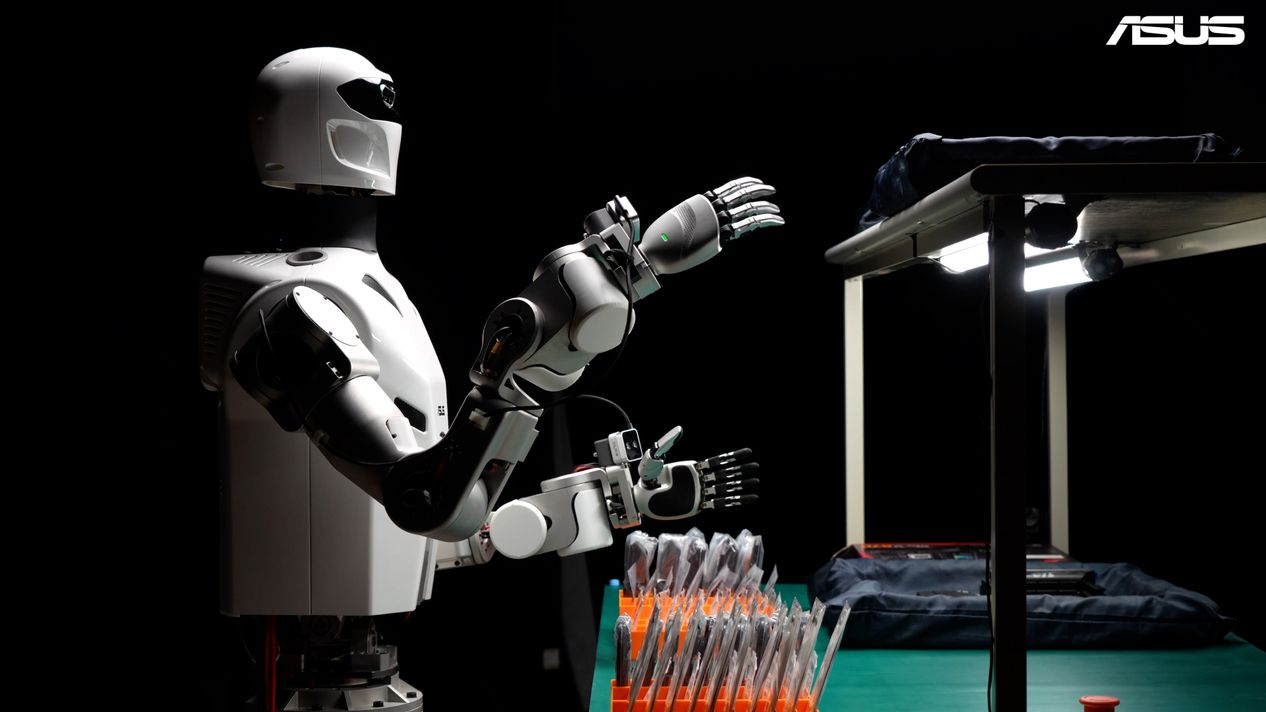
Gallop beside its motherboard-accessory packing workstation in an ASUS-supplied image. Image: ASUS. Source: ASUS.
In its November 13 account of the project, ASUS says Gallop is working at a group electronics manufacturing services factory. The program began in early 2026 and sits within the Humanoid Robotics business unit of its Physical AI Solutions Business Group.
The first assignment involves 15 small motherboard accessories, many enclosed in thin, transparent bags. ASUS says the station takes about 20 seconds per board and sets Gallop a target of 99.5% success within that time—the standard it says it applies to a human worker. Those figures describe the intended performance, not a published test result.
Small, flexible objects make this a demanding manipulation task. ASUS says it chose the station to test whether the robot can handle most of an operation without someone constantly beside it. That distinction matters economically: completing a movement does not establish that a machine can free a worker from a station.
The company's argument for a humanoid is compatibility with workspaces and tools already designed for people. It also acknowledges that conventional automation suits fixed, high-volume tasks. Gallop's case therefore rests on handling variation and difficult objects well enough to justify its complexity, rather than replacing every existing form of factory automation.
A 73–25 procedural vote moved a broad energy-permitting deal forward. Its data-center transmission charges could shift costs from other customers, but utility oversight, tribal rights and clean-energy protections remain disputed. Another Senate test is scheduled for November 16.
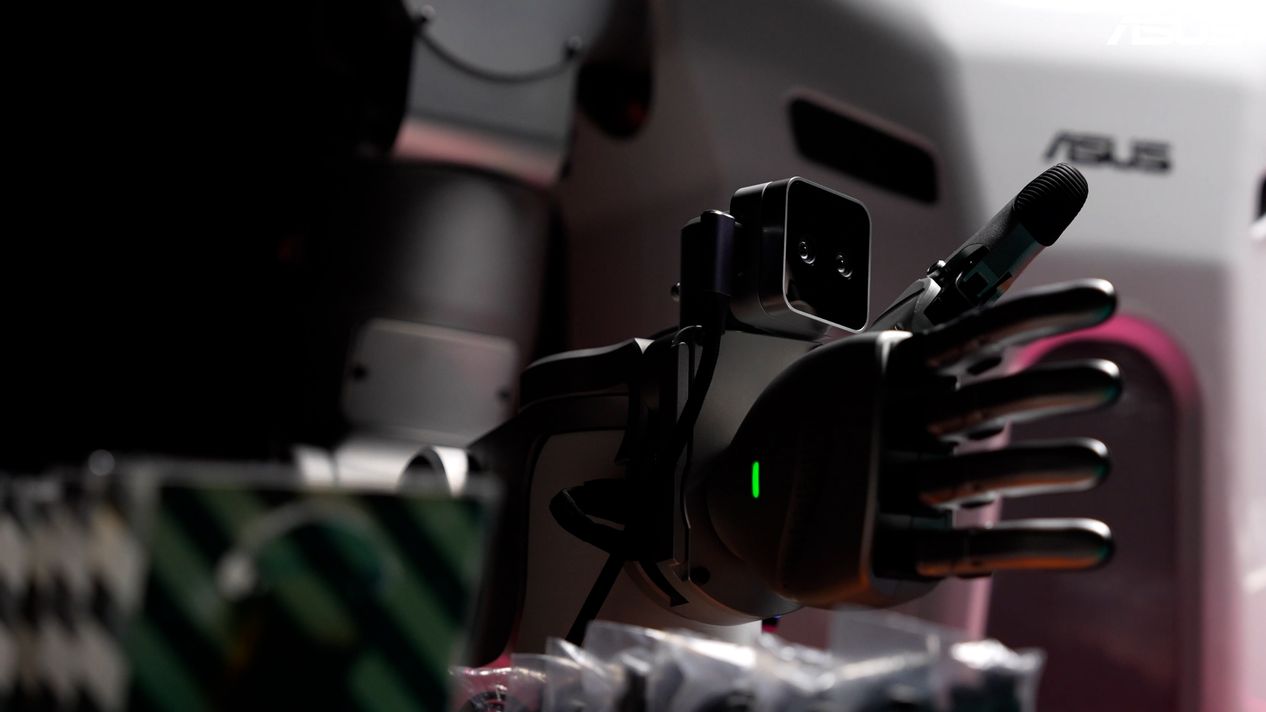
Gallop's hand and wrist-mounted camera. Integration of ASUS's own dexterous hand remains on its company-reported development agenda. Image: ASUS. Source: ASUS.
ASUS says access to its group factories gives it production parts, experienced operators and quality requirements against which to develop Gallop. Its proposed advantage is task-specific demonstrations and testing conditions, rather than simply collecting more data. ASUS is also the developer and the initial evaluator; its account provides no independent assessment of performance.
According to ASUS, Gallop starts with existing open AI models. Experienced workers, with their consent, wear head cameras to record demonstrations. Simulation produces variations, and an operator wearing a virtual reality headset and gloves guides the robot through the task using the workstation's parts and cameras. Recordings from deployment are intended to feed further training. A report describing the development process attributes this approach and the performance target to ASUS, rather than providing independent test results.
Gallop currently has two arms on a fixed base. ASUS designs the body and is developing a dexterous hand with tactile sensing in-house, while sourcing motors and other standard components from partners. Integration of its own hand and a move to wheels are still on the coming year's agenda.
ASUS describes software that separates planning, supervision, movement skills and physical control. A second AI checks the planner's steps and can revise the plan when something goes wrong. Fixed interfaces are intended to let ASUS exchange AI models without rebuilding the machine. The system runs on a single NVIDIA Jetson AGX Thor onboard computer. That design combines outside computing hardware and models with ASUS's own body, hand and task integration; whether model changes improve factory output will require testing.
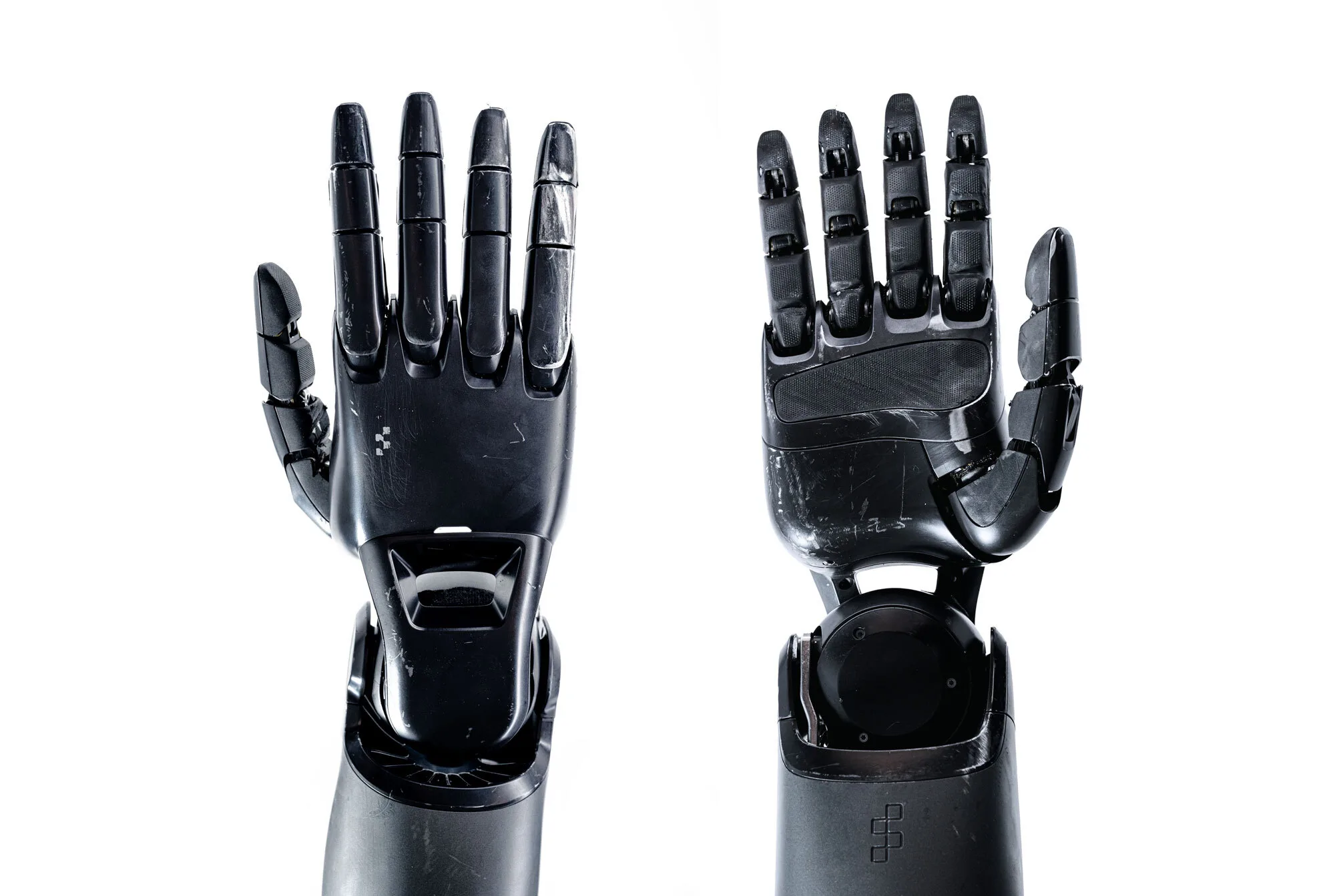
Figure's robotic hands and wrists. Its company-reported BMW deployment account identified the forearm as the leading hardware failure point. Image: Figure AI. Source: Figure AI.
Humanoid developer Figure AI offers a precedent for both factory operation and the hardware problems it can expose. In a November 19, 2025 deployment account, Figure said its second-generation Figure 02 robot had loaded more than 90,000 parts and logged more than 1,250 hours of runtime during an 11-month deployment at carmaker BMW's Spartanburg plant. Its task was loading sheet-metal parts into a fixture for conventional industrial robots to weld.
Figure described six months of daily runtime within the deployment and said the robot ran 10-hour shifts, Monday through Friday. Those are supplier-reported operating figures for a different task, not a like-for-like benchmark for Gallop. Figure also listed placement success and human interventions as performance measures, but its stated success threshold and zero-intervention goal were targets, not disclosed achieved rates.
The deployment fed into another hardware generation. Although Figure described hardware failures as minimal overall, it identified the forearm as its leading failure point and said it redesigned wrist electronics and cabling for its successor, Figure 03. Figure 02 had returned from BMW as part of its retirement. The account shows why factory access matters beyond demonstrations and AI training: sustained use can reveal component and thermal constraints that require physical redesign.
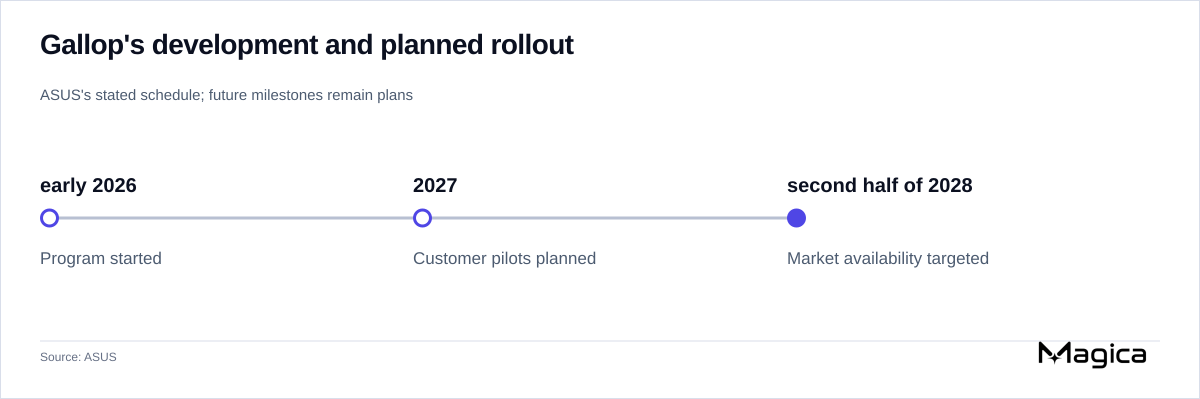
ASUS's company-reported timeline distinguishes the program's start from planned pilots and targeted market availability. Source: ASUS.
ASUS plans a customer demonstration at Computex 2027, customer pilots during 2027 and market availability in the second half of 2028. A brief account sourced to ASUS repeats that timetable; it is a company plan, not a confirmed commercial rollout. Hospitals and service sites are longer-term ambitions based on ASUS's expectation that pick-and-place skills can transfer between jobs.
The company says Gallop is intended for repetitive, physically demanding stations that are hard to staff, with workers moving into robot setup, supervision and improvement. That is its proposed division of labor, rather than a reported employment outcome.
The announcement gives no sustained runtime, human intervention rate, price or operating-cost comparison. Customers will need those measures alongside achieved task accuracy and speed to judge whether Gallop can meet quality requirements while reducing the labor needed for the whole station. The planned pilots must also establish whether the learning process transfers beyond ASUS's own production environment—and whether a humanoid is worth choosing over conventional automation for the job.
Commerce Secretary Howard Lutnick faces questions over delayed restrictions on suspected Nvidia chip diversions and the company’s access to rulemaking. Commerce disputes claims of chilled enforcement, while China’s trade leverage complicates the account.

Fermi has signed preliminary agreements for 600MW of powered land with a customer identified in reporting as Amazon. Customer funding and a lighter construction burden offer a route forward, but the developer has lost its TensorWave lease and faces land and financing deadlines.
Meta reports more than 2 million weekly Business Agent businesses, but leaves paid demand undisclosed. Its AI financing has also grown beyond the initial $35 billion offering plan.
Google says its Teamwork framework produced seven mathematical results with Gemini 3.1 Pro, three reproduced with Gemini 3.7 Flash. Human-checked proofs and a formal verification support the research claim, but novelty varies and the cost of reproducing it in the paid preview remains unresolved.
tvOS 27.2.1 brings Siri AI to second-generation and newer Apple TV 4K boxes, according to updated reporting. Eligible owners can keep their existing streamer, but need a nearby paired device with Siri AI enabled.
OpenAI is rolling out ChatGPT Wallet to eligible US Pro subscribers, giving its dots agents tokenized card payments for existing website checkouts. Users approve purchases with biometrics, while merchant acceptance, reliability and demand remain tests for the limited launch.
Cerebras expects Microsoft cloud-inference revenue to begin in early 2027, subject to service milestones. Quarterly revenue rose 55%, but OpenAI delivery delays, preferential customer terms and long-term infrastructure commitments complicate the expansion.
Meta has expanded Muse’s phone-calling feature beyond early testers to paid US subscribers. The rollout puts routine errands behind a subscription, while business acceptance and an earlier human-contractor experiment complicate the promise of autonomous calls.
Anthropic deployed a fix for authentication problems affecting Claude services and closed the incident on November 13. Later reporting described residual failures, whose connection to the login incident remains unconfirmed.
Treasury Secretary Scott Bessent said agencies had backed export restrictions on Nvidia customer Megaspeed for months. He challenged Commerce’s handling of the case and Nvidia’s safeguards, while Megaspeed denies illicit chip exports to China.
Applied Materials expects chipmaking equipment demand to rise more than 30% in 2027, while supplier capacity and factory readiness will determine how much demand becomes sales.
Shi Bingzhe and two companies face money laundering charges over 917 servers allegedly acquired from Aperia International. The case now covers five individuals and six companies, but the new charges do not establish the servers’ chip contents or ultimate destination.
Nothing’s December AI device has appeared with red and green lights and an apparent recording button. The clues suggest an audio tool, but existing AI recorders leave the company needing to explain its hardware, service costs and use of personal context.
Apify says an intruder accessed customer accounts and personal information or stored data. Customer notices describe credential rotations and two-factor resets, while the affected-account count and full data exposure remain unclear.
Chinese computing projects still specify Nvidia processors, but their reported values mix proposals and contracts. Conditional US licenses, Chinese restrictions, financing and customer demand complicate the path to usable capacity.
The former Huawei server business has passed Shenzhen's listing committee review for an 8 billion yuan IPO. Its growing market share and profits sit alongside negative operating cash flow and a sharp increase in short-term borrowing.
EU leaders gather for their first dedicated AI discussion, weighing investment, foreign dependencies and safety while Ukraine diplomacy competes for attention. The informal summit is a strategic discussion, with no political statement scheduled for adoption.
New hardware orders have increased Nscale's 2027 funding needs and limited its ability to defer spending. The British AI infrastructure provider is pursuing a New York listing targeting a $35 billion valuation while financing for its Anthropic contracts remains uncommitted.
Commerce Secretary Howard Lutnick has agreed to voluntary Senate testimony as bipartisan scrutiny of Nvidia exports turns to government approvals and enforcement. A hearing date remains unconfirmed, and intelligence suspicions remain disputed.