Editorial Team
8 min read
A 73–25 procedural vote moved a broad energy-permitting deal forward. Its data-center transmission charges could shift costs from other customers, but utility oversight, tribal rights and clean-energy protections remain disputed. Another Senate test is scheduled for November 16.
The U.S. Senate cleared an initial hurdle on November 9, 2026, for the Bipartisan American Affordability and Jobs Act (BAAJA), a broad energy-permitting proposal that would accelerate infrastructure approvals and charge data centers more for using the electricity grid. The official roll call records a 73–25 vote to invoke cloture on the motion to proceed, limiting debate on whether to take up the legislative vehicle. Two senators did not vote.
The bargain links a pressing infrastructure problem to a politically contentious answer: build energy projects faster, while moving more of the cost of serving large computing facilities onto their developers. Sponsors promise lower household bills. Whether consumers benefit also depends on which projects get built, how utilities control spending and what protections survive the negotiations.
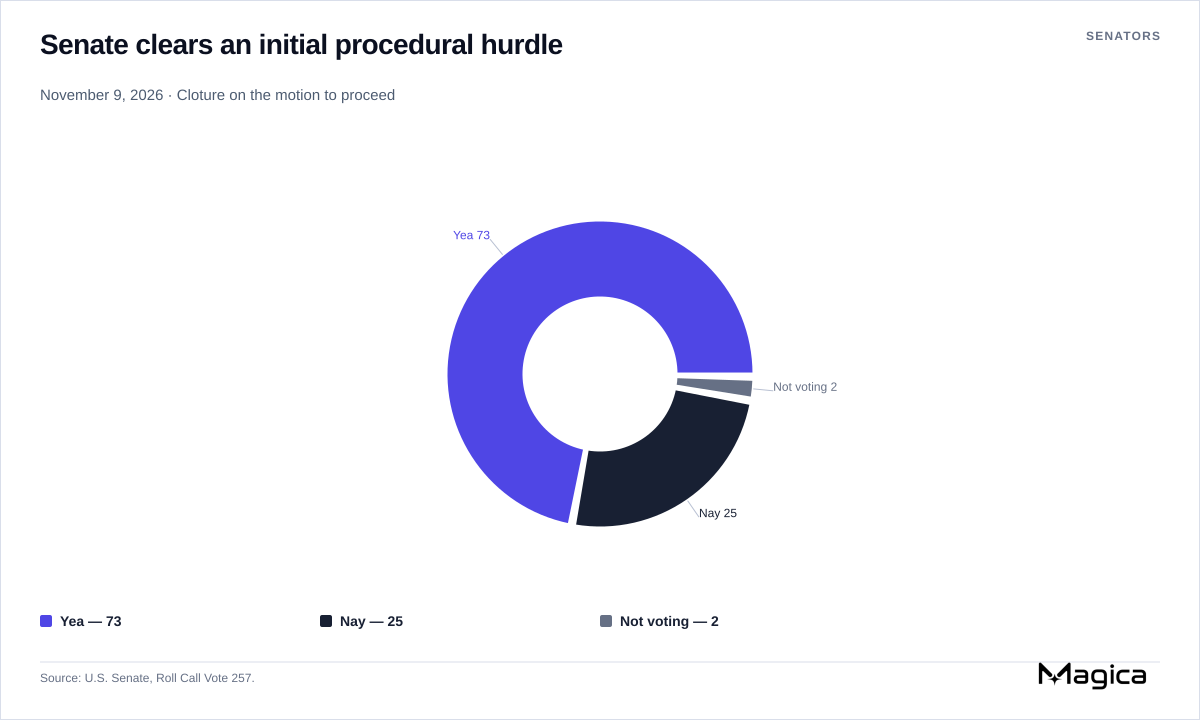
The Senate’s November 9 vote invoked cloture on the motion to proceed to BAAJA’s legislative vehicle. Final passage remained pending. Source: U.S. Senate. Source: U.S. Senate Roll Call Vote 257.
Environment and Public Works Chair Shelley Moore Capito, a West Virginia Republican who has pursued permitting legislation through multiple bills, negotiated the package with her committee’s ranking Democrat, Sheldon Whitehouse of Rhode Island. Their counterparts on Energy and Natural Resources are Chair Mike Lee, a Utah Republican, and ranking Democrat Martin Heinrich of New Mexico.
The four senators’ committees oversee different parts of the bargain. Capito’s prepared floor remarks describe changes to environmental-review laws alongside transmission, historic-preservation and ratepayer provisions. She argues that the package must benefit coal mines, wind projects, gas pipelines, solar farms and manufacturing alike.
Capito introduced the original bill as S. 5653 on September 30. The Congressional Research Service’s November 5 section summary covers that introduced version, before the weekend revisions that helped secure Monday’s coalition.
Support crosses industries with different interests in the outcome. The American Clean Power Association represents clean-energy developers; the American Petroleum Institute represents oil and gas companies. Both back the bill, alongside business groups and labor unions. Many environmental organizations oppose the same deal because it would also ease fossil-fuel development and restrict challenges to project approvals.
The demand pressure predates this vote. A Lawrence Berkeley National Laboratory report released by the Department of Energy in December 2024 estimated that U.S. data centers consumed 176 terawatt-hours of electricity in 2023, about 4.4% of the national total. Its 2028 projections ranged from 325 to 580 terawatt-hours, or 6.7% to 12% of U.S. consumption. These estimates cover data centers broadly, including uses beyond AI.
BAAJA would change the transmission-pricing rules applied to those facilities. An Arnold Ventures-supported transmission-cost study by Grid Strategies explains in its white paper that data centers would pay both a share of the existing grid’s costs and the incremental transmission costs triggered by serving them. The Federal Energy Regulatory Commission (FERC), the federal electricity regulator, has previously regarded that combined pricing as charging above the cost of service; the bill would change the policy for data centers. Extra payments would reduce transmission charges for other customers.
The paper’s broader state-level protections could cover generation, storage and distribution costs, but states would choose whether to implement them. That distinction matters: federal transmission charges alone do not settle every cost associated with a new data center.
Grid Strategies’ November 2 analysis estimates $55 billion in transmission payments from data centers over ten years, including $35 billion above what they might pay under current policy. The white paper describes a rough estimate based on an assumed 40.3 gigawatts of data-center additions and other assumptions, with significant uncertainty about how much load the policy would cover and the incremental transmission costs. The figures are projected payments, rather than money committed or collected.
Heinrich’s post-vote statement highlights the $55 billion figure and argues that the package would lower bills and emissions. Separately, Rhodium Group modeling described in a report on the negotiations projects average annual household electricity bills $50 to $78 lower in 2040 with the bill. Those are modeled future savings. The projected power-sector emissions reduction ranges from 1% to 18%, mainly depending on clean energy’s competitiveness with gas.
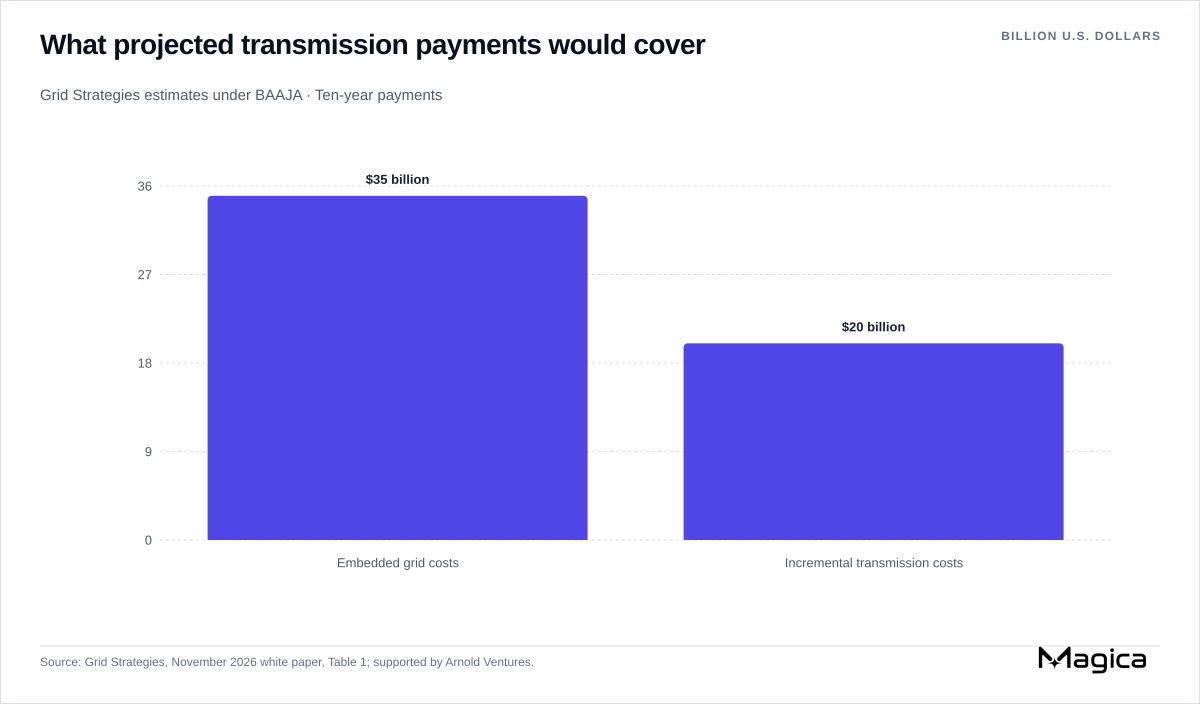
Grid Strategies’ company-reported estimates divide projected ten-year payments into $35 billion for existing-grid costs and $20 billion for incremental transmission costs. The embedded-cost figure is distinct from the projected $35 billion increase over current policy. Source: Grid Strategies — BAAJA transmission funding white paper.
BAAJA would expand federal authority to site and approve certain large interstate transmission projects and oversee utility planning. But weekend revisions narrowed some provisions to attract power-sector support.
The Edison Electric Institute, the trade group representing investor-owned utilities, endorsed the revised package after withholding support for earlier permitting efforts. Its members Duke Energy and Southern Company had individually lobbied against previous attempts. Under the revised text, only state energy regulators could refer suspect local transmission-planning practices to FERC for investigation; governors and other state officials could not. FERC could reject a referral, according to the account of the changes.
Other regulatory tools offer a relevant comparison. FERC’s Order No. 1920 called for regional transmission plans looking at least 20 years ahead and addressed cost allocation. The order’s requirements also included considering technologies that improve existing lines’ capacity and identifying opportunities to increase capacity when replacing infrastructure. BAAJA would add statutory changes to a field already undergoing regulatory reform; new construction is one part of the grid response. DOE’s 2024 demand report also identified onsite generation, storage and data-center flexibility as options.
Opponents question both federal control and the incentives governing spending. Former FERC Chairman Mark Christie argues that the bill leaves states without adequate authority over the allocation of large transmission projects’ costs. Paul Cicio, CEO of Industrial Energy Consumers of America, a trade association representing industrial customers, criticizes exceptions to transmission competition that he says protect monopoly utilities. Their objections expose a separate question from who pays: whether the infrastructure is built economically.
The proposal would shorten filing windows for legal challenges, constrain environmental reviews and protect previously issued permits. The National Environmental Policy Act, one of the laws affected, requires federal agencies to consider projects’ environmental effects and gives the public an opportunity to participate before approval.
Supporters argue that more predictable decisions would unlock clean energy alongside fossil fuels. Opponents say the restrictions would leave communities less able to stop harmful or unlawful development. The text allows agencies to revoke or alter permits when ordered by a court. Even so, the Natural Resources Defense Council, an environmental advocacy group opposing the bill, objects to limits on courts’ ability to halt construction when reviews are deficient, according to an account of its concerns.
The sponsors revised tribal-consultation requirements and added a proposed Department of Energy program to help state, local and tribal governments assess data centers’ effects on electricity, water, infrastructure and local economies. They also added protections for union collective-bargaining agreements, according to a report detailing the amendments.
The historic-preservation dispute concerns how federal projects consider historic properties, including places of religious or cultural importance to tribes. Nevada Democratic Senator Catherine Cortez Masto nevertheless said the historic-preservation changes were made without input from tribes in her state and demanded their removal. She voted to advance consideration but said she would oppose final passage if the provisions remained. A coalition of tribal organizations likewise said the manager’s amendment failed to resolve its concerns, the report on remaining opposition records.
Clean-energy protections also face a test of implementation. President Donald Trump endorsed the bill but said on November 9 that he would not approve wind turbines. Whitehouse said the legislation would end federal payments to developers to relinquish offshore wind leases. Maryland Democratic Senator Chris Van Hollen voted against advancing the package, saying it did not sufficiently protect his state’s pending offshore wind project from administration obstruction, according to a report on the competing positions.
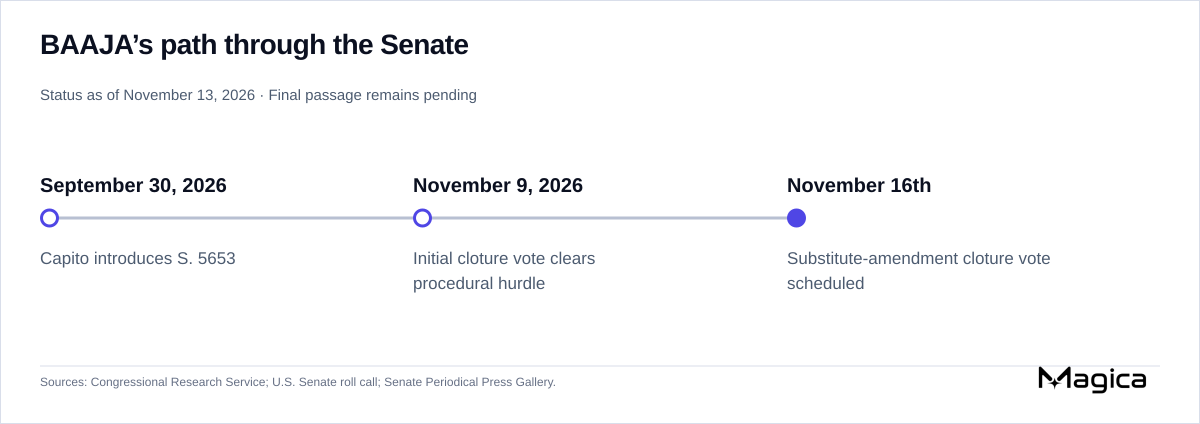
As of November 13, another cloture vote was scheduled for November 16. Sources: Congressional Research Service, U.S. Senate and Senate Periodical Press Gallery. Source: Congressional Research Service — BAAJA section summary.
The November 9 activity record confirms that the vote concerned H.R. 2347. That tax bill is the legislative vehicle for BAAJA, as the Congressional Record’s program for the following day explains.
The Senate’s November 12 floor log schedules a cloture vote on Capito’s substitute amendment among roll calls beginning at 5:30 p.m. on November 16. That is another procedural test, with final Senate approval still required before the House and president could complete enactment.
The initial 73 votes do not guarantee the final coalition. Cortez Masto’s conditions demonstrate that gap. House Minority Leader Hakeem Jeffries, the New York Democrat expected to become speaker after his party’s midterm gains, criticized the package and said the revisions were still under review. Some Democrats favor waiting until their party controls both chambers in the next Congress. Republican support for accepting the Senate product is also uncertain, Jefferies analysts said in a research note described in reporting on the House obstacle.
The next votes will determine which version of the permitting bargain can survive. For electricity customers, the consequential evidence will be the final cost-allocation and oversight rules, the treatment of tribal and environmental challenges, and whether the promised faster clean-energy approvals can withstand the administration’s continued opposition to wind.
Commerce Secretary Howard Lutnick faces questions over delayed restrictions on suspected Nvidia chip diversions and the company’s access to rulemaking. Commerce disputes claims of chilled enforcement, while China’s trade leverage complicates the account.

Fermi has signed preliminary agreements for 600MW of powered land with a customer identified in reporting as Amazon. Customer funding and a lighter construction burden offer a route forward, but the developer has lost its TensorWave lease and faces land and financing deadlines.
Meta reports more than 2 million weekly Business Agent businesses, but leaves paid demand undisclosed. Its AI financing has also grown beyond the initial $35 billion offering plan.
Google says its Teamwork framework produced seven mathematical results with Gemini 3.1 Pro, three reproduced with Gemini 3.7 Flash. Human-checked proofs and a formal verification support the research claim, but novelty varies and the cost of reproducing it in the paid preview remains unresolved.
tvOS 27.2.1 brings Siri AI to second-generation and newer Apple TV 4K boxes, according to updated reporting. Eligible owners can keep their existing streamer, but need a nearby paired device with Siri AI enabled.
OpenAI is rolling out ChatGPT Wallet to eligible US Pro subscribers, giving its dots agents tokenized card payments for existing website checkouts. Users approve purchases with biometrics, while merchant acceptance, reliability and demand remain tests for the limited launch.
ASUS is testing its first humanoid robot at an electronics factory, targeting customer pilots in 2027. Its manufacturing experience supplies real tasks and training data, but sustained reliability and commercial economics remain unproven.
Cerebras expects Microsoft cloud-inference revenue to begin in early 2027, subject to service milestones. Quarterly revenue rose 55%, but OpenAI delivery delays, preferential customer terms and long-term infrastructure commitments complicate the expansion.
Meta has expanded Muse’s phone-calling feature beyond early testers to paid US subscribers. The rollout puts routine errands behind a subscription, while business acceptance and an earlier human-contractor experiment complicate the promise of autonomous calls.
Anthropic deployed a fix for authentication problems affecting Claude services and closed the incident on November 13. Later reporting described residual failures, whose connection to the login incident remains unconfirmed.
Treasury Secretary Scott Bessent said agencies had backed export restrictions on Nvidia customer Megaspeed for months. He challenged Commerce’s handling of the case and Nvidia’s safeguards, while Megaspeed denies illicit chip exports to China.
Applied Materials expects chipmaking equipment demand to rise more than 30% in 2027, while supplier capacity and factory readiness will determine how much demand becomes sales.
Shi Bingzhe and two companies face money laundering charges over 917 servers allegedly acquired from Aperia International. The case now covers five individuals and six companies, but the new charges do not establish the servers’ chip contents or ultimate destination.
Nothing’s December AI device has appeared with red and green lights and an apparent recording button. The clues suggest an audio tool, but existing AI recorders leave the company needing to explain its hardware, service costs and use of personal context.
Apify says an intruder accessed customer accounts and personal information or stored data. Customer notices describe credential rotations and two-factor resets, while the affected-account count and full data exposure remain unclear.
Chinese computing projects still specify Nvidia processors, but their reported values mix proposals and contracts. Conditional US licenses, Chinese restrictions, financing and customer demand complicate the path to usable capacity.
The former Huawei server business has passed Shenzhen's listing committee review for an 8 billion yuan IPO. Its growing market share and profits sit alongside negative operating cash flow and a sharp increase in short-term borrowing.
EU leaders gather for their first dedicated AI discussion, weighing investment, foreign dependencies and safety while Ukraine diplomacy competes for attention. The informal summit is a strategic discussion, with no political statement scheduled for adoption.
New hardware orders have increased Nscale's 2027 funding needs and limited its ability to defer spending. The British AI infrastructure provider is pursuing a New York listing targeting a $35 billion valuation while financing for its Anthropic contracts remains uncommitted.
Commerce Secretary Howard Lutnick has agreed to voluntary Senate testimony as bipartisan scrutiny of Nvidia exports turns to government approvals and enforcement. A hearing date remains unconfirmed, and intelligence suspicions remain disputed.