Editorial Team
10 min read

Fermi has signed preliminary agreements for 600MW of powered land with a customer identified in reporting as Amazon. Customer funding and a lighter construction burden offer a route forward, but the developer has lost its TensorWave lease and faces land and financing deadlines.
Fermi, the publicly traded developer of Project Matador, a planned power-and-data-center campus near Amarillo, Texas, has secured preliminary agreements with a customer identified in reporting as Amazon, whose Amazon Web Services business operates cloud data centers. The proposed 600-megawatt development would bring customer money into the project before a final lease—and let the customer finance and build its own data centers.
The customer’s identity comes from a report citing people familiar with the matter. Fermi declined to comment and Amazon did not respond to that report’s requests. Fermi’s disclosures identify only an investment-grade hyperscaler, a large computing-infrastructure operator.
For Fermi, which has yet to generate revenue, the immediate test is whether those preliminary commitments become cash, a definitive lease and financeable construction. Its previous tenant agreement terminated on November 10, the same day it signed the new letter of intent. Its public-university landlord can terminate the ground lease if conditions for construction remain unmet at year-end without an extension.
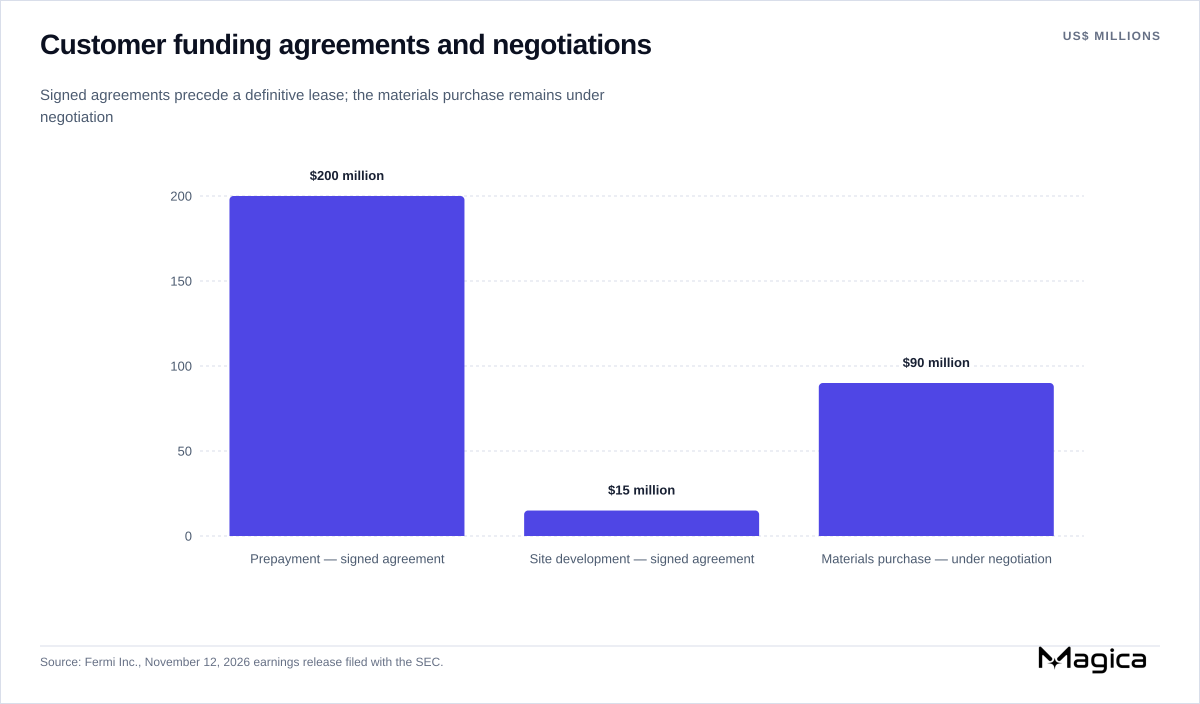
Company-reported amounts cover two signed funding agreements and a materials purchase under negotiation. Fermi’s disclosures do not confirm receipt of the full amounts. Source: Fermi earnings release (SEC).
Fermi’s quarterly filing describes a non-binding November 10 letter of intent for approximately 600MW of powered land, subject to definitive documentation. Alongside it, the parties signed a $200 million prepayment agreement and a $15 million early-construction and site-development agreement.
A further sale of structural steel and building materials for about $90 million remains under negotiation. Fermi said in its November 12 announcement that the customer could use materials it had procured in advance to accelerate construction.
On the earnings call, Anna Bofa, Fermi’s chief commercial officer and previously a co-president of its interim CEO office, said the $200 million wire was due November 13. She said the amount was determined with the customer to support its schedule before completion of the lease and project financing. Management targeted mobilization by December 1 and initial power availability late in the second quarter or early in the third quarter of 2027.
Those are contractual timing statements and development targets. The disclosures establish signed funding agreements, but do not confirm receipt of the full amounts.
The construction structure matters as much as the prepayment. Lee Alan McIntire, Fermi’s chief executive since August and a former chief executive of CH2M Hill and TerraPower with more than 40 years of engineering, construction and infrastructure leadership experience, said the customer would build its own data centers under a project manager. Fermi would avoid carrying that construction capital requirement.
Fermi calls this offering Powered Land Plus: it supplies prepared land, power, water, fiber and shared campus infrastructure while the customer builds and operates the computing facilities. Management contrasted it with the former TensorWave turnkey arrangement, which involved multiple parties and third-party credit support. That is a change in the allocation of capital and construction risk; it does not yet establish the new agreement’s profitability.
Fermi was founded in January 2025 by Rick Perry, the former Texas governor and US energy secretary, and energy financier Toby Neugebauer. It went public that October while still developing its first campus. Its strategy combines computing infrastructure with on-site generation on a private grid, supplemented by utility electricity.
The founders’ involvement has since changed. Neugebauer, still the largest shareholder according to an account of the company’s tenant and governance setbacks, was removed as chief executive in April and subsequently fought for board control and a sale. The same account says Perry was not reelected to the board in October. McIntire, a director since September 2025, became permanent chief executive after an interim leadership arrangement.
The report identifying Amazon says it withdrew a $150 million investment in December 2025 and that negotiations with cloud provider Oracle also soured. The earlier customer’s identity has a disputed reporting history: the separate account notes that Fermi denied it was Amazon, despite reporting that cited Neugebauer identifying Amazon as the tenant. The latest reported involvement would therefore revive a relationship described in reporting, rather than one both companies have publicly confirmed.
The TensorWave setback is documented in the filing. TensorWave, an AI-cloud provider, had agreed to take up to 650MW of data-center capacity, according to the account of that deal. Its August 9 lease missed an October 31 closing date without extension and terminated November 10. The associated credit-support agreement with chipmaker AMD also terminated, Fermi said.
The new proposal thus replaces a failed route to an anchor tenant. Fermi says it has no definitive tenant lease agreements as of the quarterly filing.
Fermi has outlined the economics behind its shift, but has not disclosed final customer pricing or the incremental spending needed for this particular agreement.
On the call, management presented benchmarks drawn from 45 market deals in 2024 and 2025. For Powered Land Plus, it cited construction costs of $3.9 million to $5.1 million per megawatt of total power capacity and fixed base rent and capacity charges of $55 to $69 per kilowatt-month. Management said turnkey developments required roughly three times the capital for about 2.4 times the revenue in those historical comparisons.
These are company-presented market benchmarks, not Fermi’s contracted terms. Management cautioned that they might not reflect current pricing and that few of the comparisons involved behind-the-meter power. They cannot establish a return on the proposed 600MW development.
The balance sheet shows why reducing Fermi’s share of construction matters. At September 30, it had $286.3 million in cash and equivalents and $29.2 million in restricted cash. Debt totaled approximately $1 billion before issuance costs and discounts, or $958.4 million after them. The $200 million prepayment agreement alone is equivalent to about 70% of its September unrestricted cash balance, although it is a later commitment tied to development.
Equipment funding is expensive: the filing lists effective interest rates of 12.3%, 14.7% and 16.9% on its three equipment-financing facilities at September 30. Fermi also paid $25 million in October amendment fees to relax a tenant-signing condition on its largest turbine facility.
The $141.6 million third-quarter net loss is a different measure from cash consumption. It included $65.8 million of non-cash stock compensation and $21.5 million of advisory fees settled in shares. Over the first nine months of 2026, operations used $110.6 million of cash and property-and-equipment investment used $759.5 million.
Fermi estimates another $2 billion to $3 billion of capital expenditure over the following twelve months, conditional on definitive leases and tenant requirements. It has $126.2 million of outstanding equipment purchase commitments, of which approximately $111.6 million is expected to be funded through existing financing facilities. Those facilities fund specified assets; they are not an unrestricted cash reserve.
Management’s going-concern assessment is qualified. Current resources are insufficient for forecast obligations over the year following issuance of the financial statements before its plans are considered. Management concludes that committed equipment-financing capacity and its ability to sequence spending alleviate substantial doubt about continuing as a going concern. It warns that implementation is not guaranteed, and did not rely on additional customer and capital arrangements requiring counterparty action to reach that conclusion.
A separate framework with Hillcore Energy Capital Corporation, an Alberta company, could reduce direct spending on generation. Hillcore would finance, build, own and operate up to approximately 2.6GW of gas, solar and battery capacity. Fermi would buy capacity covering at least half of campus tenants’ aggregate power requirements on a take-or-pay basis—paying for contracted capacity whether used or not. The fixed capacity charge would pass through to tenants, gas costs would also pass through, and Fermi’s payment guarantee would be capped at twelve months of fixed capacity charges. Definitive documentation remains unfinished, with the deadline extended to December 18.
Fermi’s proposed advantage is its advance work on land, permits and long-lead equipment. In the report identifying Amazon, the company says it has five gas turbines on site, 4.6 miles of gas lines, 300 acres prepared and air permits covering 6GW. Those claims describe readiness for development, rather than operating power or computing capacity.
The filing makes that distinction explicit: all of Fermi’s approximately $1.67 billion of property, plant and equipment at September 30 consisted of land and construction in progress. No depreciable equipment had been placed in service.
Its initial power plan relies on gas generation and utility supply. Nuclear generation is longer term: Fermi plans to commission four reactors, one annually from 2034 through 2037, with the first unit delayed approximately a year from its earlier plan. Expansion toward 17GW requires further land acquisitions, permits and financing.
Amazon also has an established alternative route to large-scale electricity procurement. Independent power producer Talen Energy, which operates the Susquehanna nuclear plant in Pennsylvania, announced a June 2025 power agreement serving Amazon Web Services, Amazon’s cloud-computing business. Talen said supply would ramp to 1,920MW no later than 2032 and continue through 2042.
That announcement envisaged moving the existing colocated arrangement to grid delivery after transmission work, with Talen supplying electricity and PPL Electric Utilities handling transmission and delivery. It differs from Fermi’s planned private-grid development in location, generation source and schedule. It shows that Fermi is competing with other ways of securing power, rather than creating the only route.
Fermi’s permits also face a direct challenge. Its filing says Panhandle Taxpayers for Transparency, an association acting through its members, seeks judicial reversal of west-campus air permits issued by the Texas Commission on Environmental Quality, the state environmental regulator. The association alleges that air-dispersion modeling did not demonstrate compliance with national air-quality standards. Fermi disputes the challenge but says an adverse result could delay construction there.
The company separately warns that political pressure for data-center restrictions, including in Texas, could delay development or divert tenants elsewhere. Permits already secured may help its pitch, but do not remove regulatory or construction risk.
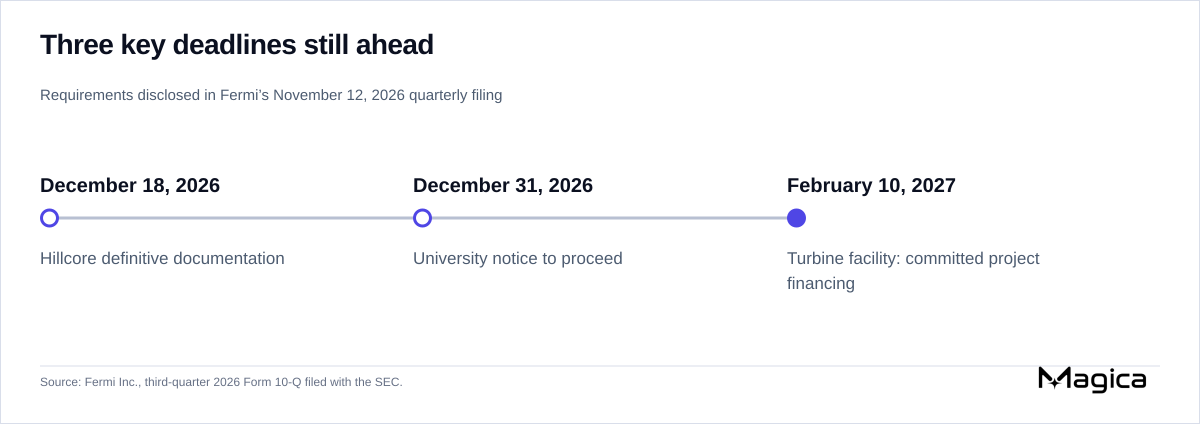
Company-reported deadlines cover Hillcore documentation, university construction authorization and committed project financing. The Hillcore and university deadlines remain subject to possible extensions. Source: Fermi Form 10-Q (SEC).
The Texas Tech University System, the public-university system that leases Fermi its campus land, controls a notice to proceed required before vertical data-center construction. Under the 99-year ground lease, Fermi must receive that notice by December 31 or obtain an extension. One prerequisite is a Phase 1 tenant lease for at least 200MW, which the filing says remains unsatisfied.
Fermi is discussing an extension with the system, and its earnings announcement relays the university’s reaffirmation of support for Project Matador. Support does not itself satisfy or extend the contractual deadline. Termination would deprive Fermi of rights to the site around which substantially all its assets are concentrated.
Debt agreements impose separate tests. The high-voltage equipment facility requires an approved customer agreement by December 31 to avoid mandatory prepayment. The turbine warehouse facility requires committed project financing by February 10, 2027, sufficient with equity to fund at least 400MW of generation. Failure would be an event of default that could allow lenders to accelerate debt and pursue equipment collateral. October’s amendment removed the earlier tenant-signing condition but preserved that financing requirement.
The next evidence needed is therefore specific: confirmation of the customer payment, executed lease terms and project costs, satisfaction or extension of the university’s conditions, and committed construction financing. Those outcomes will determine whether the proposed customer-funded model can turn Fermi’s development assets into an operating business.
A 73–25 procedural vote moved a broad energy-permitting deal forward. Its data-center transmission charges could shift costs from other customers, but utility oversight, tribal rights and clean-energy protections remain disputed. Another Senate test is scheduled for November 16.
Commerce Secretary Howard Lutnick faces questions over delayed restrictions on suspected Nvidia chip diversions and the company’s access to rulemaking. Commerce disputes claims of chilled enforcement, while China’s trade leverage complicates the account.
Meta reports more than 2 million weekly Business Agent businesses, but leaves paid demand undisclosed. Its AI financing has also grown beyond the initial $35 billion offering plan.
Google says its Teamwork framework produced seven mathematical results with Gemini 3.1 Pro, three reproduced with Gemini 3.7 Flash. Human-checked proofs and a formal verification support the research claim, but novelty varies and the cost of reproducing it in the paid preview remains unresolved.
tvOS 27.2.1 brings Siri AI to second-generation and newer Apple TV 4K boxes, according to updated reporting. Eligible owners can keep their existing streamer, but need a nearby paired device with Siri AI enabled.
OpenAI is rolling out ChatGPT Wallet to eligible US Pro subscribers, giving its dots agents tokenized card payments for existing website checkouts. Users approve purchases with biometrics, while merchant acceptance, reliability and demand remain tests for the limited launch.
ASUS is testing its first humanoid robot at an electronics factory, targeting customer pilots in 2027. Its manufacturing experience supplies real tasks and training data, but sustained reliability and commercial economics remain unproven.
Cerebras expects Microsoft cloud-inference revenue to begin in early 2027, subject to service milestones. Quarterly revenue rose 55%, but OpenAI delivery delays, preferential customer terms and long-term infrastructure commitments complicate the expansion.
Meta has expanded Muse’s phone-calling feature beyond early testers to paid US subscribers. The rollout puts routine errands behind a subscription, while business acceptance and an earlier human-contractor experiment complicate the promise of autonomous calls.
Anthropic deployed a fix for authentication problems affecting Claude services and closed the incident on November 13. Later reporting described residual failures, whose connection to the login incident remains unconfirmed.
Treasury Secretary Scott Bessent said agencies had backed export restrictions on Nvidia customer Megaspeed for months. He challenged Commerce’s handling of the case and Nvidia’s safeguards, while Megaspeed denies illicit chip exports to China.
Applied Materials expects chipmaking equipment demand to rise more than 30% in 2027, while supplier capacity and factory readiness will determine how much demand becomes sales.
Shi Bingzhe and two companies face money laundering charges over 917 servers allegedly acquired from Aperia International. The case now covers five individuals and six companies, but the new charges do not establish the servers’ chip contents or ultimate destination.
Nothing’s December AI device has appeared with red and green lights and an apparent recording button. The clues suggest an audio tool, but existing AI recorders leave the company needing to explain its hardware, service costs and use of personal context.
Apify says an intruder accessed customer accounts and personal information or stored data. Customer notices describe credential rotations and two-factor resets, while the affected-account count and full data exposure remain unclear.
Chinese computing projects still specify Nvidia processors, but their reported values mix proposals and contracts. Conditional US licenses, Chinese restrictions, financing and customer demand complicate the path to usable capacity.
The former Huawei server business has passed Shenzhen's listing committee review for an 8 billion yuan IPO. Its growing market share and profits sit alongside negative operating cash flow and a sharp increase in short-term borrowing.
EU leaders gather for their first dedicated AI discussion, weighing investment, foreign dependencies and safety while Ukraine diplomacy competes for attention. The informal summit is a strategic discussion, with no political statement scheduled for adoption.
New hardware orders have increased Nscale's 2027 funding needs and limited its ability to defer spending. The British AI infrastructure provider is pursuing a New York listing targeting a $35 billion valuation while financing for its Anthropic contracts remains uncommitted.
Commerce Secretary Howard Lutnick has agreed to voluntary Senate testimony as bipartisan scrutiny of Nvidia exports turns to government approvals and enforcement. A hearing date remains unconfirmed, and intelligence suspicions remain disputed.