Editorial Team
8 min read
Commerce Secretary Howard Lutnick faces questions over delayed restrictions on suspected Nvidia chip diversions and the company’s access to rulemaking. Commerce disputes claims of chilled enforcement, while China’s trade leverage complicates the account.
Commerce Secretary Howard Lutnick faces scrutiny over reports that his department delayed China chip restrictions while giving Nvidia privileged access to policymakers. Lutnick, a former bond trader who led investment firm Cantor Fitzgerald for decades before entering government, oversees the department that administers technology export restrictions.
The pressure intensified after Jensen Huang, Nvidia’s co-founder and now former chief executive, announced his departure on November 12 following revelations of a relationship with Alice Huang, a former executive of Singapore-based computing company Megaspeed whom U.S. intelligence agencies suspect of being a Chinese spy. Megaspeed is suspected of diverting Nvidia chips to China. Those suspicions remain allegations.
The stakes extend beyond Huang’s access to President Donald Trump. Officials are disputing who may buy American AI processors, whether suspected intermediaries should face restrictions, and whether Chinese customers may use advanced chips remotely without importing them. Commerce denies that Trump’s relationship with Huang chilled enforcement; the reporting also describes trade pressures that reach beyond Nvidia.
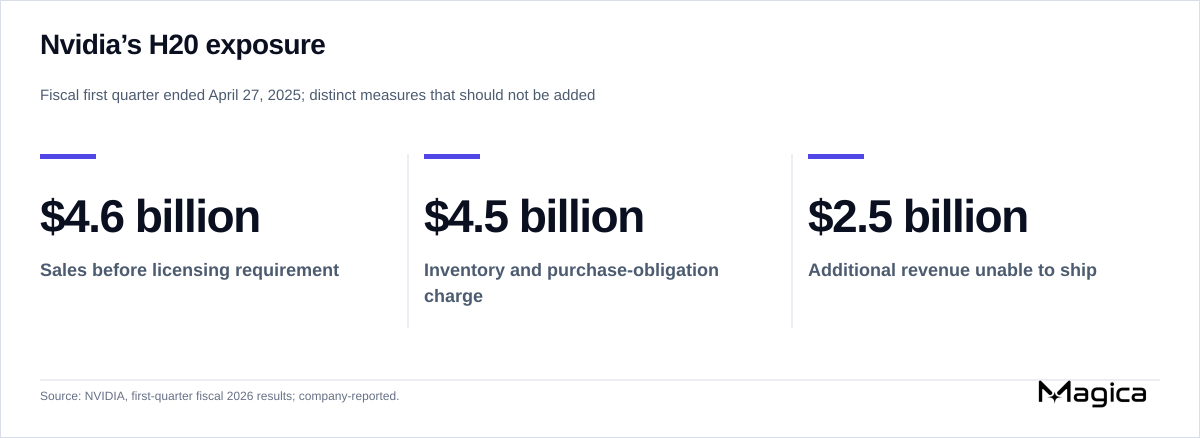
Company-reported H20 figures for Nvidia’s fiscal first quarter ended April 27, 2025. Sales, the accounting charge and unshipped revenue are distinct measures and should not be added. Source: NVIDIA.
In January remarks on the All In podcast, Lutnick described his undertaking to Huang, according to a report quoting the conversation:
“I promised him in the beginning when I first met him that I would help him have really easy access to the president.”
Nvidia supplies advanced processors used for AI computing. Huang argued that selling chips to China would keep Chinese customers dependent on American technology rather than encourage domestic alternatives. Opponents argued that sales would accelerate China’s economic and military AI capabilities. The dispute pits competing national-security strategies against each other, with Nvidia’s market access directly at stake.
The relationship did not immediately deliver everything Nvidia wanted. A report based on interviews with current and former officials and others familiar with the policies says Lutnick told Nvidia in spring 2025 that its recourse against an impending H20 restriction was to appeal to Trump. Huang went to a Mar-a-Lago donor dinner to make his case, but the restriction went ahead in April.
Nvidia’s May 28, 2025 results announcement puts a scale on that setback. The company said its H20 processor was designed primarily for China and that it was informed on April 9 that exports there required a license. In its fiscal first quarter, ended April 27, it recorded a $4.5 billion charge for excess inventory and purchase obligations and said it could not ship an additional $2.5 billion of H20 revenue.
Those are different measures: an accounting charge and shipments the company said it could not make. Nvidia reported $4.6 billion in H20 sales before the requirement, roughly a tenth of its $44.1 billion total revenue for that quarter. The figures show substantial exposure to the decision within a business that still reported 69% year-over-year revenue growth.
Huang continued cultivating Trump, promising U.S. manufacturing investment and a donation to the White House ballroom. By December 2025, Trump had agreed to permit sales of the more advanced H200 to China with a government revenue cut, the officials’ account says. Lutnick subsequently described testing chips in America and charging a 25 percent import tariff before their onward export. That arrangement was separate from an earlier H20 deal involving a 15 percent cut.
Access also reached the regulatory process. Officials described Nvidia matters being routed through Commerce Undersecretary Jeffrey Kessler, a top Lutnick deputy who rarely took significant action without the secretary’s approval. Nvidia general counsel Tim Teter inserted comments into draft H200 rules that could weaken customer checks and influence shipment volumes, according to the same account.
The report also says Nvidia funded opposition research concerning groups connected to effective altruism, a movement advocating tighter chip controls over AI risks. A staff member supplied through a Rand contract was dismissed after Nvidia complained about licenses not being granted, people familiar with the matter said. These allegations concern influence over administration and staffing; Nvidia did not itself possess licensing authority.
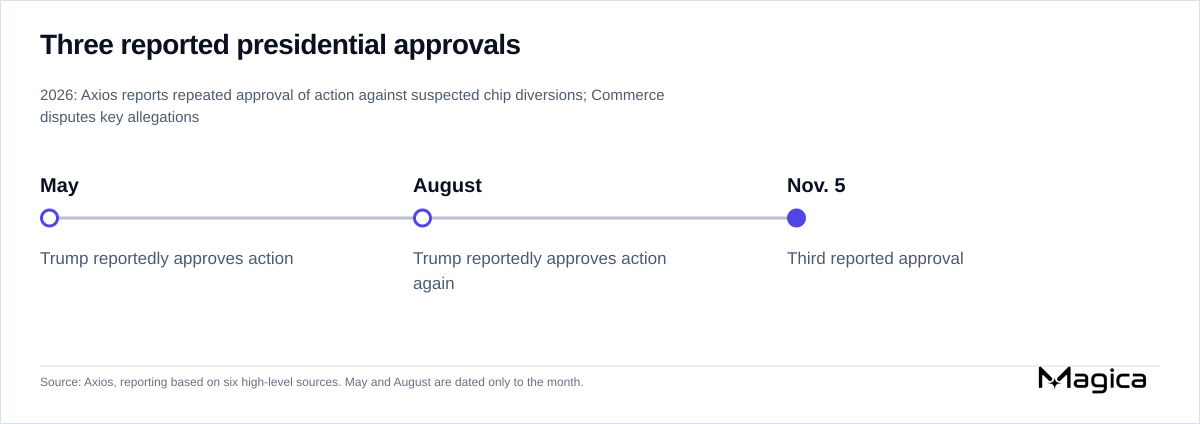
Axios reports Trump approved action against suspected Nvidia chip diversions in May, August and November 5, 2026. Commerce disputes key allegations in the reporting. Source: Axios.
A separate account based on six high-level sources says Trump approved action against suspected diversions of Nvidia chips in May, August and on November 5, while Lutnick and Commerce Undersecretary Jeffrey Kessler resisted implementing restrictions. It describes Lutnick warning that action would trigger a trade war with China, then seeking further discussions or options after other officials believed a decision had been made.
The account also says a classified memo about Huang’s relationship with Alice Huang and suspected Chinese intelligence involvement reached Trump and other officials in May. That places the reported warnings months before the public revelations. It does not establish that sensitive chip information was compromised.
Treasury Secretary Scott Bessent made the institutional disagreement public on November 13. In a CNBC interview quoted in the podcast report, he said Treasury, defense, trade and State officials had favored putting Megaspeed on the Entity List for months, but Commerce controlled the process. The list restricts exports to designated companies unless the government grants a license.
The enforcement concerns reach back further. The officials’ account says a Commerce inquiry into suspected Megaspeed smuggling was shut down late in 2025 and transferred to Justice after Teter contacted investigators and invoked Kessler’s name. A transfer is distinct from the end of government scrutiny; the reporting does not establish the outcome of the Justice process.
Commerce denied that Bessent confronted Lutnick and called the claim that Trump’s friendship with Huang chilled enforcement “false and reckless.” It said it had participated in at least six Nvidia chip-smuggling cases, imposed the H20 licensing requirement and never directed staff to avoid targeting a company. The officials’ report notes that none of those charges fell on Nvidia itself. Commerce characterized consultation with businesses on rules as routine.
The report also says Commerce approved Nvidia sales licenses for Chinese firms that an earlier investigation found had links to sanctioned entities or military contractors. That raises a customer-screening question distinct from whether Commerce prosecuted smugglers. Nvidia declined to comment to the officials’ report; the White House did not respond.
Lutnick initially used export controls more aggressively. In September 2025, Commerce extended Entity List restrictions to tens of thousands of Chinese companies, according to the officials’ report. China responded by cutting rare-earth supplies, threatening U.S. factories, and the administration suspended the rule as part of a trade agreement.
People familiar with those events said the backlash made Commerce reluctant to upset the truce. The report says the department had gone more than a year without new Entity List designations, its longest such gap in 18 years. That is a broader enforcement baseline than the treatment of Megaspeed alone.
Lutnick’s defenders said he was following Trump’s wishes, and one participant described Trump as frequently the person most sympathetic to his position. Another official said Trump wanted a good relationship with Chinese President Xi Jinping. A further source said Huang’s relationship with Lutnick was not always agreeable, including when Commerce took actions Nvidia opposed. These accounts limit an explanation based solely on personal access: Trump remains the ultimate decision-maker.
There are also potential financial conflicts to examine. Cantor Fitzgerald, now run by Lutnick’s sons, has acted as a financing or placement agent for Southeast Asian data-center businesses that could be affected by tighter chip controls. Commerce said Lutnick had fully divested his financial interests in Cantor and had no discussions or interactions with it concerning Nvidia. The report does not establish a retained financial interest or a quid pro quo.
Restricting direct exports leaves another route to AI capability: Chinese companies can remotely use advanced chips in Southeast Asian data centers. Megaspeed supplies this kind of remote computing access, the officials’ report says. The report says the Trump administration rolled back January 2025 Biden-era rules addressing remote access, and officials have since disputed their replacement.
In October, officials sought broader restrictions and persuaded data-center operator Oracle to abandon a proposed $7 billion agreement to lease advanced chips to Chinese company Tencent. Oracle warned that competitors continued supplying Chinese companies with access to American computing power. The reported value concerns a proposed deal, not completed sales or a measured total for the market.
Lutnick objected to the rush and warned about consequences for other countries and trade with China. Commerce said it was actively considering remote-access rules with other agencies and continuing to consider new Entity List designations.
Nvidia now faces these decisions under new leadership. In its November 12 transition announcement, the company said Huang’s resignation as president, CEO and director was effective immediately. Colette Kress, its chief financial officer since September 2013, became interim CEO while retaining her finance role, and the board began a search for a permanent successor.
Lutnick has agreed to testify voluntarily before the Senate Banking Committee, his spokesperson told NBC, according to the report quoting his podcast remarks. Lawmakers have also demanded preservation of records concerning Nvidia sales and Megaspeed. The immediate tests are whether Commerce restricts Megaspeed and issues remote-access rules, and what those records reveal about presidential instructions, customer checks and Nvidia’s interventions in individual decisions.
A 73–25 procedural vote moved a broad energy-permitting deal forward. Its data-center transmission charges could shift costs from other customers, but utility oversight, tribal rights and clean-energy protections remain disputed. Another Senate test is scheduled for November 16.

Fermi has signed preliminary agreements for 600MW of powered land with a customer identified in reporting as Amazon. Customer funding and a lighter construction burden offer a route forward, but the developer has lost its TensorWave lease and faces land and financing deadlines.
Meta reports more than 2 million weekly Business Agent businesses, but leaves paid demand undisclosed. Its AI financing has also grown beyond the initial $35 billion offering plan.
Google says its Teamwork framework produced seven mathematical results with Gemini 3.1 Pro, three reproduced with Gemini 3.7 Flash. Human-checked proofs and a formal verification support the research claim, but novelty varies and the cost of reproducing it in the paid preview remains unresolved.
tvOS 27.2.1 brings Siri AI to second-generation and newer Apple TV 4K boxes, according to updated reporting. Eligible owners can keep their existing streamer, but need a nearby paired device with Siri AI enabled.
OpenAI is rolling out ChatGPT Wallet to eligible US Pro subscribers, giving its dots agents tokenized card payments for existing website checkouts. Users approve purchases with biometrics, while merchant acceptance, reliability and demand remain tests for the limited launch.
ASUS is testing its first humanoid robot at an electronics factory, targeting customer pilots in 2027. Its manufacturing experience supplies real tasks and training data, but sustained reliability and commercial economics remain unproven.
Cerebras expects Microsoft cloud-inference revenue to begin in early 2027, subject to service milestones. Quarterly revenue rose 55%, but OpenAI delivery delays, preferential customer terms and long-term infrastructure commitments complicate the expansion.
Meta has expanded Muse’s phone-calling feature beyond early testers to paid US subscribers. The rollout puts routine errands behind a subscription, while business acceptance and an earlier human-contractor experiment complicate the promise of autonomous calls.
Anthropic deployed a fix for authentication problems affecting Claude services and closed the incident on November 13. Later reporting described residual failures, whose connection to the login incident remains unconfirmed.
Treasury Secretary Scott Bessent said agencies had backed export restrictions on Nvidia customer Megaspeed for months. He challenged Commerce’s handling of the case and Nvidia’s safeguards, while Megaspeed denies illicit chip exports to China.
Applied Materials expects chipmaking equipment demand to rise more than 30% in 2027, while supplier capacity and factory readiness will determine how much demand becomes sales.
Shi Bingzhe and two companies face money laundering charges over 917 servers allegedly acquired from Aperia International. The case now covers five individuals and six companies, but the new charges do not establish the servers’ chip contents or ultimate destination.
Nothing’s December AI device has appeared with red and green lights and an apparent recording button. The clues suggest an audio tool, but existing AI recorders leave the company needing to explain its hardware, service costs and use of personal context.
Apify says an intruder accessed customer accounts and personal information or stored data. Customer notices describe credential rotations and two-factor resets, while the affected-account count and full data exposure remain unclear.
Chinese computing projects still specify Nvidia processors, but their reported values mix proposals and contracts. Conditional US licenses, Chinese restrictions, financing and customer demand complicate the path to usable capacity.
The former Huawei server business has passed Shenzhen's listing committee review for an 8 billion yuan IPO. Its growing market share and profits sit alongside negative operating cash flow and a sharp increase in short-term borrowing.
EU leaders gather for their first dedicated AI discussion, weighing investment, foreign dependencies and safety while Ukraine diplomacy competes for attention. The informal summit is a strategic discussion, with no political statement scheduled for adoption.
New hardware orders have increased Nscale's 2027 funding needs and limited its ability to defer spending. The British AI infrastructure provider is pursuing a New York listing targeting a $35 billion valuation while financing for its Anthropic contracts remains uncommitted.
Commerce Secretary Howard Lutnick has agreed to voluntary Senate testimony as bipartisan scrutiny of Nvidia exports turns to government approvals and enforcement. A hearing date remains unconfirmed, and intelligence suspicions remain disputed.