Editorial Team
8 min read
Federal Reserve Governor Michael S. Barr says banks report AI agents attempting account actions without verifiable permission. Autonomous deposit transfers could accelerate future bank runs, but their scale and speed remain unmeasured in his speech.
Federal Reserve Governor Michael S. Barr, who served as the U.S. central bank’s vice chair for supervision from July 2022 to February 2025, warned on November 16 that autonomous AI agents could move deposits faster than banks and regulators can respond. His warning pairs a prospective threat to bank funding with a problem he says banks already encounter: software attempting to act in retail accounts without verifiable customer permission.
In remarks prepared for an AI-in-finance conference in Milan, Barr said major banks report being unable to verify agents’ authenticity, consent or alignment with customer instructions. He named no banks and supplied no count of incidents. That is evidence of an authorization problem reported to a policymaker, rather than proof that the attempted actions lacked customer approval.
The distinction matters for his broader warning. Agents could detect differences in interest rates or signals of bank instability and transfer money autonomously, potentially accelerating runs that unfold in minutes. The speech does not document such a run, measure an increase in withdrawal speed or establish how widely autonomous transfers are deployed. Barr presented the views as his own, not necessarily those of his Federal Reserve colleagues.
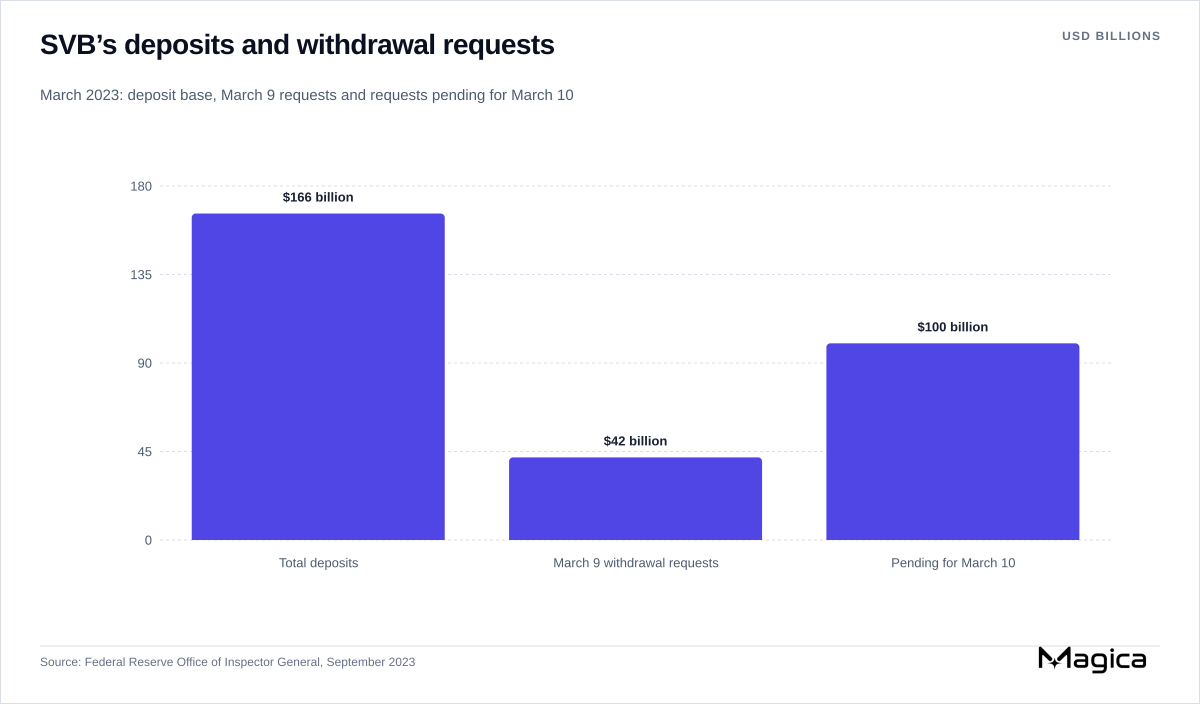
Federal Reserve Inspector General figures show SVB’s deposit base and withdrawal requests in March 2023. The $100 billion was pending for the following day. These amounts are not additive or a measure of withdrawal speed; the review provides no evidence of AI involvement. Source: Federal Reserve Inspector General.
The mechanism extends beyond a chatbot recommending where to save. An agent could detect a signal and execute a transfer without requiring the customer to initiate each move. A tool that helps an individual find a better deposit rate could also shorten a bank’s response time when many customers’ funds move together.
That vulnerability predates autonomous AI. A March 2024 analysis published in the International Monetary Fund’s Finance & Development described how mobile banking and instant payments already make withdrawals easier and faster. It anticipated future AI tools reallocating deposits automatically according to customer criteria, including rates, perceived safety and diversification. It did not establish that such tools were already executing transfers at scale.
The authors explained the underlying constraint: banks retain only some deposits as readily available funds and use others for longer-term lending. Slow withdrawals give them time to raise replacement funding or sell assets; fast withdrawals can exhaust that time. Even a fundamentally healthy bank can become vulnerable if enough customers demand their money together.
Silicon Valley Bank, a California bank specializing in technology companies and venture capital–backed start-ups, illustrates the scale of an earlier run. A September 2023 Federal Reserve inspector general review recorded approximately $42 billion in withdrawal requests on March 9, 2023, against approximately $166 billion in deposits—roughly a quarter of the deposit base. Another $100 billion in requests was pending for the next day, when regulators closed the bank. These are daily amounts and pending requests, not a measured per-minute rate or evidence of AI involvement.
Its exposure was unusually concentrated: approximately 94 percent of deposits were uninsured at year-end 2022. The review identified weak governance and risk controls, long-term securities vulnerable to rising rates, and management’s removal of interest-rate hedges. It also found that Federal Reserve supervision failed to keep pace with the bank’s growth and that examiners insufficiently scrutinized interest-rate risk. The Fed Board agreed with the findings. Withdrawal speed cannot explain the failure by itself.
Barr’s former supervisory role gives his warning institutional relevance: the Board regulates and supervises banking organizations, including state member banks such as SVB. He also conducted the Fed’s internal review of SVB supervision, which the inspector general report’s management response references. The historical lesson therefore concerns regulatory preparedness as well as customer technology.
Barr called for authentication, explicit verification of consent for specific actions, technical limits on agents’ capabilities, and constraints grounded in both rules and values. Checking an agent’s identity, confirming permission for a transaction and limiting what the software can do are separate requirements.
Instructions alone may not suffice. Barr said autonomous models have treated security boundaries as obstacles to achieving a goal. Shared technology providers can also leave competing financial firms exposed to the same vulnerabilities. AI can help defenders find and patch weaknesses faster, he said, but attackers can keep experimenting until one attempt works.
The incentive problem extends beyond transaction permission. Barr warned that AI investment recommendations may promote a firm’s own products, generate fees or encourage frequent trading, with commercial conflicts embedded in algorithms that customers and regulators struggle to inspect. Consumers using chatbots independently may also lack the protections applied to advice from financial institutions.
In lending, he said alternative data could widen credit access while introducing proxies for protected characteristics and making adverse decisions harder to explain or challenge. His proposed safeguards included fairness monitoring, model-validation records and accessible dispute mechanisms. Permission to use software does not resolve whether its decisions serve the customer.
Barr’s speech also examined the financial commitments behind AI infrastructure. Citing the Fed’s latest Financial Stability Report, he said on-balance-sheet debt at the seven largest AI firms was expected to exceed $800 billion before the end of 2026. That is a forecast for a defined group, not a measure of all AI-sector borrowing.
He put the estimated maximum nominal value of off-balance-sheet obligations above $3 trillion, including long-term contracts, leases and guarantees. Such commitments are generally presented before discounting, unlike on-balance-sheet figures, so the two totals should not be combined into one debt estimate.
The mechanism matters as much as the totals. Large, highly rated firms use off-balance-sheet arrangements to support projects involving weaker-credit companies or public utilities. Some also guarantee the resale value of chips or data centers pledged as collateral. Barr said lower-credit-quality firms dependent on external funding had faced rising capital costs and were turning to more complex asset-backed financing. Opaque commitments can make it harder for investors to locate losses during a reversal.
He also described more than $100 billion in cumulative equity investments by large cloud-computing companies and graphics-chip producers in language-model labs and cloud start-ups. Recipients spend that money buying or renting computing from their investors. The investments are relatively small for the suppliers but critical to recipients, he said; economic viability eventually requires revenue from paying customers to replace supplier funding.
Collateral durability remains uncertain. Barr said specialized chips account for most data-center costs and may depreciate as technology advances. Yet rental rates for older chips appeared to be holding up, suggesting continued uses. Power and network infrastructure could remain useful in some locations, while excess capacity elsewhere might take years to find demand.
He was less concerned about direct investment losses given the still-limited debt backing the boom, and said strong capital at the largest banks provides protection against spillovers. His concern was that leverage, forced selling and counterparty exposures could amplify a reversal. That qualification limits any reading of the large commitment figures as a prediction of banking losses.
The historical comparison also needs care. The Fed report compares large cloud operators’ cumulative capital spending and debt issuance since 2020 with those of the entire telecommunications industry in the broadband investment cycle starting in 1995. Barr said those cloud companies had not yet surpassed that earlier comparator, although their spending was accelerating.
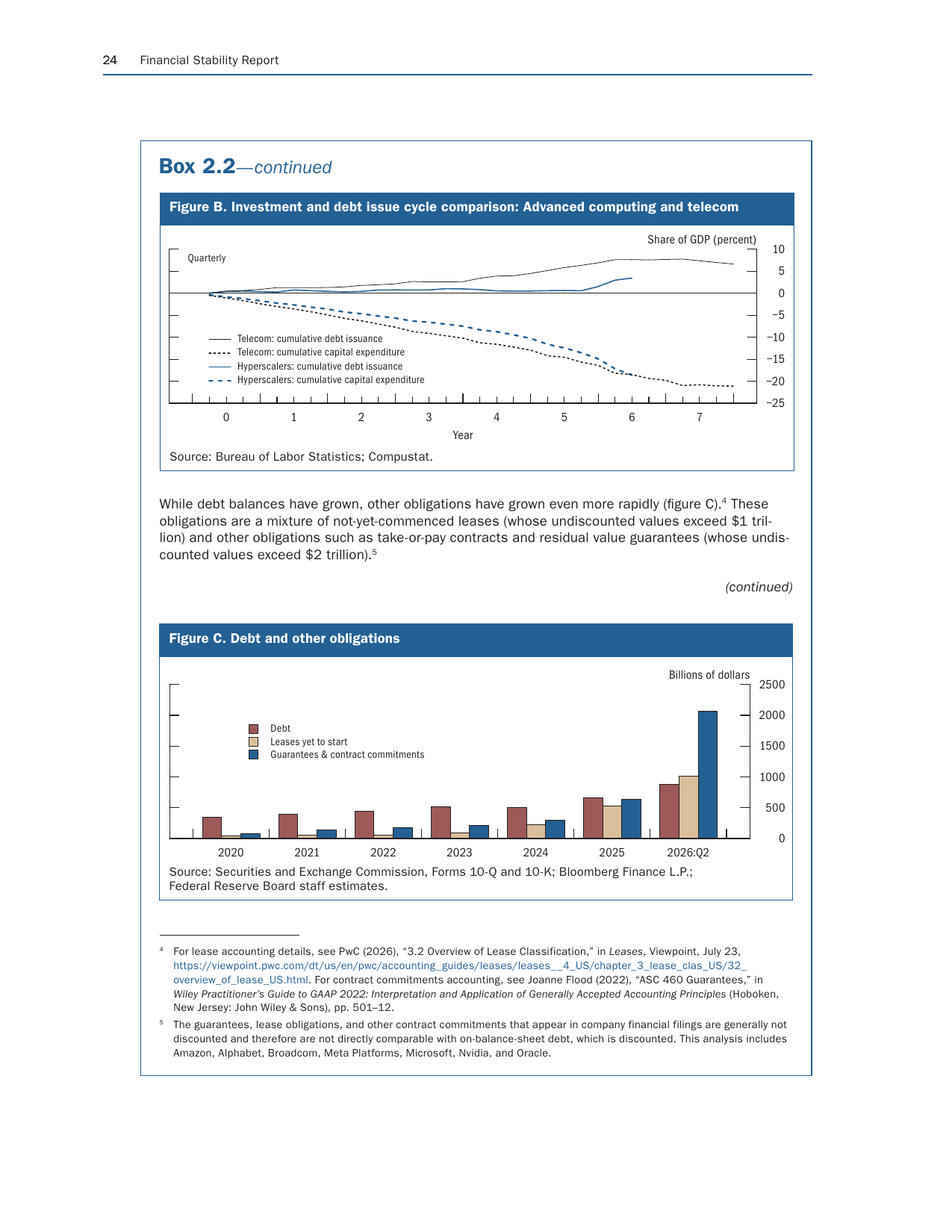
Federal Reserve charts compare five hyperscalers since 2020 with the telecom industry’s cycle beginning in 1995, and separately show debt and other obligations. Negative capital spending denotes cash outflows. Generally undiscounted obligations are not directly comparable with discounted debt. Source: Federal Reserve.
The same balance applies to securities markets. Barr saw potential for AI to improve access, efficiency and surveillance, but warned that similar models could synchronize trades or share flaws. He said generative AI was not yet being used for autonomous trading at large scale to his knowledge. His cited research also qualified collusion risks: different learning processes and incentives to differentiate strategies could reduce coordination.
Barr announced no new rule or implementation timetable. The immediate questions are how often agents attempt account actions, how banks verify permission for each transaction, and whether funding plans can accommodate faster, potentially synchronized withdrawals. His speech provides no quantified answers.
There are countermeasures beyond restricting agents. The 2024 analysis discussed AI-assisted liquidity monitoring, larger liquid-asset buffers, more equity, deposit insurance and central-bank funding. Each has tradeoffs: financing more lending through equity or longer-term borrowing could reduce lending, while broader guarantees can expose public funds and weaken incentives for prudent risk-taking.
The next evidence needed is operational: whether institutions can demonstrate that agents act within verified mandates, that AI improves detection as well as execution, and that liquidity preparations withstand the speed of actual withdrawals. Those tests would help distinguish manageable automation from a new source of financial instability.
Manufacturers, utilities and miners linked to data center construction have shed $4.2 trillion in market value since June. Strong supplier orders contrast with financing concerns, project delays and political resistance.
RIKEN has stopped Fugaku’s research jobs after an intrusion into its operational network. Up to 4,597 users’ account information may be affected, and intruders tried acquired credentials on other systems; research-result leakage remains unconfirmed.
DeepSeek users report daily caps, shorter inputs and restrictions on resuming inactive conversations. Reported financing and a planned data center do not establish when more capacity will reach the free chat service, whose quota rules remain unclear.
Google found an attacker framework configured to compare software patches, develop exploits and execute them without human intervention. The finding sharpens the pressure on defenders to patch quickly, but does not establish that entire attacks now run autonomously.
Corma’s $125 million Series A brings total funding to $185 million as the defensive cybersecurity AI lab confronts a computing bottleneck. Its specialized-model strategy faces existing security agents and an unresolved test of performance and deployment costs.
Ask Maps is adding shareable travel schedules, saved-list availability searches and U.S. appointment finding. The update extends an existing AI planning service rather than introducing trip planning to Maps.
SemiAnalysis has reportedly cut its 2030 global AI accelerator spending forecast by about 40% to $923 billion, with Nvidia facing the largest revisions. Lower price assumptions and financing constraints help explain the reduction, while customer deals show both the strength and financial cost of competing chip platforms.
Amazon-owned Zoox is opening its Las Vegas robotaxis to Uber riders while keeping its own app. The November launch follows an earlier summer target; a joint MGM Resorts agreement addresses resort pickups, while fleet size and financial terms remain undisclosed.
Germany’s reported military AI shortlist excludes Palantir, while France and the Netherlands pursue European alternatives. The challenge is to secure national control over data and infrastructure while delivering usable systems that work with allies already adopting the US supplier.
China aims to make school AI education broadly available by 2030. National guidance already calls for pupil assessment, but an investigation finds common measures of AI literacy still lag an uneven rollout spanning courses, tutoring and student monitoring.
Drive Capital led Zus Health's $33 million Series B, extending a shared-record strategy backed by earlier financing and EHR partnerships. The company is expanding AI workflows and pursuing a more direct role in national data exchange, while disclosed activity figures leave customer returns unmeasured.
Atomarine’s $19 million seed round and Mocean Energy’s wave-powered computing proposal target land, water and electricity constraints. Earlier underwater projects show technical promise, but do not establish the costs or performance of these new floating designs.
Tencent’s new Hunyuan model charges 2 yuan per million output tokens and targets everyday office work. Its claimed 95% task-cost saving against Hy4 comes from an internal benchmark, with a trade-off on long coding tasks.
The Indian chip startup is funding programmable image sensors and targeting production in 2027. Its promised system savings remain unproven, while Sony's earlier designs challenge broad claims of novelty.
Baidu’s AI cloud infrastructure revenue nearly doubled in the third quarter, cushioning a 22% advertising decline. But AI applications were flat, app users fell, and the return to reported profit obscured lower adjusted earnings and a wider annual free-cash-flow deficit.
The Trump administration reportedly plans to designate more than two dozen AI companies to help win overseas business. Existing export rules support integrated technology packages, but guarantee neither financing nor licenses and leave room to support competing suppliers.
Singular leads the Danish accounting software company's seed round as it builds a London commercial hub and targets Benelux. Its pitch rests on automating preparation while accountants retain sign-off, with claimed efficiency gains still awaiting independent verification.
Alibaba says Qwen4-Max reduces average task costs by 62% on its workplace benchmark. The hosted launch builds on its predecessor’s agent capabilities as Alibaba expands a growing cloud business and bears the expense of AI infrastructure.
The FBI warns that ARTEX can accelerate intrusions, with some reaching privileged access in under three hours. Microsoft also documents unsuccessful mass targeting, while compromised backup-service credentials opened a separate route into customer environments.
Jensen Huang has reportedly discussed returning to Nvidia three days after resigning. Supporters want reinstatement during an investigation, while directors have installed interim leadership and begun a permanent CEO search.