Editorial Team
6 min read
Tencent’s new Hunyuan model charges 2 yuan per million output tokens and targets everyday office work. Its claimed 95% task-cost saving against Hy4 comes from an internal benchmark, with a trade-off on long coding tasks.
Tencent, the company behind Tencent Cloud and the Hunyuan family of AI models, released Hy4 flash on November 16 for research, documents, slides and other everyday work. The launch pairs sharply lower API prices with a more conditional proposition: Tencent says the model completes tasks at one-twentieth the cost of Hy4 in its own internal evaluation, according to the launch report.
For developers and office users, the consequential distinction is between cheaper tokens and cheaper completed work. Tencent’s published rates establish the former. The latter depends on how much output a task needs, the quality of the result and whether a smaller model can finish it reliably.
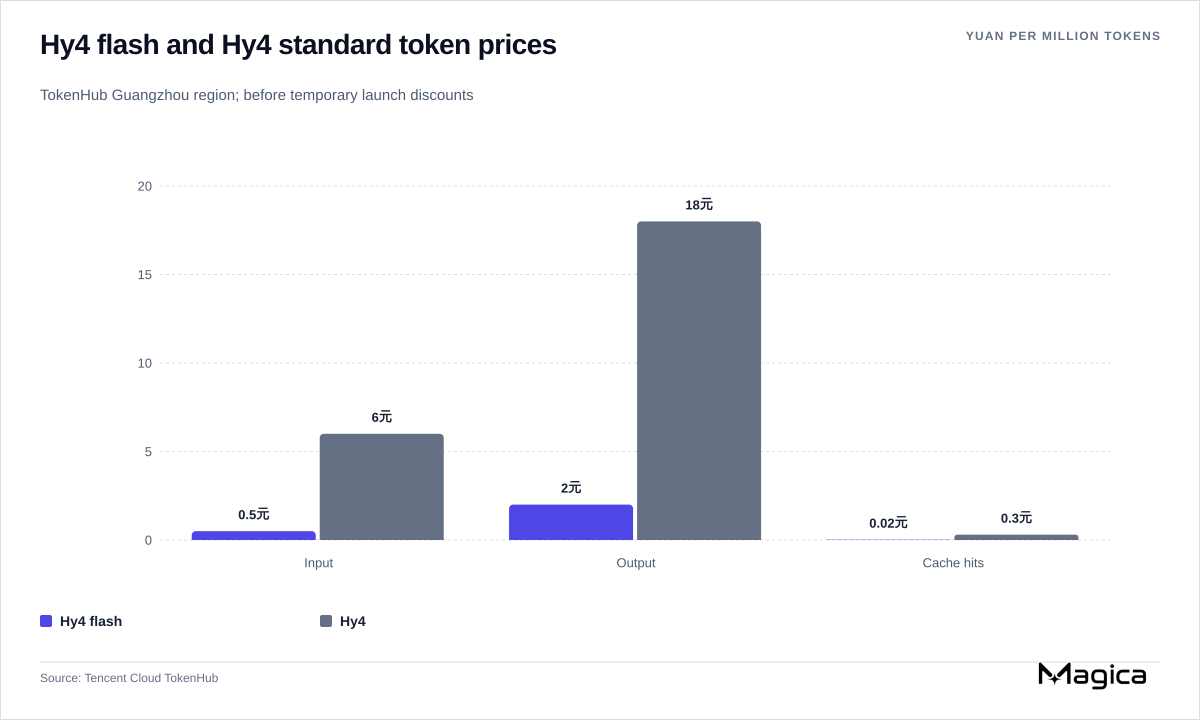
Tencent Cloud’s standard TokenHub rates, before temporary launch discounts, compare token charges rather than completed-task costs. Source: Tencent Cloud.
Tencent introduced Hunyuan as its proprietary foundation model on September 7, 2023, opening it to enterprises in China through Tencent Cloud APIs. At that launch, Tencent said Hunyuan was already connected to 50 of its own products, including games, meeting software and document tools. Its role extends from developing models to distributing them through its cloud and applications.
It announced the larger Hy4 on November 4, 2026, introducing visual understanding and improvements to long-horizon agent tasks. Flash now adds a cheaper option within that generation.
Hy4 flash accepts multimodal input and supports a one-million-token context window. It has 224 billion total parameters, including 64 billion Engram parameters, but activates 12 billion per token, according to the . Total model size therefore should not be read as the amount of computation used for every token.
Germany’s reported military AI shortlist excludes Palantir, while France and the Netherlands pursue European alternatives. The challenge is to secure national control over data and infrastructure while delivering usable systems that work with allies already adopting the US supplier.
Tencent Cloud’s TokenHub model-service platform, which offers both Hunyuan and third-party models, lists the following rates for its Guangzhou region. These are token prices, before the temporary launch discount, rather than measured costs to complete a job.
| Charge per million tokens | Hy4 flash | Hy4 |
|---|---|---|
| Input | 0.5 yuan | 6 yuan |
| Output | 2 yuan | 18 yuan |
| Cache hits | 0.02 yuan | 0.3 yuan |
Dividing those listed rates puts flash at one-twelfth of Hy4’s input price, one-ninth of its output price and one-fifteenth of its cache-hit price. None of those ratios alone is the claimed one-twentieth task cost. They compare standard rates: Tencent’s Hy4 announcement also offers that model at half its standard TokenHub price through December 31, while flash’s half-price promotion runs through November 30. The reports do not specify how launch discounts enter the WorkIndex calculation.
The same platform also sells competing models. Its listed DeepSeek-V4.1-Flash-1017 output price is 4 yuan per million tokens off-peak and 8 yuan at peak times; MiniMax-M3.1-Flash lists output at 4 yuan, while GLM-5.3-Flash lists it at 2.8 yuan. Flash’s 2-yuan output rate is lower than those alternatives on TokenHub, but that comparison does not establish equivalent capability or total task expenditure.
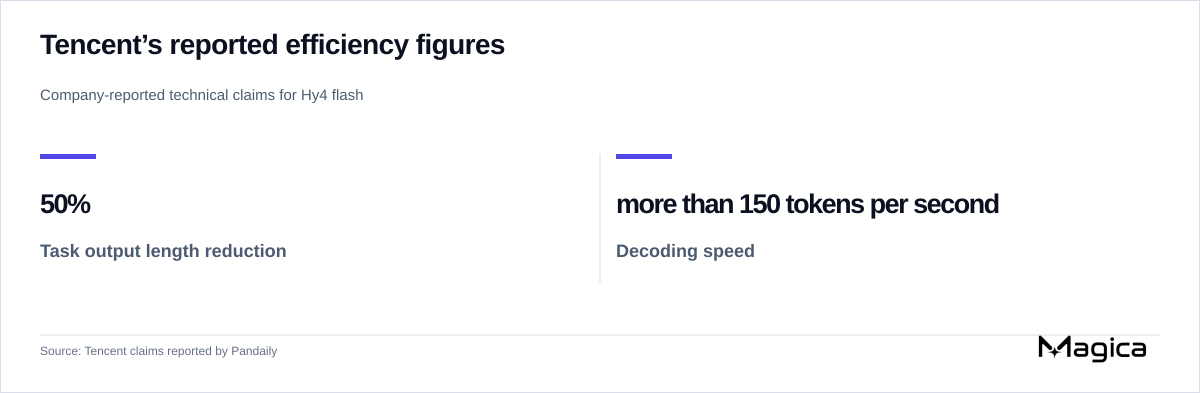
Tencent’s company-reported efficiency figures. The launch reports omit hardware and serving conditions needed to reproduce the decoding-speed claim. Source: Pandaily.
Tencent attributes the economics to changes across pre-training, post-training and inference. Its reported technical explanation includes hybrid attention, LatentMoE and Engram. The report describes Engram as a lookup-style parameter module that expands capacity at lower computational cost. The company says the key-value cache is one-sixth the size of Hy4’s and one-twenty-fourth of Hy3’s.
In post-training, Tencent says it distilled capabilities from Hy4 and used reinforcement learning to reduce end-to-end task output length by 50%. At inference, it cites optimizations including four-bit quantization and decoding above 150 tokens per second. Shorter output provides a second route to lower bills alongside the lower price per token; these remain company claims about its system. The launch reports do not provide the hardware or serving conditions needed to reproduce the decoding-speed figure.
The main task-cost comparison comes from WorkIndex, Tencent’s nonpublic evaluation built around typical tasks in WorkBuddy, its AI work assistant. Those include creating and editing slides, document editing, spreadsheet repair, audio and video processing, and visual understanding, combined with human ratings.
In the company’s results, as described in the launch coverage, flash slightly outperforms Hy4 preview, a model with 770 billion total and 49 billion active parameters. It reports task costs of one-thirteenth of Hy4 preview’s, one-twentieth of Hy4’s and one-eighth of DeepSeek-V4.1-Flash-1017’s. The DeepSeek comparison specifically uses its maximum setting and peak-hour pricing. The performance comparison with the preview should not be mistaken for a claim that flash surpasses the final Hy4.
A separate blind test involved 85 internal WorkBuddy users completing 259 tasks across 27 categories. Tencent says flash’s satisfaction came close to Claude Haiku 5.5, with the lowest cost and shortest task time among the models tested. The reported comparison supplies no numerical satisfaction scores. This is an internal user evaluation, rather than independent confirmation of a general performance lead.
There is also a substantive limit to the substitution argument: Tencent’s WorkBuddy team reported a slight decline on long coding tasks relative to Hy4. The company recommends flash for deep search, document work, slides, simple front-end pages and computer use, while directing complex, long software-engineering work to Hy4.
Serving capacity is another part of the rollout. In a November 6 report, Tencent said on November 5 that it had expanded Hy4 inference capacity tenfold after heavy WorkBuddy demand caused many users to hit usage limits on the first day. The report concerns the larger model; whether flash can sustain its claimed speed under heavy demand remains to be tested.
Flash is already available through TokenHub, WorkBuddy, Yuanbao, WeCom, QQ, ima and Marvis. Tencent says it is coming to OpenRouter and plans to release its weights. Those plans do not establish that the weights are available at launch.
Through November 30, Tencent is offering free use in WorkBuddy and half-price TokenHub API access. That promotion gives users a way to test the model, but their purchase decision needs to distinguish temporary prices from the listed rates.
The unresolved question is how much of Tencent’s task-cost advantage survives outside its own evaluation. WorkIndex is not public, and the reported coding regression already shows that task selection matters. For a team considering a switch, the useful comparison is the cost and time to produce an acceptable result on its own recurring work, including any retries or corrections.
China aims to make school AI education broadly available by 2030. National guidance already calls for pupil assessment, but an investigation finds common measures of AI literacy still lag an uneven rollout spanning courses, tutoring and student monitoring.
Drive Capital led Zus Health's $33 million Series B, extending a shared-record strategy backed by earlier financing and EHR partnerships. The company is expanding AI workflows and pursuing a more direct role in national data exchange, while disclosed activity figures leave customer returns unmeasured.
Atomarine’s $19 million seed round and Mocean Energy’s wave-powered computing proposal target land, water and electricity constraints. Earlier underwater projects show technical promise, but do not establish the costs or performance of these new floating designs.
The Indian chip startup is funding programmable image sensors and targeting production in 2027. Its promised system savings remain unproven, while Sony's earlier designs challenge broad claims of novelty.
Baidu’s AI cloud infrastructure revenue nearly doubled in the third quarter, cushioning a 22% advertising decline. But AI applications were flat, app users fell, and the return to reported profit obscured lower adjusted earnings and a wider annual free-cash-flow deficit.
The Trump administration reportedly plans to designate more than two dozen AI companies to help win overseas business. Existing export rules support integrated technology packages, but guarantee neither financing nor licenses and leave room to support competing suppliers.
Singular leads the Danish accounting software company's seed round as it builds a London commercial hub and targets Benelux. Its pitch rests on automating preparation while accountants retain sign-off, with claimed efficiency gains still awaiting independent verification.
Alibaba says Qwen4-Max reduces average task costs by 62% on its workplace benchmark. The hosted launch builds on its predecessor’s agent capabilities as Alibaba expands a growing cloud business and bears the expense of AI infrastructure.
The FBI warns that ARTEX can accelerate intrusions, with some reaching privileged access in under three hours. Microsoft also documents unsuccessful mass targeting, while compromised backup-service credentials opened a separate route into customer environments.
Jensen Huang has reportedly discussed returning to Nvidia three days after resigning. Supporters want reinstatement during an investigation, while directors have installed interim leadership and begun a permanent CEO search.
House China committee chairman John Moolenaar demanded answers from Commerce Secretary Howard Lutnick over delayed restrictions on Nvidia customer Megaspeed. The dispute concerns enforcement, overseas access to advanced chips and commercial influence as President Donald Trump prepares to visit China.
Apple reportedly still aims to unveil iPhone-linked glasses at WWDC 2027 and ship before year-end. Siri control of existing apps is the software bet, but delays cloud the schedule and Meta already has an established eyewear lineup.
Treasury Secretary Scott Bessent urged Nvidia to recruit an outside CEO and explain within 10 days whether suspect chip sales inflated earnings. The board is considering internal and external candidates, while export enforcement also faces scrutiny.
Congressional scrutiny and company investigations are testing what Nvidia knew about Megaspeed, a Singapore cloud operator whose Malaysian subsidiary bought nearly $2 billion of its technology. Megaspeed denies wrongdoing; the available reporting has not conclusively traced suspected chip diversion to China.
Commerce Secretary Howard Lutnick is backing narrower restrictions on Chinese access to overseas AI computing, according to a report examining his former firm’s financing relationships. Bitdeer filings establish Cantor’s role and the scale of its client’s planned expansion, but do not establish improper influence on policy.
Microsoft said services were fully restored on Saturday after a global Microsoft 365 outage disrupted email, healthcare communications and public services. It blamed an earlier network capacity upgrade exposed by a later change, with a full technical review still to come.
Cursor says a key exposed by Fireworks led an attacker to unredacted credentials in historical coding-agent records and then its extension cache. Up to 5,000 users potentially received malicious Claude Code builds. Cursor has moved inference off Fireworks; successful endpoint compromises remain uncounted.
Police are investigating a top tax-accountant exam scorer's admission of AI-assisted cheating, while the government reviews national qualification tests held in 2026 and prepares stronger controls.
An early tally puts Japanese listed companies’ first-half net profit growth at 43.2%, led by manufacturers. Filings show AI component demand alongside currency benefits and non-AI earnings gains, while procurement delays and canceled infrastructure reservations expose the costs of expansion.