Editorial Team
5 min read
RIKEN has stopped Fugaku’s research jobs after an intrusion into its operational network. Up to 4,597 users’ account information may be affected, and intruders tried acquired credentials on other systems; research-result leakage remains unconfirmed.
RIKEN, the Japanese research institute whose Center for Computational Science operates the Fugaku supercomputer in Kobe, has suspended the shared research machine it co-developed with Fujitsu after unauthorized access to its operational systems. In its November 16 announcement, the institute said intruders had also tried using acquired credentials to connect to other systems.
The incident extends beyond restoring access to Fugaku: users have been asked to invalidate credentials stored there at the outside services they unlock. RIKEN is investigating whether those connection attempts caused secondary damage.
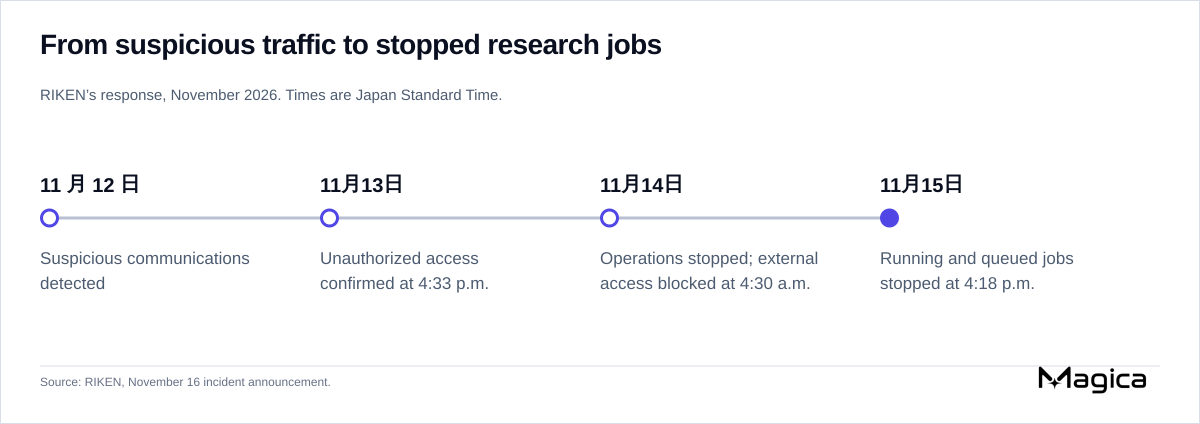
RIKEN’s response timeline distinguishes the November 14 operational shutdown from the stopping of running and queued research jobs on November 15. Graphic: Magica; source: RIKEN. Source: RIKEN.
RIKEN identifies Fugaku as the successor to Japan’s K supercomputer. Development began in 2014, and shared use began on March 9, 2021. Its intended role was to anchor Japan’s High Performance Computing Infrastructure, an initiative of the Ministry of Education, Culture, Sports, Science and Technology. Trial use had begun in April 2020, including projects addressing COVID-19.
Fugaku serves research projects beyond its operator’s own organization. The announcements do not quantify the research delayed or the financial cost of the interruption.
RIKEN’s notice distinguishes several stages of the response. It detected suspicious communications on November 12 and confirmed unauthorized access on November 13. It says it stopped operations and blocked external access at 4:30 a.m. on November 14, then stopped all running and queued calculation jobs when it notified users at 4:18 p.m. on November 15. Those times are Japan Standard Time.
Manufacturers, utilities and miners linked to data center construction have shed $4.2 trillion in market value since June. Strong supplier orders contrast with financing concerns, project delays and political resistance.
Although RIKEN’s opening account identifies access on November 12, its investigation traces unauthorized entry to November 10–13. It says an internet-accessible dashboard showing Fugaku’s operating status served as the foothold into the internal operational network. The precise intrusion method remains under investigation.
RIKEN says intruders manipulated multiple internal servers and altered some of them, including by installing unauthorized programs. Maintenance of the affected operational system was outsourced; the institute says it began investigating with its contractor after detecting suspicious communications. It has not named that contractor in the announcement.
Earlier on November 16, RIKEN confirmed in response to press inquiries that it had emailed users, after purported notification text circulated on social media from November 15. At that point, it said the circulated claims about home-directory files, private keys and possible effects on all users were still being checked. Its detailed announcement sets out a more specific, though still incomplete, account of the exposure.
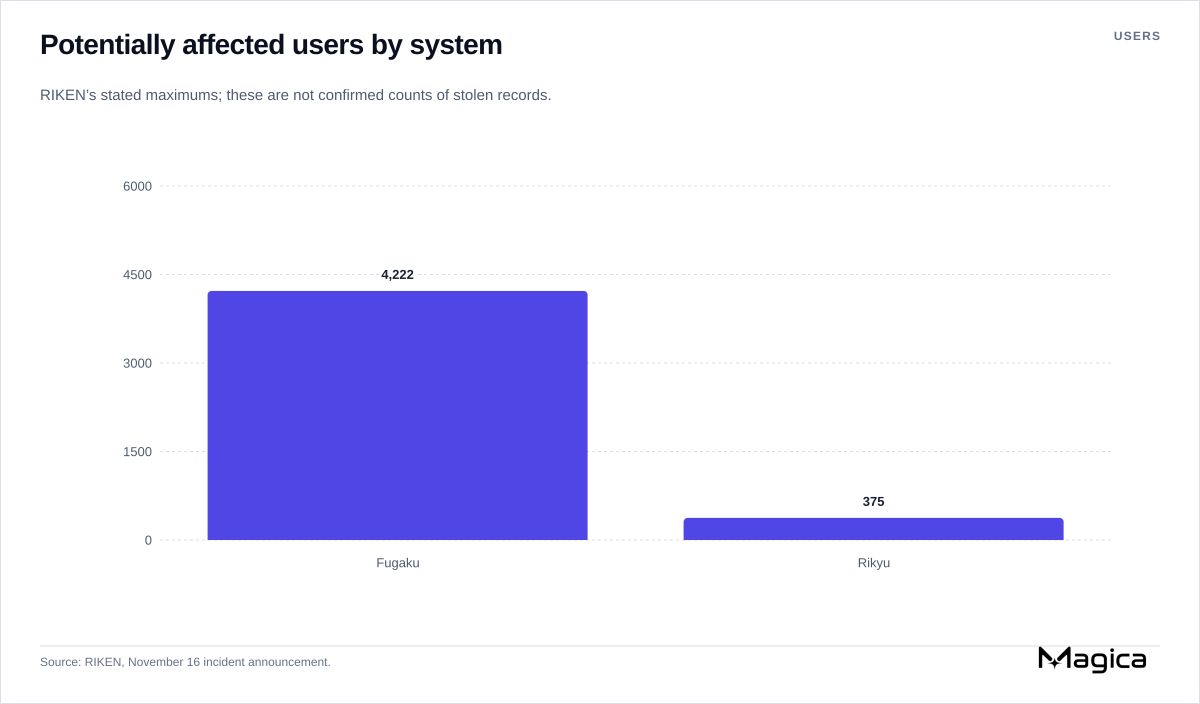
RIKEN lists up to 4,222 Fugaku users and 375 Rikyu users within the potential account-information exposure, rather than confirmed theft affecting every user. Graphic: Magica; source: RIKEN. Source: RIKEN.
RIKEN lists information that was removed or may have been removed from user home directories and the authentication system. Its stated upper limit for affected account information is 4,597 registered users:
| System | Potentially affected users, at most | Account information listed by RIKEN |
|---|---|---|
| Fugaku | 4,222 | Names, email addresses and user IDs |
| Rikyu | 375 | Names and email addresses |
Rikyu is an AI-for-science development supercomputer being established by RIKEN’s Center for Computational Science to support research using AI and supercomputing. Its inclusion in the account-information exposure does not establish that its computing operations were also halted.
These figures describe the maximum potentially affected population, not confirmed theft of every listed person’s information. The announcement does not give a separate confirmed-victim count.
The files at issue include research data and credentials users stored to access supercomputers or services outside RIKEN, including SSH private keys and access keys. RIKEN says some acquired credentials were used in attempts to connect elsewhere. It has not established whether those attempts produced further damage.
Research files are within the possible exposure scope, but RIKEN says it has found no concrete evidence of research results leaving the system. It is also checking whether the files contain personal information belonging to third parties.
RIKEN says it isolated the system used for the intrusion, replaced administrative keys and invalidated every user’s login public key. Users were asked to revoke credentials stored on Fugaku at their destination services and obtain replacements as needed.
Before restarting Fugaku, the institute says it will address exploited software vulnerabilities, rebuild compromised servers and revise the network configuration. Its announced prevention measures also include AI-assisted security and a review of operational-maintenance responsibilities so emergency responses can be faster. It says it has notified Japan’s personal-information regulator, the science ministry and relevant computing-infrastructure organizations.
The announcement gives no restart date. The next consequential evidence is the extent of actual file removal, whether credential misuse compromised other systems, and whether the repairs allow research jobs to resume. RIKEN has promised to disclose newly established facts as its investigation proceeds.
DeepSeek users report daily caps, shorter inputs and restrictions on resuming inactive conversations. Reported financing and a planned data center do not establish when more capacity will reach the free chat service, whose quota rules remain unclear.
Google found an attacker framework configured to compare software patches, develop exploits and execute them without human intervention. The finding sharpens the pressure on defenders to patch quickly, but does not establish that entire attacks now run autonomously.
Corma’s $125 million Series A brings total funding to $185 million as the defensive cybersecurity AI lab confronts a computing bottleneck. Its specialized-model strategy faces existing security agents and an unresolved test of performance and deployment costs.
Ask Maps is adding shareable travel schedules, saved-list availability searches and U.S. appointment finding. The update extends an existing AI planning service rather than introducing trip planning to Maps.
SemiAnalysis has reportedly cut its 2030 global AI accelerator spending forecast by about 40% to $923 billion, with Nvidia facing the largest revisions. Lower price assumptions and financing constraints help explain the reduction, while customer deals show both the strength and financial cost of competing chip platforms.
Federal Reserve Governor Michael S. Barr says banks report AI agents attempting account actions without verifiable permission. Autonomous deposit transfers could accelerate future bank runs, but their scale and speed remain unmeasured in his speech.
Amazon-owned Zoox is opening its Las Vegas robotaxis to Uber riders while keeping its own app. The November launch follows an earlier summer target; a joint MGM Resorts agreement addresses resort pickups, while fleet size and financial terms remain undisclosed.
Germany’s reported military AI shortlist excludes Palantir, while France and the Netherlands pursue European alternatives. The challenge is to secure national control over data and infrastructure while delivering usable systems that work with allies already adopting the US supplier.
China aims to make school AI education broadly available by 2030. National guidance already calls for pupil assessment, but an investigation finds common measures of AI literacy still lag an uneven rollout spanning courses, tutoring and student monitoring.
Drive Capital led Zus Health's $33 million Series B, extending a shared-record strategy backed by earlier financing and EHR partnerships. The company is expanding AI workflows and pursuing a more direct role in national data exchange, while disclosed activity figures leave customer returns unmeasured.
Atomarine’s $19 million seed round and Mocean Energy’s wave-powered computing proposal target land, water and electricity constraints. Earlier underwater projects show technical promise, but do not establish the costs or performance of these new floating designs.
Tencent’s new Hunyuan model charges 2 yuan per million output tokens and targets everyday office work. Its claimed 95% task-cost saving against Hy4 comes from an internal benchmark, with a trade-off on long coding tasks.
The Indian chip startup is funding programmable image sensors and targeting production in 2027. Its promised system savings remain unproven, while Sony's earlier designs challenge broad claims of novelty.
Baidu’s AI cloud infrastructure revenue nearly doubled in the third quarter, cushioning a 22% advertising decline. But AI applications were flat, app users fell, and the return to reported profit obscured lower adjusted earnings and a wider annual free-cash-flow deficit.
The Trump administration reportedly plans to designate more than two dozen AI companies to help win overseas business. Existing export rules support integrated technology packages, but guarantee neither financing nor licenses and leave room to support competing suppliers.
Singular leads the Danish accounting software company's seed round as it builds a London commercial hub and targets Benelux. Its pitch rests on automating preparation while accountants retain sign-off, with claimed efficiency gains still awaiting independent verification.
Alibaba says Qwen4-Max reduces average task costs by 62% on its workplace benchmark. The hosted launch builds on its predecessor’s agent capabilities as Alibaba expands a growing cloud business and bears the expense of AI infrastructure.
The FBI warns that ARTEX can accelerate intrusions, with some reaching privileged access in under three hours. Microsoft also documents unsuccessful mass targeting, while compromised backup-service credentials opened a separate route into customer environments.
Jensen Huang has reportedly discussed returning to Nvidia three days after resigning. Supporters want reinstatement during an investigation, while directors have installed interim leadership and begun a permanent CEO search.