Editorial Team
8 min read
China aims to make school AI education broadly available by 2030. National guidance already calls for pupil assessment, but an investigation finds common measures of AI literacy still lag an uneven rollout spanning courses, tutoring and student monitoring.
China’s drive to bring AI education to schoolchildren nationwide by 2030 has reached a harder question than how many classes to provide: how to establish what pupils have learned. A November 16 investigation, based on school visits, interviews and document reviews, finds an uneven rollout with little agreement on how AI literacy should be taught or measured.
This is not an absence of assessment policy. A 2025 national guide already recommends evaluating pupils’ AI knowledge, skills, thinking and values. The unresolved issue is turning those goals into dependable measures across schools with different resources and different uses for the technology.
With almost 200 million pupils in primary and secondary education, the stakes extend beyond a new subject. Schools are also using AI to generate lessons, mark work and monitor students. Learning how AI works, learning other subjects with AI and being assessed by AI are different activities; success in one does not establish success in the others.
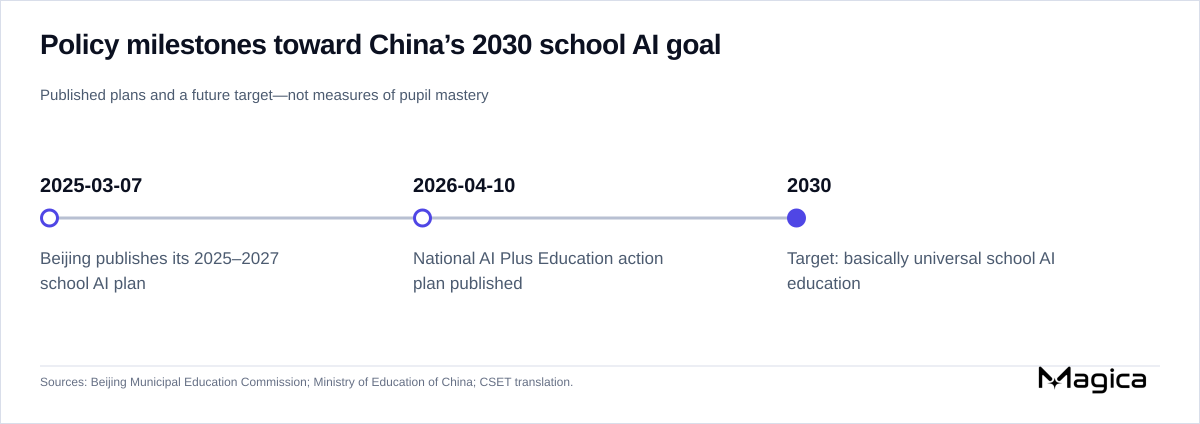
Beijing’s school plan preceded the broader national action plan. The 2030 milestone is a policy target, not an achieved learning outcome. Source: Beijing Municipal Education Commission.
China’s Ministry of Education, the central department coordinating the national initiative, has encouraged schools to introduce AI courses, train teachers and develop pilots since 2024. Its school-specific notice, available in English translation, sets the goal of making AI education basically universal in primary and secondary schools by 2030. It ties the programme to cultivating innovative talent, encourages capable localities to pilot approaches and calls for support for educationally disadvantaged regions.
The ministry and four other central departments issued the broader AI Plus Education action plan in April 2026. It extends the initiative across education, including university foundation courses, vocational skills and teacher training. Local authorities are to specify school course objectives, content and class hours. Its 2030 goals concern provision and system change; they are not evidence of pupil mastery.
Beijing’s Municipal Education Commission, which directs the capital’s school programme, had already published its 2025–2027 plan in March 2025. From the autumn 2025 term, it requires at least eight class hours of AI education annually, taught separately or within existing subjects. Primary pupils are to learn through experience, junior secondary pupils through understanding and application, and senior secondary pupils through integrated practical work. Ethics runs through the programme.
The investigation’s review of regional plans found that Ningxia and Gansu intend to put AI literacy into high-stakes school entrance exams by 2027. That creates an approaching decision about what knowledge will count, even as common assessment methods remain under development.
The Ministry of Education’s Basic Education Teaching Steering Committee issued a 2025 school AI education guide, reproduced by Pingliang’s municipal education bureau, that goes beyond course provision. It calls for school-based indicators covering knowledge, skills, thinking and values, using project presentations, oral project defences and practical tasks. It also recommends recording learning processes in pupil AI literacy portfolios and using results to improve teaching.
Those instructions qualify the investigation’s finding that China has yet to establish a standard framework for measuring AI literacy. Assessment is already part of the policy; school-based indicators are not necessarily a common, widely adopted measure. Beijing’s plan also provides for regular quality evaluations and teaching inspections, while the April national plan calls for teacher literacy assessments and evaluation of educational AI applications.
There are international reference points, too. The United Nations education agency UNESCO’s 2024 framework for students defines 12 competencies across a human-centred mindset, AI ethics, techniques and applications, and system design, progressing through understanding, applying and creating. It offers curricular goals rather than proof that Chinese schools have adopted comparable tests.
The investigation reviewed more than 100 government procurement documents and found authorities had committed at least $31 million over the preceding year to AI classroom equipment, training and teaching platforms. That is a documented spending floor, not a national total. It does not establish cost per pupil or educational return.
The school examples show why a single adoption figure would conceal important differences. Beijing New Talent Academy, a private school charging $39,000 a year and serving more than 2,000 students, has developed a digital innovation curriculum spanning AI, robotics and programming, plus its own classroom AI model. Its headmaster describes the goal for most pupils as using AI for everyday learning and creation, rather than becoming AI engineers.
Funan County Qinqing High School in rural Anhui is addressing a shortage of qualified teachers. Headmaster Yang Tianliang told the investigation that its 4,000 pupils, mostly children of migrant workers, learn core subjects through AI-generated lessons on tablets. He said its agents ask questions rather than simply give answers. He also credited the approach with raising university admission rates from below 60% to 90% in recent years, figures the investigation could not independently verify. The claim is not established evidence of an AI-driven improvement.
Deployment also requires teacher work. An August account drawing on Xinhua’s classroom reporting describes teachers at Beijing No. 13 Secondary School reviewing and revising AI-generated assignments. It also relays reports of systems misjudging some essays, struggling to follow mathematical reasoning and failing to transfer data cleanly between competing platforms.
The April national plan proposes shared educational computing services, data resources and education models to support local use and avoid wasteful duplication. Its financing arrangements are government-led but allow universities, companies and other participants, including purchases of services. These are proposed infrastructure and funding mechanisms, not demonstrated savings.
The expansion also reaches sensitive student data. Beijing’s plan calls for health records, regular psychological monitoring and AI health companions. The national plan seeks model safety reviews and protection against privacy leaks and misuse. Evaluating this rollout therefore requires examining data use and safeguards alongside classroom results.
A research account based on a working paper examines 30 months of administrative records for 26,811 students in grades 7–12 in one county in central China. The records extend through June 2025. The study covers nine subjects and examines self-directed use of generative AI, commonly general-purpose tools without special educational functionality.
The researchers compare changes among students adopting AI at different times with changes among students who had not yet adopted it. Within six months, average homework completion time fell from 64 to about 45 minutes. They report homework scores rising 18% relative to the pre-adoption mean, while monthly closed-book exam scores fell 20% relative to their pre-adoption average. These are relative changes, not percentage-point changes in marks.
This is an observational comparison using staggered adoption, not a random assignment of pupils to a national AI curriculum. Its estimates cannot establish the effects of structured AI education or be applied to every Chinese school.
The findings also vary with use. About one in five AI-using students continued to spend roughly as much time on homework as non-users and achieved similar exam scores, despite higher homework scores. The authors caution that differences in motivation, information or AI skills could help explain that pattern; requiring more homework time alone is not a proven remedy.
The same research account distinguishes general-purpose answer tools from pedagogically designed tutors and cites a separate study in which a guarded, pedagogically designed tutor improved learning. The policy choice is therefore partly about how tools are used and what pupils are rewarded for doing, rather than whether AI is present in a classroom.
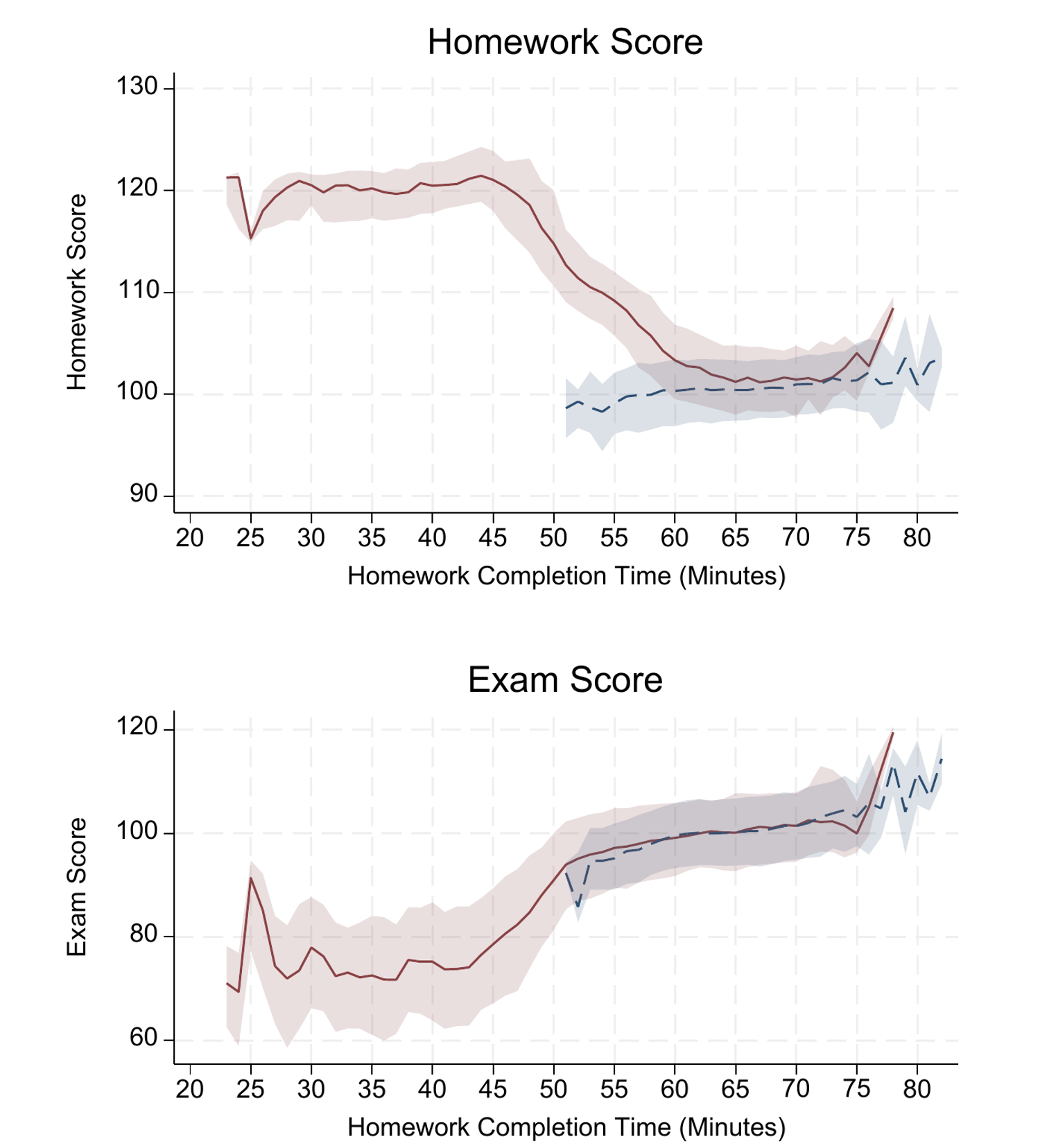
Median homework scores (top) and exam scores (bottom) by completion time. Solid red: AI users; dashed blue: non-users; shading: interquartile ranges. This observational comparison does not prove that requiring more homework time restores learning. Source: Strömberg, Lei and Wu (2026). Source: CEPR VoxEU.
The first test of progress will be how schools turn existing guidance into assessments that distinguish a pupil’s understanding from a system’s output. Project demonstrations and oral defences can contribute evidence, but whether schools apply common standards and achieve comparable results remains unresolved.
As regions prepare to put AI literacy into entrance exams, officials will need to show what those exams measure and how the results relate to practical competence. Public buyers also need evidence that separates teacher workload savings, pupil learning and data protection: a product can perform well on one and poorly on another.
The decisive evidence would connect the instruction pupils receive, their ability to explain and use AI responsibly, and what they can do independently. Course hours and procurement commitments show the reach of China’s experiment. They cannot settle its educational results.
Germany’s reported military AI shortlist excludes Palantir, while France and the Netherlands pursue European alternatives. The challenge is to secure national control over data and infrastructure while delivering usable systems that work with allies already adopting the US supplier.
Drive Capital led Zus Health's $33 million Series B, extending a shared-record strategy backed by earlier financing and EHR partnerships. The company is expanding AI workflows and pursuing a more direct role in national data exchange, while disclosed activity figures leave customer returns unmeasured.
Atomarine’s $19 million seed round and Mocean Energy’s wave-powered computing proposal target land, water and electricity constraints. Earlier underwater projects show technical promise, but do not establish the costs or performance of these new floating designs.
Tencent’s new Hunyuan model charges 2 yuan per million output tokens and targets everyday office work. Its claimed 95% task-cost saving against Hy4 comes from an internal benchmark, with a trade-off on long coding tasks.
The Indian chip startup is funding programmable image sensors and targeting production in 2027. Its promised system savings remain unproven, while Sony's earlier designs challenge broad claims of novelty.
Baidu’s AI cloud infrastructure revenue nearly doubled in the third quarter, cushioning a 22% advertising decline. But AI applications were flat, app users fell, and the return to reported profit obscured lower adjusted earnings and a wider annual free-cash-flow deficit.
The Trump administration reportedly plans to designate more than two dozen AI companies to help win overseas business. Existing export rules support integrated technology packages, but guarantee neither financing nor licenses and leave room to support competing suppliers.
Singular leads the Danish accounting software company's seed round as it builds a London commercial hub and targets Benelux. Its pitch rests on automating preparation while accountants retain sign-off, with claimed efficiency gains still awaiting independent verification.
Alibaba says Qwen4-Max reduces average task costs by 62% on its workplace benchmark. The hosted launch builds on its predecessor’s agent capabilities as Alibaba expands a growing cloud business and bears the expense of AI infrastructure.
The FBI warns that ARTEX can accelerate intrusions, with some reaching privileged access in under three hours. Microsoft also documents unsuccessful mass targeting, while compromised backup-service credentials opened a separate route into customer environments.
Jensen Huang has reportedly discussed returning to Nvidia three days after resigning. Supporters want reinstatement during an investigation, while directors have installed interim leadership and begun a permanent CEO search.
House China committee chairman John Moolenaar demanded answers from Commerce Secretary Howard Lutnick over delayed restrictions on Nvidia customer Megaspeed. The dispute concerns enforcement, overseas access to advanced chips and commercial influence as President Donald Trump prepares to visit China.
Apple reportedly still aims to unveil iPhone-linked glasses at WWDC 2027 and ship before year-end. Siri control of existing apps is the software bet, but delays cloud the schedule and Meta already has an established eyewear lineup.
Treasury Secretary Scott Bessent urged Nvidia to recruit an outside CEO and explain within 10 days whether suspect chip sales inflated earnings. The board is considering internal and external candidates, while export enforcement also faces scrutiny.
Congressional scrutiny and company investigations are testing what Nvidia knew about Megaspeed, a Singapore cloud operator whose Malaysian subsidiary bought nearly $2 billion of its technology. Megaspeed denies wrongdoing; the available reporting has not conclusively traced suspected chip diversion to China.
Commerce Secretary Howard Lutnick is backing narrower restrictions on Chinese access to overseas AI computing, according to a report examining his former firm’s financing relationships. Bitdeer filings establish Cantor’s role and the scale of its client’s planned expansion, but do not establish improper influence on policy.
Microsoft said services were fully restored on Saturday after a global Microsoft 365 outage disrupted email, healthcare communications and public services. It blamed an earlier network capacity upgrade exposed by a later change, with a full technical review still to come.
Cursor says a key exposed by Fireworks led an attacker to unredacted credentials in historical coding-agent records and then its extension cache. Up to 5,000 users potentially received malicious Claude Code builds. Cursor has moved inference off Fireworks; successful endpoint compromises remain uncounted.
Police are investigating a top tax-accountant exam scorer's admission of AI-assisted cheating, while the government reviews national qualification tests held in 2026 and prepares stronger controls.
An early tally puts Japanese listed companies’ first-half net profit growth at 43.2%, led by manufacturers. Filings show AI component demand alongside currency benefits and non-AI earnings gains, while procurement delays and canceled infrastructure reservations expose the costs of expansion.