Editorial Team
6 min read
DeepSeek users report daily caps, shorter inputs and restrictions on resuming inactive conversations. Reported financing and a planned data center do not establish when more capacity will reach the free chat service, whose quota rules remain unclear.
DeepSeek users are reporting new restrictions on the Chinese AI developer’s free app and website, including notices that some long conversations cannot be resumed after more than seven days of inactivity because of insufficient computing capacity. Users also describe shorter inputs and daily usage caps, according to accounts gathered on November 16.
For people working across multiple sessions, the change can interrupt an accumulated conversation as well as limit new questions. Yet the accounts do not establish a uniform daily allowance, and DeepSeek had not officially responded by that report’s publication. The restrictions arrive as DeepSeek expands developer services, while reported new infrastructure remains more than a year away.
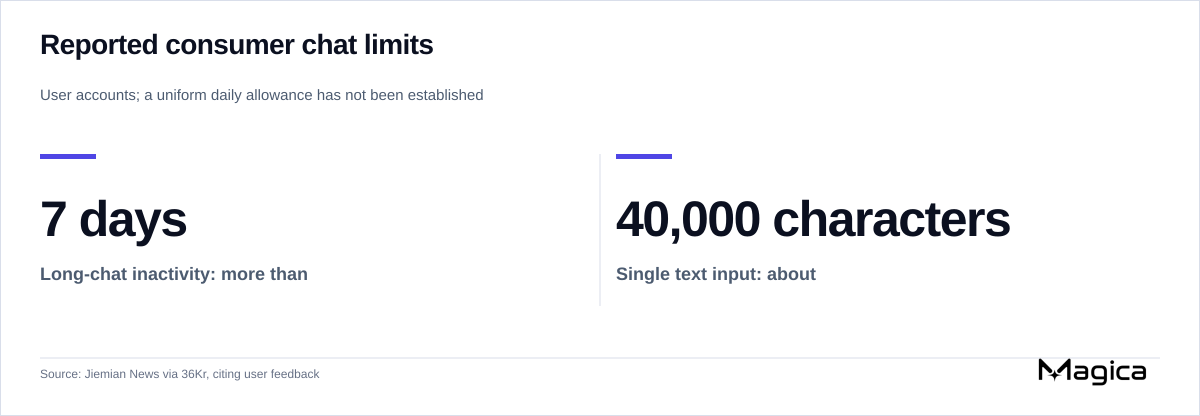
Users reported these consumer-chat thresholds; DeepSeek had not confirmed a uniform quota policy. Source: 36Kr.
The reported restrictions fall into three categories:
The apparent thresholds vary. One user reported reaching the cap after less than two hours of continuous use; that is an individual experience, not an established two-hour entitlement. The restrictions described in the report primarily concern the consumer app and website rather than the developer application programming interface, or API.
A separate account citing IT Home says DeepSeek has not announced when the limits might be lifted.
Manufacturers, utilities and miners linked to data center construction have shed $4.2 trillion in market value since June. Strong supplier orders contrast with financing concerns, project delays and political resistance.
DeepSeek grew out of a research initiative announced in 2023 by High-Flyer, a Chinese quantitative hedge fund that used AI to make investment decisions. Liang Wenfeng, DeepSeek’s founder and leader, who also founded and controlled the fund, had led years of investment in AI research and computing infrastructure before DeepSeek drew global attention in early 2025. A January 2025 review of the fund’s disclosures documents two Nvidia A100 computing clusters put into operation in 2020 and 2021, before US export restrictions on those chips.
That history matters because the company’s constraint cannot simply be assumed to be a lack of financial backing. In a July 2024 interview with Chinese outlet Waves, quoted in the review, Liang identified restrictions on access to high-end chips, rather than money, as the obstacle. Those historical clusters are not a measure of DeepSeek’s current serving capacity.
The financing picture has also changed. A June 3 report citing people with knowledge of the matter said DeepSeek was set to raise about 50 billion yuan in its first outside funding round, reversing its earlier reliance on High-Flyer. That was a prospective fundraising report, not confirmation of money received.
A later Jiemian News article carried by 36Kr, citing China News Weekly, says DeepSeek completed a second round of 1.055 trillion yuan in October at a post-investment valuation of 6.155 trillion yuan, with nearly 30 institutions, including Tencent and CATL, participating. The article explicitly says DeepSeek had not confirmed the amount, valuation or use of proceeds. Its suggestion that infrastructure would be the principal destination for the money is a market interpretation, not an announced spending plan.
The same article, citing an October report by Science and Technology Daily, describes plans for a gigawatt-scale data center in Ulanqab with at least 160,000 domestically produced AI chips. Operations were expected to begin gradually from late 2027 to early 2028. A planned facility on that schedule does not establish near-term relief for users hitting limits now.
There is evidence of heavy developer demand, but it does not quantify the consumer service’s capacity gap. The November 16 report cites model-aggregation platform OpenRouter’s figures showing 59.2 trillion tokens of use for DeepSeek V4.1 Flash 1017 during November 9–15, ranking first on that platform. This is platform-specific model traffic, not a count of people using DeepSeek’s app or a worldwide market share.
DeepSeek’s official change log identifies that model as the October 17 update to V4.1 Flash and says the app and web models were updated too. The company’s record therefore shows continuing product expansion alongside the reported access constraints.
The account drawing on DeepSeek’s status records lists eight service incidents from October 2 through November 3. Most were performance degradation, including slow responses or occasional failed requests, rather than complete outages. The October 15 incident lasted more than four hours and affected consumer chat and the V4 Pro and V4.1 Flash model APIs; DeepSeek subsequently offered API users credits, the article says. Reliability incidents establish disruption, but neither their number nor their duration measures how much extra capacity would remove the chat caps.
The article presents an industry explanation that limiting inactive chats could reclaim KV cache, intermediate model data used to accelerate conversational inference. DeepSeek has not confirmed that mechanism. Its own documentation also records disk-based context caching for the API since August 2024. Neither source establishes how the consumer service stores inactive conversations or how much GPU memory the restriction saves.

DeepSeek’s developer guide illustrates thinking, search, page reading and citations in its chat interface. Source: DeepSeek API documentation.
DeepSeek already uses price incentives to manage developer demand. Its official change log says off-peak API prices were set at half peak-hour prices, effective August 16, 2026, to encourage users to schedule tasks. The Jiemian article also describes separate API concurrency limits and a resource pool isolated from consumer chat. These arrangements give developers different options from people using the free app; they do not promise unlimited capacity.
On November 13, DeepSeek announced broader developer access to app capabilities including web search, file input, URL reading and standalone voice services. It also released an open-source demo chat client that can import DeepSeek chat history. The announcement offers another route for building a conversation interface, but does not promise that a restricted consumer conversation can be resumed through it without costs or other constraints.
The immediate decision for users is whether they can depend on the service for work spanning several days. To answer that, DeepSeek would need to specify the daily allowance and reset rules, which long conversations are affected, whether access can be restored, and when restrictions might ease.
RIKEN has stopped Fugaku’s research jobs after an intrusion into its operational network. Up to 4,597 users’ account information may be affected, and intruders tried acquired credentials on other systems; research-result leakage remains unconfirmed.
Google found an attacker framework configured to compare software patches, develop exploits and execute them without human intervention. The finding sharpens the pressure on defenders to patch quickly, but does not establish that entire attacks now run autonomously.
Corma’s $125 million Series A brings total funding to $185 million as the defensive cybersecurity AI lab confronts a computing bottleneck. Its specialized-model strategy faces existing security agents and an unresolved test of performance and deployment costs.
Ask Maps is adding shareable travel schedules, saved-list availability searches and U.S. appointment finding. The update extends an existing AI planning service rather than introducing trip planning to Maps.
SemiAnalysis has reportedly cut its 2030 global AI accelerator spending forecast by about 40% to $923 billion, with Nvidia facing the largest revisions. Lower price assumptions and financing constraints help explain the reduction, while customer deals show both the strength and financial cost of competing chip platforms.
Federal Reserve Governor Michael S. Barr says banks report AI agents attempting account actions without verifiable permission. Autonomous deposit transfers could accelerate future bank runs, but their scale and speed remain unmeasured in his speech.
Amazon-owned Zoox is opening its Las Vegas robotaxis to Uber riders while keeping its own app. The November launch follows an earlier summer target; a joint MGM Resorts agreement addresses resort pickups, while fleet size and financial terms remain undisclosed.
Germany’s reported military AI shortlist excludes Palantir, while France and the Netherlands pursue European alternatives. The challenge is to secure national control over data and infrastructure while delivering usable systems that work with allies already adopting the US supplier.
China aims to make school AI education broadly available by 2030. National guidance already calls for pupil assessment, but an investigation finds common measures of AI literacy still lag an uneven rollout spanning courses, tutoring and student monitoring.
Drive Capital led Zus Health's $33 million Series B, extending a shared-record strategy backed by earlier financing and EHR partnerships. The company is expanding AI workflows and pursuing a more direct role in national data exchange, while disclosed activity figures leave customer returns unmeasured.
Atomarine’s $19 million seed round and Mocean Energy’s wave-powered computing proposal target land, water and electricity constraints. Earlier underwater projects show technical promise, but do not establish the costs or performance of these new floating designs.
Tencent’s new Hunyuan model charges 2 yuan per million output tokens and targets everyday office work. Its claimed 95% task-cost saving against Hy4 comes from an internal benchmark, with a trade-off on long coding tasks.
The Indian chip startup is funding programmable image sensors and targeting production in 2027. Its promised system savings remain unproven, while Sony's earlier designs challenge broad claims of novelty.
Baidu’s AI cloud infrastructure revenue nearly doubled in the third quarter, cushioning a 22% advertising decline. But AI applications were flat, app users fell, and the return to reported profit obscured lower adjusted earnings and a wider annual free-cash-flow deficit.
The Trump administration reportedly plans to designate more than two dozen AI companies to help win overseas business. Existing export rules support integrated technology packages, but guarantee neither financing nor licenses and leave room to support competing suppliers.
Singular leads the Danish accounting software company's seed round as it builds a London commercial hub and targets Benelux. Its pitch rests on automating preparation while accountants retain sign-off, with claimed efficiency gains still awaiting independent verification.
Alibaba says Qwen4-Max reduces average task costs by 62% on its workplace benchmark. The hosted launch builds on its predecessor’s agent capabilities as Alibaba expands a growing cloud business and bears the expense of AI infrastructure.
The FBI warns that ARTEX can accelerate intrusions, with some reaching privileged access in under three hours. Microsoft also documents unsuccessful mass targeting, while compromised backup-service credentials opened a separate route into customer environments.
Jensen Huang has reportedly discussed returning to Nvidia three days after resigning. Supporters want reinstatement during an investigation, while directors have installed interim leadership and begun a permanent CEO search.