Editorial Team
6 min read
Finnable raised ₹405 crore to expand lending, technology and partnerships, with Bharat Value Fund supplying ₹150 crore. Its shift toward loans on its own balance sheet has lifted margins, while rising costs make sustained profitability the next test.
Finnable, a Bengaluru-based non-banking financial company focused on personal loans to salaried borrowers, has raised ₹405 crore in Series C funding led by Bharat Value Fund. The Wealth Company, which manages the fund, said the proceeds would expand on-book lending, strengthen Finnable’s technology and grow lending partnerships, in a statement carried in the funding report.
The financing backs a shift already under way: Finnable is retaining more loans on its own balance sheet rather than relying as heavily on co-lending with other financial institutions. That has increased margins, according to an earlier credit assessment, but the expansion also brings a test of loan quality, funding and operating costs.

Finnable co-founders Amit Arora, left, and Nitin Gupta, pictured in the company’s November 2025 funding release. Photo: Finnable. Source: Finnable.
Bharat Value Fund invested ₹150 crore, about 37% of the announced round. It is a Category II Alternative Investment Fund managed by The Wealth Company Alternates, part of Pantomath Group. The investment announcement describes this as the fund’s first fintech and NBFC investment. Its stated rationale is demand for retail credit and confidence in Finnable’s underwriting, distribution and founding team.
New investors also included Pratithi Investments, the investment firm of Infosys co-founder Kris Gopalakrishnan, and NKSquared, the investment arm of Zerodha co-founders Nithin and Nikhil Kamath. The Wealth Company’s statement named returning investors TVS Capital and MEMG Family Office. A separate also named existing backer Claypond Capital and identified the participating family office with Manipal Group chairman Ranjan Pai. The accounts do not disclose a valuation, ownership stakes or governance rights for the new round.
Roborock lists the Qrevo 2 Pro at $449.99, about 44% below its displayed reference price. The vacuum-and-mop robot automates mop care, but water-tank upkeep, app settings and mixed review findings limit the hands-off promise.
Finnable was incorporated in 2015 and began lending in 2019. Co-founder and chief executive Nitin Gupta previously worked in risk and analytics at Standard Chartered and founded NettPositive, an analytics firm serving global banks that was acquired by Equifax. Co-founder Amit Arora held senior Standard Chartered roles in retail banking, risk and digital transformation. Credit rating agency Crisil Ratings cites their more than two decades of experience each as a strength in its September 28 assessment of Finnable Credit Private Limited.
The regulated lender, Finnable Credit, is registered with the Reserve Bank of India as a middle-layer NBFC. Its wholly owned subsidiary Finnable Technologies handles loan origination technology, underwriting support and servicing; the parent remains responsible for regulated lending and customer loan exposures. Crisil assesses the two together as the Finnable group.
Finnable described its target customers in a November 2025 company release as salaried people earning ₹15,000–₹50,000 a month. It said its model combines digital underwriting with physical verification and collections. The business therefore depends on both software and the cost of serving and collecting from borrowers.
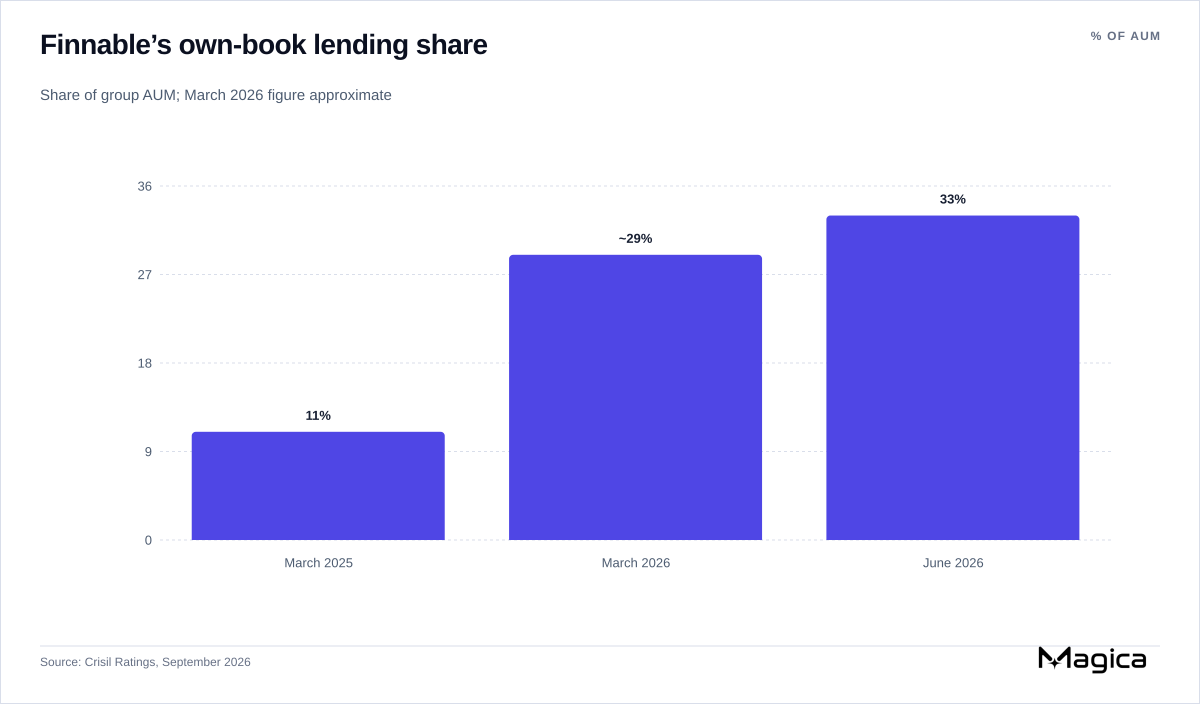
Finnable’s own-book share of group AUM before the Series C. March 2026 is approximate. Chart: Magica; source: Crisil Ratings. Source: Crisil Ratings.
Finnable said in the funding announcement that consolidated assets under management exceeded ₹4,600 crore in October 2026. Its reported ₹51 crore profit after tax for the first half of FY27 surpassed the ₹46 crore reported for the whole of FY26. The half-year result is a milestone, rather than a like-for-like annual growth comparison.
The latest financing follows a November 2025 equity raise reported at ₹500 crore, led by Z47 and TVS Capital, in the funding history. Crisil separately records approximately ₹250 crore of equity infused during FY26. The accounts do not reconcile the announced round size with that recorded infusion.
Before the new round, Crisil considered capitalisation comfortable: group net worth was ₹557 crore on June 30, 2026, gearing was 1.9 times and capital adequacy was 29.3%. It also assessed liquidity as adequate, citing about ₹157 crore of unencumbered cash and equivalents at July 31 against approximately ₹81 crore of debt obligations over the following month. These are historical measures, not a post-financing balance sheet.
Crisil put group AUM at ₹3,925 crore in June 2026. About 33% was held on Finnable’s own book, up from 11% in March 2025; the remaining 67% was co-lending. Holding more loans itself gives Finnable greater exposure to the income and risks of those assets.
The announcements describe personal loans, loans against property and consumer finance. Crisil’s assessment shows the limits of that diversification: unsecured personal lending remains central, while loans against property, introduced in June 2025, were still nascent. It found that 84% of AUM comprised borrowers with credit bureau CIBIL scores above 710, providing a more specific picture than the broad description of “underserved” borrowers.

Group 90-day delinquency before and after adjustment for trailing 12 months’ write-offs. Chart: Magica; source: Crisil Ratings. Source: Crisil Ratings.
Crisil linked the larger own-book share to higher net interest margins. Its group-level figures show that profitability improved despite higher costs:
| Measure | FY26 | First quarter FY27, ended June 2026 |
|---|---|---|
| Net interest margin, on total-income basis | 10.5% | 12.8%, annualised |
| Operating expenses / average managed assets | 6.7% | 7.5%, annualised |
| Credit costs / average managed assets | 2.2% | 2.7%, annualised |
| Return on managed assets | 1.3% | 2.0%, annualised |
These quarter-versus-year comparisons describe the position before the Series C; annualised quarterly rates are not full-year outcomes.
Loan quality had also improved in the assessment. Loans more than 90 days past due were 0.7% in June 2026, but Finnable writes off loans once they are more than 150 days overdue. After adjusting for the preceding 12 months’ write-offs, Crisil’s 90-day delinquency measure was 2.1%, down from 2.9% in March 2025. The adjustment matters because the headline overdue figure alone excludes loans already written off.
The investment announcement offers newer asset-quality indicators, including 99.3% collection efficiency in the second quarter of FY27, but does not provide the calculation basis needed to compare that figure with Crisil’s delinquency measure.
The next evidence needed is whether a larger own-book portfolio can sustain better returns after operating costs and loan losses, while preserving capital and liquidity. Crisil identified sustained return on managed assets around 2.5%, together with improving asset quality and healthy capitalisation, as an upward rating factor; sustained gearing above 3.5 times or deteriorating asset quality that weakens earnings could pressure the rating. Those pre-round criteria make the next test concrete: how Finnable deploys the capital, rather than simply how large its AUM becomes.
A Weibo leaker claims to have obtained ceramic components for Apple's expected 2027 anniversary iPhone. Reports infer a possible limited edition from low planned capacity, but the component, production approval and retail plan remain unresolved.
Microsoft released KB5138318 to fix a crash triggered by November’s Windows Server 2025 security hotpatch in specific IPv6 configurations. The corrective update takes effect without a restart, but requires an existing baseline and servicing stack.
Edovia’s Screens 5.10.6 puts a remote desktop above a keyboard and trackpad on a half-folded iPhone Duo. The layout makes an existing computer more accessible, with hardware, network and software costs still attached.

Amazon’s 18-core M5 Pro MacBook Pro with 24GB memory and 2TB storage costs $100 more than the 15-core version. The advertised $500 saving uses a reference price; Apple’s launch prices complicate the wider discount claims.

Amazon's Black Friday sale puts the 256GB MacBook Neo at $599.99 and the 512GB model with Touch ID at $699.99 across all four colors. The discounts largely reverse Apple's summer price increase rather than establish a substantially cheaper entry point than at launch.
The crowdfunded small Android phone promises 12GB of RAM and 256GB of storage at unchanged backer prices. Funding, battery specifications and certification remain unresolved ahead of a May 2027 shipment target.
X’s first parental controls let adults limit teens’ time, recommendations and contacts without reading messages. The optional supervision follows protections already offered by Instagram, while leaving questions about age checks and safety outcomes.
Amazon’s reported $699 Black Friday offer restored the 512GB MacBook Neo’s March launch price and narrowed its premium over the 256GB sale model to $50. Only Blush qualified, and a later update listed $749.
Apple Kukatpally will open at Lake Shore-Y Junction Mall, taking the iPhone maker’s company-owned retail network in India to seven stores across six cities and adding direct retail to its existing Hyderabad operations.
Allstate's outage disrupted customer and agent access for a third day ahead of Thanksgiving. Oklahoma lawmakers sought late-fee waivers and protection against coverage lapses, while local accounts showed payment access varied and the cause remained unexplained.
KaOS 2026.11 removes the Plasma desktop and Qt 5 from its repositories, completing a transition to Niri and Noctalia already under way in September. Existing Plasma installations remain installed but lose maintenance, while the replacement still has authorization problems.

Amazon lists December 31, 2026 as the minimum security-update date for its 2018 Paperwhite and 2019 Kindle. Qualifying purchases can carry a longer guarantee, and the policy announces no store shutdown.

An Amazon drone struck a cable and a neighboring garage after delivering shampoo near Detroit. The FAA is investigating as Prime Air expands, but the cause and broader accident rate remain unresolved.
Leaked materials point to a 7-inch, 120Hz Lenovo handheld for Android games and PC or console streaming. Existing rivals and Lenovo’s own C700 make the missing price, final hardware and service support central to its appeal.
A Chinese distribution-forum report points to lower allocations through January 2027, adding to concerns over GeForce availability. Nvidia has not confirmed the cut, and its model coverage and reach outside China remain unclear.
Some Android beta testers can reportedly turn videos into animated WhatsApp stickers with original audio, sound effects or voice recordings. The feature expands existing sticker tools, while keeping sound muted until recipients choose to play it.
A supply-chain report puts 2027 shipment targets below 2026 goals at Apple, Samsung and most major rivals, including cuts of about 29% at vivo and 25% at Xiaomi. Primary market research shows why memory shortages threaten affordable phones most, but the targets remain unconfirmed.
Mark Gurman says Apple has long had iPads running macOS internally, but is adapting Mac features for iPadOS rather than developing a consumer release. A separate large foldable faces display-production problems, a reported $3,000–$5,000 price range and an unresolved operating-system choice.
One Windows 11 user reported lower idle write activity after removing Adobe’s PDF extension and clearing associated background data. The reported 300GB total comes from a counter that includes non-disk transfers, leaving actual SSD writes and the scope of the problem unresolved.