Editorial Team
7 min read
A supply-chain report puts 2027 shipment targets below 2026 goals at Apple, Samsung and most major rivals, including cuts of about 29% at vivo and 25% at Xiaomi. Primary market research shows why memory shortages threaten affordable phones most, but the targets remain unconfirmed.
Apple, the iPhone maker, and Samsung Electronics, which makes both Galaxy phones and memory chips, reportedly plan to ship fewer smartphones in 2027 than their targets for 2026. Several rivals face much sharper cuts as expensive memory makes lower-priced handsets harder to sell profitably.
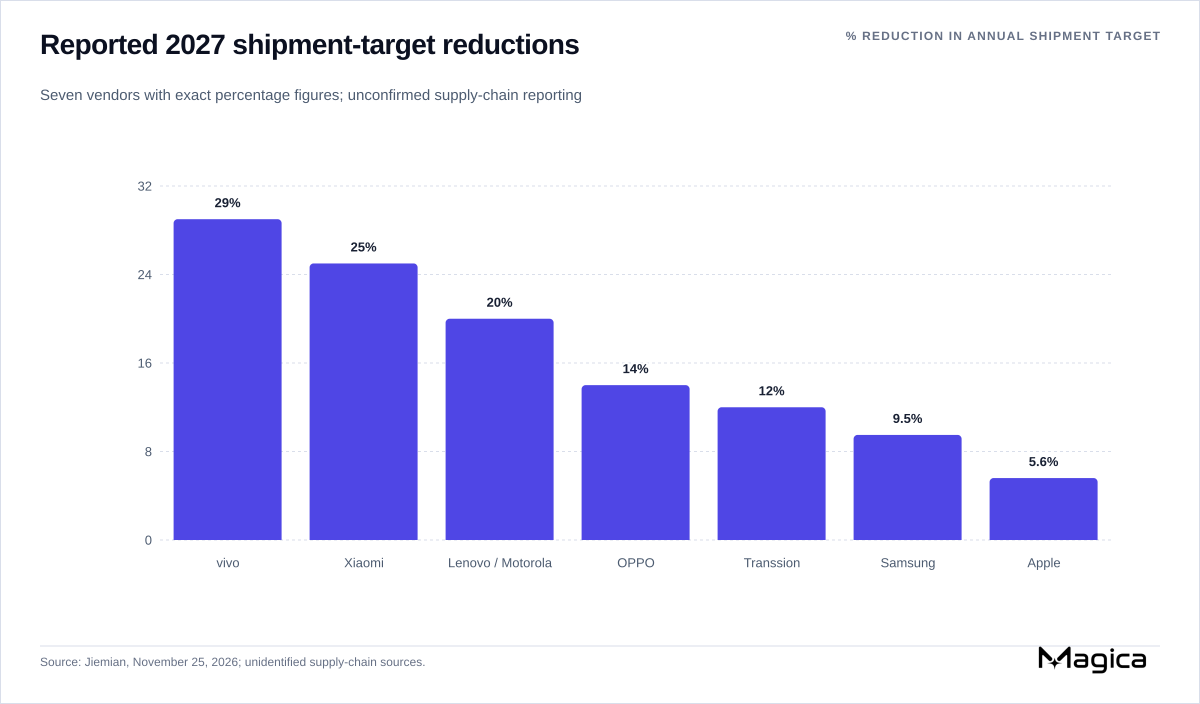
Reported reductions compare unconfirmed 2027 targets with 2026 targets, not completed shipments. Huawei’s reduction exceeds 16%; Honor’s goal is unchanged. Neither is plotted. Chart: Magica; data: Jiemian. Source: Jiemian.
A November 25 report citing unidentified supply-chain sources said most major phone manufacturers had recently settled on lower 2027 shipment targets because memory-chip costs remained high. None had responded to its requests for verification by publication.
The comparison is between reported annual targets. It does not measure completed 2026 shipments, retail purchases or confirmed company guidance. Much of the subsequent coverage repeats this account rather than independently confirming the figures.
| Manufacturer | Reported 2026 target | Reported 2027 target | Reported reduction |
|---|---|---|---|
| Apple | 233 million | 220 million | 5.6% |
| Samsung | 232 million | 210 million | 9.5% |
| Xiaomi | 120 million | 90 million | 25% |
| OPPO | 105 million | 90 million | 14% |
| vivo | 85 million | 60 million | 29% |
| Transsion | 66 million | 58 million | 12% |
| Huawei | 60 million | Below 50 million | More than 16% |
| Lenovo, principally Motorola | 50 million | 40 million | 20% |
| Honor | 50 million | 50 million | Unchanged |
Figures are approximate; the percentage reductions are those given in the original report. Its Transsion target is 58 million, although a subsequent account lists 66 million alongside a 12% reduction. The table follows the original.
The scale of the retrenchment differs by measure. Subtracting the reported targets gives Xiaomi a 30 million-unit reduction and vivo a 25 million-unit reduction, compared with 22 million at Samsung and 13 million at Apple. Between those two Chinese vendors, vivo has the steeper percentage cut, while Xiaomi loses more planned volume.
International Data Corporation, the technology-market research firm known as IDC, provides an observed baseline. Its final historical tracker data put worldwide smartphone shipments at 276.3 million in the second quarter of 2026, down 7.4% year on year. The figures cover new branded devices and exclude refurbished units.
Samsung and Apple, the two largest vendors that quarter, grew shipments 8.1% and 14.9%, respectively. Xiaomi, OPPO and vivo completed the top five, with declines of 26.4%, 17.1% and 19.6%. This is earlier shipment performance, distinct from the annual targets now being reported.
IDC attributed the leaders’ resilience to early supply commitments and more expensive products, where memory takes a smaller share of component costs. It estimated memory costs had risen nearly 300% year on year and exceeded 65% of the component bill at the low end.
The firm also forecasts worldwide smartphone shipments falling 16.7% in 2026 and average selling prices rising 27.6% to $581. An industry average reflects the mix of phones sold as well as price changes; it does not imply that every model becomes that much more expensive.
Counterpoint Research, another technology-market research firm, offers a complementary explanation in its November outlook: Apple benefits from premium positioning, financing, customer loyalty and supplier priority, while Samsung has internal component production and established carrier and retail relationships. Those advantages offer more room to manage shortages than a strategy built around inexpensive, high-volume models.
DRAM provides working memory for running applications; NAND flash retains photos, apps and other data. Demand from AI infrastructure is competing with consumer electronics for limited memory supply, according to the research described in the reporting on component costs. This is a constraint on supply allocation as well as on handset prices.
Samsung’s own results show the competing incentives within a company that supplies components and sells finished phones. In its October 29 earnings release, Samsung said its memory business achieved record quarterly revenue and operating profit after emphasizing AI products amid capacity constraints. Strong server demand raised memory prices across applications, it said. Its memory sales strategy continued to prioritize AI applications, including server memory and storage.
Samsung’s combined mobile and networks businesses, meanwhile, reported a third-quarter operating loss of 0.6 trillion won on revenue of 37.7 trillion won. Revenue rose both sequentially and year on year, helped by flagship launches, but the company said cost pressures reduced earnings from a year earlier. The combined result does not establish a standalone smartphone loss.
For 2027, Samsung said its mobile business would focus on flagships, hardware innovation and operating efficiency. Its networks business also faced weaker North American and high-margin software sales in the quarter, underscoring why the combined loss cannot all be assigned to phone memory costs.
Honor, a smartphone manufacturer previously spun off from Huawei, is the only manufacturer in the reported group keeping its target unchanged, at about 50 million units. That is a plan to hold volume, rather than a forecast of growth.
There is some recent performance behind the stance. The original supply-chain account cited Caixin reporting of IDC data showing Honor was the only leading vendor in China with quarter-on-quarter shipment growth in the third quarter of 2026. That narrower comparison does not establish worldwide or year-on-year growth.
Speaking after the November 23 Honor 700-series launch, Honor chief executive Li Jian said mid-range phones faced greater cost pressure than flagships. He also said manufacturers were cutting processor, camera or memory specifications to preserve prices, according to the original report. His account describes competitors’ trade-offs from the perspective of a manufacturer promoting its own continued push.
The targets have already proved changeable. The same report said Xiaomi cut its 2026 goal below 100 million around midyear, then raised it to 110 million in July after judging that memory prices might peak and replenishing lower-end orders. It gives a 120 million comparison target for 2026 without explaining the intervening change. That gap in the chronology makes the figures planning snapshots rather than a settled trajectory.
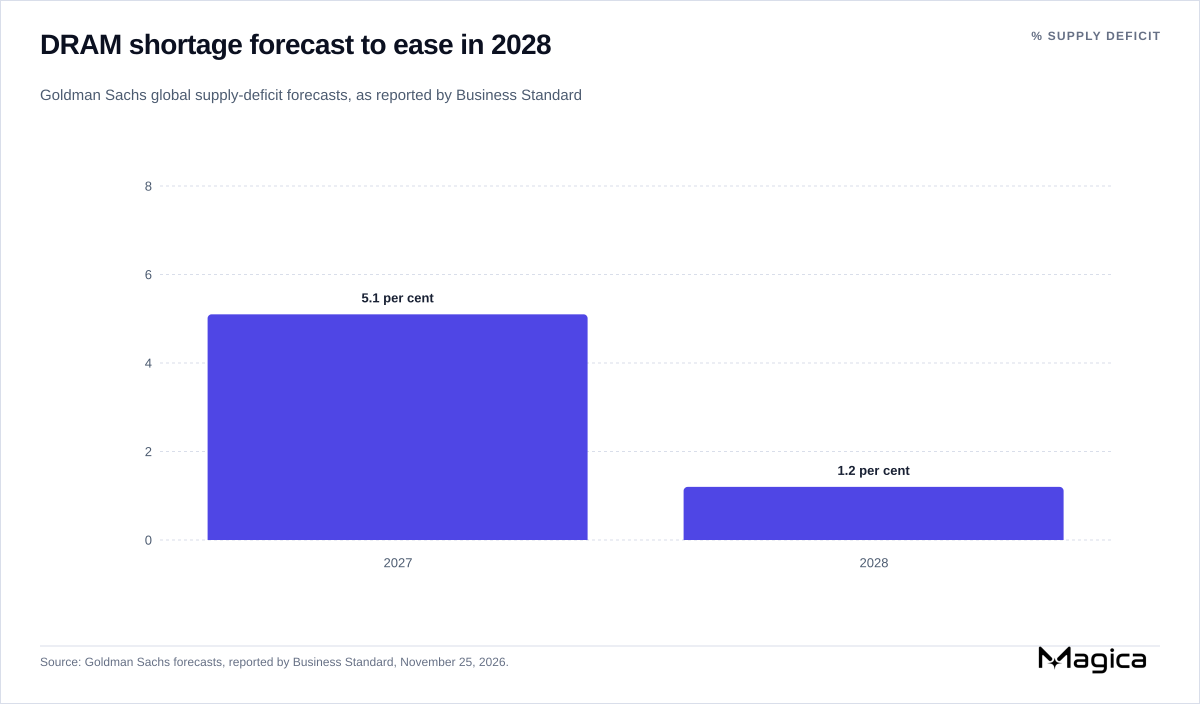
Goldman Sachs forecasts a narrower global DRAM supply gap in 2028. These projections do not guarantee lower phone prices. Chart: Magica; forecasts reported by Business Standard. Source: Business Standard.
Counterpoint’s market forecast puts worldwide shipments down about 14% in 2026 and another 6% in 2027. Its 2026 outlook is less severe than IDC’s 16.7% forecast. It also projects 2027 declines of 4% for Apple and 3% for Samsung, different from the reported target reductions. Analyst shipment forecasts and manufacturers’ planning targets should not be substituted for one another.
Near-term capacity relief is uncertain. The original supply-chain account cited Counterpoint’s expectation that major new memory fabs would not begin production before 2028. It also cited investment bank Goldman Sachs’s November 22 forecast of a 5.1% global DRAM supply deficit in 2027, narrowing to 1.2% in 2028, when conventional DRAM and NAND prices could fall about 20%. These remain forecasts, not promised supply or retail price cuts.
Counterpoint expects a 6% shipment rebound in 2028, still leaving the market about 14% below 2025. It says some buyers will defer replacement or choose refurbished phones, and that recovery depends on cheaper memory feeding through to retail prices.
The next evidence to watch is manufacturers’ confirmation or revision of orders, memory allocation to phones and the prices and specifications of affordable models. A recovery in component supply will matter to mass-market buyers only if manufacturers can again sell devices they can afford.
Roborock lists the Qrevo 2 Pro at $449.99, about 44% below its displayed reference price. The vacuum-and-mop robot automates mop care, but water-tank upkeep, app settings and mixed review findings limit the hands-off promise.
A Weibo leaker claims to have obtained ceramic components for Apple's expected 2027 anniversary iPhone. Reports infer a possible limited edition from low planned capacity, but the component, production approval and retail plan remain unresolved.
Microsoft released KB5138318 to fix a crash triggered by November’s Windows Server 2025 security hotpatch in specific IPv6 configurations. The corrective update takes effect without a restart, but requires an existing baseline and servicing stack.
Edovia’s Screens 5.10.6 puts a remote desktop above a keyboard and trackpad on a half-folded iPhone Duo. The layout makes an existing computer more accessible, with hardware, network and software costs still attached.

Amazon’s 18-core M5 Pro MacBook Pro with 24GB memory and 2TB storage costs $100 more than the 15-core version. The advertised $500 saving uses a reference price; Apple’s launch prices complicate the wider discount claims.

Amazon's Black Friday sale puts the 256GB MacBook Neo at $599.99 and the 512GB model with Touch ID at $699.99 across all four colors. The discounts largely reverse Apple's summer price increase rather than establish a substantially cheaper entry point than at launch.
Finnable raised ₹405 crore to expand lending, technology and partnerships, with Bharat Value Fund supplying ₹150 crore. Its shift toward loans on its own balance sheet has lifted margins, while rising costs make sustained profitability the next test.
The crowdfunded small Android phone promises 12GB of RAM and 256GB of storage at unchanged backer prices. Funding, battery specifications and certification remain unresolved ahead of a May 2027 shipment target.
X’s first parental controls let adults limit teens’ time, recommendations and contacts without reading messages. The optional supervision follows protections already offered by Instagram, while leaving questions about age checks and safety outcomes.
Amazon’s reported $699 Black Friday offer restored the 512GB MacBook Neo’s March launch price and narrowed its premium over the 256GB sale model to $50. Only Blush qualified, and a later update listed $749.
Apple Kukatpally will open at Lake Shore-Y Junction Mall, taking the iPhone maker’s company-owned retail network in India to seven stores across six cities and adding direct retail to its existing Hyderabad operations.
Allstate's outage disrupted customer and agent access for a third day ahead of Thanksgiving. Oklahoma lawmakers sought late-fee waivers and protection against coverage lapses, while local accounts showed payment access varied and the cause remained unexplained.
KaOS 2026.11 removes the Plasma desktop and Qt 5 from its repositories, completing a transition to Niri and Noctalia already under way in September. Existing Plasma installations remain installed but lose maintenance, while the replacement still has authorization problems.

Amazon lists December 31, 2026 as the minimum security-update date for its 2018 Paperwhite and 2019 Kindle. Qualifying purchases can carry a longer guarantee, and the policy announces no store shutdown.

An Amazon drone struck a cable and a neighboring garage after delivering shampoo near Detroit. The FAA is investigating as Prime Air expands, but the cause and broader accident rate remain unresolved.
Leaked materials point to a 7-inch, 120Hz Lenovo handheld for Android games and PC or console streaming. Existing rivals and Lenovo’s own C700 make the missing price, final hardware and service support central to its appeal.
A Chinese distribution-forum report points to lower allocations through January 2027, adding to concerns over GeForce availability. Nvidia has not confirmed the cut, and its model coverage and reach outside China remain unclear.
Some Android beta testers can reportedly turn videos into animated WhatsApp stickers with original audio, sound effects or voice recordings. The feature expands existing sticker tools, while keeping sound muted until recipients choose to play it.
Mark Gurman says Apple has long had iPads running macOS internally, but is adapting Mac features for iPadOS rather than developing a consumer release. A separate large foldable faces display-production problems, a reported $3,000–$5,000 price range and an unresolved operating-system choice.
One Windows 11 user reported lower idle write activity after removing Adobe’s PDF extension and clearing associated background data. The reported 300GB total comes from a counter that includes non-disk transfers, leaving actual SSD writes and the scope of the problem unresolved.