Editorial Team
6 min read
X’s first parental controls let adults limit teens’ time, recommendations and contacts without reading messages. The optional supervision follows protections already offered by Instagram, while leaving questions about age checks and safety outcomes.
X, the social network formerly called Twitter, is rolling out its first parental controls for accounts belonging to 13- to 17-year-olds. Adults can restrict recommendations, approve followers and set daily usage limits. X says supervision does not expose message contents, searches or viewing history, according to the launch report and its documentation.
The November 26 launch gives families an optional layer of control over a platform that says it is not designed for or promoted to children. It also brings X closer to an existing competitor: Instagram already offered parents messaging-contact visibility without access to conversations, alongside daily limits that block app access.
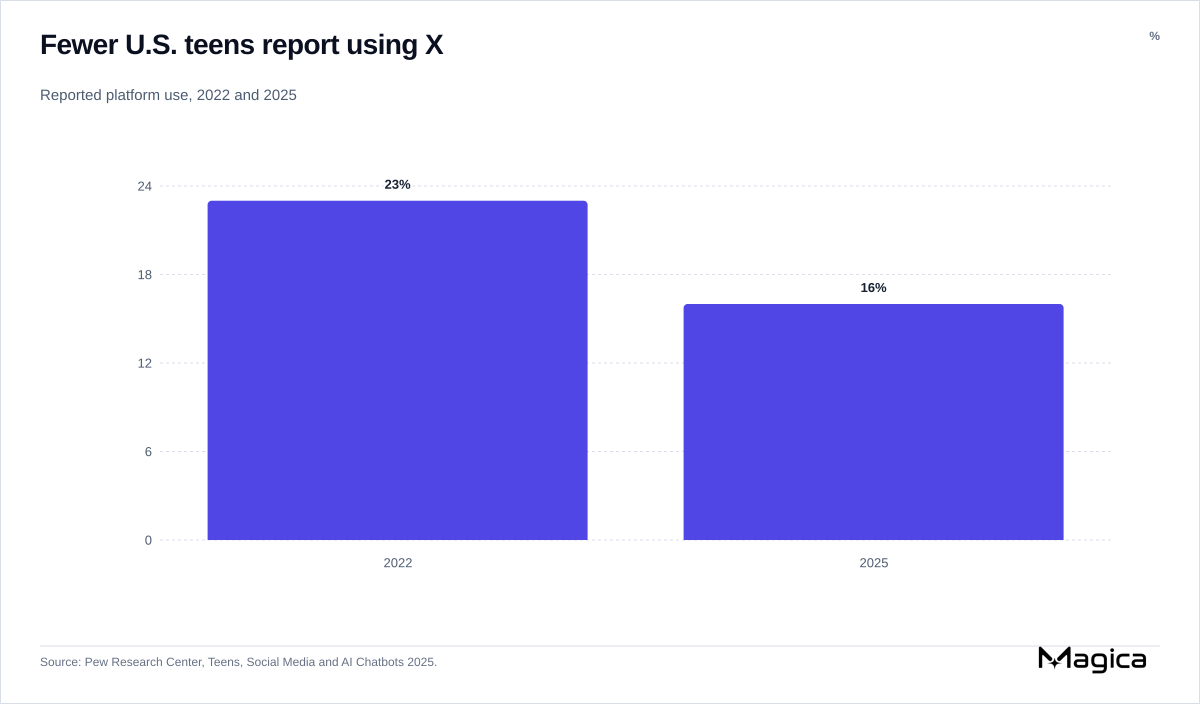
U.S. teen use of X fell from 23% in 2022 to 16% in 2025, according to Pew Research Center. Platform use does not measure supervision adoption or safety outcomes. Source: Pew Research Center.
In its help page, X describes a broad set of permissions. Adults can limit the For You recommendation feed and videos to accounts the teen follows, turn off sensitive media and add restricted words to hide matching posts and videos. They can also manage photo tagging, discovery by email address or phone number, and location on posts.
Messaging controls let the adult choose whether the teen can receive messages from accounts they follow, verified accounts or anyone. Separately, the adult can see which accounts have one-to-one chats with the teen. Neither permission allows the adult to read those messages, send messages as the teen, sign into the account or change its password.
Follower approval has a specific privacy consequence: switching it on also protects the teen’s account, because only protected accounts can approve new followers. Switching it off leaves the account protected, with the teen taking over approval of follow requests.
Time management goes beyond a reminder. Parents can see usage over the preceding seven days and set a daily cap in 15-minute increments. X says access locks for the rest of the day when the limit is reached and resets at midnight in the teen’s local time. Raising or removing the cap restores access sooner.
Launch coverage describes protected teen accounts, restrictions on sensitive media and blocked targeted advertising. The reports differ on timing: one describes protected accounts as a new default, while the other says the protections already exist. Neither description makes those baseline settings dependent on linking a parent. The new supervision adds an adult who can manage settings and requests.
Setup begins with the parent or guardian generating a QR code or link. The teen sees who is requesting supervision and what access it grants, then accepts or declines. One adult can supervise up to five teens, while each teen can be linked to only one adult at a time.
Once linked, the teen sees which settings the adult manages, but cannot change those locked settings. Both sides can see a record of changes and decisions. This makes supervision visible without making its powers equal.
An adult can end the arrangement at any time. A teen can request an end, but the adult approves or denies it. Mridul Singhai, X’s product engineering lead, also said supervision ends automatically when the teen becomes an adult, in comments reported at launch.
When the link ends, the teen retains the account, posts and followers. Managed settings unlock but remain at their last values until the teen changes them. Ending supervision therefore does not automatically reverse the privacy choices made during it.
Eligibility also depends on account information. X requires a birth date to determine whether someone can supervise or be supervised, and says some situations may require a selfie check or identity verification. The documentation does not establish how reliably those checks identify eligible users.
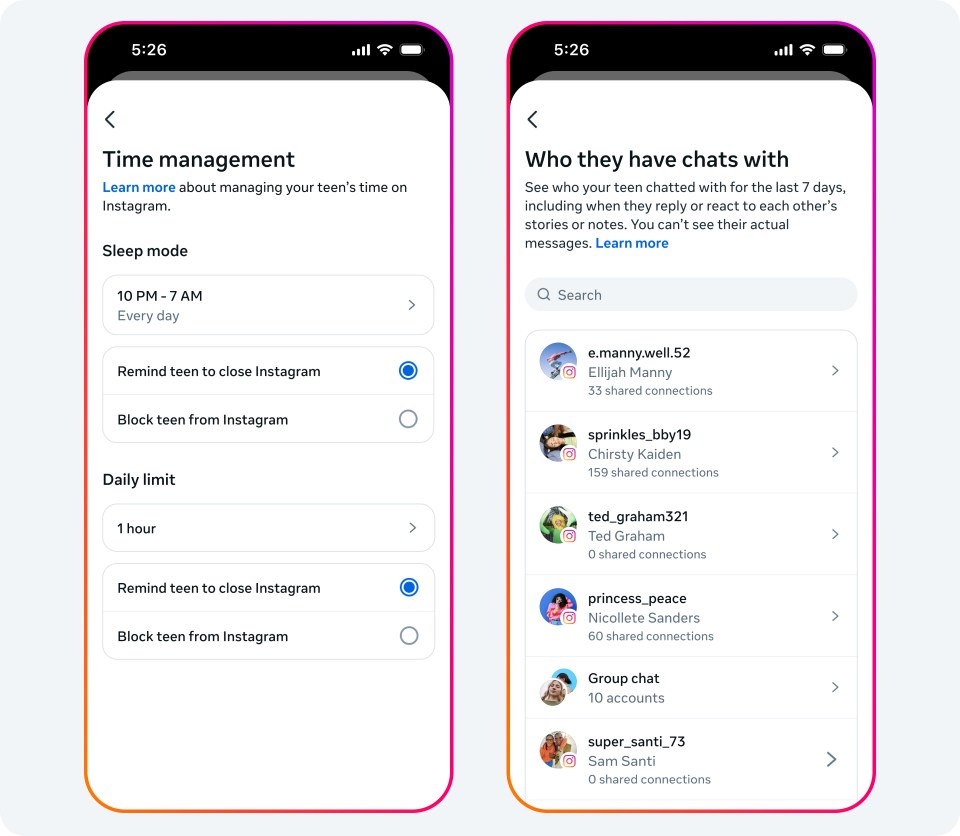
Meta’s Instagram supervision interface shows time controls and chat contacts without exposing message contents. Image: Meta. Source: Meta.
Meta, Instagram’s operator, introduced its Teen Accounts protections in September 2024 and said in a June 2025 update that they had reached every country where Instagram was available. Its announcement describes automatic restrictions on messaging and sensitive content, with parental permission required for under-16s to make settings less strict.
Meta also said parents using supervision could see whom their teen had messaged over the previous seven days without reading the messages, and set daily limits that block access once reached. X’s documentation does not specify the same seven-day window for chat contacts; its seven-day measure concerns time spent.
X also reaches a smaller share of U.S. teens than it once did. A Pew Research Center survey found that 16% reported using X in 2025, compared with 23% in 2022—a decline of seven percentage points. Instagram was used by a majority of teens. The 2025 study surveyed 1,458 U.S. teens online through Ipsos from September 25 to October 9, 2025, and weighted results to represent 13- to 17-year-olds living with their parents. These are self-reported platform-use figures, not measures of supervision uptake or safety.
The launch comes three days after Oregon and Virginia filed actions over sexualized imagery generated by Grok, the AI assistant integrated with X. In its November 23 announcement, Oregon’s justice department identifies X and Grok as products of Elon Musk’s SpaceX corporation and says the AI and social media subsidiaries are referred to as xAI.
The states allege that the operators promoted the services as safe while failing to prevent nonconsensual sexualized imagery, including child sexual abuse material. Those are allegations, and the timing does not establish why X introduced parental controls. The announced account settings do not establish that Grok’s image-generation safeguards have changed.
The dispute also predates this week’s state actions. Three teens sued xAI earlier in 2026, alleging that Grok generated child sexual abuse material when its “spicy mode” launched the previous year, according to the launch coverage.
Age recognition is an immediate test of coverage. X’s birth-date requirement and possible verification checks do not establish how it will identify teens using adult birth dates. The competitor’s record shows why implementation matters: in a March 2025 update, Meta said it was removing a measure intended to stop teens bypassing protections because it had inadvertently locked out some parents sharing devices with them. It described testing an approach that would place suspected teens into protective settings regardless of the listed birthday.
For X, the next evidence needed is how many eligible families establish supervision and whether linked accounts encounter less harmful content or unwanted contact. The launch materials provide no adoption or outcome measurements. Until those exist, the rollout establishes a set of parental permissions and privacy boundaries, rather than demonstrated safety gains.
Roborock lists the Qrevo 2 Pro at $449.99, about 44% below its displayed reference price. The vacuum-and-mop robot automates mop care, but water-tank upkeep, app settings and mixed review findings limit the hands-off promise.
A Weibo leaker claims to have obtained ceramic components for Apple's expected 2027 anniversary iPhone. Reports infer a possible limited edition from low planned capacity, but the component, production approval and retail plan remain unresolved.
Microsoft released KB5138318 to fix a crash triggered by November’s Windows Server 2025 security hotpatch in specific IPv6 configurations. The corrective update takes effect without a restart, but requires an existing baseline and servicing stack.
Edovia’s Screens 5.10.6 puts a remote desktop above a keyboard and trackpad on a half-folded iPhone Duo. The layout makes an existing computer more accessible, with hardware, network and software costs still attached.

Amazon’s 18-core M5 Pro MacBook Pro with 24GB memory and 2TB storage costs $100 more than the 15-core version. The advertised $500 saving uses a reference price; Apple’s launch prices complicate the wider discount claims.

Amazon's Black Friday sale puts the 256GB MacBook Neo at $599.99 and the 512GB model with Touch ID at $699.99 across all four colors. The discounts largely reverse Apple's summer price increase rather than establish a substantially cheaper entry point than at launch.
Finnable raised ₹405 crore to expand lending, technology and partnerships, with Bharat Value Fund supplying ₹150 crore. Its shift toward loans on its own balance sheet has lifted margins, while rising costs make sustained profitability the next test.
The crowdfunded small Android phone promises 12GB of RAM and 256GB of storage at unchanged backer prices. Funding, battery specifications and certification remain unresolved ahead of a May 2027 shipment target.
Amazon’s reported $699 Black Friday offer restored the 512GB MacBook Neo’s March launch price and narrowed its premium over the 256GB sale model to $50. Only Blush qualified, and a later update listed $749.
Apple Kukatpally will open at Lake Shore-Y Junction Mall, taking the iPhone maker’s company-owned retail network in India to seven stores across six cities and adding direct retail to its existing Hyderabad operations.
Allstate's outage disrupted customer and agent access for a third day ahead of Thanksgiving. Oklahoma lawmakers sought late-fee waivers and protection against coverage lapses, while local accounts showed payment access varied and the cause remained unexplained.
KaOS 2026.11 removes the Plasma desktop and Qt 5 from its repositories, completing a transition to Niri and Noctalia already under way in September. Existing Plasma installations remain installed but lose maintenance, while the replacement still has authorization problems.

Amazon lists December 31, 2026 as the minimum security-update date for its 2018 Paperwhite and 2019 Kindle. Qualifying purchases can carry a longer guarantee, and the policy announces no store shutdown.

An Amazon drone struck a cable and a neighboring garage after delivering shampoo near Detroit. The FAA is investigating as Prime Air expands, but the cause and broader accident rate remain unresolved.
Leaked materials point to a 7-inch, 120Hz Lenovo handheld for Android games and PC or console streaming. Existing rivals and Lenovo’s own C700 make the missing price, final hardware and service support central to its appeal.
A Chinese distribution-forum report points to lower allocations through January 2027, adding to concerns over GeForce availability. Nvidia has not confirmed the cut, and its model coverage and reach outside China remain unclear.
Some Android beta testers can reportedly turn videos into animated WhatsApp stickers with original audio, sound effects or voice recordings. The feature expands existing sticker tools, while keeping sound muted until recipients choose to play it.
A supply-chain report puts 2027 shipment targets below 2026 goals at Apple, Samsung and most major rivals, including cuts of about 29% at vivo and 25% at Xiaomi. Primary market research shows why memory shortages threaten affordable phones most, but the targets remain unconfirmed.
Mark Gurman says Apple has long had iPads running macOS internally, but is adapting Mac features for iPadOS rather than developing a consumer release. A separate large foldable faces display-production problems, a reported $3,000–$5,000 price range and an unresolved operating-system choice.
One Windows 11 user reported lower idle write activity after removing Adobe’s PDF extension and clearing associated background data. The reported 300GB total comes from a counter that includes non-disk transfers, leaving actual SSD writes and the scope of the problem unresolved.