Editorial Team
6 min read
Google’s 8,192-chip Ironwood submission completed the MLPerf DeepSeek-V3 benchmark in 1.70 minutes, close to NVIDIA’s 1.53 minutes at the same accelerator count. Google’s scaling data also shows the extra chip-time required for its fastest result, leaving cost and energy comparisons unresolved.
Google Cloud’s custom AI chips approached NVIDIA’s completion time on a large language model benchmark in results released November 16. But the cloud provider’s own scaling figures show that its fastest configuration consumed more chip-time, leaving buyers with separate questions about speed and cost.
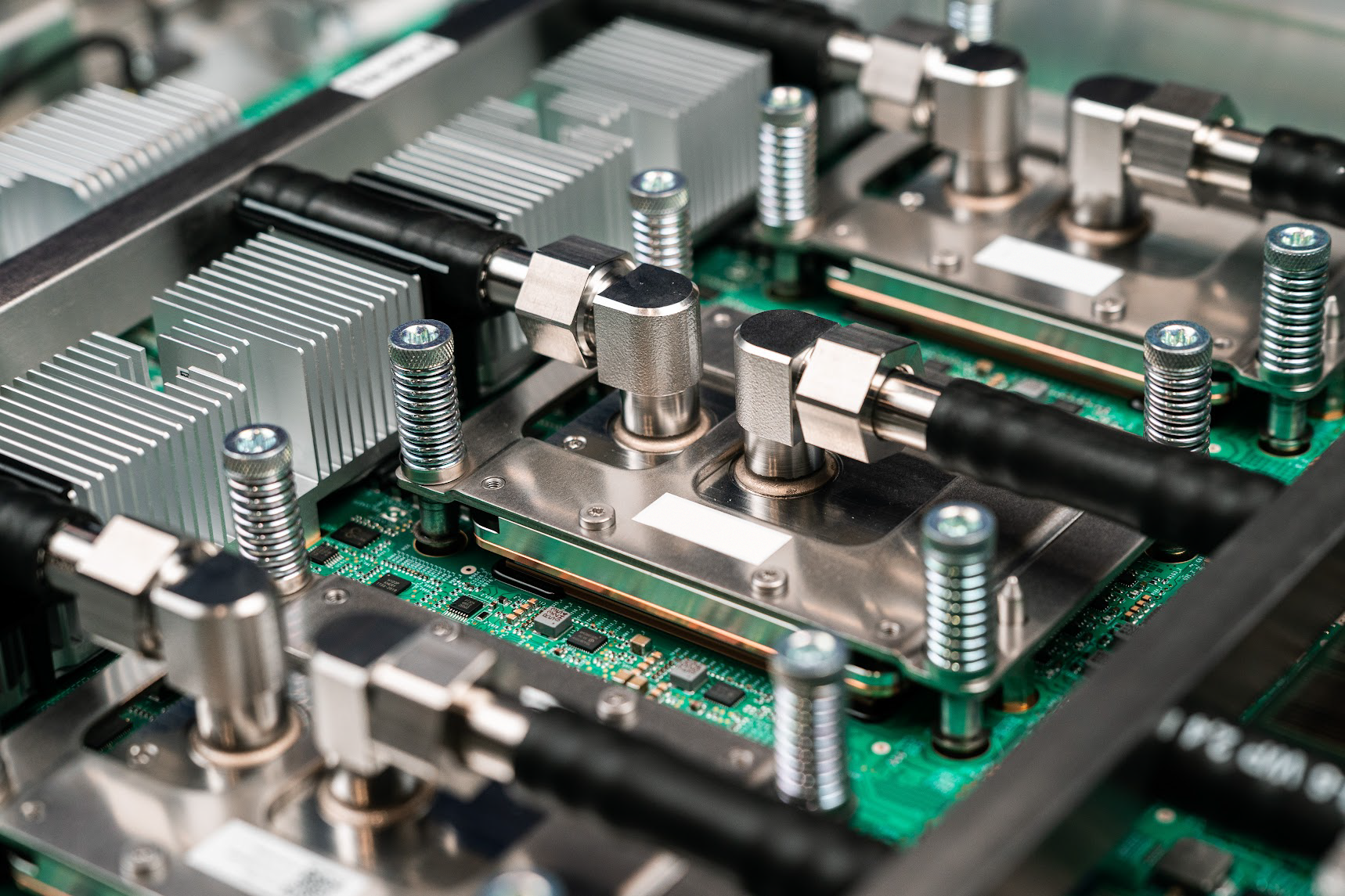
Three Ironwood TPUs connected to liquid cooling, pictured in Google’s November 2025 announcement. Image: Google Cloud. Source: Google Cloud.
Google published 10 results across its seventh-generation Ironwood Tensor Processing Units, or TPUs, and cloud instances using NVIDIA Grace Blackwell graphics processing units, or GPUs. Google said in its announcement that 8,192 Ironwood chips reached the DeepSeek-V3 benchmark’s target quality in 1.70 minutes, its largest TPU submission to date.
The test concerns pre-training a 671-billion-parameter mixture-of-experts language model. Google’s reported times measure work from an official reference checkpoint to a prescribed convergence criterion. They do not represent the time needed to develop and train such a model from scratch.
MLPerf Training is an open-source, peer-reviewed suite of full-system tests covering models, software and hardware. Its organizer, MLCommons, is an open AI engineering consortium that has built benchmarks with industry and academia since 2018. The consortium says an expert panel curates the workloads to help infrastructure users compare systems.
This round marks Ironwood’s first appearance in MLPerf Training, alongside the first NVIDIA Rubin-generation submissions. It is a benchmark debut for an existing Google product: in November 2025, Google said Ironwood would become generally available in the coming weeks.
Google’s earlier product announcement placed Ironwood in a decade-long TPU development effort and said TPUs trained and served models including Google’s Gemini and Anthropic’s Claude. Ironwood supports pre-training, reinforcement learning and inference—the execution of trained models. These results concern training workloads rather than establishing serving performance.
For Google, the submissions support two infrastructure offerings: its own accelerators and systems using NVIDIA chips. Both sit within its AI Hypercomputer architecture, which integrates compute, networking, storage and software. A strong TPU result can therefore broaden customers’ hardware choices while Google continues offering NVIDIA-based capacity.
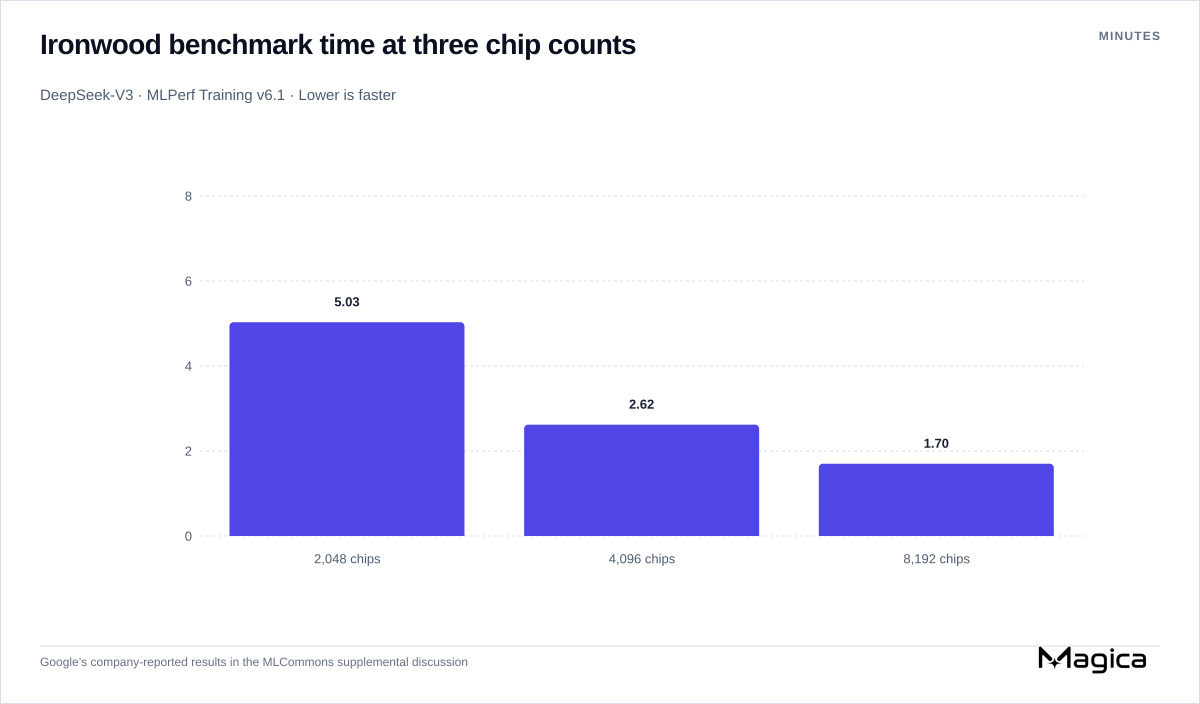
Company-reported Ironwood benchmark times from the reference checkpoint to target quality. Elapsed time does not establish electricity use or customer cost. Chart: Magica; data: Google via MLCommons. Source: MLCommons supplemental results.
Google’s contribution to the supplemental results discussion supplies the scaling data behind its fastest DeepSeek-V3 run:
| Ironwood chips | Benchmark time | Approximate accelerator-minutes* |
|---|---|---|
| 2,048 | 5.03 minutes | 10,300 |
| 4,096 | 2.62 minutes | 10,730 |
| 8,192 | 1.70 minutes | 13,930 |
Accelerator count multiplied by reported elapsed minutes, rounded to the nearest ten.
Quadrupling chips from 2,048 to 8,192 reduced elapsed time by about 66% but increased accelerator-minutes by about 35%. This measures accelerator occupancy during the timed benchmark. It is neither an electricity measurement nor a customer bill: those require power data, pricing and the costs of supporting infrastructure.
Google reports approximately 96% scaling efficiency for the first doubling, falling to 77% for the second. Its timed-run effective model-compute utilization, measured against Ironwood’s peak BF16 performance, declined from 56% to 54% to 42% across the three configurations.
The largest run used one inter-chip interconnect domain. That is a submitted configuration, rather than Ironwood’s architectural limit: Google’s 2025 announcement described a superpod connecting up to 9,216 chips. The distinction matters when judging the scale demonstrated by a benchmark against the capacity a supplier advertises.
Google attributes its performance to MaxText’s mixed-precision implementation and a schedule that overlaps communication between chips with computation. Those software and network choices are part of the measured system; the result cannot be assigned to silicon alone.
An independent comparison of the submissions puts DeepSeek-V3 at 1.53 minutes on 8,192 NVIDIA GB300 GPUs, against roughly 1.70 minutes on 8,192 Ironwood chips. It also identifies a faster, larger GB300 result: 1.38 minutes on 10,240 GPUs.
The equal-count comparison places Google close to NVIDIA on this workload without establishing an overall performance lead. Equal accelerator counts do not imply equal processing capacity, power consumption or rental prices. The report also cautions that the largest submitted configurations are not fundamental architecture limits.
NVIDIA says in its supplemental statement that its newer Vera Rubin NVL72 platform achieved approximately 97% DeepSeek-V3 scaling efficiency from 256 to 1,024 GPUs, cutting time from 16.12 to 4.14 minutes. That is a different hardware generation and a smaller scaling range than Google’s largest Ironwood runs.
The field extends beyond those two suppliers. MLCommons reported 250 results from 153 systems and 24 submitting organizations, using NVIDIA, AMD and Google accelerators. Cloud-based systems accounted for 57 systems, or 37%, up from 29% in v6.0.
AMD had no DeepSeek-V3 or Qwen3.5-GRPO results in the independent comparison. Its other submissions nevertheless illustrate why benchmark performance is not simply a contest between new chips: AMD’s supplemental statement reports an average 19% performance increase over v6.0 on the same eight-GPU MI350X and MI355X platforms, measured across Llama 2 70B LoRA fine-tuning and Llama 3.1 8B training.
The supplemental descriptions are written by the submitting organizations. MLCommons explicitly says they do not represent its opinions or views; that qualification applies to Google’s explanations as well as its competitors’.
MLCommons added two workloads in v6.1: DLRMv4-HSTU, a recommendation benchmark replacing DLRM-dcnv2, and Qwen3.5-397B, a large language model post-training benchmark. The latter uses Group Relative Policy Optimization, or GRPO, to learn software-engineering tasks such as tool-calling. It tests reinforcement learning after pre-training, rather than repeating the DeepSeek workload.
Google reported that 640 Ironwood chips completed this new test in 18.02 minutes, with accuracy of 0.765 against a 0.69 target. It split the system into a 128-chip trainer and 128 four-chip sampling engines. Code generation and learning ran concurrently; Google said training chips waited less than 3% of the time.
Its software combined MaxText training, vLLM sampling with TPU support, Google Kubernetes Engine sandboxing and weight synchronization. The result tests coordination between generating candidate actions and learning from them, making the system design consequential alongside accelerator throughput.
Google also submitted five reinforcement-learning results on its NVIDIA-based A4X and A4X Max cloud instances. Its supplemental statement gives 21.03 minutes for a 256-GB200 reinforcement-learning run. Separately, 256 GB300 GPUs completed DeepSeek-V3 in 31.96 minutes. Neither is a comparison at matching accelerator count with Google’s largest TPU submissions.
The unresolved question is what customers must spend to reach useful model quality within their deadlines. Google’s scaling curve shows a concrete choice: fewer accelerator-minutes at the smaller configuration, or shorter elapsed time at the largest. The submitted results do not establish a comparable cost-per-run or energy advantage over NVIDIA systems.
The next useful comparison would hold workload and quality target constant while adding actual infrastructure charges, measured energy, obtainable capacity and the engineering required to reproduce the run. For teams choosing infrastructure, the central decision is how much a shorter development cycle is worth—and whether the benchmark’s configuration is economical and available for their own work.
South Korea is strengthening device checks and considering public Wi-Fi shutdowns before its November 19 college entrance exam, after a tax-accountant exam top scorer admitted using AI to cheat. The response still depends heavily on human screening, with no electronic device detectors planned for this year's test.
Russia’s objections to observer participation stalled the opening of a Geneva weapons conference, where governments must decide whether to authorize negotiations on autonomous weapons and whether any resulting rules should be binding.
Apple’s iOS 27.3 beta ties higher allowances for server-based AI to existing iCloud+ plans. Basic Siri commands remain free, but undisclosed daily limits leave the value of paid access uncertain.
The partners plan to combine IBM quantum processors, NVIDIA computing and Fermilab physics expertise to study modular quantum systems. A separate decoder release promises faster error-correction research, with important limits on its performance comparisons.
Federal Reserve Chairman Kevin Warsh outlined AI scenarios spanning shared prosperity, job displacement and an investment downturn. The exercise offers no forecast or rate guidance as colleagues worry that the infrastructure buildout is adding to inflation.
OpenAI is offering approved organizations a free classifier for suspected child sexual abuse images, including AI-generated material. Early results suggest less review work, but existing detection alternatives and the need for human review qualify the launch.
Nvidia plans scientific computing racks for early 2027, extending Vera beyond its initial AI deployments. Its 2.4× performance-per-watt claim comes from one airflow simulation against AMD Turin; performance against newer rivals and delivered costs remain unresolved.
OpenAI’s CEO expressed empathy for Nvidia founder Jensen Huang but withheld judgment on reinstatement. His confidence in continued AI financing comes with a direct commercial stake and unresolved deployment risks.
TensorWave will supply dedicated AMD infrastructure under a six-year OpenAI agreement, with delivery expected from 2027. Its operating record and financial backing sit alongside an undisclosed contract price and a recently terminated site lease.
California alleges OpenAI endangered the public and misled consumers by testing powerful AI models without adequate controls. The lawsuit follows a Hugging Face intrusion that OpenAI’s own account traced to containment failures, missing monitors and mishandled warning signs.
Perplexity has launched Frontier Research to develop AI that can formulate questions, test hypotheses and produce interpretable discoveries. The company promises more than 10,000 GPUs, but existing automated-research systems show why computing resources and generated papers alone cannot establish scientific value.
The new lab led by Stanford professors Yejin Choi and Carlos Guestrin has backing from Nvidia, Cisco and Snowflake. It promises systems that improve on company work, but research benchmarks leave production costs and customer control unproven.
NVIDIA announced a Rubin HPC GPU with more than 50,000 CUDA cores, sparse data acceleration and seventh-generation NVLink. The design targets simulations used by scientists and AI agents, but missing performance, power and pricing details leave its practical advantage unproven.
OpenAI will open 50,000 new ChatGPT access grants on November 23, covering up to 150,000 researchers and collaborators. New recipients get Plus instead of Pro, with first-come selection replacing a lottery. Its pilot study reports perceived time savings but does not establish faster discovery.
OpenAI reports production healthcare workflows at CVS and Cigna and stronger computer-use evaluations. The results show progress across disconnected software, but leave complete-task reliability and total deployment costs unresolved.
President Donald Trump supported a return for Nvidia co-founder Jensen Huang, but the company has installed interim leadership and begun a successor search amid scrutiny of his conduct and alleged Chinese intelligence ties.
Intel disclosed the bandwidth target for its next Xeon server processors at SC26, alongside previously announced core and cache limits. Application performance, power requirements and launch timing remain unresolved.
Mercedes-Benz plans California early access to city-driving and hands-free highway assistance in December, ahead of a 2027 U.S. rollout. Mixed road tests and unannounced subscription prices leave buyers waiting for evidence of everyday value.
Researchers estimate that 403 large U.S. data centers consumed 81.8 TWh in a year. Their regional-grid analysis reveals substantial fossil-fuel dependence, but cannot isolate AI demand or fully expose the underlying facility data.
HSBC lowered its Zhipu share-price target to HK$500 and delayed forecast adjusted breakeven by two years. Improving API margins and substantial fundraising cushion a business whose gross profit still covers little of its research bill.