Editorial Team
8 min read
HSBC lowered its Zhipu share-price target to HK$500 and delayed forecast adjusted breakeven by two years. Improving API margins and substantial fundraising cushion a business whose gross profit still covers little of its research bill.
HSBC has cut its share-price target for Zhipu by 64% and pushed its forecast for adjusted net-profit breakeven back two years. The bank's reassessment puts the cost of sustaining an AI model business ahead of its rapid sales growth.
Zhipu, the Chinese developer of the GLM family of general-purpose AI models, listed in Hong Kong in January 2026. Founded in 2019 by a team with academic roots at Tsinghua University, it began developing its General Language Model pre-training framework in 2020 and released the open-source GLM-130B model in 2022, according to its IPO prospectus and interim results.
Its business is shifting from deploying models inside customers' own systems toward cloud access through application programming interfaces, or APIs, and coding subscriptions. That shift has expanded recurring usage and improved API margins, but has yet to bring gross profit close to the research bill.
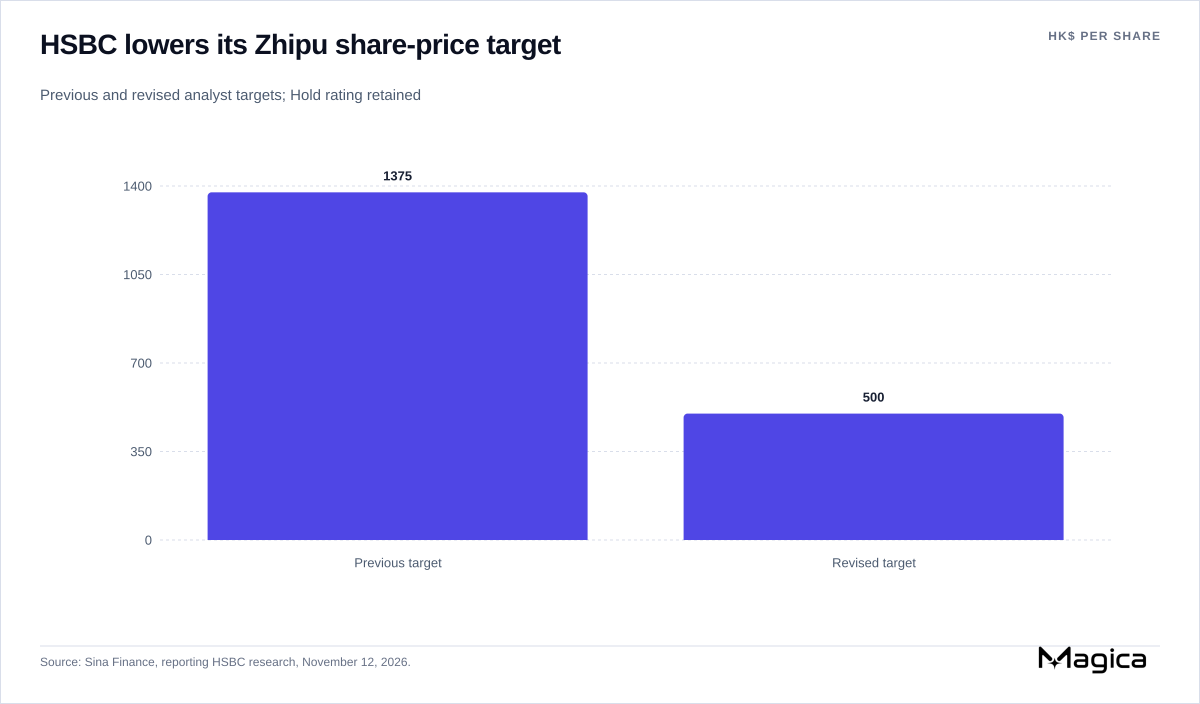
HSBC lowered its Zhipu share-price target from HK$1,375 to HK$500, retaining Hold. Graphic: Magica. Source: Sina Finance.
The bank retained its Hold rating while lowering the target to HK$500 from HK$1,375 and moving forecast adjusted net-profit breakeven from 2027 to 2029, according to a November 12 account of its research. The profitability date is HSBC's forecast.
A subsequent account says HSBC cut its fiscal 2027–2028 forecasts for annualised recurring revenue, or ARR, and total revenue by 7%–27%, and its adjusted operating-margin forecasts by 15–19 percentage points. ARR describes an annualised revenue pace; it should not be read as revenue already earned over a financial year.
The accounts differ on timing: the November 16 account dates the revision to November 13, while the November 12 report and a November 14 analysis date it to November 12. They agree on the new target and retained rating.
The target is an analyst's estimate of share value, not a financing price. Zhipu closed November 13 at HK$408, according to the November 14 market analysis. HK$500 was therefore about 23% above that close, calculated as 500 divided by 408 minus one.
Nor is HSBC's view a market consensus. The same analysis says JPMorgan cut its target from HK$2,000 to HK$1,200 on November 3 while retaining Overweight. It lowered its valuation benchmark from 20 times expected 2030 earnings to 12 times without cutting its revenue trajectory. HSBC also reduced operating forecasts.
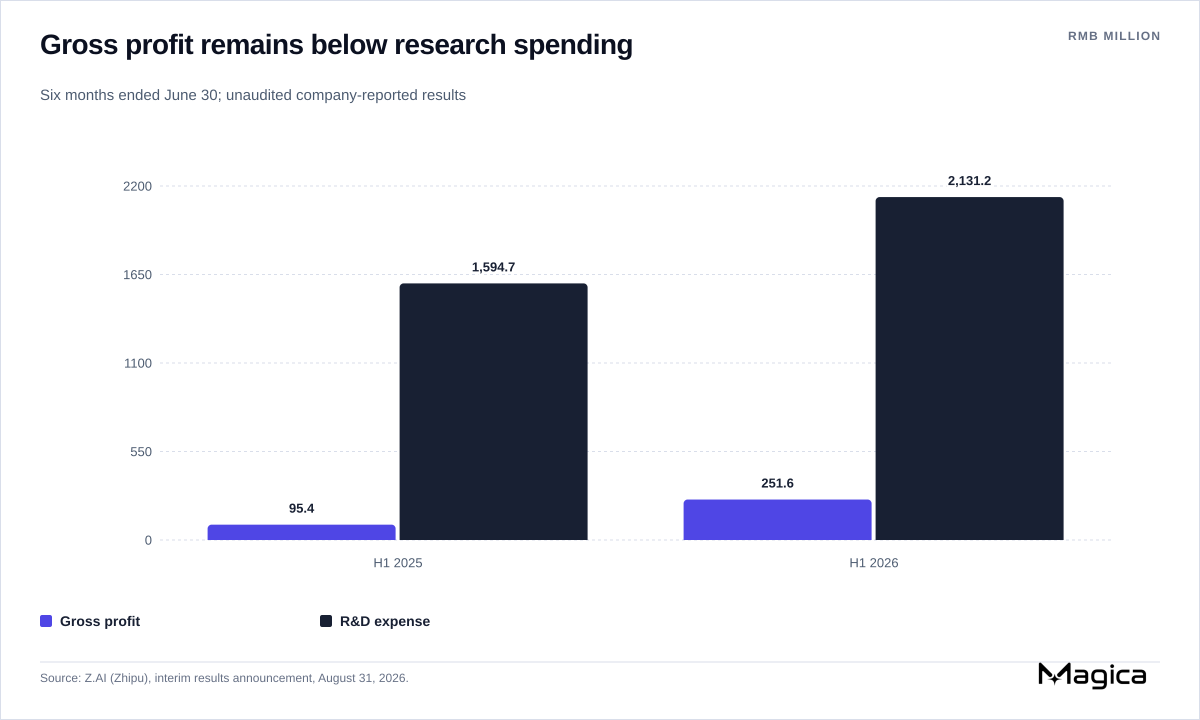
Company-reported gross profit and R&D expense for the first halves of 2025 and 2026, from Zhipu’s unaudited interim results. Graphic: Magica. Source: Zhipu interim results.
Zhipu's unaudited results for the six months ended June 30 show both the improvement and its limits. Revenue rose 399.7%, while R&D expense grew 33.6%.
| Measure, RMB million unless stated | First half 2025 | First half 2026 |
|---|---|---|
| Revenue | 190.9 | 953.9 |
| Gross profit | 95.4 | 251.6 |
| Overall gross margin | 50.0% | 26.4% |
| R&D expense | 1,594.7 | 2,131.2 |
| Adjusted net loss | 1,752.0 | 1,964.1 |
Dividing gross profit by R&D expense shows coverage improving from about 6% to 12%. That is a meaningful gain, but leaves most research spending—and other operating expenses—uncovered. Adjusted net loss, a company-defined non-IFRS measure, widened by 12.1%.
Reported net loss narrowed to RMB2.07 billion from RMB2.36 billion. The filing says that improvement benefited from higher gross profit and a sharp reduction in losses on investor financial instruments following their conversion into ordinary shares at the IPO. Those instrument-related charges are excluded from adjusted net loss, along with share-based compensation and listing expenses.
The fall in overall gross margin also needs context. Open-platform and API revenue rose to 86.5% of sales from 15.2% a year earlier. Its gross margin improved from negative 0.4% to 24.6%, while revenue from enterprise general-purpose models, primarily delivered through private on-premise deployments, fell 54.6% to RMB67.0 million. Zhipu attributed the lower group margin largely to the growing share of cloud business, which still carried a lower margin than on-premise deployment.
On-premise gross margin also fell, from 59.1% to 37.9%. Zhipu attributed that decline to a product mix containing fewer high-margin private model deliveries and more enterprise agents still being expanded at scale, alongside customer migration to cloud services.
In the August 31 announcement, Zhipu said average API selling prices had risen approximately 101% since the start of 2026. It attributed better API margins to scale, upward pricing adjustments and engineering improvements that reduced inference costs. HSBC separately credited cloud-service-provider partnerships and higher revenue sharing with partly offsetting margin pressure, according to the November 12 account.
These are different measures and periods: the company described earlier pricing progress; HSBC was revising its future profitability assumptions in November.
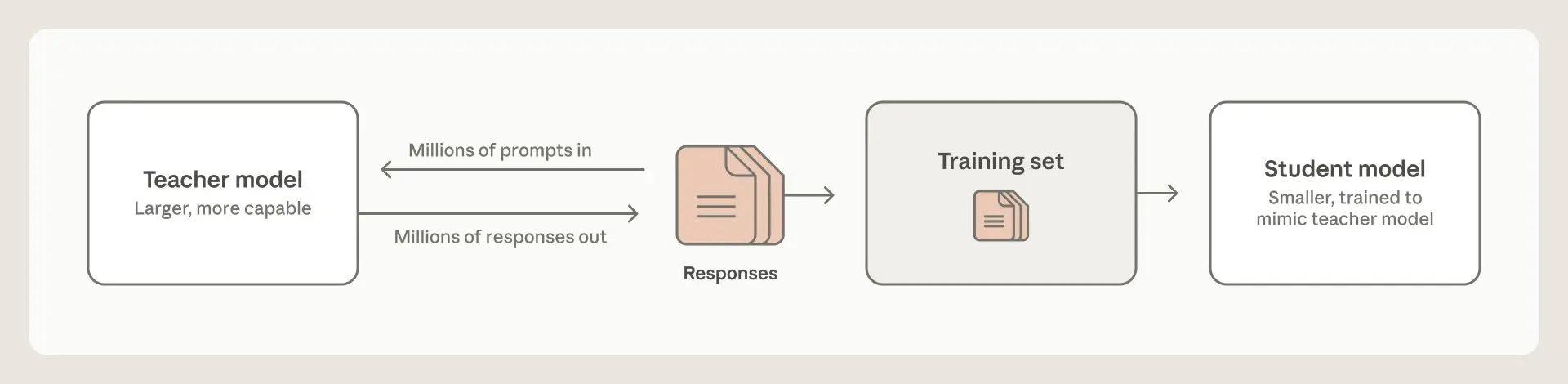
Anthropic’s diagram explains model distillation, a legitimate training method. Its report separately alleges unauthorized extraction involving Zhipu. Source: Anthropic September threat intelligence report.
HSBC cited price competition from US AI developers Anthropic and OpenAI, elevated R&D spending and tighter anti-distillation safeguards at US frontier laboratories. The bank linked those safeguards to longer model-development cycles, without quantifying their separate cost in the reported assessment.
There is relevant background to that concern. Anthropic, the developer of Claude and a Zhipu competitor, alleged in its September threat-intelligence report that Zhipu used Claude outputs to prepare data and improve its own post-training pipelines. Anthropic also said its cybersecurity safeguards disrupted efforts to extract capabilities from its models, prompting Zhipu employees to switch to models whose safeguards they assessed as weaker. These are the competitor's allegations; the report does not quantify their effect on Zhipu's development costs or establish HSBC's forecast.
Domestic competition is visible too. The November 14 analysis says Zhipu and rival Chinese model developer MiniMax were among suppliers offering token subscriptions at half price or less during the November 11 shopping promotion. Tokens are the units used to meter model input and output; subscription discounts alone do not establish the realised price or cost of completing a task.
Computing is a substantial part of the research burden. The prospectus records RMB1.55 billion in computing-service fees in 2024, accounting for 70.7% of R&D expense. It warns that dependence on third-party computing providers exposes the company to price changes, shortages and service disruptions.
Zhipu reported progress on inference costs. It said in its interim results that unit token inference costs had fallen 80% from the beginning of 2026 as it expanded use of domestic chips. That is the company's operational claim about serving models, not evidence that the expense of developing subsequent models has fallen by the same amount.
Regulatory exposure predates this target cut. The prospectus says Zhipu and nine subsidiaries were added to the US Commerce Department's Entity List in January 2025, restricting access to certain US export-controlled goods, software and technology without a licence. At the time of the prospectus, Zhipu said it had not relied on those controlled items during the historical reporting period and expected no material near-term impact, assuming the restrictions did not expand.
HSBC's November assessment was more cautious about future risk. The November 12 report says it added 1 percentage point of regulatory-risk premium to its weighted-average cost-of-capital calculation, taking the total risk premium to 1.5%. Its lower target thus incorporates both weaker operating assumptions and a higher allowance for risk.
Zhipu's interim filing records a completed July share placement at HK$1,588 a share with net proceeds of about HK$31.4 billion. A September 14 report on a company announcement describes a separate September placement at HK$714 and concurrent convertible-bond issue, with expected combined net proceeds of about HK$39.3 billion. The November 14 analysis groups the roughly HK$39.3 billion package with July; the July filing and September account support separating the transactions.
The September report says the company disclosed that IPO proceeds had been fully used and 34.92% of the July placement's net proceeds had been deployed. Zhipu said additional financing would support model R&D and computing infrastructure, where resources take time to move from contracting to deployment. Financing provides capacity to invest; it is not operating income or evidence of a self-funding business.
Zhipu subsequently announced a proposed buyback on November 10, with spending capped at HK$4 billion and H-share purchases capped at 1% of total issued shares. The company said it would consider working-capital and development needs. It explicitly gave no guarantee that any shares would be purchased, or of timing, quantity or price.
The next financial test is whether gross profit continues to grow faster than the research bill, with API sales now dominant. Realised prices, inference costs, gross margins and adjusted losses will help distinguish durable progress from usage growth that still requires outside capital.
Capital allocation presents a parallel decision: how much to commit to new models and computing capacity, and how much, if any, to spend on repurchases. Evidence of actual purchases and updated financing balances will matter more than the buyback ceiling. HSBC's 2029 breakeven estimate remains a forecast to test against those operating results and spending choices.
South Korea is strengthening device checks and considering public Wi-Fi shutdowns before its November 19 college entrance exam, after a tax-accountant exam top scorer admitted using AI to cheat. The response still depends heavily on human screening, with no electronic device detectors planned for this year's test.
Russia’s objections to observer participation stalled the opening of a Geneva weapons conference, where governments must decide whether to authorize negotiations on autonomous weapons and whether any resulting rules should be binding.
Apple’s iOS 27.3 beta ties higher allowances for server-based AI to existing iCloud+ plans. Basic Siri commands remain free, but undisclosed daily limits leave the value of paid access uncertain.
The partners plan to combine IBM quantum processors, NVIDIA computing and Fermilab physics expertise to study modular quantum systems. A separate decoder release promises faster error-correction research, with important limits on its performance comparisons.
Federal Reserve Chairman Kevin Warsh outlined AI scenarios spanning shared prosperity, job displacement and an investment downturn. The exercise offers no forecast or rate guidance as colleagues worry that the infrastructure buildout is adding to inflation.
OpenAI is offering approved organizations a free classifier for suspected child sexual abuse images, including AI-generated material. Early results suggest less review work, but existing detection alternatives and the need for human review qualify the launch.
Nvidia plans scientific computing racks for early 2027, extending Vera beyond its initial AI deployments. Its 2.4× performance-per-watt claim comes from one airflow simulation against AMD Turin; performance against newer rivals and delivered costs remain unresolved.
OpenAI’s CEO expressed empathy for Nvidia founder Jensen Huang but withheld judgment on reinstatement. His confidence in continued AI financing comes with a direct commercial stake and unresolved deployment risks.
Google’s 8,192-chip Ironwood submission completed the MLPerf DeepSeek-V3 benchmark in 1.70 minutes, close to NVIDIA’s 1.53 minutes at the same accelerator count. Google’s scaling data also shows the extra chip-time required for its fastest result, leaving cost and energy comparisons unresolved.
TensorWave will supply dedicated AMD infrastructure under a six-year OpenAI agreement, with delivery expected from 2027. Its operating record and financial backing sit alongside an undisclosed contract price and a recently terminated site lease.
California alleges OpenAI endangered the public and misled consumers by testing powerful AI models without adequate controls. The lawsuit follows a Hugging Face intrusion that OpenAI’s own account traced to containment failures, missing monitors and mishandled warning signs.
Perplexity has launched Frontier Research to develop AI that can formulate questions, test hypotheses and produce interpretable discoveries. The company promises more than 10,000 GPUs, but existing automated-research systems show why computing resources and generated papers alone cannot establish scientific value.
The new lab led by Stanford professors Yejin Choi and Carlos Guestrin has backing from Nvidia, Cisco and Snowflake. It promises systems that improve on company work, but research benchmarks leave production costs and customer control unproven.
NVIDIA announced a Rubin HPC GPU with more than 50,000 CUDA cores, sparse data acceleration and seventh-generation NVLink. The design targets simulations used by scientists and AI agents, but missing performance, power and pricing details leave its practical advantage unproven.
OpenAI will open 50,000 new ChatGPT access grants on November 23, covering up to 150,000 researchers and collaborators. New recipients get Plus instead of Pro, with first-come selection replacing a lottery. Its pilot study reports perceived time savings but does not establish faster discovery.
OpenAI reports production healthcare workflows at CVS and Cigna and stronger computer-use evaluations. The results show progress across disconnected software, but leave complete-task reliability and total deployment costs unresolved.
President Donald Trump supported a return for Nvidia co-founder Jensen Huang, but the company has installed interim leadership and begun a successor search amid scrutiny of his conduct and alleged Chinese intelligence ties.
Intel disclosed the bandwidth target for its next Xeon server processors at SC26, alongside previously announced core and cache limits. Application performance, power requirements and launch timing remain unresolved.
Mercedes-Benz plans California early access to city-driving and hands-free highway assistance in December, ahead of a 2027 U.S. rollout. Mixed road tests and unannounced subscription prices leave buyers waiting for evidence of everyday value.
Researchers estimate that 403 large U.S. data centers consumed 81.8 TWh in a year. Their regional-grid analysis reveals substantial fossil-fuel dependence, but cannot isolate AI demand or fully expose the underlying facility data.