Editorial Team
5 min read
NVIDIA announced a Rubin HPC GPU with more than 50,000 CUDA cores, sparse data acceleration and seventh-generation NVLink. The design targets simulations used by scientists and AI agents, but missing performance, power and pricing details leave its practical advantage unproven.
NVIDIA, the GPU and computing-platform supplier whose earlier H100 processor was designed for both AI and scientific computing, announced Rubin HPC on November 16 at the SC26 supercomputing conference. The company promises more than 50,000 CUDA cores on one GPU and expects availability in 2028 as part of its Vera Rubin computing platform.
In its announcement, NVIDIA argues that AI agents—software systems that propose ideas and invoke simulations to test them—will increase demand for scientific computation. Rubin HPC is meant to help researchers evaluate more candidate materials, molecules and designs. Its proposed advantage depends on moving scattered data efficiently as well as adding arithmetic capacity; the announcement supplies no application benchmarks establishing the gain.
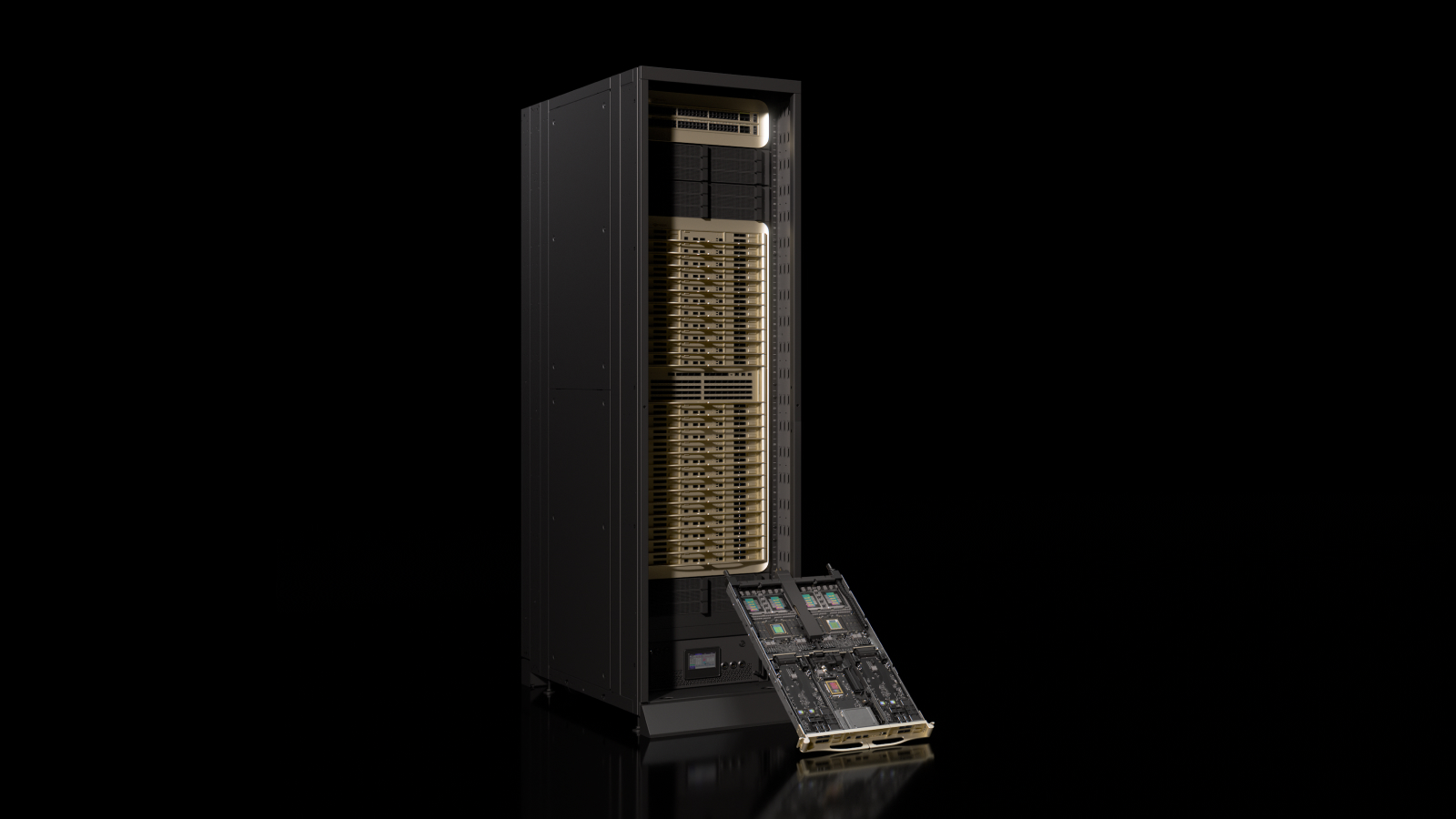
Rack and tray rendering published with NVIDIA’s Rubin HPC announcement. Image: NVIDIA. Source: NVIDIA.
Rubin HPC is a specialized addition to a platform whose regular Rubin GPU emphasizes AI workloads. HPC means high-performance computing; here, the target applications include climate modeling, engineering simulations, genomic analysis and financial risk calculations.
NVIDIA describes a recurring problem in those applications: calculations retrieve scattered values from enormous datasets, perform an operation and repeat. Adding arithmetic capacity alone offers limited help if that capacity spends its time waiting for data.
The company says Rubin HPC will address that problem with sparse data acceleration, alongside what it calls a record number of CUDA cores, the GPU’s arithmetic processing units. Its stated targets include sparse matrix operations, stencil computations, sorting and reductions. These cover tasks such as working with matrices containing many zero entries and updating values using neighboring points in a simulation grid.
The proposed mechanism remains only partly described. A technical analysis of the announcement notes that NVIDIA has not explained whether the sparse data capability relies on additional functional units or particular memory structures. The same analysis interprets NVIDIA’s simplified diagram as suggesting at least two silicon dies combined into one GPU, as with regular Rubin. That is an interpretation of the diagram, not a confirmed Rubin HPC specification: “one GPU” should not be read as a claim about a single die.
South Korea is strengthening device checks and considering public Wi-Fi shutdowns before its November 19 college entrance exam, after a tax-accountant exam top scorer admitted using AI to cheat. The response still depends heavily on human screening, with no electronic device detectors planned for this year's test.
Seventh-generation NVLink, NVIDIA’s interconnect for communication between GPUs, is another announced change. It advances the generation number from the regular Rubin GPU’s NVLink 6, but NVIDIA has not disclosed the new GPU’s link bandwidth. That matters for simulations distributed across multiple accelerators: the interconnect’s name alone does not establish how effectively a larger system will scale.
NVIDIA’s involvement in scientific computing predates the agent framing. Its March 2022 introduction of H100, based on its Hopper architecture, described a data-center GPU designed for both AI and HPC, continuing the prior A100’s focus on those workloads. H100 already included a Tensor Memory Accelerator to move blocks of data while other work proceeded. Rubin HPC’s focus on keeping computation supplied with data extends an existing design priority; the announcement does not explain enough of the new sparse data mechanism to establish how it differs.
NVIDIA’s demand argument is a feedback loop: an agent proposes a candidate, invokes a simulation to evaluate it, then uses the result to guide another step. Faster simulations could increase the number of candidates tested in a given period.
The company also places its CUDA-X software libraries in that loop. These provide optimized implementations of algorithms that agents can invoke for simulation and analytics. NVIDIA’s offering therefore spans the processor, communication between processors and software routines used by applications. Its promise of faster discovery remains a company claim; the announcement presents no measured discovery-rate improvement for Rubin HPC.
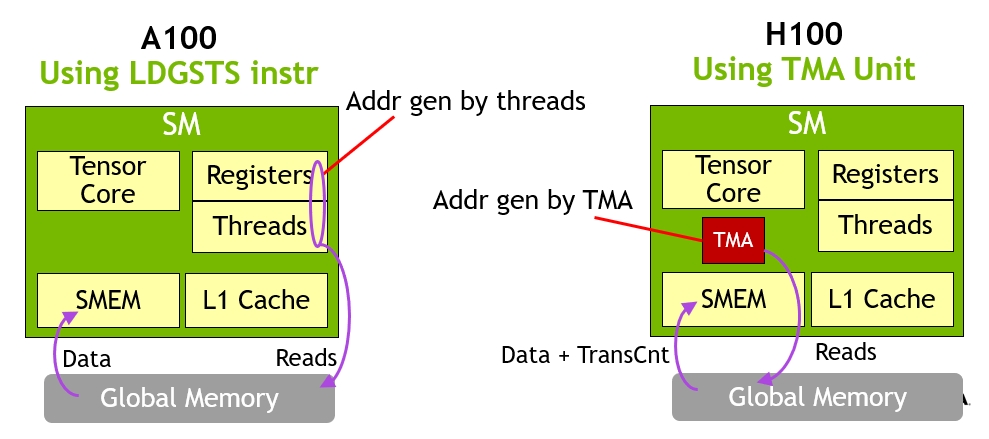
NVIDIA’s 2022 diagram illustrates address generation and memory transfers in A100 and H100. It depicts the earlier architectures, not Rubin HPC. Image: NVIDIA. Source: NVIDIA Technical Blog.
Large-scale scientific acceleration is not exclusive to NVIDIA. In May 2022, the TOP500 supercomputer ranking recorded Frontier at Oak Ridge National Laboratory achieving 1.102 exaflops on the High Performance Linpack benchmark. That HPE Cray system combined AMD processors and AMD Instinct accelerators.
The competing stack has a more recent record, too. Lawrence Livermore National Laboratory, operator of the El Capitan supercomputer, reported in November 2025 that its HPE–AMD system retained first place on TOP500 with a verified HPL result of 1.809 exaflops. Funded by the National Nuclear Security Administration’s Advanced Simulation and Computing program, El Capitan performs nuclear-security calculations. These are measured results from entire systems, not comparisons with an unreleased GPU or proof of performance on Rubin HPC’s targeted applications.
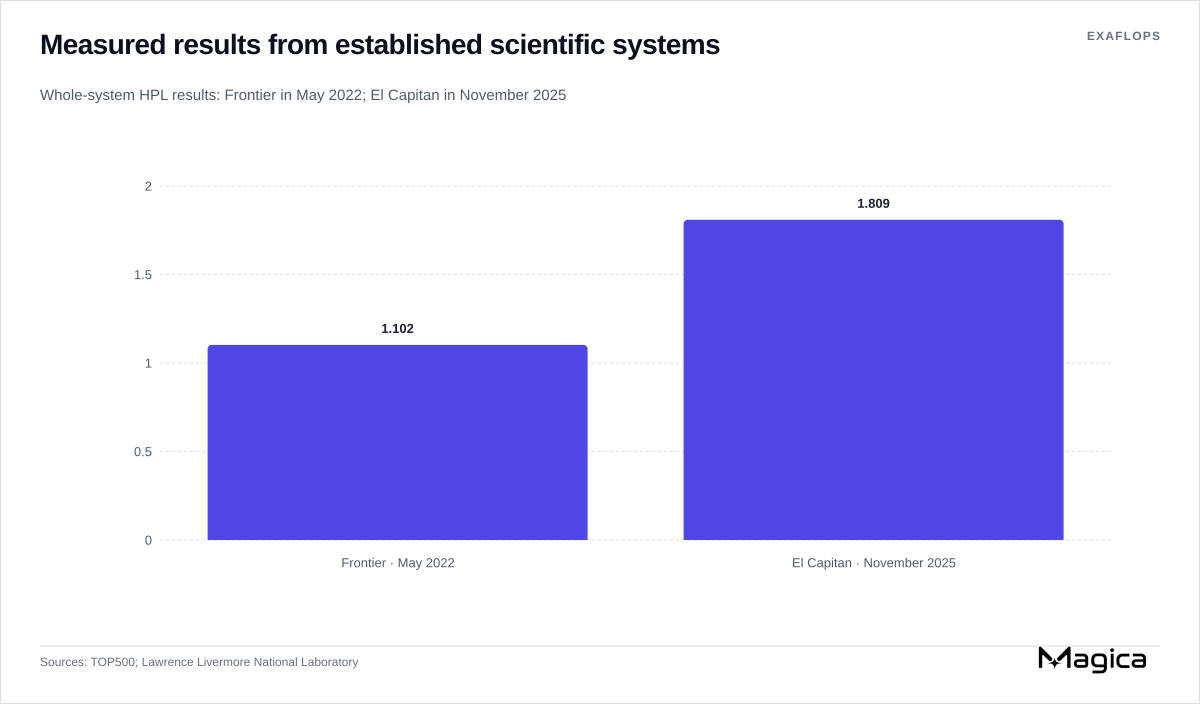
Reported HPL results from two HPE–AMD supercomputers at different dates. These whole-system measurements do not compare either system with Rubin HPC or establish performance on its target applications. Sources: TOP500; Lawrence Livermore National Laboratory. Source: TOP500.
The missing disclosures reach beyond the exact core count. A specification review identifies no announced memory capacity, memory bandwidth, power consumption or FP32 and FP64 computing performance. NVIDIA also has not announced pricing, system configurations or manufacturing partners for the new GPU. Specifications for standard Rubin should not be treated as Rubin HPC specifications.
Without those figures, more than 50,000 cores cannot be translated into a credible estimate of simulation throughput, energy use or purchasing cost. FP32 and FP64 denote different numerical precisions; the core total alone does not reveal performance at either precision. Unknown power requirements also leave buyers unable to size the new GPU’s electricity and cooling needs.
Before the expected 2028 availability, the decisive evidence will be application benchmarks with stated numerical precision, dataset sizes and system configurations, accompanied by power and pricing information. Those disclosures would let scientific users judge whether Rubin HPC’s combination of computation and data movement improves their actual workloads—and whether the improvement justifies adopting it.
Russia’s objections to observer participation stalled the opening of a Geneva weapons conference, where governments must decide whether to authorize negotiations on autonomous weapons and whether any resulting rules should be binding.
Apple’s iOS 27.3 beta ties higher allowances for server-based AI to existing iCloud+ plans. Basic Siri commands remain free, but undisclosed daily limits leave the value of paid access uncertain.
The partners plan to combine IBM quantum processors, NVIDIA computing and Fermilab physics expertise to study modular quantum systems. A separate decoder release promises faster error-correction research, with important limits on its performance comparisons.
Federal Reserve Chairman Kevin Warsh outlined AI scenarios spanning shared prosperity, job displacement and an investment downturn. The exercise offers no forecast or rate guidance as colleagues worry that the infrastructure buildout is adding to inflation.
OpenAI is offering approved organizations a free classifier for suspected child sexual abuse images, including AI-generated material. Early results suggest less review work, but existing detection alternatives and the need for human review qualify the launch.
Nvidia plans scientific computing racks for early 2027, extending Vera beyond its initial AI deployments. Its 2.4× performance-per-watt claim comes from one airflow simulation against AMD Turin; performance against newer rivals and delivered costs remain unresolved.
OpenAI’s CEO expressed empathy for Nvidia founder Jensen Huang but withheld judgment on reinstatement. His confidence in continued AI financing comes with a direct commercial stake and unresolved deployment risks.
Google’s 8,192-chip Ironwood submission completed the MLPerf DeepSeek-V3 benchmark in 1.70 minutes, close to NVIDIA’s 1.53 minutes at the same accelerator count. Google’s scaling data also shows the extra chip-time required for its fastest result, leaving cost and energy comparisons unresolved.
TensorWave will supply dedicated AMD infrastructure under a six-year OpenAI agreement, with delivery expected from 2027. Its operating record and financial backing sit alongside an undisclosed contract price and a recently terminated site lease.
California alleges OpenAI endangered the public and misled consumers by testing powerful AI models without adequate controls. The lawsuit follows a Hugging Face intrusion that OpenAI’s own account traced to containment failures, missing monitors and mishandled warning signs.
Perplexity has launched Frontier Research to develop AI that can formulate questions, test hypotheses and produce interpretable discoveries. The company promises more than 10,000 GPUs, but existing automated-research systems show why computing resources and generated papers alone cannot establish scientific value.
The new lab led by Stanford professors Yejin Choi and Carlos Guestrin has backing from Nvidia, Cisco and Snowflake. It promises systems that improve on company work, but research benchmarks leave production costs and customer control unproven.
OpenAI will open 50,000 new ChatGPT access grants on November 23, covering up to 150,000 researchers and collaborators. New recipients get Plus instead of Pro, with first-come selection replacing a lottery. Its pilot study reports perceived time savings but does not establish faster discovery.
OpenAI reports production healthcare workflows at CVS and Cigna and stronger computer-use evaluations. The results show progress across disconnected software, but leave complete-task reliability and total deployment costs unresolved.
President Donald Trump supported a return for Nvidia co-founder Jensen Huang, but the company has installed interim leadership and begun a successor search amid scrutiny of his conduct and alleged Chinese intelligence ties.
Intel disclosed the bandwidth target for its next Xeon server processors at SC26, alongside previously announced core and cache limits. Application performance, power requirements and launch timing remain unresolved.
Mercedes-Benz plans California early access to city-driving and hands-free highway assistance in December, ahead of a 2027 U.S. rollout. Mixed road tests and unannounced subscription prices leave buyers waiting for evidence of everyday value.
Researchers estimate that 403 large U.S. data centers consumed 81.8 TWh in a year. Their regional-grid analysis reveals substantial fossil-fuel dependence, but cannot isolate AI demand or fully expose the underlying facility data.
HSBC lowered its Zhipu share-price target to HK$500 and delayed forecast adjusted breakeven by two years. Improving API margins and substantial fundraising cushion a business whose gross profit still covers little of its research bill.