Editorial Team
7 min read
Mercedes-Benz plans California early access to city-driving and hands-free highway assistance in December, ahead of a 2027 U.S. rollout. Mixed road tests and unannounced subscription prices leave buyers waiting for evidence of everyday value.
Mercedes-Benz plans to bring navigation-guided city-driving assistance to U.S. customers in 2027, alongside a hands-free highway feature due in the spring. Its MB.DRIVE ASSIST PRO extends the luxury carmaker’s existing speed, steering and lane-change assistance to turns, intersections and dense urban traffic along a navigation route.
In its November 16 announcement, Mercedes said selected California customers would get access to both through an invitation-only program starting in December 2026.
Both features are SAE Level 2 assistance: drivers must monitor the road and remain ready to take control immediately. The city component tested in San Francisco also required hands on the wheel. Early drives suggest a useful reduction in workload, but Mercedes will have to show that supervised assistance makes driving sufficiently easier to justify a subscription.
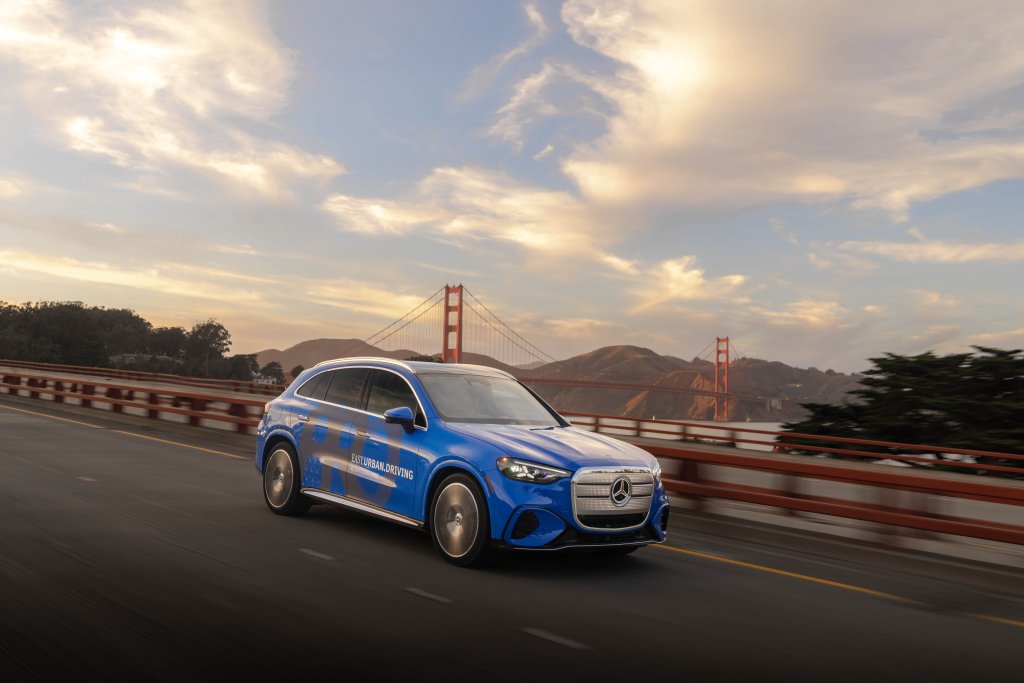
A Mercedes-Benz demonstration vehicle in San Francisco. Photo: Mercedes-Benz USA. Source: Mercedes-Benz USA.
Mercedes’ customer guide distinguishes its assistance features from DRIVE PILOT, a separate Level 3 conditional-automation system.
Mercedes already has a record of offering more automation in a narrower setting. The California Department of Motor Vehicles’ June 2023 approval made Mercedes the first company authorized under the state’s autonomous-vehicle deployment program to sell or lease vehicles with an automated driving system to the public. DRIVE PILOT performs driving tasks without active human control under specified conditions, while the driver remains behind the wheel to take over when prompted. That original permit covered designated highways in daylight at no more than 40 mph and excluded city streets. It illustrates why extending assistance to more complicated roads does not, by itself, transfer responsibility away from the driver.
In one city test, an electric GLC accelerated and braked smoothly, waited for an oncoming bus before passing double-parked vehicles, and stopped for traffic lights, stop signs and pedestrians. The tester found its cautious behavior appropriate for surface streets.
A separate nearly hour-long drive required just one intervention: an accelerator tap when the vehicle remained stopped at an intersection. It otherwise negotiated cyclists, pedestrians and erratic traffic. That account describes the city feature as requiring continuing contact with the steering wheel, even while the system handles the route.
The less enthusiastic third test supplies useful counterevidence. A GLC alternated its turn signals while approaching a left turn, then completed the correct maneuver. A description of the software says computing supplier Nvidia’s Alpamayo driving model selects the vehicle’s trajectory, with a conventional rules-based stack running alongside as a safety check. A Mercedes engineer suggested that conflicting priorities between the two could explain the behavior; that was an explanation offered after the drive, rather than a confirmed diagnosis.
That tester also encountered long pauses at stop signs and inconsistent pedestrian caution. The car slowed for someone still on the sidewalk, yet later entered an intersection closer to a crossing pedestrian than the driver preferred. The account describes the latter distance as safe, but the behavior was unsettling. Most of the route still required no intervention; the driver voluntarily disengaged once near a parked vehicle.
The city system also allows the driver to contribute: steering or accelerating does not end the assistance, while pressing the brake does, according to the first test. These are short demonstrations with different routes and driver judgments. Their intervention counts cannot establish a general failure rate or a safety advantage over competing systems.
Hands-Free Highway Assist permits hands off the wheel on eligible controlled-access highways at speeds up to 85 mph, Mercedes says. The driver must remain attentive, with a camera monitoring attention. Proactive Lane Change Assist can change lanes to pass slower traffic or position the car for an exit.
Here, the test accounts diverged. One highway drive was described as competent within its operating limits. Another recorded at least six requests to resume holding the wheel during a roughly 45-minute S-Class loop. The reviewer was told that the system was starting conservatively and handing back control early when it anticipated complicated situations. In a GLS, that same tester overrode a lane change into the path of a rapidly approaching vehicle, according to the test account.
In the separate highway test, attention monitoring prompted the driver only once over about 30 miles in two vehicles, while the driver was adjusting a mirror. That tester nevertheless canceled a GLE lane change when a pickup towing a trailer was signaling toward the same lane. The driver intervened before learning whether the system would resolve the conflict itself.
An attention warning, a request to hold the wheel and a driver’s precautionary override are different events. These accounts should not be combined into a single disengagement statistic.
The interface created friction too. The reviewer who experienced frequent handbacks struggled to see the subtle hands-free status indicator and often waited 10 to 20 seconds after an override before hands-free driving became available again. That account contrasts the delay with more immediate transitions in competing GM and BMW systems.
The competitive baseline is already established. GM’s Super Cruise, Ford’s BlueCruise and BMW’s Highway Assistant offer supervised hands-free highway driving. Test reporting identifies Tesla’s Full Self-Driving as the closer comparison for navigation-guided city assistance. Driverless robotaxis observed during the demonstrations represent a different service, rather than a feature buyers can activate in these Mercedes vehicles.
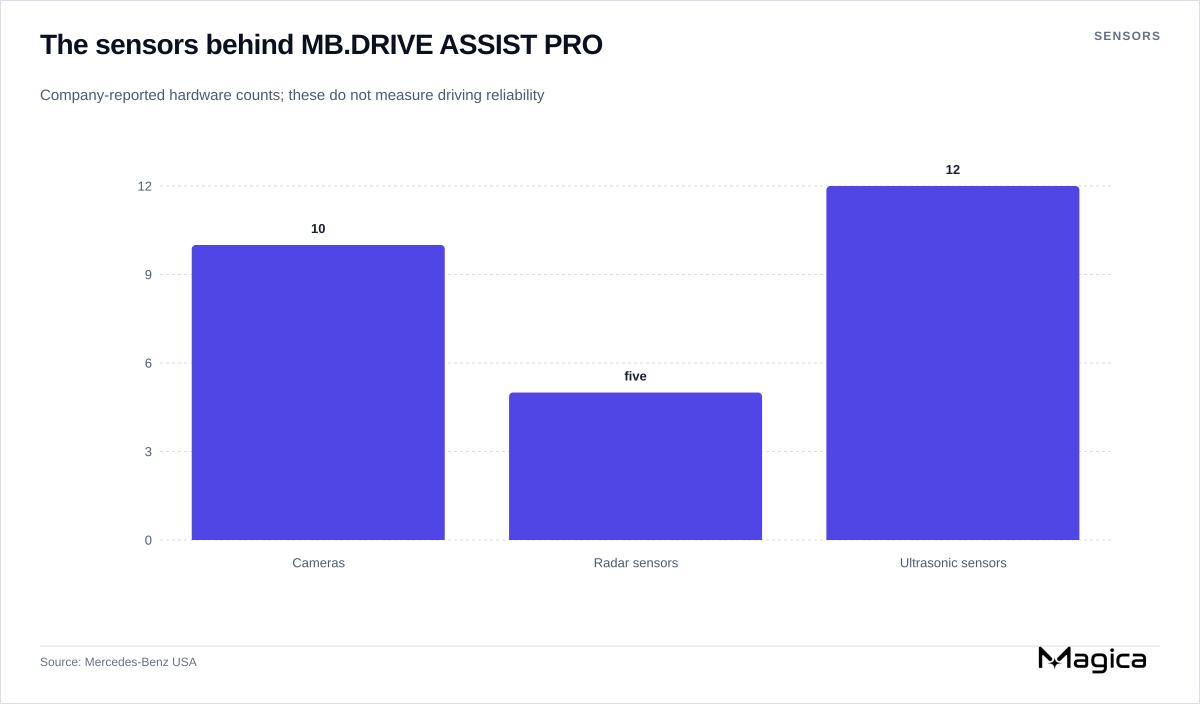
Company-reported sensor counts for MB.DRIVE ASSIST PRO describe its hardware, rather than its driving reliability. Source: Mercedes-Benz USA.
Mercedes’ MB.OS vehicle operating system underpins the new assistance generation. The company says in its U.S. announcement that Pro uses 10 cameras, five radar sensors and 12 ultrasonic sensors, with computing capacity of up to 254 trillion operations per second. Those specifications describe the hardware; they do not measure driving reliability.
Mercedes identifies itself as the overall system architect. Its technology account names Nvidia as its strategic partner for the Western-market urban system and Momenta as its partner in China. Mercedes says it has been a Momenta investor since 2017; Pro has been available in China since the new CLA’s introduction at the end of 2025. Mercedes also names Wayve as an additional partner bringing its AI driving technology to a new model. The partnerships are market-specific, so the shared product name does not establish identical underlying software.
The computing supplier’s involvement predates this launch. Mercedes and Nvidia announced their software-defined vehicle cooperation in June 2020, describing address-to-address driving and the sale of additional capabilities and subscriptions through software updates as objectives.
For U.S. customers, installed hardware determines access. Mercedes says certain eligible 2027 CLA Electric, GLE, GLS and S-Class vehicles already have the necessary equipment, with more passenger-car models to follow from model year 2028. California early-access eligibility also includes specified 2026 CLA Electric and 2027 GLC Electric vehicles; an invitation to that program should not be confused with universal commercial availability.
Mercedes describes Pro as supporting the navigation route, including highway exits and urban traffic; one road-test account describes the demonstrated city feature as exclusively off-highway. Buyers will need to distinguish the city component, the separate hands-free highway function and the package offered for their particular car.
On equipped vehicles, Pro can be purchased digitally and delivered through an over-the-air update. A test report says both features will initially be free for selected California early-access participants. A Mercedes representative told the publication that Pro subscriptions would be offered for three years from the factory, or for one year or one month through the digital store. The representative described intended pricing as competitive with alternatives such as Tesla, but supplied no final price.
The arrangement gives Mercedes a service to sell after the vehicle purchase. Without final prices, buyers cannot calculate the recurring cost against existing assistance packages or the workload saved while continuing to supervise.
The next test begins with selected California owners and lessees, followed by the planned 2027 rollout. Mercedes’ group technology page targets the first half of 2027 for Germany and the U.S.; its U.S. announcement gives the broader commercial window as beginning in 2027.
The evidence buyers still need is specific: final prices, model and road eligibility, and how reliably the delivered software handles lane changes, intersections and transitions back to the driver. The decisive question is how much work the delivered systems remove while a person continues supervising—and whether that reduction justifies the subscription.
South Korea is strengthening device checks and considering public Wi-Fi shutdowns before its November 19 college entrance exam, after a tax-accountant exam top scorer admitted using AI to cheat. The response still depends heavily on human screening, with no electronic device detectors planned for this year's test.
Russia’s objections to observer participation stalled the opening of a Geneva weapons conference, where governments must decide whether to authorize negotiations on autonomous weapons and whether any resulting rules should be binding.
Apple’s iOS 27.3 beta ties higher allowances for server-based AI to existing iCloud+ plans. Basic Siri commands remain free, but undisclosed daily limits leave the value of paid access uncertain.
The partners plan to combine IBM quantum processors, NVIDIA computing and Fermilab physics expertise to study modular quantum systems. A separate decoder release promises faster error-correction research, with important limits on its performance comparisons.
Federal Reserve Chairman Kevin Warsh outlined AI scenarios spanning shared prosperity, job displacement and an investment downturn. The exercise offers no forecast or rate guidance as colleagues worry that the infrastructure buildout is adding to inflation.
OpenAI is offering approved organizations a free classifier for suspected child sexual abuse images, including AI-generated material. Early results suggest less review work, but existing detection alternatives and the need for human review qualify the launch.
Nvidia plans scientific computing racks for early 2027, extending Vera beyond its initial AI deployments. Its 2.4× performance-per-watt claim comes from one airflow simulation against AMD Turin; performance against newer rivals and delivered costs remain unresolved.
OpenAI’s CEO expressed empathy for Nvidia founder Jensen Huang but withheld judgment on reinstatement. His confidence in continued AI financing comes with a direct commercial stake and unresolved deployment risks.
Google’s 8,192-chip Ironwood submission completed the MLPerf DeepSeek-V3 benchmark in 1.70 minutes, close to NVIDIA’s 1.53 minutes at the same accelerator count. Google’s scaling data also shows the extra chip-time required for its fastest result, leaving cost and energy comparisons unresolved.
TensorWave will supply dedicated AMD infrastructure under a six-year OpenAI agreement, with delivery expected from 2027. Its operating record and financial backing sit alongside an undisclosed contract price and a recently terminated site lease.
California alleges OpenAI endangered the public and misled consumers by testing powerful AI models without adequate controls. The lawsuit follows a Hugging Face intrusion that OpenAI’s own account traced to containment failures, missing monitors and mishandled warning signs.
Perplexity has launched Frontier Research to develop AI that can formulate questions, test hypotheses and produce interpretable discoveries. The company promises more than 10,000 GPUs, but existing automated-research systems show why computing resources and generated papers alone cannot establish scientific value.
The new lab led by Stanford professors Yejin Choi and Carlos Guestrin has backing from Nvidia, Cisco and Snowflake. It promises systems that improve on company work, but research benchmarks leave production costs and customer control unproven.
NVIDIA announced a Rubin HPC GPU with more than 50,000 CUDA cores, sparse data acceleration and seventh-generation NVLink. The design targets simulations used by scientists and AI agents, but missing performance, power and pricing details leave its practical advantage unproven.
OpenAI will open 50,000 new ChatGPT access grants on November 23, covering up to 150,000 researchers and collaborators. New recipients get Plus instead of Pro, with first-come selection replacing a lottery. Its pilot study reports perceived time savings but does not establish faster discovery.
OpenAI reports production healthcare workflows at CVS and Cigna and stronger computer-use evaluations. The results show progress across disconnected software, but leave complete-task reliability and total deployment costs unresolved.
President Donald Trump supported a return for Nvidia co-founder Jensen Huang, but the company has installed interim leadership and begun a successor search amid scrutiny of his conduct and alleged Chinese intelligence ties.
Intel disclosed the bandwidth target for its next Xeon server processors at SC26, alongside previously announced core and cache limits. Application performance, power requirements and launch timing remain unresolved.
Researchers estimate that 403 large U.S. data centers consumed 81.8 TWh in a year. Their regional-grid analysis reveals substantial fossil-fuel dependence, but cannot isolate AI demand or fully expose the underlying facility data.
HSBC lowered its Zhipu share-price target to HK$500 and delayed forecast adjusted breakeven by two years. Improving API margins and substantial fundraising cushion a business whose gross profit still covers little of its research bill.