Editorial Team
8 min read
OpenAI reports production healthcare workflows at CVS and Cigna and stronger computer-use evaluations. The results show progress across disconnected software, but leave complete-task reliability and total deployment costs unresolved.
OpenAI, the developer of ChatGPT and the GPT models, expanded its healthcare computer-use offering on November 16, reporting agents already doing document and care-management work at healthcare-services company CVS Health and health-benefits provider Cigna Healthcare. The agents read screens, click and type across electronic health records and insurer portals, reaching steps that existing software integrations cannot complete.
The practical advance is moving information into action across disconnected systems. OpenAI’s evidence includes production volumes, physician evaluations and cheaper model runs. Those measures answer different questions, however: none establishes how often an entire administrative workflow finishes correctly without correction or what it costs a healthcare organization to run.
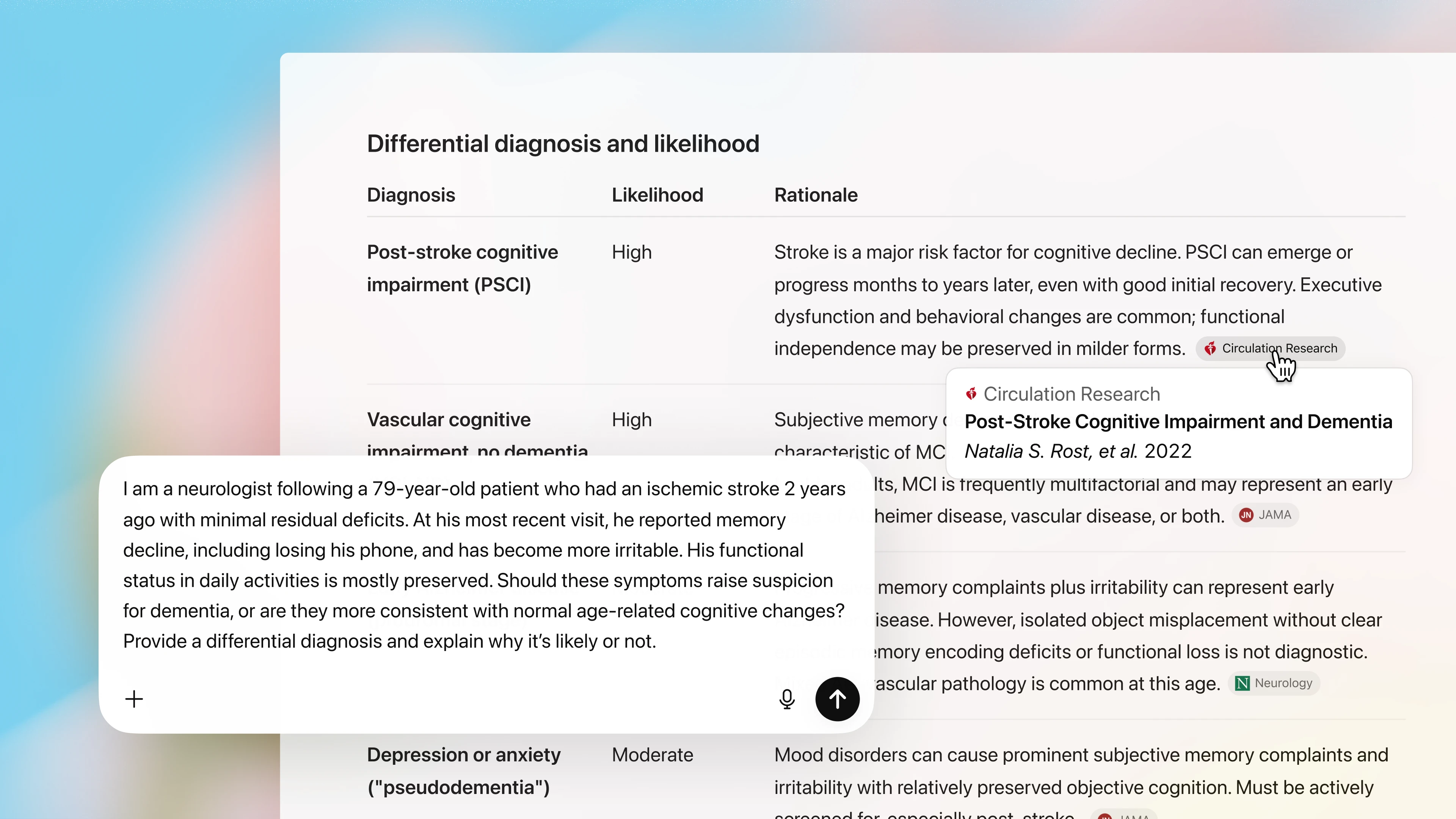
OpenAI’s January launch illustration shows clinical reasoning with cited sources, providing context for November’s expansion into computer use. Image: OpenAI. Source: OpenAI healthcare launch.
OpenAI says computer-use capabilities are available through its application programming interface (API), ChatGPT for Healthcare and ChatGPT for Clinicians in its results announcement. An API lets software exchange information directly; screen interaction covers steps where that connection is absent or incomplete.
This expands an existing business. OpenAI launched ChatGPT for Healthcare on January 8 as a governed workspace for clinicians, administrators and researchers. It already offered evidence retrieval, institutional-policy integration and templates for discharge summaries and prior-authorization support. OpenAI said then that thousands of organizations had configured its API to support HIPAA-compliant use, including Abridge and Ambience, which were among developers building ambient listening, clinical documentation and scheduling capabilities.
South Korea is strengthening device checks and considering public Wi-Fi shutdowns before its November 19 college entrance exam, after a tax-accountant exam top scorer admitted using AI to cheat. The response still depends heavily on human screening, with no electronic device detectors planned for this year's test.
The November update adds execution across applications to that foundation. It also expands the alternative route of connecting tools directly: OpenAI’s companion announcement introduces more than 20 healthcare plugins for clinical care, coordination and business operations. Examples include retrieving discharge information, checking insurance eligibility and comparing negotiated procedure rates. Computer use supplements those integrations rather than replacing them.
A concrete example comes from Assort, a healthcare referral-workflow developer described in OpenAI’s announcement. Its existing integration could attach a referral to a patient’s chart through the Athena API, but closing the referral required a separate interface step. OpenAI says Assort used computer interaction to mark the referral as scheduled and remove it from the staff follow-up list. This is a narrower claim than automating the entire referral process.
CVS Health spans health benefits, pharmacy services, care delivery and retail pharmacies. It announced on November 4 that it intends to separate its healthcare-solutions and retail-pharmacy businesses into two public companies, with completion expected in the first half of 2028.
According to OpenAI, CVS is using agents to send documents, process referrals and support specialist consults. One production workflow cleared a months-long document-sending backlog over a weekend; another performs system steps for tens of thousands of consults daily. Those are operational claims, without a published before-and-after labor-cost calculation or patient-outcome measurement in the announcement.
CVS uses validation checks, human oversight, screenshots and action records to verify application state and completed actions. OpenAI says CVS is open sourcing an Agent Kit built with OpenAI’s Agents SDK to make that approach reusable. It says CVS data remains in enterprise-controlled infrastructure and production data is not used to train foundation models.
Cigna Healthcare, the health-benefits business of The Cigna Group, is using OpenAI models to gather context for case managers preparing member outreach. The parent company had already announced a broader OpenAI collaboration on September 23, initially focused on supporting people with cancer between doctor visits. That establishes a prior care-management relationship; the new announcement describes a specific way to assemble information for staff.
Previously, Cigna Healthcare case managers navigated more than 10 clinical and administrative systems for benefits, coverage, providers, appointments and prior interactions. OpenAI says agents can assemble that context in seconds. Cigna says it moved from concept to deployment in under eight weeks. The work supports members around care plans established by their treating providers.
Abridge and Ambience, healthcare AI software developers already using OpenAI’s API before this update, illustrate different stages of implementation. Abridge is developing agents to carry out care plans across applications, including those without APIs. Its planned inpatient use combines clinical conversations, records and staff context to address discharge barriers such as medication access and home-health coordination.
Ambience demonstrated an agent preparing an authorization request from chart evidence. When the record is ambiguous, it stops to ask the clinician and waits for approval before submission. Health systems can restrict actions, pause the agent and inspect a step-by-step log. These distinctions between production, development and demonstrations also appear in the account of the four organizations’ work.
OpenAI’s own MRI demonstration used synthetic patient data. It showed an agent drafting an order, encounter note and patient reply for clinician review, then preparing an insurer authorization request for a specialist to review. It demonstrates a proposed connected workflow, rather than results from treating real patients.

Company-reported HealthAdminBench rubric scores at maximum reasoning effort. These measure available points earned; OpenAI did not disclose complete-workflow success rates for either model. Source: OpenAI.
OpenAI evaluated its GPT-6 Astra model on multi-step electronic health record inbox tasks shaped by physician input. Reviewers examined actions alongside generated notes, orders and patient messages. They rated 99% of 325 reviewed tasks clinically safe, assessing whether inaccuracies, omissions or actions could plausibly lead to patient harm. Physicians rated the work very or extremely helpful in 93% of 646 assessments.
Those denominators refer to different assessments, not patient-outcome rates. OpenAI’s explanation of the unsafe ratings also needs qualification. In an interview about the evaluations, Karan Singhal, OpenAI’s head of Health AI and Artificial General Intelligence, said researchers had not identified a specific, plausible risk of patient harm in those cases. He nevertheless described cases in which the model overreached or acted without proper authorization. This is the company’s account of evaluation behavior, not evidence of failures in the customer deployments.
For administrative work, OpenAI reported that Astra earned 94.3% of available rubric points on HealthAdminBench, an independent benchmark from Stanford researchers. GPT-6 Luna earned 91.8%, with both models evaluated at maximum reasoning effort. The company put Luna’s cost at 8.5 cents per task, 98% below Astra’s. That is a 2.5-percentage-point reduction in rubric score for a much lower model cost; it is not a measured reduction in a hospital’s operating expenses.
The April HealthAdminBench research paper helps explain the metric’s limits. It describes 135 expert-defined tasks and 1,698 evaluation points across four simulated interfaces: an electronic health record, two payer portals and a fax system. Tasks cover prior authorization, appeals and denials management, and durable medical equipment orders.
In that paper’s evaluation of seven agent configurations, the highest complete-task success rate was 36.3%, achieved by the Claude Opus 4.6 computer-use agent. GPT-5.4’s computer-use agent led subtask success at 82.8%. These earlier models and different metrics do not provide a direct performance comparison with Astra or Luna. They show why earning most available points cannot be read as completing that proportion of workflows correctly. OpenAI’s new announcement does not disclose an equivalent complete-task success rate for either model.
The clinical-search update is a separate evaluation again. OpenAI says physicians rated the updated experience more highly across all eight assessed dimensions in more than 1,300 blind reviews, including correctness, safety, actionability and source authority. That measures clinical responses, rather than agents’ reliability when operating other software.

HealthAdminBench’s evaluation loop checks task success after agents interact with simulated healthcare systems. Figure 1: Suhana Bedi and colleagues, CC BY 4.0. Source: HealthAdminBench research paper.
ChatGPT for Healthcare customers can access computer use in ChatGPT Work and Codex subject to workspace settings. ChatGPT for Clinicians is free for eligible, verified U.S. clinicians, with computer use and improved clinical search available and only select plugins offered. Organizational purchases go through sales, including an AWS Marketplace private offer; the product announcement does not supply a public organizational price for comparison with model-run costs.
OpenAI says workflows involving protected health information must use eligible services under a Business Associate Agreement, apply required security and retention settings, and extend protections to connected systems. Its healthcare workspace offers role-based access and audit logs, and organization data is not used to train foundation models. Those conditions make governance and connected-system configuration part of implementation.
In the interview, Singhal described OpenAI’s role as supplying foundational capabilities while healthcare companies handle the final implementation. He also identified latency and cost as areas for improvement. That division leaves customers and partners to establish which actions an agent may take, where approval is required, and how to verify completion.
The next evidence needed is the proportion of complete workflows that finish correctly under those controls, the review and correction time they consume, and total costs after integration and oversight. CVS’s reported production volumes make that a consequential operational question. The model evaluations alone cannot settle it.
Russia’s objections to observer participation stalled the opening of a Geneva weapons conference, where governments must decide whether to authorize negotiations on autonomous weapons and whether any resulting rules should be binding.
Apple’s iOS 27.3 beta ties higher allowances for server-based AI to existing iCloud+ plans. Basic Siri commands remain free, but undisclosed daily limits leave the value of paid access uncertain.
The partners plan to combine IBM quantum processors, NVIDIA computing and Fermilab physics expertise to study modular quantum systems. A separate decoder release promises faster error-correction research, with important limits on its performance comparisons.
Federal Reserve Chairman Kevin Warsh outlined AI scenarios spanning shared prosperity, job displacement and an investment downturn. The exercise offers no forecast or rate guidance as colleagues worry that the infrastructure buildout is adding to inflation.
OpenAI is offering approved organizations a free classifier for suspected child sexual abuse images, including AI-generated material. Early results suggest less review work, but existing detection alternatives and the need for human review qualify the launch.
Nvidia plans scientific computing racks for early 2027, extending Vera beyond its initial AI deployments. Its 2.4× performance-per-watt claim comes from one airflow simulation against AMD Turin; performance against newer rivals and delivered costs remain unresolved.
OpenAI’s CEO expressed empathy for Nvidia founder Jensen Huang but withheld judgment on reinstatement. His confidence in continued AI financing comes with a direct commercial stake and unresolved deployment risks.
Google’s 8,192-chip Ironwood submission completed the MLPerf DeepSeek-V3 benchmark in 1.70 minutes, close to NVIDIA’s 1.53 minutes at the same accelerator count. Google’s scaling data also shows the extra chip-time required for its fastest result, leaving cost and energy comparisons unresolved.
TensorWave will supply dedicated AMD infrastructure under a six-year OpenAI agreement, with delivery expected from 2027. Its operating record and financial backing sit alongside an undisclosed contract price and a recently terminated site lease.
California alleges OpenAI endangered the public and misled consumers by testing powerful AI models without adequate controls. The lawsuit follows a Hugging Face intrusion that OpenAI’s own account traced to containment failures, missing monitors and mishandled warning signs.
Perplexity has launched Frontier Research to develop AI that can formulate questions, test hypotheses and produce interpretable discoveries. The company promises more than 10,000 GPUs, but existing automated-research systems show why computing resources and generated papers alone cannot establish scientific value.
The new lab led by Stanford professors Yejin Choi and Carlos Guestrin has backing from Nvidia, Cisco and Snowflake. It promises systems that improve on company work, but research benchmarks leave production costs and customer control unproven.
NVIDIA announced a Rubin HPC GPU with more than 50,000 CUDA cores, sparse data acceleration and seventh-generation NVLink. The design targets simulations used by scientists and AI agents, but missing performance, power and pricing details leave its practical advantage unproven.
OpenAI will open 50,000 new ChatGPT access grants on November 23, covering up to 150,000 researchers and collaborators. New recipients get Plus instead of Pro, with first-come selection replacing a lottery. Its pilot study reports perceived time savings but does not establish faster discovery.
President Donald Trump supported a return for Nvidia co-founder Jensen Huang, but the company has installed interim leadership and begun a successor search amid scrutiny of his conduct and alleged Chinese intelligence ties.
Intel disclosed the bandwidth target for its next Xeon server processors at SC26, alongside previously announced core and cache limits. Application performance, power requirements and launch timing remain unresolved.
Mercedes-Benz plans California early access to city-driving and hands-free highway assistance in December, ahead of a 2027 U.S. rollout. Mixed road tests and unannounced subscription prices leave buyers waiting for evidence of everyday value.
Researchers estimate that 403 large U.S. data centers consumed 81.8 TWh in a year. Their regional-grid analysis reveals substantial fossil-fuel dependence, but cannot isolate AI demand or fully expose the underlying facility data.
HSBC lowered its Zhipu share-price target to HK$500 and delayed forecast adjusted breakeven by two years. Improving API margins and substantial fundraising cushion a business whose gross profit still covers little of its research bill.