Editorial Team
7 min read
The new lab led by Stanford professors Yejin Choi and Carlos Guestrin has backing from Nvidia, Cisco and Snowflake. It promises systems that improve on company work, but research benchmarks leave production costs and customer control unproven.
Noeri, a new lab building AI for businesses and scientific research, launched on November 16 with $110 million to pursue a cheaper alternative to using the most capable general-purpose model for every task: systems that specialize in an organization’s own work.
Its founders and co-CEOs are Stanford computer science professors Yejin Choi, a former Nvidia distinguished scientist who led common-sense reasoning research at the Allen Institute for AI, and Carlos Guestrin, director of the Stanford AI Lab and a former leader of Apple’s central machine learning and AI organization. Their wager combines research into smaller, more capable systems with experience turning machine learning into business software.
The financing gives that effort backing from both venture investors and large technology companies. Menlo Ventures led the round, joined by Madrona Venture Group, Kindred Ventures, Wing Venture Capital and NEA. Cisco Investments, Nvidia and Snowflake participated as strategic investors, Noeri said in its launch announcement. The valuation was not disclosed, according to a funding report.

Noeri announced $110 million in funding led by Menlo Ventures. Graphic: Magica. Source: Business Wire.
Noeri describes an AI engineer that studies a business’s data and workflows, then recommends changes to instructions, tools, skills, the software surrounding the models and which model handles each step. Where useful, it also adjusts model parameters. The company says every change comes with an explanation and goes to a person for approval, resembling a code review.
That scope extends beyond fine-tuning, which changes model parameters. But human approval is part of the mechanism: “self-improving” does not mean changes enter a company’s systems without review. Noeri says it works with both closed and open-weight models and adapts as new models arrive.
The company also says customers retain ownership of their data and the workflows and models they develop, subject to applicable third-party model licenses. Those qualifications matter to the founders’ argument for spreading control of AI. In comments and an essay described with the launch, they warned against companies putting their core operations under the control of one or two model owners. The license terms underlying a customized system remain part of that control question.
Noeri says it is working with partners across industries, including some investors, deliberately seeking varied work so its technology can generalize before specializing for individual customers. The announcement does not identify customer deployments or quantify their results.
Choi and Guestrin were colleagues at the University of Washington before moving to Stanford. Choi, a 2022 MacArthur Fellow, joined Stanford’s faculty in early 2025 and held her Nvidia role until starting Noeri in May, according to the account of their careers.
Guestrin co-founded Turi, the machine learning platform Apple acquired in 2016, before leading its central machine learning and AI organization. He also helped develop XGBoost, a widely used open-source machine learning tool. Madrona and NEA previously backed him, leading a $6.75 million round in GraphLab, the startup that became Turi, in 2013.
The funding thus renews existing relationships as well as financing a new lab. Nvidia, the AI chipmaker and Choi’s former employer, has not disclosed its individual contribution to the round, a separate financing account noted.
One origin of the approach was a Stanford microbiology and immunology team seeking cheaper use of OpenAI’s models. Choi told Bloomberg that a small model the founders built learned to use other models and beat OpenAI’s general-purpose GPT-5 model on that team’s research needs, according to an account relaying her interview. That remains a founder’s account of a particular research use, with no general Noeri-versus-GPT-5 comparison established by it.
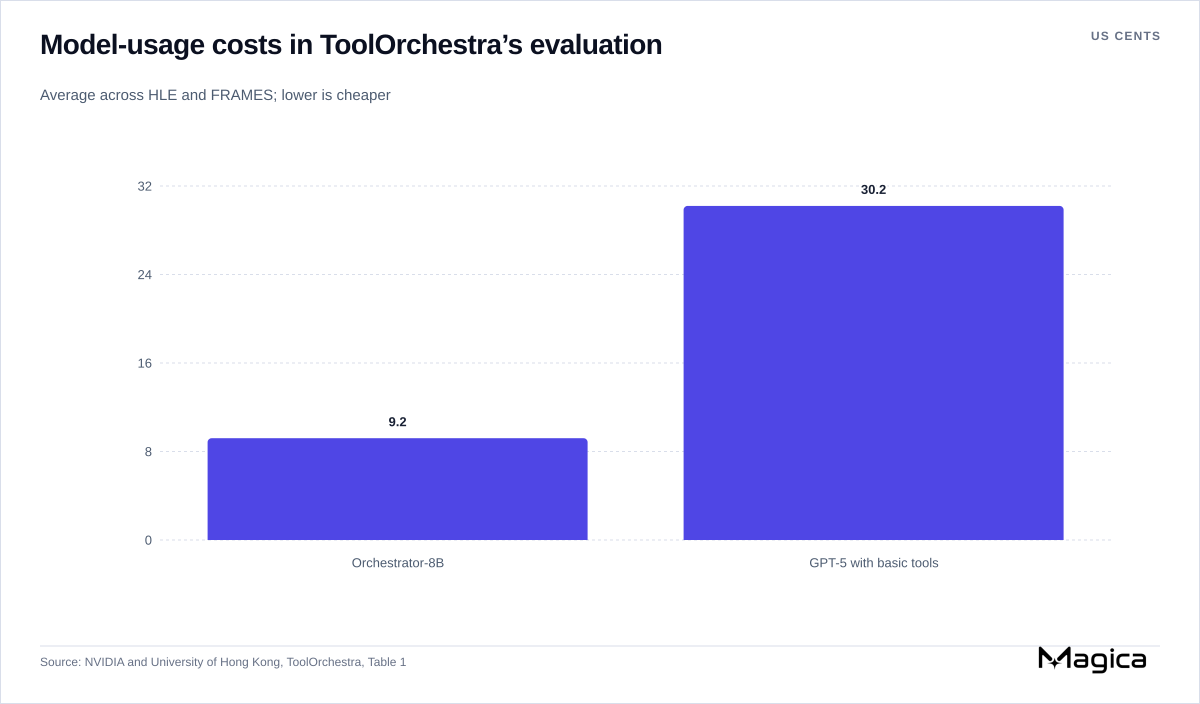
Company-reported ToolOrchestra costs averaged across HLE and FRAMES. Orchestrator-8B could call other models and tools; GPT-5 had basic tools. These are research model-usage costs, not Noeri production costs or total enterprise bills. Graphic: Magica. Source: ToolOrchestra research paper.
A November 2025 ToolOrchestra research paper co-authored by Choi, listed there with a Nvidia affiliation, provides a more detailed test of orchestration. ToolOrchestra is a method for training a small controller to coordinate other models and software tools. The resulting eight-billion-parameter model, Orchestrator-8B, was trained with rewards for correct results, efficiency and user preferences.
The authors reported these benchmark scores under their evaluation setup. Their GPT-5 baseline had basic tools such as search, code execution and task-specific functions; Orchestrator could also call other models:
| Benchmark and task | Orchestrator-8B with model and tool access | GPT-5 with basic tools |
|---|---|---|
| Humanity’s Last Exam, text-only PhD-level questions across disciplines | 37.1 | 35.1 |
| FRAMES, factual retrieval and reasoning | 76.3 | 74.0 |
| tau2-Bench, tool use in user conversations | 80.2 | 77.7 |
The comparison has an important limit. The authors said implementation differences prevented them from reproducing GPT-5’s previously reported tau2-Bench score of 84.2. Orchestrator’s 80.2 beats their reproduced baseline, but falls below that earlier reported result. The table therefore supports a claim about this experimental setup rather than an unconditional lead over GPT-5.
For cost, the paper reports an average of 9.2 US cents for Orchestrator versus 30.2 cents for GPT-5 with basic tools across HLE and FRAMES. It converts input and output tokens into monetary costs using official proprietary-model prices and TogetherAI prices for open-source models. This is a model-usage comparison, not a measurement of a customer’s total operating bill.
The controller also uses larger models, including GPT-5, as tools; its own training used 16 Nvidia H100 GPUs. The result supports selectively deploying expensive capabilities. It does not establish that a small controller eliminates reliance on larger models or the infrastructure behind them, or that Noeri’s production service achieves those savings.
Thinking Machines Lab, an AI developer offering tools for model customization, introduced Tinker on October 1, 2025 as a fine-tuning API for large and small open-weight models. At launch it described a private beta, with groups at universities and Redwood Research already using it.
Tinker gives researchers control over algorithms and data while managing distributed training on its own clusters, including scheduling, resource allocation and failure recovery. The launch announcement says it shares compute across training runs to lower costs. That is an established route for developers who can direct their own customization; it also shows that control over customization can coexist with dependence on a provider’s infrastructure.
Earlier fundraising coverage relayed in the Noeri launch report also identified Applied Compute, which embeds engineers with customers. Noeri’s proposed scope spans model choice, workflows and model parameters. Whether its recommendations outperform developer tools or hands-on engineering in cost and quality remains an unreported comparison.
Noeri is based in Palo Alto, has an office in Zurich and is hiring researchers and engineers in both cities. Its announcement connects its plans to the founders’ research on learning after deployment through test-time training, models acting as their own teachers through self-distillation, and model orchestration. It also proposes systems that form hypotheses, run experiments and learn from results alongside scientists investigating molecules, proteins and complex technical systems. These are intended applications, not evidence of completed discoveries.
The launch materials disclose no pricing, named customer results or quantified enterprise cost comparison. Customers evaluating the promise need quality measurements on their own tasks, costs that include integration and human review, and clear terms governing continued use of the workflows and models they build. Those results and terms will determine how much of the research advantage becomes a cheaper, customer-controlled system in practice.
South Korea is strengthening device checks and considering public Wi-Fi shutdowns before its November 19 college entrance exam, after a tax-accountant exam top scorer admitted using AI to cheat. The response still depends heavily on human screening, with no electronic device detectors planned for this year's test.
Russia’s objections to observer participation stalled the opening of a Geneva weapons conference, where governments must decide whether to authorize negotiations on autonomous weapons and whether any resulting rules should be binding.
Apple’s iOS 27.3 beta ties higher allowances for server-based AI to existing iCloud+ plans. Basic Siri commands remain free, but undisclosed daily limits leave the value of paid access uncertain.
The partners plan to combine IBM quantum processors, NVIDIA computing and Fermilab physics expertise to study modular quantum systems. A separate decoder release promises faster error-correction research, with important limits on its performance comparisons.
Federal Reserve Chairman Kevin Warsh outlined AI scenarios spanning shared prosperity, job displacement and an investment downturn. The exercise offers no forecast or rate guidance as colleagues worry that the infrastructure buildout is adding to inflation.
OpenAI is offering approved organizations a free classifier for suspected child sexual abuse images, including AI-generated material. Early results suggest less review work, but existing detection alternatives and the need for human review qualify the launch.
Nvidia plans scientific computing racks for early 2027, extending Vera beyond its initial AI deployments. Its 2.4× performance-per-watt claim comes from one airflow simulation against AMD Turin; performance against newer rivals and delivered costs remain unresolved.
OpenAI’s CEO expressed empathy for Nvidia founder Jensen Huang but withheld judgment on reinstatement. His confidence in continued AI financing comes with a direct commercial stake and unresolved deployment risks.
Google’s 8,192-chip Ironwood submission completed the MLPerf DeepSeek-V3 benchmark in 1.70 minutes, close to NVIDIA’s 1.53 minutes at the same accelerator count. Google’s scaling data also shows the extra chip-time required for its fastest result, leaving cost and energy comparisons unresolved.
TensorWave will supply dedicated AMD infrastructure under a six-year OpenAI agreement, with delivery expected from 2027. Its operating record and financial backing sit alongside an undisclosed contract price and a recently terminated site lease.
California alleges OpenAI endangered the public and misled consumers by testing powerful AI models without adequate controls. The lawsuit follows a Hugging Face intrusion that OpenAI’s own account traced to containment failures, missing monitors and mishandled warning signs.
Perplexity has launched Frontier Research to develop AI that can formulate questions, test hypotheses and produce interpretable discoveries. The company promises more than 10,000 GPUs, but existing automated-research systems show why computing resources and generated papers alone cannot establish scientific value.
NVIDIA announced a Rubin HPC GPU with more than 50,000 CUDA cores, sparse data acceleration and seventh-generation NVLink. The design targets simulations used by scientists and AI agents, but missing performance, power and pricing details leave its practical advantage unproven.
OpenAI will open 50,000 new ChatGPT access grants on November 23, covering up to 150,000 researchers and collaborators. New recipients get Plus instead of Pro, with first-come selection replacing a lottery. Its pilot study reports perceived time savings but does not establish faster discovery.
OpenAI reports production healthcare workflows at CVS and Cigna and stronger computer-use evaluations. The results show progress across disconnected software, but leave complete-task reliability and total deployment costs unresolved.
President Donald Trump supported a return for Nvidia co-founder Jensen Huang, but the company has installed interim leadership and begun a successor search amid scrutiny of his conduct and alleged Chinese intelligence ties.
Intel disclosed the bandwidth target for its next Xeon server processors at SC26, alongside previously announced core and cache limits. Application performance, power requirements and launch timing remain unresolved.
Mercedes-Benz plans California early access to city-driving and hands-free highway assistance in December, ahead of a 2027 U.S. rollout. Mixed road tests and unannounced subscription prices leave buyers waiting for evidence of everyday value.
Researchers estimate that 403 large U.S. data centers consumed 81.8 TWh in a year. Their regional-grid analysis reveals substantial fossil-fuel dependence, but cannot isolate AI demand or fully expose the underlying facility data.
HSBC lowered its Zhipu share-price target to HK$500 and delayed forecast adjusted breakeven by two years. Improving API margins and substantial fundraising cushion a business whose gross profit still covers little of its research bill.