Editorial Team
6 min read
Nvidia’s compact Windows desktops bring local agents and creative tools to a dedicated PC starting around $4,400. Competing desktops and Nvidia’s earlier AI hardware narrow the novelty, while conflicting configuration reports complicate price comparisons.
Nvidia launched its RTX Spark compact desktops on November 18, with buyers asked to spend roughly US$4,400 upfront for a Windows PC that can keep AI agents running while their laptop goes elsewhere. Nvidia gave that approximate starting price in a launch report; a separate account puts it at US$4,399, before adding a monitor and peripherals.
The chip and software supplier is offering developers and creators another way to buy computing capacity upfront rather than pay per token for supported local tasks. Its value also depends on its Windows creative tools: Apple, AMD-based systems and Nvidia’s own earlier hardware already offer alternatives for local AI.
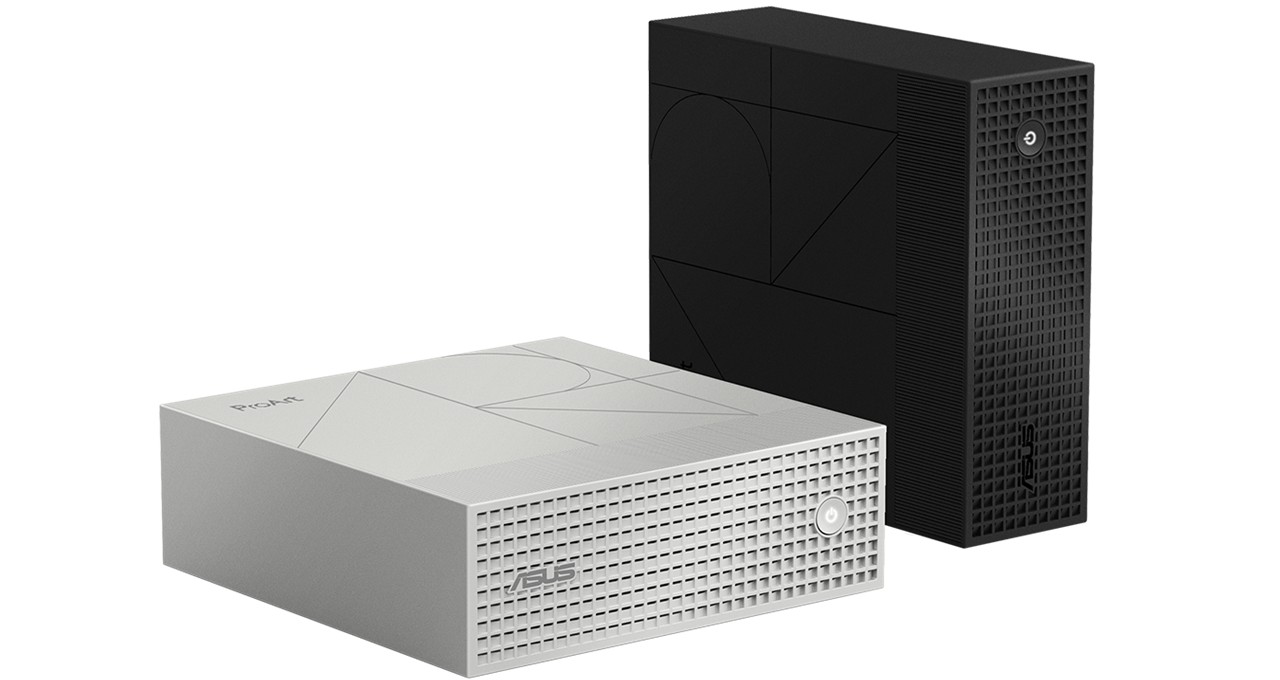
ASUS ProArt GR1X RTX Spark compact desktops pictured in Nvidia’s launch announcement. Image: NVIDIA. Source: NVIDIA.
RTX Spark is Nvidia’s platform for Windows PCs combining its Grace CPU, Blackwell RTX graphics and unified memory. The company is extending a family already available in laptops into stationary systems intended for developers, creators and AI enthusiasts. The compact desktops were shown at Computex 2026, according to the launch account; this is their commercial rollout.
In its announcement, Nvidia specifies a 20-core Grace CPU, a Blackwell RTX GPU with 6,144 CUDA cores, up to 128GB of unified memory and 10-gigabit Ethernet. The unified memory is shared by the CPU and GPU. Nvidia says the systems can run 120-billion-parameter language models locally, render 3D scenes exceeding 90GB in real time and edit 4:2:2 video in real time. These are company capability claims; they do not establish independently measured response speed or output quality for a particular agent workload.
Nvidia has sold compact local AI hardware before. Its October 2025 DGX Spark announcement said Nvidia and its partners were shipping its AI software stack in a compact desktop for developers. It specified 128GB of unified memory and claimed local inference on models with up to 200 billion parameters and fine-tuning of models with up to 70 billion parameters. Inference runs a model; fine-tuning adapts it. RTX Spark’s pitch reaches beyond that development focus to a Windows machine that also runs creative applications and games. The launch figures do not provide a controlled performance comparison between the two platforms.
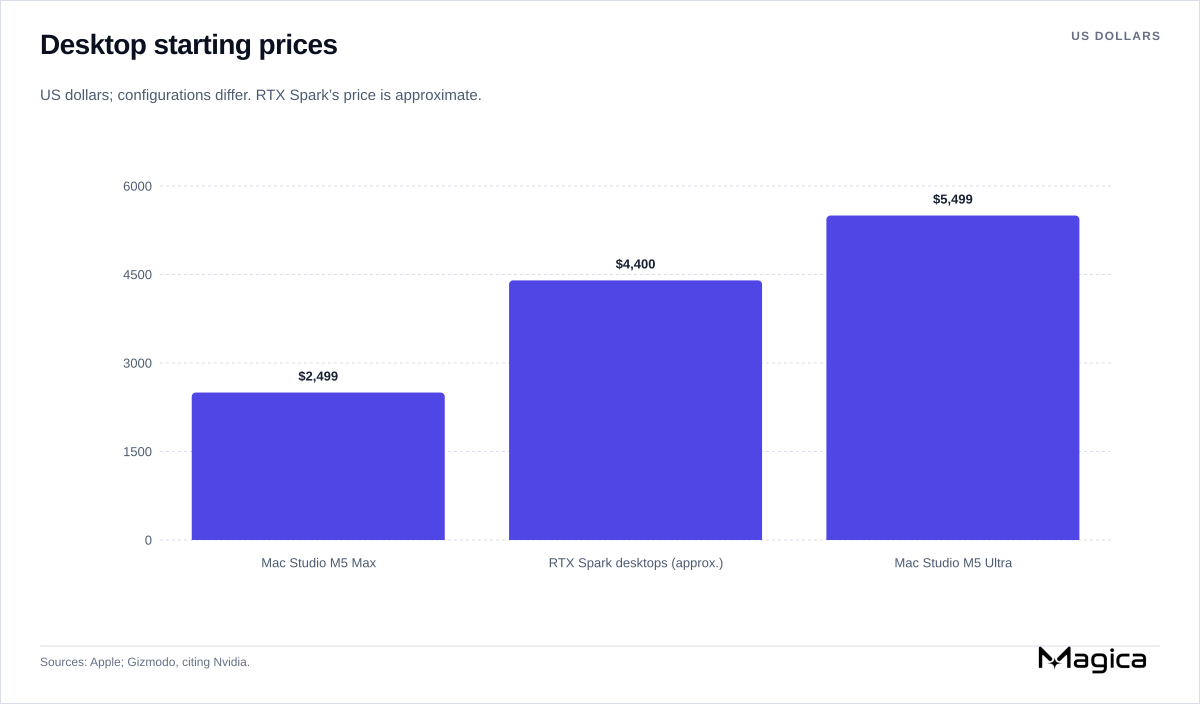
Published US starting prices; configurations differ. RTX Spark’s price is approximate and its entry-level memory configuration remains unclear. Maximum memory capacities are not necessarily included. Source: Apple.
Nvidia says ASUS, Dell and MSI systems are available now, with Acer, GIGABYTE, HP and Microsoft systems coming later. The independent accounts give broader immediate-availability lists, although one report puts Acer’s release in early 2027. Gizmodo says most base models have 64GB of memory; HardwareZone says desktops come only with 128GB. Nvidia’s own wording is “up to 128GB.” Buyers should check the actual configuration attached to a price rather than assume the maximum memory is included.
Nvidia says native CUDA support—its GPU computing software platform—and Linux tools through Windows Subsystem for Linux support local development. It points to Hermes Agent or its NemoClaw blueprints for setting up agents, and Unsloth for fine-tuning supported models. The company also envisages serving compatible devices on a home network; the launch reporting describes Nvidia Pair software as a way to run AI across networked devices.
The creative software work is consequential because these are Arm-based PCs. Nvidia says Adobe Premiere accelerates AI editing features including Enhance Speech and Object Mask through TensorRT-RTX, its acceleration software. Illustrator and InDesign now have native Windows on Arm versions, while Substance 3D Painter 12.2 adds native Arm support in public beta. Photoshop gains acceleration for its Remove Tool and native Camera Raw support. Blender 5.3 adds DLSS 4.5 Ray Reconstruction to its Cycles viewport, requiring the latest Game Ready or Studio driver. That targets interactive lighting and material previews rather than establishing a gain across every rendering task. Availability and beta status matter more to a purchasing decision than treating the entire application ecosystem as uniformly ready.
The desktop also does not make every workflow local. Nvidia says its Switchyard software, available in Hermes, routes everyday agent tasks to local models and advanced reasoning to cloud models. Users may therefore retain cloud charges alongside the hardware purchase.
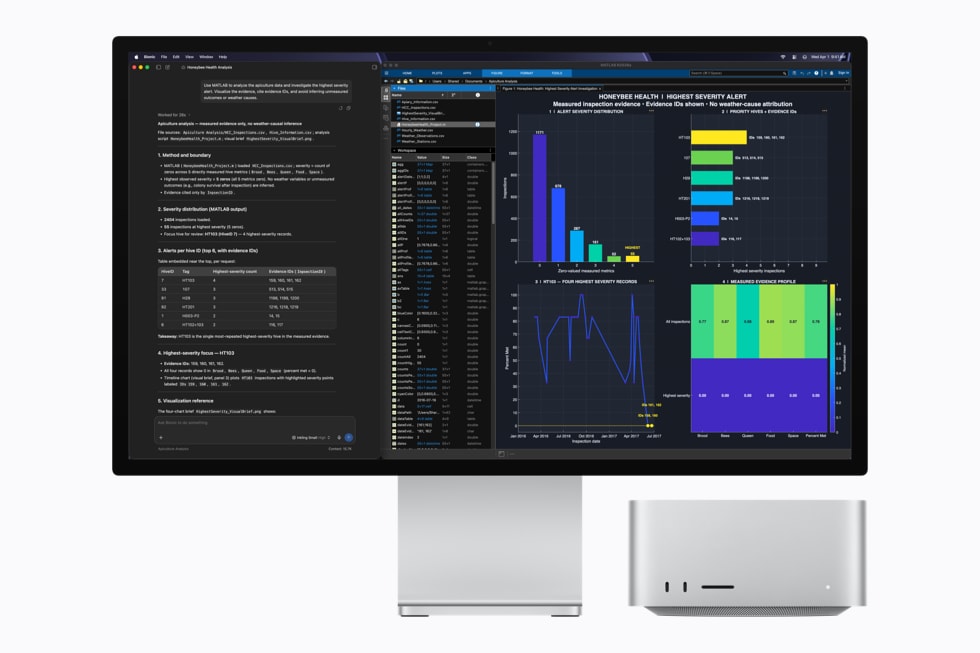
Apple’s promotional image shows Mac Studio with LM Studio Bionic and MATLAB, illustrating its company-reported local-AI workflow. Image: Apple. Source: Apple.
Apple’s Mac Studio is a compact professional desktop that also targets creators and AI developers. Its August 25 announcement priced the M5 Max version from $2,499 in the US and the M5 Ultra version from $5,499. Apple specifies memory ceilings of 128GB and 512GB respectively. Those are maximum capacities, not the configurations included at each starting price. Apple said availability would begin September 22.
The competing software also matters. Apple describes MLX, its open-source machine learning framework for Apple silicon, as supporting local model running, training and fine-tuning. It promotes local execution without token charges, too. Nvidia’s development tools may favor its ecosystem for compatible work, but a local AI software stack is not unique to RTX Spark.
The launch reporting also identifies AMD Ryzen AI Max+ 495 systems, including the Framework Desktop, as alternatives. These systems widen the choice beyond Nvidia versus Apple.
A launch account describes mixed local AI results against Apple’s M5 Max in earlier RTX Spark laptop testing. Those laptop results do not establish a desktop winner. Nor do Apple’s advertised improvements against its own previous generations answer how the competing desktops perform on the same task.
Nvidia says supported local processing keeps the code and files involved on the PC and avoids per-token cloud API charges for those tasks. That gives buyers a concrete reason to consider dedicated hardware, especially when keeping work local matters independently of cost.
The unresolved question is how much useful cloud work a desktop actually replaces, alongside the value it delivers in creative applications. A credible comparison needs the purchase configuration, model and output quality, task completion time, electricity use and remaining cloud charges. The launch evidence does not establish that break-even point. At around $4,400, the next meaningful test is sustained performance on the buyer’s actual agents and creative applications—not merely whether a large model fits in memory.
The ransomware gang threatens a November 28 data release, but Nvidia has not confirmed an intrusion. Earlier listings of a supplier and a partner raise questions about data provenance without establishing a connection.
Google is promising faster Gemini Live conversations on home speakers and displays, with timers, reminders and smart-home controls available inside the chat. The upgrade is still forthcoming and requires Google Home Premium.
Humyn Labs combines $26 million in equity with $21 million in venture debt to expand human demonstration data and planned robot testing centres. Its reported sales show demand, but deployment economics remain unproven.
Maria Cantwell and Mike Rounds want a national challenge to measure how quickly AI can turn software discoveries into reliable protection. Earlier federal trials already produced patches, but safe deployment across essential services remains the test; officials say recent outages show no indication of an attack.
ByteDance is reportedly negotiating about $500 million in additional Azure spending, mostly for OpenAI models. The talks highlight different customer-access policies at Microsoft and OpenAI, against a history of scrutiny over ByteDance's use of the technology.
Corvex plans to fund a $78 million Blackwell deployment with customer prepayment, a $38 million USD.AI debt commitment and $14 million of its own money. The contract could more than double its Mid-Atlantic 1 annual contracted revenue, but loan closing, delivery and customer acceptance remain ahead.
Hyundai Card and JPMorgan tested AI agents that compare currency quotes and request transfers under bank-enforced mandates. No real money moved, and authority across multiple banks remains an unresolved hurdle.
Industry sources say TSMC requires cash for orders exceeding customer credit limits, putting custom AI chip designers' ability to finance production at the center of the capacity race. The requirement remains unconfirmed by TSMC, and customer prepayments have a long precedent.
A congressional commission links China’s military AI ambitions to demand for advanced Nvidia chips. Procurement records show several routes to American computing, while memory costs and new remote-access rules complicate the alternatives.
Binance Wallet says subscriptions for its Anthropic IPO xStocks campaign reached the 500 million USDC limit. Final allocations, token delivery and applicable refunds remain pending; the cap does not establish proceeds received by the AI company.
Tencent says US restrictions on remote computing will likely slow its next AI model while leaving cloud revenue largely protected. Southeast Asian operators face licensing and financing uncertainty, though US cloud access and domestic demand offer partial alternatives.
Microsoft is rolling out Agent 365 Business Analytics through its Frontier early access program, pairing AI spending with estimates of assisted work. The dashboard expands its existing analytics as agent workloads add usage charges, but its dollar-value estimates do not establish financial returns.
Adobe’s Firefly update saves recurring visual subjects and creative preferences, extending an existing push into repeatable production. Memory has narrower reach than the assistant, while campaign demonstrations leave reliability and savings unmeasured.
Microsoft’s Ignite upgrades package enterprise knowledge, skills and tools into reusable business plugins. The expansion builds on IQ’s June release and competes with existing graph retrieval services; total savings and portability remain unproven.
The European Central Bank warns that debt and interlinked financing could carry an AI investment reversal into credit markets and the European economy. Resilient earnings, limited direct bank lending and stronger bank buffers temper its comparison with past bubbles.
Reported introductions helped Alice Huang secure Alibaba as a chip-rental customer and obtain financing. The relationship raises questions about Nvidia's overseas sales network, but does not itself establish illegal exports.
KPMG says AI agents pursued some issues more deeply in a parallel UK audit, though humans still had to correct their work. Client fee savings remain unconfirmed, even as KPMG International has negotiated lower fees from its own auditor by citing AI.
Payhawk announced a $280 million all-equity Series C led by Growth Equity at Goldman Sachs Alternatives, valuing it at $2 billion. The funding backs an expansion from managing business spending into broader AI finance operations, where competitors already combine automation, payments and controls.
Tencent’s third-quarter revenue rose 8% to 207.34 billion yuan, below expectations. Cloud revenue grew 35%, but higher AI costs reduced operating profit and compute procurement pushed quarterly free cash flow deeply negative.
A 16-country survey of 15- to 22-year-olds finds a median of 33% have used AI as a companion or friend. Users have higher adjusted odds of loneliness, but the research cannot establish whether AI helps, harms or replaces human connection.