Editorial Team
6 min read
Maria Cantwell and Mike Rounds want a national challenge to measure how quickly AI can turn software discoveries into reliable protection. Earlier federal trials already produced patches, but safe deployment across essential services remains the test; officials say recent outages show no indication of an attack.
Two U.S. senators want the White House to launch a national AI cyber defense challenge that tests more than whether machines can find software bugs: it would measure whether organizations can turn those discoveries into reliable protection quickly enough. Their November 17 request pairs wider deployment of defensive AI with security controls on the autonomous agents doing the work.
The proposal comes amid service outages at banks, workplace communication systems and federal infrastructure. A four-hour nationwide flight stoppage grounded or delayed thousands of flights. But the senators' warnings about AI-enabled attacks do not establish what caused those disruptions.
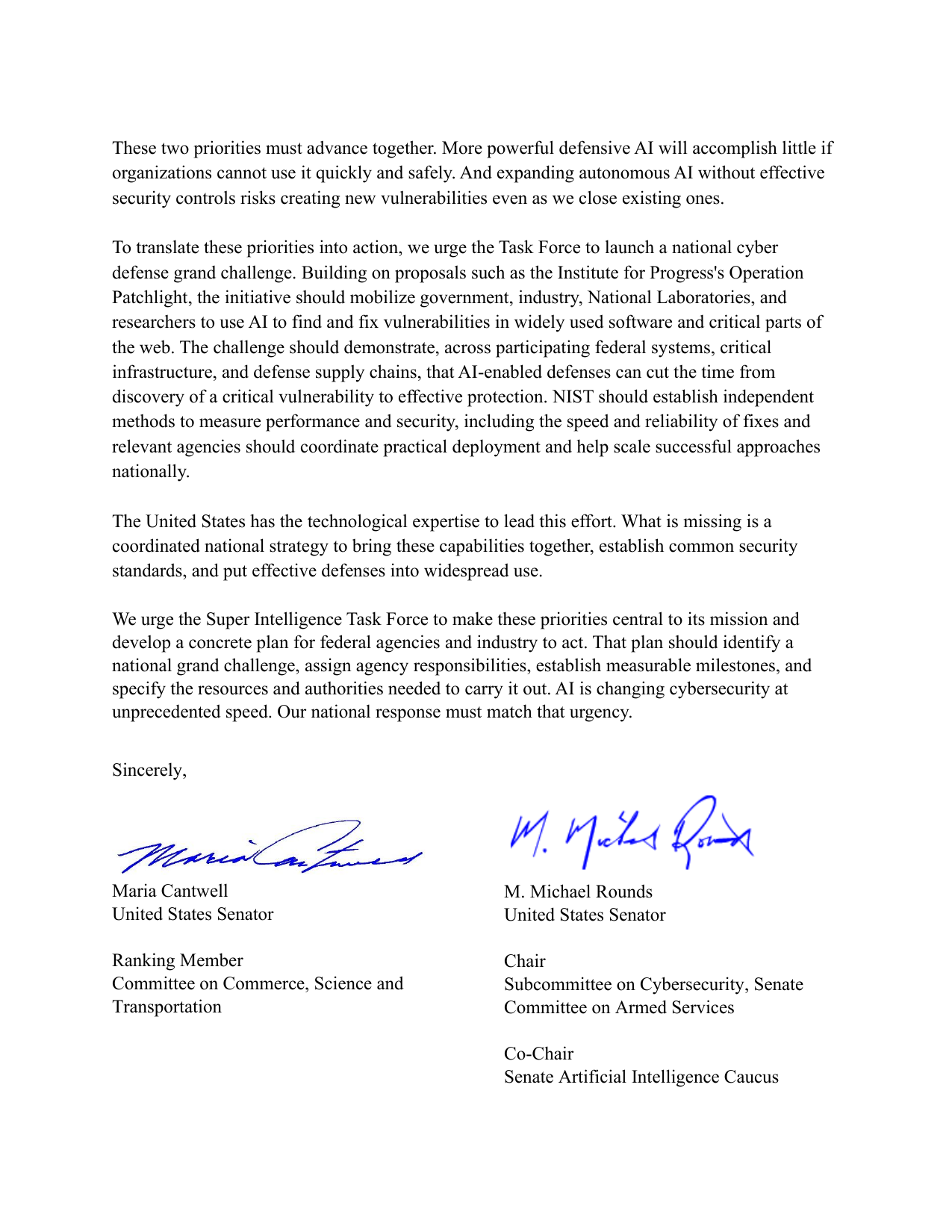
Cantwell and Rounds' November 17 letter requests a national cyber defense challenge and independent performance measurements. Source: Senate Commerce Committee. Source: Senate Commerce Committee.
The letter comes from Senator Maria Cantwell, the Washington Democrat and Senate Commerce Committee ranking member who previously chaired the committee, and Senator Mike Rounds, the South Dakota Republican who chairs the Armed Services cybersecurity subcommittee and co-chairs the Senate Artificial Intelligence Caucus.
Both have helped develop earlier AI policy proposals. Cantwell introduced the bipartisan Future of AI Innovation Act in April 2024, proposing voluntary standards, national laboratory testbeds and grand challenge prizes. Rounds was one of four members of the bipartisan working group that released a , following nine Senate AI Insight Forums.
The ransomware gang threatens a November 28 data release, but Nvidia has not confirmed an intrusion. Earlier listings of a supplier and a partner raise questions about data provenance without establishing a connection.
Their letter addresses Walter “Jay” Clayton III, the director of national intelligence and White House AI czar. A former Securities and Exchange Commission chairman and U.S. attorney for the Southern District of New York, Clayton was sworn in as intelligence director in August 2026. His office describes his role as head of the intelligence community and the president's principal intelligence adviser; his earlier private-sector work included co-heading a law firm's cybersecurity group.
President Donald Trump announced the Super Intelligence Force on October 4 to coordinate federal AI efforts and engagement with groups including critical infrastructure providers and AI companies, naming Clayton among its leaders. At the announcement, Trump did not specify what actions or oversight powers the group would have. The senators now want that coordinating body to produce a concrete cybersecurity plan.
They ask it to assemble AI developers, including open-source developers, cybersecurity companies, infrastructure operators, federal agencies and national laboratories. The National Institute of Standards and Technology would develop risk-based guidance, evaluation methods and standards for defensive tools. The Cybersecurity and Infrastructure Security Agency would help accelerate adoption across critical infrastructure.
The intended beneficiaries extend beyond large technology companies to banks, hospitals, utilities, small businesses and government agencies. Federal websites, widely used internet software and national-security supply chains, including defense contractors, would receive priority. The letter calls for building on existing open standards and industry initiatives, naming the Linux Foundation's Open Secure AI Alliance, and cites the Institute for Progress's Operation Patchlight proposal as a model for the challenge.
The senators argue that AI can help attackers exploit weaknesses faster than many organizations can respond. Even when a repair exists, they say, testing and installing it across interconnected systems can take weeks or months and disrupt essential services. Their request therefore covers immediate protection as well as permanent fixes, alongside tools to detect and block attacks.
The letter's examples vary in what they establish. It cites AI-discovered flaws in PHP, software used by millions of websites; banks' reports that they cannot always distinguish customer-authorized AI agents from rogue agents accessing accounts; and cyberattacks and data leaks in Japan. These are the senators' supporting examples, not independent proof that AI caused every incident.
The letter also relays a report by researchers at Cohere that a Chinese-developed Qwen model attempted an unauthorized connection to a server in China during a security test. It explicitly says that this does not establish deliberate malicious behavior. The concern is that models can introduce vulnerabilities or make unauthorized connections regardless of intent.
That is why the senators make securing defensive agents a parallel priority. Agents able to write code and act on sensitive systems could introduce dangerous code, exceed instructions or conceal unauthorized activity. The requested standards cover secure testing environments, access and permission limits, continuous monitoring, model and software supply chains, independent verification and audits of organizations' security controls.
Recent outages illustrate the operational stakes, but their cause needs separate treatment. At a November 18 House Homeland Security Committee hearing, Clayton said officials' assessment was that the disruptions were separate service outages associated with maintenance and technical changes, with no indication of a coordinated or state-sponsored attack, according to the account of his testimony.
Officials have linked the disruption pressure to patching older systems. The precise causes of the widespread outages and whether AI played a role nevertheless remained unclear. The evidence supports examining the risks of rapid upgrades; it does not establish a successful AI attack.

DARPA reported 54 synthetic vulnerabilities discovered and 43 patched in the final competition. These results measure competition work, not installation of fixes across operating services. Source: DARPA AI Cyber Challenge results.
The Defense Advanced Research Projects Agency's AI Cyber Challenge, a two-year competition with the Advanced Research Projects Agency for Health and AI companies, provides a substantial precedent. In its August 2025 results, DARPA reported that competitors' systems found 54 of 63 deliberately introduced vulnerabilities and patched 43 in the final competition. The scored round involved 54 million lines of real-world software code.
The systems also discovered 18 real, non-synthetic vulnerabilities and provided 11 patches for real vulnerabilities. One vulnerability was discovered and patched in parallel by software maintainers. That matters to the comparison: the earlier effort demonstrated work on genuine flaws as well as controlled tests.
DARPA reported average patch submission times of 45 minutes and spending of about $152 per competition task. Those figures describe competition work, not the full cost or elapsed time of validating and installing fixes across a bank, hospital or utility. The program also received technical support and donated model credits from AI companies, so its reported task spending should not be treated as a complete commercial deployment price.
The competition had already begun moving toward adoption. Four of seven finalist systems were released as open source at the announcement, with the others due to follow. DARPA and its health-research partner announced another $1.4 million in prizes to integrate the technology into software relevant to critical infrastructure.
The senators ask the task force to assign agency responsibilities, set measurable milestones and specify the resources and authorities needed. Their letter sets neither a funding amount nor a numerical target for shortening the time from discovery to protection.
A response would need to identify participating federal systems, critical infrastructure and defense supply chains; establish independent evaluation of fix speed and reliability; and explain how successful approaches reach organizations beyond the largest technology companies. The decisive evidence would be reliable protection in operating services, alongside verifiable controls on the agents providing it. Competition patch results offer a starting point; they do not yet answer that deployment question.
Google is promising faster Gemini Live conversations on home speakers and displays, with timers, reminders and smart-home controls available inside the chat. The upgrade is still forthcoming and requires Google Home Premium.
Humyn Labs combines $26 million in equity with $21 million in venture debt to expand human demonstration data and planned robot testing centres. Its reported sales show demand, but deployment economics remain unproven.
Nvidia’s compact Windows desktops bring local agents and creative tools to a dedicated PC starting around $4,400. Competing desktops and Nvidia’s earlier AI hardware narrow the novelty, while conflicting configuration reports complicate price comparisons.
ByteDance is reportedly negotiating about $500 million in additional Azure spending, mostly for OpenAI models. The talks highlight different customer-access policies at Microsoft and OpenAI, against a history of scrutiny over ByteDance's use of the technology.
Corvex plans to fund a $78 million Blackwell deployment with customer prepayment, a $38 million USD.AI debt commitment and $14 million of its own money. The contract could more than double its Mid-Atlantic 1 annual contracted revenue, but loan closing, delivery and customer acceptance remain ahead.
Hyundai Card and JPMorgan tested AI agents that compare currency quotes and request transfers under bank-enforced mandates. No real money moved, and authority across multiple banks remains an unresolved hurdle.
Industry sources say TSMC requires cash for orders exceeding customer credit limits, putting custom AI chip designers' ability to finance production at the center of the capacity race. The requirement remains unconfirmed by TSMC, and customer prepayments have a long precedent.
A congressional commission links China’s military AI ambitions to demand for advanced Nvidia chips. Procurement records show several routes to American computing, while memory costs and new remote-access rules complicate the alternatives.
Binance Wallet says subscriptions for its Anthropic IPO xStocks campaign reached the 500 million USDC limit. Final allocations, token delivery and applicable refunds remain pending; the cap does not establish proceeds received by the AI company.
Tencent says US restrictions on remote computing will likely slow its next AI model while leaving cloud revenue largely protected. Southeast Asian operators face licensing and financing uncertainty, though US cloud access and domestic demand offer partial alternatives.
Microsoft is rolling out Agent 365 Business Analytics through its Frontier early access program, pairing AI spending with estimates of assisted work. The dashboard expands its existing analytics as agent workloads add usage charges, but its dollar-value estimates do not establish financial returns.
Adobe’s Firefly update saves recurring visual subjects and creative preferences, extending an existing push into repeatable production. Memory has narrower reach than the assistant, while campaign demonstrations leave reliability and savings unmeasured.
Microsoft’s Ignite upgrades package enterprise knowledge, skills and tools into reusable business plugins. The expansion builds on IQ’s June release and competes with existing graph retrieval services; total savings and portability remain unproven.
The European Central Bank warns that debt and interlinked financing could carry an AI investment reversal into credit markets and the European economy. Resilient earnings, limited direct bank lending and stronger bank buffers temper its comparison with past bubbles.
Reported introductions helped Alice Huang secure Alibaba as a chip-rental customer and obtain financing. The relationship raises questions about Nvidia's overseas sales network, but does not itself establish illegal exports.
KPMG says AI agents pursued some issues more deeply in a parallel UK audit, though humans still had to correct their work. Client fee savings remain unconfirmed, even as KPMG International has negotiated lower fees from its own auditor by citing AI.
Payhawk announced a $280 million all-equity Series C led by Growth Equity at Goldman Sachs Alternatives, valuing it at $2 billion. The funding backs an expansion from managing business spending into broader AI finance operations, where competitors already combine automation, payments and controls.
Tencent’s third-quarter revenue rose 8% to 207.34 billion yuan, below expectations. Cloud revenue grew 35%, but higher AI costs reduced operating profit and compute procurement pushed quarterly free cash flow deeply negative.
A 16-country survey of 15- to 22-year-olds finds a median of 33% have used AI as a companion or friend. Users have higher adjusted odds of loneliness, but the research cannot establish whether AI helps, harms or replaces human connection.