Editorial Team
7 min read
Manufacturing partners have reportedly told buyers that Nvidia will not permit server orders to ship to Malaysia, Singapore, Thailand and Indonesia as they assess new US export controls. The uncertainty is already reaching cloud-project financing.
Nvidia, the US supplier of processors used to develop advanced artificial intelligence models, has reportedly told manufacturing partners to stop shipping servers to four Southeast Asian countries while they assess new US export controls. The interruption is already affecting financing for a cloud project intended to serve a Chinese customer, according to a Financial Times report republished by CNA.
Server manufacturers Dell Technologies and Super Micro Computer, known as Supermicro, have told buyers in Malaysia, Singapore, Thailand and Indonesia that Nvidia will not allow their orders to ship, the report said, citing three people with knowledge of the matter. It is unclear whether the halt is temporary. Nvidia and its partners are working out how to comply, the people said.
The commercial stakes extend beyond the servers' physical destination. Chinese AI developers have rented access to advanced Nvidia chips through Southeast Asian cloud providers. Rules governing those remote customers can therefore affect both equipment deliveries and the business supporting a data centre's financing.
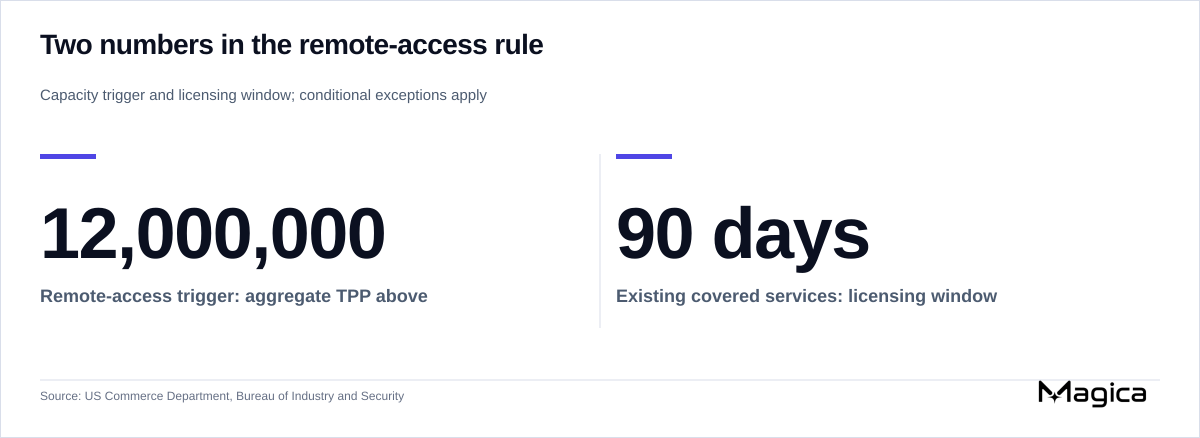
The Commerce Department rule sets a capacity threshold and a licensing window for existing covered services. Conditional exceptions apply; equipment counts alone do not establish whether Aolani needs a licence. Source: US Commerce Department.
The US Commerce Department's Bureau of Industry and Security, the agency administering these export controls, made its interim final rule effective on November 19. It builds on existing restrictions on advanced chips destined for entities headquartered, or with ultimate parents headquartered, in Macau or Country Group D:5, which includes China.
The rule adds two distinct requirements:
The remote-access threshold is more than 12 million in “aggregate TPP,” the rule's measure summing chips' total processing performance. It measures theoretical processing capacity, rather than the computing time actually consumed. The reported Aolani equipment count alone does not establish how this test applies to its project.
That remote-access provision has a conditional exception for computing used exclusively for commercial recommendation systems, such as ranking products or content, with reporting and due-diligence requirements. Its definition excludes systems designed or used to generate new text, images, audio, video or software, including systems that also make recommendations. The exception does not remove separate licensing obligations elsewhere in the rules.
Suppliers are expected to obtain information about data centres' customer checks, including direct or indirect ownership and control by Macau or D:5 persons. A data centre's inability or refusal to provide sufficient information is a red flag suppliers must resolve before proceeding.
Existing data centres covered by the remote-access provision have 90 days from the rule's effective date to obtain a licence to continue those services or face future export restrictions. An unidentified cloud executive in the shipment report said providers did not know how to apply. The deadline is specified; practical execution remains disputed by that industry participant.
Both the new destination requirement and the remote-access provision provide for case-by-case licence review. A reported supplier pause therefore does not establish a permanent prohibition on every sale to the four countries.
Aolani, a Singapore-based cloud company, planned to lease advanced computing capacity to ByteDance, the Chinese owner of TikTok, according to two people cited in the shipment report. Some bankers that had agreed to finance the project have stopped issuing credit worth about $500 million, and ByteDance could drop the arrangement, the account said.
That amount describes disrupted credit, not a disclosed total project cost or a confirmed loss. The report does not establish that the entire project has been cancelled.
The companies' computing plans predate this week's disruption. A March 12, 2026 Reuters account of a Wall Street Journal report, citing people familiar with the matter, described ByteDance working with Aolani Cloud to deploy about 500 computing systems using Nvidia's Blackwell architecture in Malaysia, totalling roughly 36,000 B200 chips.
Those figures describe reported deployment plans, rather than verified installed equipment. The earlier account does not establish that all those systems are covered by the current financing disruption. Nor do the reports identify the project's workloads sufficiently to determine whether a recommendation-system exception could apply.
Chinese demand has helped drive data centre investment in Malaysia and Indonesia, the shipment report said. Aolani provides a concrete example of the exposure: an uncertain customer arrangement can disrupt credit before the longer-term effect on hardware deployment is established.

The equipment figures describe earlier reported plans, not verified installations. The subsequent credit disruption does not establish project cancellation or that every planned system is affected. Source: Reuters via Investing.com.
China's leading AI labs remain heavily dependent on Nvidia processors for the computing-intensive early training of flagship models despite Beijing's efforts to develop domestic alternatives, according to the shipment report.
The account also places the halt in the context of Nvidia chief executive Jensen Huang's return to the role this week after a brief ouster. Huang has argued for continued chip sales to Chinese companies to increase their dependence on American technology. People cited in the report said his return had brought hopes of less strict enforcement, but little indication Nvidia would hold back from implementing the rules.
Nvidia's own quarterly filing for the period ended April 27, 2025 documents its financial exposure to earlier controls. The company, which expanded from PC graphics into AI computing, recorded a $4.5 billion charge for excess H20 chip inventory and purchase obligations after April 2025 licensing requirements reduced demand. That historical charge is not an estimate of the cost of the current pause.
The same filing warned that licensing uncertainty could encourage customers to buy competing chips or develop internal alternatives. It also identified data centre capacity, energy and capital as constraints on customers' infrastructure buildouts. Continued reliance on Nvidia does not establish that substitution is impossible, or that export licences are the only obstacle to deployment.
The shipment report, citing company accounts, puts revenue booked through Nvidia's Singapore subsidiary in 2025 at US$104 billion, up 72% in 12 months. It says some Taiwan and China revenue is also recorded through that unit.
A separate disclosure in Nvidia's April 2025 quarterly filing illustrates why billing geography needs care. Singapore accounted for 20% of total revenue by customer billing location that quarter. Nvidia said customers centralised invoicing there while products were almost always shipped elsewhere. It also said more than 99% of controlled Data Center compute revenue billed to Singapore came from orders by US-based customers.
The quarterly customer-billing disclosure and the subsidiary's annual revenue cover different periods and accounting scopes. Neither measures the value of servers physically delivered to Singapore or the revenue affected by this pause.
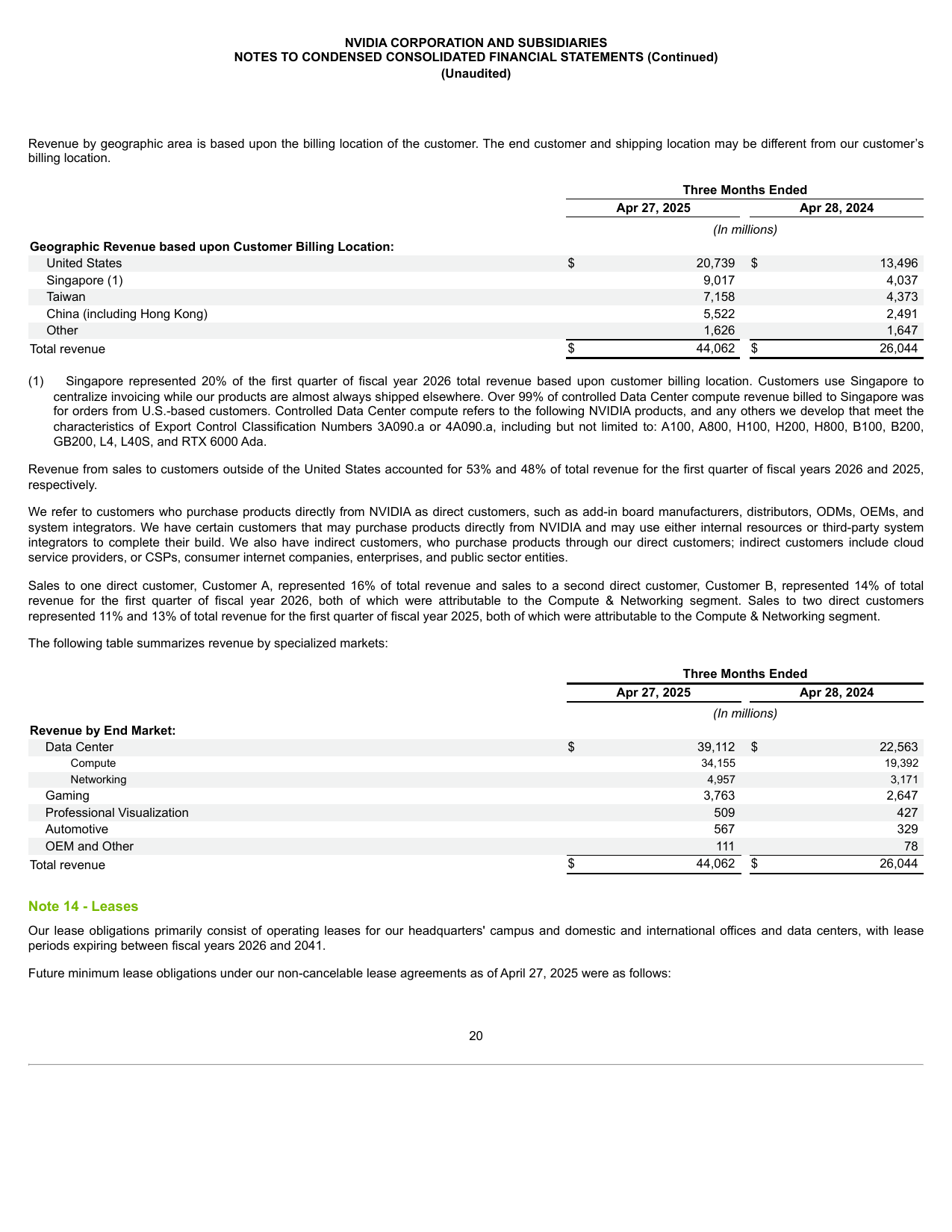
Nvidia’s company-reported revenue table uses customer billing location. Its Singapore footnote says products were almost always shipped elsewhere; these figures do not measure orders affected by the current pause. Source: Nvidia quarterly filing.
The next consequential evidence is how suppliers apply the destination rules, customer checks and remote-access requirements to individual orders. The reports provide no affected-order total or restart date. For Aolani, confirmation of its intended workloads, licensing position and financing would clarify whether the disruption is a delay or a deeper threat to the arrangement.
Nvidia declined to comment to the shipment report; Dell, Supermicro, ByteDance and Aolani did not respond to requests for comment. Until supplier instructions or licensing decisions clarify which transactions can proceed, the duration and financial scale of the interruption remain unresolved.
Trustly’s existing owners are funding new AI payment products after job cuts. New quarterly results show rising payment volumes and revenue, but weaker earnings than a year earlier.
The Pentagon denies reports that officials weighed production powers to pressure Nvidia to restore Jensen Huang. Nvidia confirms senior government input, but its board’s foreign-intelligence investigation remains open.
Perplexity says users are choosing Google's new model over rival offerings, with daily token volume doubling in three days. The 120-billion figure is cumulative, and the early demand leaves retention and task economics unresolved.
Kioxia says a proof of concept paired Nvidia software with about 1.1 PB of raw SSD capacity to expand the datasets GPUs can access. The demonstration establishes a capacity proposition, while workload performance and deployment economics remain undisclosed.
Google’s November 25 update adds Familiar Face alerts and remote siren controls to two Walmart Onn outdoor cameras. The expansion makes inexpensive Nest alternatives more capable, while the value depends on subscription access and reliable video playback.
OpenAI is testing a combined Chat and Work experience with a small group of Pro subscribers. A shared allowance arriving more broadly in December will put advanced conversations and delegated tasks on the same budget, but the size of any resulting loss of access remains unknown.
Sellers are seeking buyers for thousands of Nvidia B300 chips, while Asian data centers try to replace Chinese customers affected by U.S. controls. Rental prices have fallen, but short contracts remain scarce and operators face demanding financing terms.
Lenders are delaying or reassessing financing for Asian data centers serving Chinese technology firms as new US licensing rules put chip purchases and customers’ access to computing capacity in doubt.
Meta employees describe cuts to moderation teams and difficulty correcting mistakes as AI enforcement expands. Meta claims better accuracy, while account restrictions and an EU investigation put the effectiveness of appeals under scrutiny.
Dario Amodei rejects handing political authority to AI while defending task automation. An independent assessment finds faster progress at Anthropic, largely through AI assistance, but leaves important evidence outside public view.
OpenAI is piloting Private Inference with selected business customers. The feature targets provider access during processing, but model coverage, costs and evidence of its protections remain key questions.
Executives at rival AI developers are challenging a view reported among some Anthropic employees that people should delegate authority to superior machines. Anthropic defends human oversight, while the dispute exposes a harder question about who retains power when AI makes better decisions.
Officials told congressional staff there was no evidence China directed Alice Huang’s affair with Nvidia founder Jensen Huang. Reports of later information sharing, excluded intelligence and scrutiny of her former company complicate the security assessment.
Updates incorporating Sam Corcos’s requests appeared in his AI-built strategy game during a FinCEN cyber disruption. The Treasury CIO says computers develop it autonomously; the record does not establish time diverted from official duties or who pays the project’s costs.
SpaceX won conditional authorization for its Starmind orbital data centers, with deployment deadlines through 2040. The FCC left higher-altitude debris plans unresolved and did not judge whether the computing business will work.
NVIDIA has released Nemotron-Labs-Image-30B-A3B for non-commercial research and evaluation. The broader creation framework awaits legal clearance, and its best GenEval and GenEval2 results use GPT-6 assistance rather than the downloadable generator alone.
SpaceX reportedly lowered small-cluster Blackwell quotes to $10–$12 per GPU-hour, matching rates already offered to large customers. A possible Anthropic nonrenewal puts roughly 50,000 older H200 GPUs in focus, but does not establish an exit from the broader compute relationship.
CoreWeave’s debt sold off despite a brief stock-market rally around Nvidia’s leadership reversal. Recent fundraising and expected customer prepayments offer support, but infrastructure purchases far exceed operating cash flow and debt has more than doubled since year-end.
A public supply page advertises B300 systems at up to 18.6 million yuan apiece, alongside trader reports of nearly $3 million prices. Its verification warnings leave inventory, sellers and delivery unproven.
The Nasdaq 100 fell 4.32% in morning trading on November 25 as AI shares slid alongside tariff and inflation concerns. Its retreat approached 20% from October levels, but the comparison depends on intraday versus closing prices, and the session was unfinished.