Editorial Team
6 min read
Trustly’s existing owners are funding new AI payment products after job cuts. New quarterly results show rising payment volumes and revenue, but weaker earnings than a year earlier.
Trustly, the Swedish company founded in 2008 that lets consumers pay merchants directly from their bank accounts, announced approximately $60 million in financing on November 24. Its shareholders are backing new AI products as payment volumes grow, following a revenue contraction and substantial job cuts.

Johan Tjärnberg in Trustly’s December 2021 CEO appointment announcement. Image: Trustly. Source: Trustly CEO appointment.
Trustly Holding AB said in its financing announcement that its parent, Trustly AB, would receive approximately $60 million, or SEK600 million. This follows more than $40 million in irrevocable, legally binding equity commitments announced on October 2 from principal shareholder Nordic Capital and fellow shareholder Alfvén & Didrikson. Other existing shareholders, including funds and accounts managed by BlackRock, joined the round.
The October commitments represent more than two-thirds of the approximately $60 million total. The announcement does not disclose a valuation, individual allocations or resulting ownership percentages, limiting what the raise reveals about how investors price the business.
Nordic Capital is a private equity investor with payments experience: its Fund IX announced the Trustly acquisition in March 2018. Alfvén & Didrikson was already a shareholder then. Nordic Capital had also owned payments processor Bambora before selling it in 2017. This financing extends established investors’ exposure to the company.
Johan Tjärnberg, Trustly’s group CEO and former chairman, founded Bambora, a processor for in-store and online retailers, in 2014. He became Trustly CEO in January 2022, according to his appointment announcement. In the financing release, he described the raise as shareholder endorsement of the strategy.
The funding follows a difficult 2025. A report on the raise said revenue fell 16.8% that year and September 2026 job cuts were concentrated mainly in Brazil. A separate account put the global cuts at 205 people, or one in four employees. It reported first-half 2026 revenue growth of 4% to nearly SEK1.25 billion, while adjusted operating profit fell 25% to SEK133 million versus a year earlier.
Results published by Trustly on November 25 show further revenue growth in the third quarter, led by a 19.9% increase in the Americas. Payment value grew faster than revenue. Adjusted EBITDA more than doubled from Q2. The revenue and payment-value growth rates compare reported currencies with Q3 2025.
Trustly’s unaudited consolidated report shows the comparison:
| Measure | Q3 2025 | Q3 2026 |
|---|---|---|
| Revenue, SEK million | 584.4 | 630.2 |
| Payment value, SEK billion | 252.3 | 311.1 |
| EBITDA, SEK million | 47.4 | 8.5 |
| Adjusted EBITDA, SEK million | 89.9 | 86.9 |
| Net loss, SEK million | 151.1 | 279.0 |
Payment value includes transactions Trustly initiates without settling. EBITDA means earnings before interest, taxes, depreciation and amortization; Trustly’s adjusted figure excludes exceptional items and share-based payments.
Trustly attributed the sequential earnings improvement to SEK51 million lower combined cost of sales and credit losses after tighter US approval rules. European revenue declined. Pricing headwinds totalled SEK55 million at constant currency. Interest expense and foreign-exchange losses weighed on net earnings.
Cash and equivalents were SEK103.5 million on September 30; Trustly drew another EUR10.5 million of revolving credit in October. Most restructuring cash costs remained ahead. Including the equity raise, management expected adequate resources to continue operating.
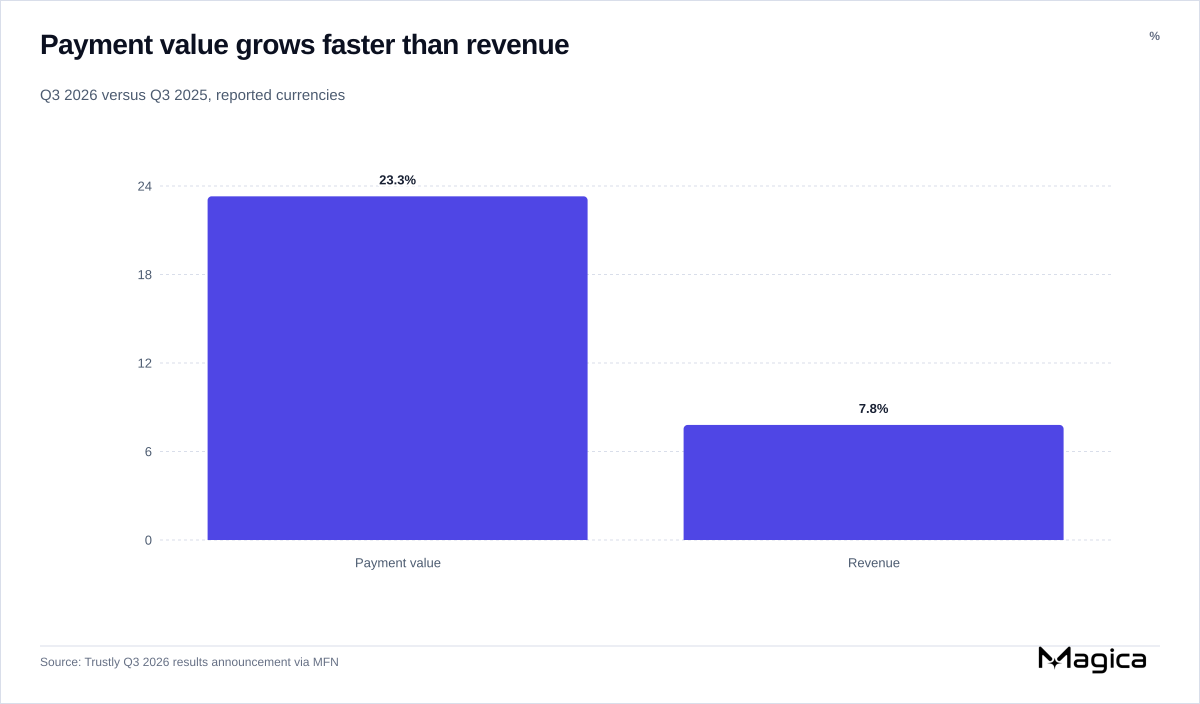
Company-reported Q3 2026 growth versus Q3 2025, using reported currencies. Payment value includes initiation-only transactions. Chart: Magica; data: Trustly. Source: Trustly Q3 2026 results announcement via MFN.
Trustly provides an open banking alternative to cards, allowing customers to pay from their accounts without a separate card or app, as the funding coverage explains. The company says its network spans the US, Canada and Europe, supports more than 50 million consumers and handles over $120 billion in transactions annually. Its financing announcement also describes connections to more than 9,000 merchants and 12,000 banks. These company figures describe payment scale, rather than AI adoption or revenue.
Trustly’s stated aims for the new products are customer acquisition, retention and risk management, as its announcement and coverage of the company’s plans explain. Those aims overlap with capabilities it has already marketed.
In its 2024 results announcement, published in June 2025, Trustly said it launched an AI-powered recurring payments service in June 2024. That service lets merchants accept repeat bank-account payments through one integration. Trustly also described its risk engine as guaranteeing payments and mitigating insufficient-funds, fraud and chargeback risks in North America.
The same release described Azura, its proprietary data engine, as combining merchant, user and bank data to recognise opted-in consumers across devices and Trustly-enabled platforms. Trustly claimed improved conversion and checkout spending, without quantifying those improvements in that release. The new funding therefore extends a business already using payment data and AI.
A July 2025 Federal Reserve staff analysis of US merchant payments cautioned against blanket savings claims. Integration, processing, subscription and bank fees affect comparisons with cards; discounts needed to attract consumers can absorb merchant savings. The paper presents its author’s analysis rather than a Federal Reserve Board policy position.
It also described competing plans from retailer Walmart with technology provider Fiserv, and from Visa through its acquired open banking business Tink. Card networks can participate in pay by bank as well as compete with it.
The payment infrastructure matters. The analysis described most US pay-by-bank deployments at that time as using the Automated Clearing House, which settles payments on a deferred basis, while some used instant payment networks. Bank connections and customer permission to access account information underpin these services. Faster settlement can improve merchants’ access to funds while making fraud prevention more urgent because instant payments are generally final and irrevocable. An AI feature alone does not establish a payment’s settlement speed or protection arrangements.
A report describing research conducted with Trustly found discounts and buyer protection important to consumers’ stated willingness to switch to pay by bank. Those conditional preferences are not observed transaction migration or demonstrated demand for the forthcoming AI products.
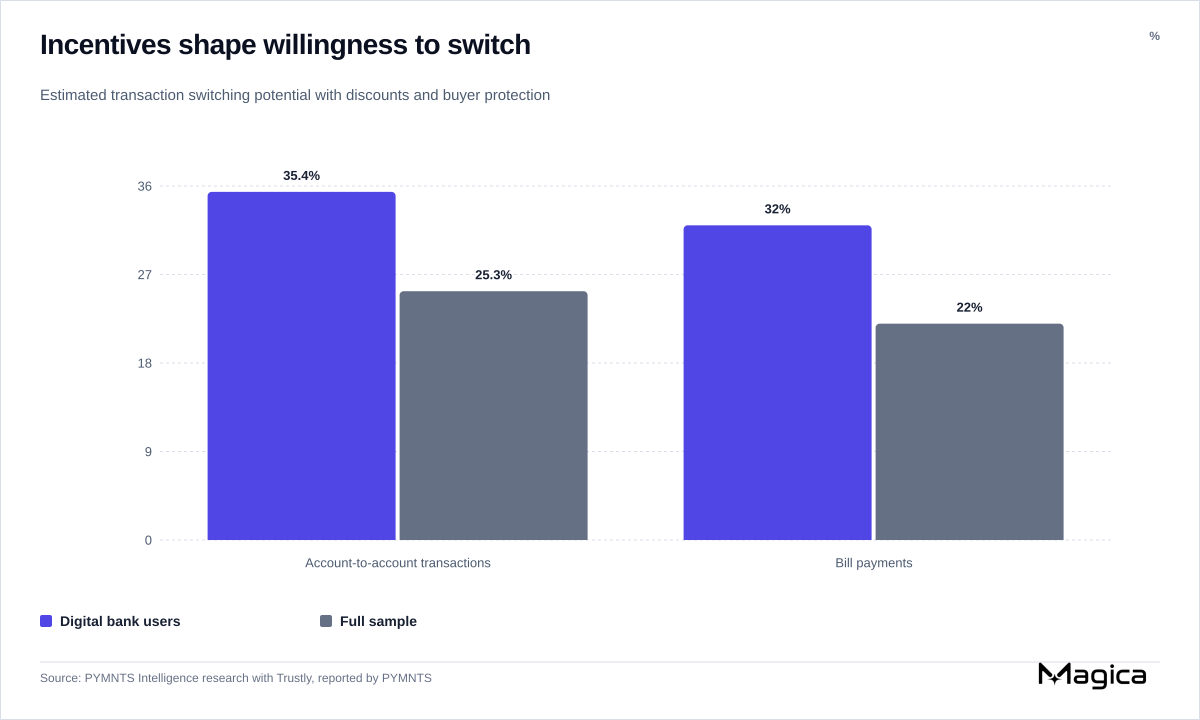
Research by PYMNTS Intelligence with Trustly estimates switching potential with discounts and buyer protection. These conditional preferences are not observed migration or demand for new AI products. Chart: Magica. Source: PYMNTS.
The quarterly report describes a payments-product pilot with two customers aimed at acquisition and customer lifetime value, without identifying it as AI.
The financing announcement does not name the new AI products, set launch dates, disclose pricing or quantify their expected effects. Nor does it explain what additional data access or permissions they would require. Merchants and investors still need evidence of capabilities beyond existing recurring payments, Azura and risk tools, followed by adoption and measurable commercial results. With payment value rising faster than revenue, the question is whether those additions can improve what Trustly earns from its growing network.
Manufacturing partners have reportedly told buyers that Nvidia will not permit server orders to ship to Malaysia, Singapore, Thailand and Indonesia as they assess new US export controls. The uncertainty is already reaching cloud-project financing.
The Pentagon denies reports that officials weighed production powers to pressure Nvidia to restore Jensen Huang. Nvidia confirms senior government input, but its board’s foreign-intelligence investigation remains open.
Perplexity says users are choosing Google's new model over rival offerings, with daily token volume doubling in three days. The 120-billion figure is cumulative, and the early demand leaves retention and task economics unresolved.
Kioxia says a proof of concept paired Nvidia software with about 1.1 PB of raw SSD capacity to expand the datasets GPUs can access. The demonstration establishes a capacity proposition, while workload performance and deployment economics remain undisclosed.
Google’s November 25 update adds Familiar Face alerts and remote siren controls to two Walmart Onn outdoor cameras. The expansion makes inexpensive Nest alternatives more capable, while the value depends on subscription access and reliable video playback.
OpenAI is testing a combined Chat and Work experience with a small group of Pro subscribers. A shared allowance arriving more broadly in December will put advanced conversations and delegated tasks on the same budget, but the size of any resulting loss of access remains unknown.
Sellers are seeking buyers for thousands of Nvidia B300 chips, while Asian data centers try to replace Chinese customers affected by U.S. controls. Rental prices have fallen, but short contracts remain scarce and operators face demanding financing terms.
Lenders are delaying or reassessing financing for Asian data centers serving Chinese technology firms as new US licensing rules put chip purchases and customers’ access to computing capacity in doubt.
Meta employees describe cuts to moderation teams and difficulty correcting mistakes as AI enforcement expands. Meta claims better accuracy, while account restrictions and an EU investigation put the effectiveness of appeals under scrutiny.
Dario Amodei rejects handing political authority to AI while defending task automation. An independent assessment finds faster progress at Anthropic, largely through AI assistance, but leaves important evidence outside public view.
OpenAI is piloting Private Inference with selected business customers. The feature targets provider access during processing, but model coverage, costs and evidence of its protections remain key questions.
Executives at rival AI developers are challenging a view reported among some Anthropic employees that people should delegate authority to superior machines. Anthropic defends human oversight, while the dispute exposes a harder question about who retains power when AI makes better decisions.
Officials told congressional staff there was no evidence China directed Alice Huang’s affair with Nvidia founder Jensen Huang. Reports of later information sharing, excluded intelligence and scrutiny of her former company complicate the security assessment.
Updates incorporating Sam Corcos’s requests appeared in his AI-built strategy game during a FinCEN cyber disruption. The Treasury CIO says computers develop it autonomously; the record does not establish time diverted from official duties or who pays the project’s costs.
SpaceX won conditional authorization for its Starmind orbital data centers, with deployment deadlines through 2040. The FCC left higher-altitude debris plans unresolved and did not judge whether the computing business will work.
NVIDIA has released Nemotron-Labs-Image-30B-A3B for non-commercial research and evaluation. The broader creation framework awaits legal clearance, and its best GenEval and GenEval2 results use GPT-6 assistance rather than the downloadable generator alone.
SpaceX reportedly lowered small-cluster Blackwell quotes to $10–$12 per GPU-hour, matching rates already offered to large customers. A possible Anthropic nonrenewal puts roughly 50,000 older H200 GPUs in focus, but does not establish an exit from the broader compute relationship.
CoreWeave’s debt sold off despite a brief stock-market rally around Nvidia’s leadership reversal. Recent fundraising and expected customer prepayments offer support, but infrastructure purchases far exceed operating cash flow and debt has more than doubled since year-end.
A public supply page advertises B300 systems at up to 18.6 million yuan apiece, alongside trader reports of nearly $3 million prices. Its verification warnings leave inventory, sellers and delivery unproven.
The Nasdaq 100 fell 4.32% in morning trading on November 25 as AI shares slid alongside tariff and inflation concerns. Its retreat approached 20% from October levels, but the comparison depends on intraday versus closing prices, and the session was unfinished.