Editorial Team
6 min read
Ray-Ban’s US store cuts the Gen 2 Wayfarer by 25% to $284.25. Buyers still face separate prescription-lens prices, a cheaper Gen 1 option and newer glasses outside Meta’s frame sale.
Ray-Ban Meta Gen 2 Wayfarer camera-and-audio glasses are listed at $284.25 on Ray-Ban’s US storefront, a 25% reduction from $379. The discount lowers the price of glasses that combine hands-free photography, open-ear sound and Meta’s AI assistant, but prescription lenses remain a separate part of the bill.
This is a discount on an earlier generation, rather than the newest Ray-Ban Meta hardware. Meta introduced Gen 2 in September 2025 starting at $379; Ray-Ban now also lists Gen 3 and lower-priced remaining Gen 1 models. That makes the decision broader than which retailer advertises the largest percentage reduction.
The glasses come from Meta’s collaboration with eyewear group EssilorLuxottica. In its 2024 partnership extension, EssilorLuxottica said the companies had worked together since 2019 and agreed to develop successive smart-eyewear products into the next decade. The arrangement combines its eyewear expertise and retail and wholesale network with Meta’s technology.
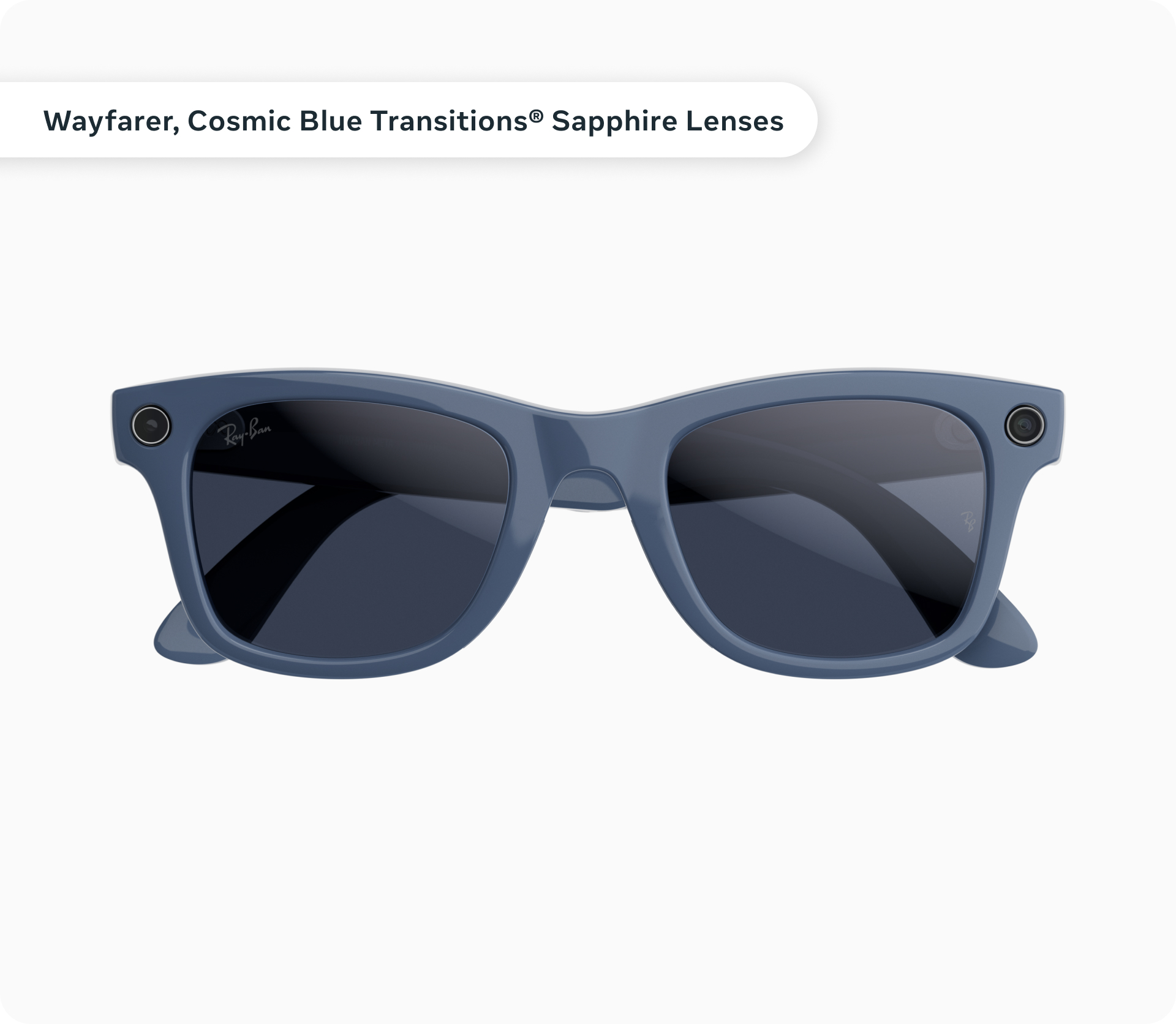
Gen 2 Wayfarer in Cosmic Blue with Transitions Sapphire lenses. This launch configuration differs from the verified $284.25 listing. Image: Meta. Source: Meta Gen 2 launch announcement.
In its Gen 2 launch announcement, Meta said the glasses added 3K Ultra HD video capture and could last up to eight hours with typical use, almost twice Gen 1’s battery life. Those are company specifications, not independently measured results. The charging case, Meta said, provides another 48 hours of charging capacity.
The US storefront puts that upgrade alongside these alternatives:
Ubisoft has made the team behind its Teammates experiment a dedicated subsidiary targeting AI characters with memory and outside game creators. Earlier playtests show both progress and limitations, while commercial plans remain undisclosed amid group cost cuts and refinancing.
| Listed configuration | Listed price |
|---|---|
| Gen 1 Wayfarer, marked “Last Chance” | $224.00 |
| Gen 2 Wayfarer, 25% off $379 | $284.25 |
| Gen 3 Wayfarer, polarized lenses | $479.00 |
The Gen 2 listing costs $60.25 more than the Gen 1 listing; this compares displayed prices rather than matched lens specifications. The Gen 3 example includes polarized lenses, so the difference between it and Gen 2 is not a measure of the price of a generation upgrade alone. Ray-Ban describes Gen 3 as slimmer, with adjustable comfort temple tips and a six-microphone array, up from five.
Lens and frame choices also change prices within Gen 2. Ray-Ban lists Skyler and Headliner configurations with Transitions lenses at $344.25 each, down from $459. Those are different combinations from the $284.25 Wayfarer, not evidence of a universal lens-upgrade surcharge.

The Gen 2 charging case provides an additional 48 hours of charging capacity, according to company-reported specifications. Image: Meta. Source: Meta Gen 2 launch announcement.
Meta’s November 20 announcement offers 25% off Ray-Ban Meta Gen 2 and Oakley Meta HSTN, and 15% off Oakley Meta Vanguard and select Meta Glasses. It names participating sellers including Amazon, Best Buy, LensCrafters, Walmart and Target, while warning that prices and availability vary by region and retailer.
The public frame promotion runs November 20–30, 2026, in the US, Canada and Australia, with separate availability in Japan, South Korea and Singapore. Meta excludes limited and creator editions, the $249 Meta Glasses model, Ray-Ban Meta Optics Gen 2, Meta Ray-Ban Display and refurbished products. An early-access report dated November 17 also identifies Ray-Ban Meta Gen 3 and Ray-Ban Meta Audio as outside Meta’s frame sale, and notes that discounts may appear only after an item is added to the cart.
Prescription eligibility is different. Meta offers 25% off qualifying prescription lenses through its website and Meta Lab stores in the US and Canada. Its offer terms include lenses for Gen 1, Gen 2, Gen 3, Optics, Audio and several other glasses, even though not all those frames receive the public frame discount. Display lenses are excluded. The lens offer can be combined with a frame discount, applies to at most five qualifying lenses per transaction and ends November 30 at 11:59 p.m. Pacific time.
Ray-Ban’s storefront separately advertises 50% off prescription lenses alongside its 25% Gen 2 promotion. A larger lens-discount percentage does not establish a cheaper finished pair: Ray-Ban’s listing does not give the full prescription-specific price or detailed eligibility for that offer. Buyers need matching frames, lens options and prescriptions to compare the retailers’ totals.
Meta also lists a US-only $100-off offer for selected recipients of a promotional email, valid November 17–December 27. It requires a redemption code and cannot be combined with other discounts. A separate US-only $30 cart-abandonment offer requires a qualifying Facebook or Instagram advertisement and no completed Meta Store AI-glasses purchase in the previous 180 days. Its terms permit temporary price reductions, but the Black Friday terms restrict combinations beyond lens offers, so buyers should verify which offers apply at checkout. Neither targeted offer is an automatic saving for every shopper.

Company-reported discounts apply separately to frames and eligible prescription lenses. Percentages cannot be added together; a larger lens discount does not establish a cheaper finished pair. Chart: Magica; sources: Meta and Ray-Ban. Source: Meta promotional terms.
One sale report gives a Gen 2 example of $224.25, reduced from $299, without identifying a matching configuration. That conflicts with the $379-to-$284.25 Wayfarer listing on Ray-Ban’s own store and the roughly $284 starting price in the early-access report. The lower figure should not be treated as a verified price for the same Gen 2 pair.
There is also an approaching alternative outside Meta’s lineup. Samsung said in its November 12 announcement that its smart glasses, developed with Google and featuring Google’s Gemini AI assistant, would reach general US availability December 10. Warby Parker models start at $395; Gentle Monster models range from $449 to $489. Samsung says the glasses are designed to work with Galaxy phones. Those are announced prices for a forthcoming product, not discounted equivalents of a configured Ray-Ban prescription order.
Before Meta’s November 30 deadline, the useful comparison is the total for the chosen generation, frame, lenses and prescription, including any offer the buyer actually qualifies for. Meta’s terms also require an account, its companion app, a compatible Android or iOS phone and wireless internet. The sale establishes a lower Gen 2 purchase price; the final configured bill and the value of newer hardware remain the decisions to resolve.
Neuralink has shown a trial participant controlling GTA VI through intended movements. Earlier gaming use and company-reported trial results put the demonstration in context, while its reliability across users remains unmeasured in the reports.
SoftBank founder Masayoshi Son reportedly explored financing a $1 trillion acquisition of memory-chip maker SK hynix, but the company says the deal is no longer under active consideration. The target brings surging earnings, existing shareholders and customer commitments that complicate any simple equation between ownership and access to AI-memory supply.
Nvidia reported $115.8 billion in quarterly revenue, but its shares fell 14% Friday amid a wider technology selloff, a leadership transition and a reported accounting investigation. Strong cash generation offers a counterweight to concerns about the durability of AI spending.
The Nasdaq 100 fell 5.6% on November 20 and closed 19.8% below its record after an intraday bear-market breach. Nvidia’s revenue surge and Anthropic’s huge IPO did not halt the rout; infrastructure bills and resilience elsewhere in the market complicate the picture.
OpenAI reports sharply lower reasoning-extraction rates in internal GPT-6.2 tests and backs sanctions against illicit foreign distillation. Its own research and rival Anthropic’s experience show why protecting hidden reasoning leaves capability transfer and customer costs unresolved.
Alberta proposes 600-metre setbacks for large data centres and expanded utility oversight, but exemptions and rules still to be written will determine how much protection communities receive.
President Donald Trump backed Commerce Secretary Howard Lutnick as lawmakers scrutinize alleged delays in restricting a suspected route for AI chips to China. A new congressional inquiry also questions Nvidia’s influence on an existing investigation.

Amazon’s month-old Echo Time is $50 off for Black Friday. Its touchscreen, home hub and optional sleep-aware alarm cost $90 more than the reported Echo Spot price, while Alexa+ access and evidence of better waking remain key buying questions.
Merck will pair its experimental data with Isomorphic Labs’ AI to seek small-molecule cancer drug candidates. The deal follows Isomorphic’s $5 billion financing, but its payments, target and development timetable remain undisclosed.
Thinking Machines Lab released a roughly 20GB open-weights model that reuses its middle layers for reasoning. It brings the Inkling family to local hardware, with competitive coding results but workload-dependent costs and preliminary evidence on oversight.
Apple’s first HomePod mini update since 2020 adds Mac audio and four-speaker surround, but Siri AI remains unavailable, core home-hub features carry over, and reviews disagree on playback reliability.
Treasury Secretary Scott Bessent says an unnamed Anthropic founder will announce a large gift to children's investment accounts within weeks, but the amount, recipients and connection to existing philanthropic pledges remain undisclosed.
Google says air cooling will limit water use at its Visakhapatnam AI hub, but environmental proceedings and residents’ accounts raise broader questions about land, electricity, public incentives and the evidence behind promised benefits.
Nvidia slipped behind Alphabet to fourth in U.S. market value during November 20 trading. The reversal follows a steep selloff despite strong reported revenue growth, with a permanent CEO still to be chosen.
Google will close the Nest app on January 25, 2027 and retire Assistant on home speakers and displays in August. Device transfers are automatic, but continued voice access requires accepting Gemini; basic assistance remains free.

Amazon says Cairn agents exploited a MONAI Label zero-day to take over a university server. Other attacks failed, and maintainers list no patched package release.
Federal Reserve Governor Lisa D. Cook sees early AI pressure on coding, translation and young workers, but says a solid overall labor market and persistent inflation still call for tighter monetary policy.
President Donald Trump threatened a tax on U.S. companies building data centers abroad without specifying how it would work. The proposal raises questions for an AI export program that has received 78 applications and for domestic construction constrained by power and community opposition.
Donald Trump said only older chips should be sold to China while discussing a broader deal with Beijing. His remarks leave unresolved which products would qualify as Washington tightens access to American AI hardware and overseas manufacturing.