Editorial Team
7 min read
A 21-year-old student used a DeepSeek-based workflow to put a Chinese version of Haruki Murakami’s new novel online within hours of its Japanese release. The reported 13-yuan model bill demonstrates a sharp speed advantage, but it excludes licensing and editorial work, while the release raises copyright questions that also apply to human-made unauthorized translations.
The quickest result from Wenyi, an AI-assisted literary-translation workflow, was not a legal Chinese edition of a new Haruki Murakami novel. It was an unauthorized digital text reported to have reached Z-Library, social platforms and resale channels within hours of the Japanese release of The Tale of KAHO on July 3. The point of the episode is less that a machine has settled literary translation than that a small workflow can now make a book widely available before a conventional publisher can complete its rights and editorial process.
The developer, the 21-year-old Nanjing Normal University literature major known publicly by the pseudonym Ping Ming, is not a professional Japanese translator. He taught himself Python two years earlier and says he built Wenyi because he wanted to read Murakami as soon as a book came out despite not reading Japanese. Murakami is the novelist whose earlier work The City and Its Uncertain Walls had left Ping waiting about a year for an official Chinese translation after he found a 2023 machine-made version unusable.
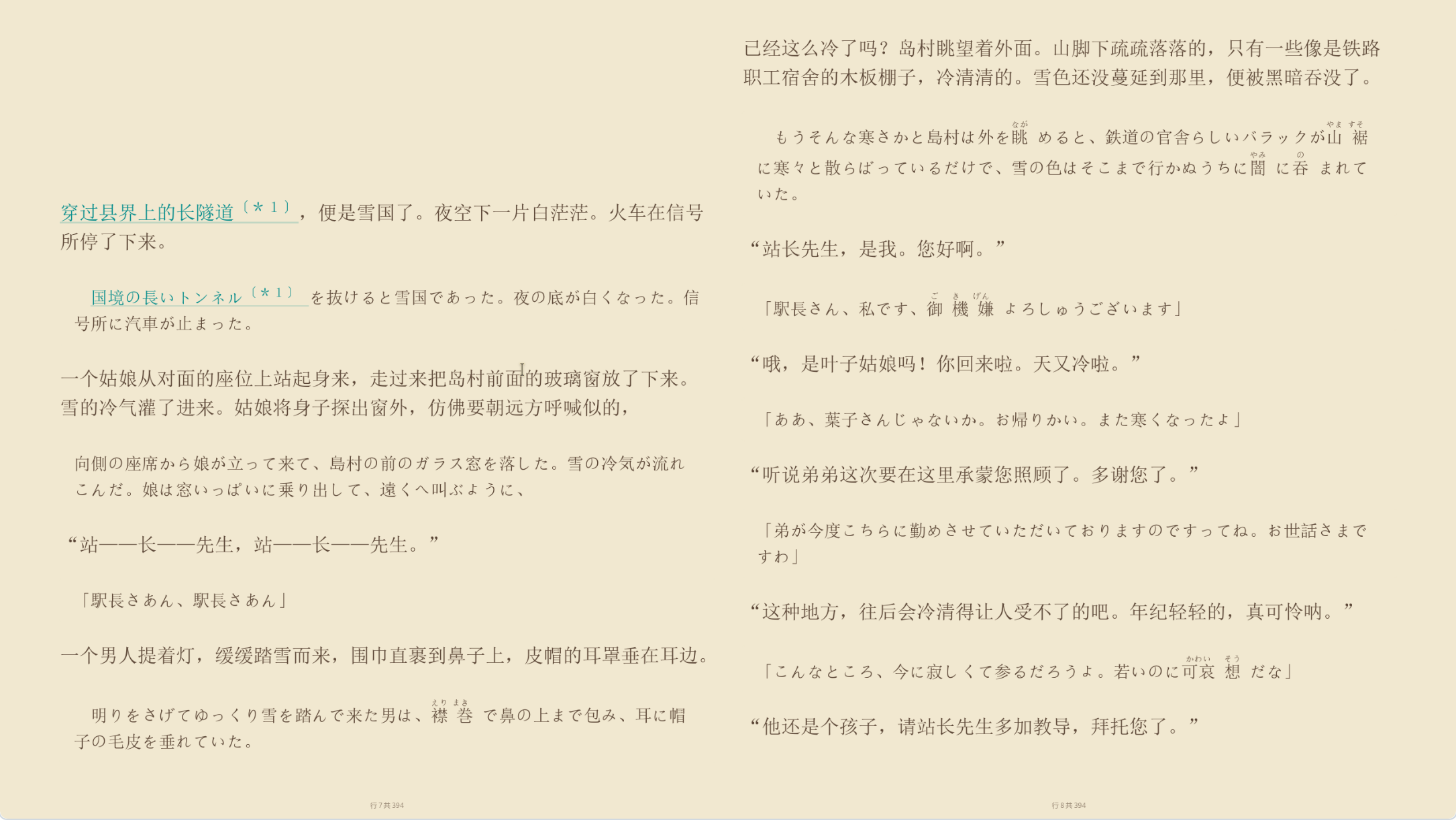
Wenyi’s official project preview shows its bilingual EPUB reading layout, with source text visually subdued beside the translation. Source: GitHub.
Wenyi is not a new foundation model. In the detailed account of the experiment, Ping says the program divided the novel into sections of fewer than 2,000 words and sent them to the Chinese AI model DeepSeek. Six paragraphs of overlap were intended to carry context between sections; the system also extracted names and terms for a living glossary, then reviewed the completed text in chunks.
The workflow responds to an ordinary long-document problem: a translation that is acceptable sentence by sentence can lose names, relationships and tone across a novel. Ping himself reported that the first version missed some of the protagonist Kaho’s nicknames and contained unnatural, machine-like wording. He made a second version with more instruction around names and a fuller polish.
The project’s maintainer’s announcement describes it as a personal-interest project, says long-form translation can take more than four hours and more than 10 yuan in DeepSeek API fees, and says the later code was mainly written with Codex assistance. That is useful context for its limits: the reported result was built from an existing model, API usage and a developer’s prompt-and-review scheme, not from a newly demonstrated translation model.
The accounts use different measures of speed. One says no human had read the completed Chinese text before Ping uploaded it four hours after the Japanese release, at a reported 13 yuan ($1.90) in DeepSeek tokens. A separate account says the machine ran for three hours and describes a second version released days later. Taken together, they establish an hours-scale release, not a single audited end-to-end production time.
Nanshan Youlu, the online alias of a part-time Japanese-to-Chinese translator, and a collaborator separately prepared a manual version and began posting it on Xiaohongshu on July 3. They removed it after finishing the final chapter, saying Wenyi’s version was nearly 100% faithful at the level of wording. But Nanshan’s assessment was not a declaration of equivalence: he said human translators read a whole novel first and construct an interpretation, while the AI text felt fragmented in its context.
That is the evidence that most directly narrows the replacement claim. The same reporting that describes readers as impressed also records a specific post-publication failure in the AI output and a translator’s objection that word-level fidelity can conflict with a coherent interpretation of the whole work.
Lin Shaohua, the translator of earlier Murakami best sellers including Kafka on the Shore and Norwegian Wood, offered the sharper version of that objection: fluency does not necessarily convey an author’s voice. The publisher-side evidence is more conditional than a blanket rejection. Liu Chengxu, an editor at Guangdong People’s Publishing House, said he would choose AI for a straightforward original but a human translator for more complex work such as hard science fiction or a thought experiment. Puzhao, an editor at Shanghai Translation Publishing House, said literary translation remains a creative use of contemporary language rather than a mechanical transfer.
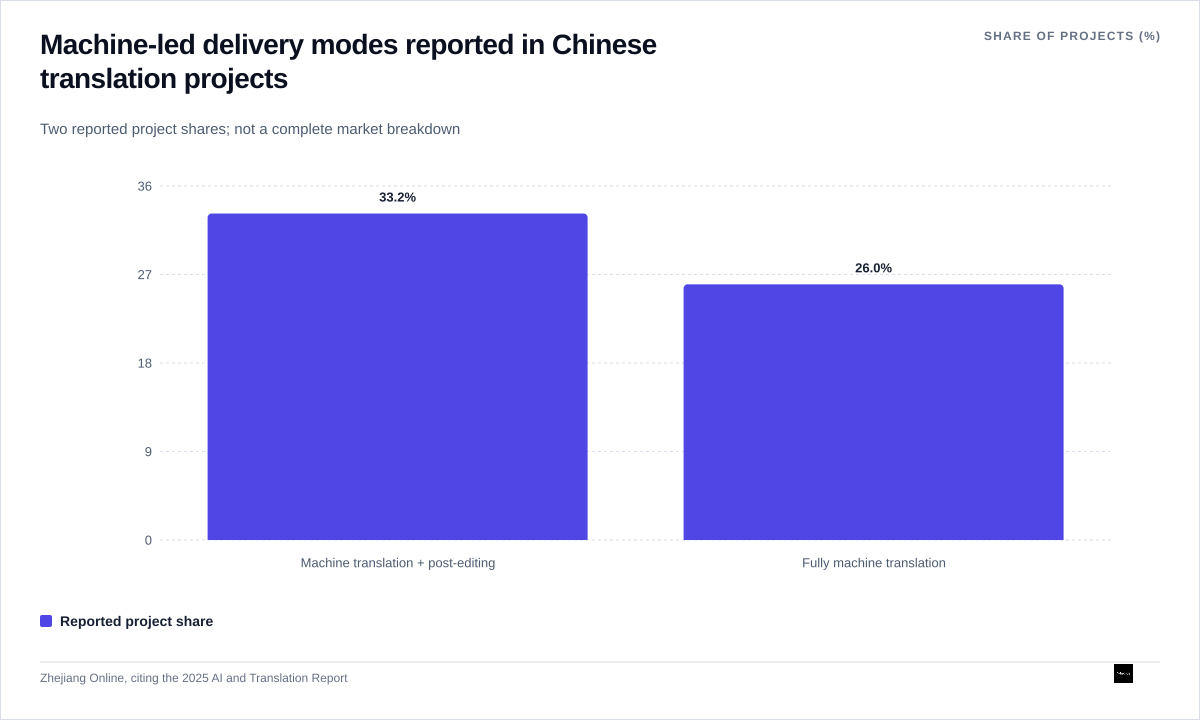
Reported shares of translation projects delivered entirely by machine translation or through machine translation with post-editing. Source: Zhejiang Online.
For a 350-page novel like The Tale of KAHO, the reporting estimates about six months for a professional translator, followed by editing, proofreading, publication and distribution, with a book reaching shelves after roughly a year. It also puts translators’ pay at 100 to 120 yuan per 1,000 Chinese characters. Neither is comparable to 13 yuan in model-token charges: the latter is the reported API cost of one unauthorized digital output, before a human had checked it.
The broader translation market was already adopting automation. The Zhejiang report cites a 2025 industry report saying 97.1% of Chinese translation enterprises use translation technology; it says 26.0% of projects are delivered entirely by machine translation and 33.2% use machine translation with post-editing. The report’s cited figures do not establish how those projects compare with a newly released literary novel, but they do locate Wenyi within an existing move toward machine first drafts and human checking.
The same account describes the incentive problem more plainly. A specialist translator identified as Xiao Xu said clients increasingly brought AI first drafts for post-editing, and that his rate had fallen from 400 yuan to 100 yuan per 1,000 characters. That is an individual account, not an industry-wide wage measure, but it illustrates why a token-cost headline can reshape expectations even when a publisher still needs rights clearance and accountable editorial work.
The retained reporting contains no indication that Murakami’s rights holders licensed the release. That absence is not a legal ruling, but China’s Copyright Law identifies translation as a right of the copyright holder and separately defines the right to make a work available to the public through information networks. Article 24’s exception for personal study, research or appreciation is conditioned on, among other things, not affecting the work’s normal use or unreasonably harming the holder’s legitimate interests; Article 52 identifies unauthorized translation among acts that can carry civil liability, subject to the law’s exceptions. Those provisions appear in the official text of the law.
That explains why the legal question is not unique to the AI output. The Zhejiang report quotes lawyers who distinguish a private translation for personal reading from putting the result on a network for an unspecified public. The manual translation shared by Nanshan and a collaborator therefore belongs in the same basic distribution question, even though their process was different.
China’s Interim Measures for the Management of Generative AI Services govern a related but distinct part of the chain. They apply to providers offering generative-AI services to the public in China; Article 7 requires providers conducting pre-training and optimization-training data processing to use lawfully sourced data and avoid infringing intellectual property. The measures do not decide whether this particular upload infringed, nor do they convert a user’s public release into a permitted translation. The immediate reported issue is the publication and circulation of a new novel without a reported licence.
Wenyi has shown that a reader with modest API spending can assemble an hours-scale, publicly circulating version of a new foreign novel. It has not shown that the output has passed the standard a licensed publisher, a rights holder or readers seeking a literary interpretation would apply.
The next meaningful evidence would be a rights-holder response, a removal or enforcement action, or a licensed publisher’s trial of a comparable workflow with a named translator and editor responsible for the result. Until then, the strongest supported conclusion is narrow: AI has compressed the time and direct generation cost of an unauthorized draft; it has not removed the decisions about permission, editorial accountability or literary judgment that turn a draft into an edition.
Treasury Secretary Scott Bessent said agencies had backed export restrictions on Nvidia customer Megaspeed for months. He challenged Commerce’s handling of the case and Nvidia’s safeguards, while Megaspeed denies illicit chip exports to China.
Applied Materials expects chipmaking equipment demand to rise more than 30% in 2027, while supplier capacity and factory readiness will determine how much demand becomes sales.
Shi Bingzhe and two companies face money laundering charges over 917 servers allegedly acquired from Aperia International. The case now covers five individuals and six companies, but the new charges do not establish the servers’ chip contents or ultimate destination.
Nothing’s December AI device has appeared with red and green lights and an apparent recording button. The clues suggest an audio tool, but existing AI recorders leave the company needing to explain its hardware, service costs and use of personal context.
Apify says an intruder accessed customer accounts and personal information or stored data. Customer notices describe credential rotations and two-factor resets, while the affected-account count and full data exposure remain unclear.
Chinese computing projects still specify Nvidia processors, but their reported values mix proposals and contracts. Conditional US licenses, Chinese restrictions, financing and customer demand complicate the path to usable capacity.
The former Huawei server business has passed Shenzhen's listing committee review for an 8 billion yuan IPO. Its growing market share and profits sit alongside negative operating cash flow and a sharp increase in short-term borrowing.
EU leaders gather for their first dedicated AI discussion, weighing investment, foreign dependencies and safety while Ukraine diplomacy competes for attention. The informal summit is a strategic discussion, with no political statement scheduled for adoption.
New hardware orders have increased Nscale's 2027 funding needs and limited its ability to defer spending. The British AI infrastructure provider is pursuing a New York listing targeting a $35 billion valuation while financing for its Anthropic contracts remains uncommitted.
Commerce Secretary Howard Lutnick has agreed to voluntary Senate testimony as bipartisan scrutiny of Nvidia exports turns to government approvals and enforcement. A hearing date remains unconfirmed, and intelligence suspicions remain disputed.
The startup founded by Microsoft data-system veterans has raised $70 million across seed and Series A rounds. Its unified analytics platform targets unpredictable AI-agent workloads, but the claimed savings still need comparable performance evidence.
Samsung Electronics is reportedly in talks to buy Modine as it expands a cooling business already bolstered by FläktGroup. Modine brings fast-growing data center sales, but weaker margins and a Texas factory still ramping production complicate the potential deal.
Nvidia faced pressure to enlarge its financing backstop before Jensen Huang departed. The leadership change raises questions about support for AI customers, but interim CEO Colette Kress helped build that strategy and chip demand remains a counterweight.
Google launched Gemini 4 Hydrogen and automatic model switching in Antigravity, claiming near-Carbon task success with less quota and faster completion. Lower token rates support the efficiency pitch, but reasoning settings, mixed competitive results and inconsistent benchmark labels leave the cost of completed work to be tested.
Japan is considering safety and reporting duties backed by enforceable orders for advanced AI. The proposal would strengthen its nonbinding framework, but capability thresholds, covered businesses and penalties remain unresolved.
Google says its new fast AI model is reaching Search users worldwide, improving complex answers and source discovery. The rollout expands access to Gemini 4, but its effect on answer quality and website traffic remains unmeasured.
Four nonprofits are asking a California court to stop five AI developers from building or deploying more capable systems. The case seeks enforceable limits even as OpenAI has previously reported a training pause and is launching defensive AI tools.
Expo Simulators gives coding agents remote iOS and Android environments with recordings for reviewers. The launch extends Expo's cloud development services into verification, with per-minute charges and shared capacity limits.
Kleiner Perkins and Clearlake Capital led Mirendil’s $1 billion Series A. Its agent-led model-building experiment points to smaller research teams, but company benchmarks, substantial compute costs and a private beta qualify the promise of wider access.
Mount Thor raised $45 million in equity, alongside separate hardware financing, to expand Apple infrastructure for AI agents and model inference. Existing Mac clouds and workload-specific performance limits put its demand and cost claims to the test.