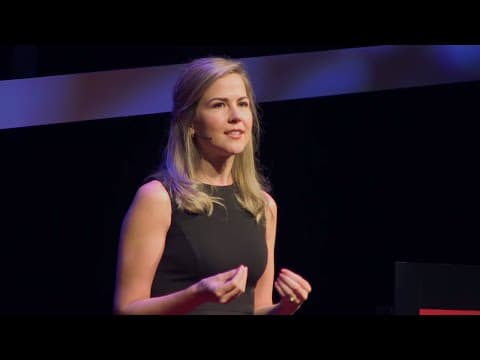
In her TEDx talk, Cassie Jaye shares her transformative experience of exploring the Men's Rights Movement, challenging her own biases, and advocating for a more inclusive dialogue on gender equality.
In 2013, Cassie Jaye, a 27-year-old award-winning documentary filmmaker and proud feminist, embarked on a journey to confront what she perceived as her enemies: the Men's Rights Movement (MRM). Initially, Jaye viewed the MRM as a misogynistic group opposing women's equality, and she aimed to expose its dark underbelly through her documentary work. However, her year-long exploration led her to unexpected revelations about gender issues and her own biases.
Jaye's previous work focused on women's issues, including reproductive rights and the importance of women in STEM fields. When she discovered that no one had documented the MRM in film, she saw an opportunity to continue advocating for women's equality by highlighting those she believed were obstructing it.
During her year of filming, Jaye interviewed 44 men's rights activists, spending between two to eight hours with each individual. As a documentarian, she adhered to the principle of not interrupting her subjects, but she later realized that she was not truly listening. Instead, she was anticipating their words, searching for statements that would confirm her preconceived notions of misogyny.
As Jaye reviewed the 100 hours of footage, she began to recognize that her initial reactions to certain statements were often unwarranted. For instance, when a men's rights activist remarked, "Just walk outside and look around, everything you see was built by a man," Jaye felt offended. However, upon reflection, she considered how a similar statement from a feminist could be perceived and realized that it was not inherently anti-male.
Through her video diary, Jaye documented her evolving views, noting a recurring theme: she often added a sexist spin to the activists' statements, assuming they were dismissing women's issues. For example, when an MRA pointed out the lack of domestic violence shelters for men, she interpreted it as a denial of women's experiences rather than an acknowledgment of men's issues.
Jaye's research and fact-checking revealed that many issues disproportionately affecting men deserve recognition. These include:
Despite her feminist background, Jaye realized that acknowledging these men's issues did not negate women's struggles. Instead, it highlighted the complexity of gender equality discussions.
In October 2016, Jaye released her documentary, "The Red Pill," which aimed to humanize men's rights activists and encourage a broader dialogue on gender equality. However, the film's release sparked a backlash from the media and feminist communities, leading to protests and smear campaigns against her. Critics accused her of promoting harmful narratives about women's rights, despite her intention to foster understanding.
Jaye learned a difficult lesson: when one begins to humanize their perceived enemies, they may face dehumanization from their own community. She reflected on how her previous beliefs had been shaped by societal narratives that painted MRAs as antagonists to women's rights.
The greatest challenge Jaye faced was confronting her own biases. She realized that her ego had led her to dismiss the humanity of those she disagreed with. Although she no longer identifies strictly as a feminist, she emphasizes that she is not anti-feminist or a men's rights activist. Instead, she advocates for a balanced approach to gender equality that includes all voices.
Jaye's experience underscores the importance of listening to diverse perspectives in discussions about gender equality. She argues that both men's rights activists and feminists have valid points, and silencing one group poses a problem for society as a whole.
Her advice to society is to stop expecting to be offended and to engage in sincere listening. By doing so, individuals can foster greater understanding, compassion, and collaboration towards solutions that benefit everyone.
In conclusion, Jaye's journey illustrates that true progress in gender equality requires an open dialogue that acknowledges the complexities of both men's and women's issues. Listening is the first step towards healing and understanding in a divided society.