This blog post explores Catullus' poem 8, focusing on themes of self-pity, lost love, and the poet's internal struggle. It breaks down the poem's structure, language, and metaphors, providing insights into the emotional turmoil experienced by Catullus as he reflects on a failed relationship.
Catullus, the renowned Roman poet, presents us with a poignant exploration of heartbreak and self-reflection in his poem number 8, also known as "Zelfbeklag" or "Self-Pity." This analysis delves into the themes, language, and emotional depth of the poem, revealing the complexities of Catullus' feelings as he grapples with the end of a significant relationship.
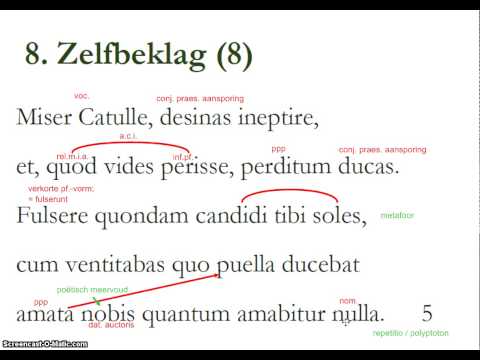
In the opening lines, Catullus addresses his own misfortune, urging himself to cease his foolishness. The phrase "miser Catulle, desinas ineptire" translates to "unfortunate Catullus, stop being foolish." This self-directed admonition sets the tone for the poem, highlighting the poet's internal conflict and the pain of lost love.
The poem's central theme revolves around loss and the struggle to accept it. Catullus implores himself to recognize what has been lost, suggesting that clinging to the past is futile. The line "quod videtis, perdidit" implies that what is seen is indeed lost, emphasizing the inevitability of acceptance. This notion of loss is further reinforced by the cognitive elements present in the text, where Catullus oscillates between desire and resignation.
Catullus employs a rich tapestry of language, utilizing various rhetorical devices to convey his emotions. The poem features a relative clause that encapsulates the essence of his lamentation. The phrase "perdum ducas" translates to "consider it lost," where the word "perdum" (lost) resonates with the theme of loss throughout the poem.
One notable stylistic device in the poem is polyptoton, where the same root word appears in different forms. For instance, the variations of the word "perdere" (to lose) and "perdum" (lost) create a rhythmic quality that underscores Catullus' emotional turmoil. This repetition serves to reinforce the poet's feelings of despair and longing.
Catullus employs metaphorical language to evoke vivid imagery of his past happiness. He reminisces about the bright days when love flourished, using phrases like "quantum... fulserunt" to describe the radiant moments shared with his beloved. This metaphor of shining suns symbolizes the joy and warmth of their relationship, contrasting sharply with his current state of sorrow.
As the poem progresses, Catullus reflects on the stark contrast between his past and present. He recalls a time when love was mutual and vibrant, stating, "non iam illud" (not anymore). This shift highlights the painful realization that the affection once shared has dissipated, leaving him in a state of longing and regret.
Throughout the poem, Catullus adopts an imperative tone, urging himself to move on. Phrases like "noli admirari" (do not admire) and "non vive miser" (do not live miserably) serve as commands to his own heart, emphasizing the struggle between desire and the need for self-preservation. This internal dialogue illustrates the complexity of human emotions, particularly in the face of heartbreak.
Catullus' poem 8 is a profound exploration of self-pity, loss, and the arduous journey toward acceptance. Through his masterful use of language, metaphor, and rhetorical devices, he captures the essence of heartbreak and the internal battles that accompany it. As readers, we are invited to reflect on our own experiences of love and loss, making Catullus' work timeless and relatable across generations. In the end, the poem serves as a reminder of the resilience of the human spirit, even in the face of profound sorrow.