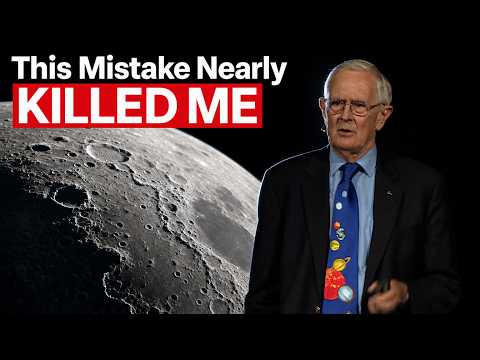
Charlie Duke, Apollo 16 astronaut, recounts his journey to the moon, detailing the launch, lunar landing, geological surprises, lunar rover explorations, and the unique challenges faced on the lunar surface. He highlights the scientific experiments conducted, the excitement and dangers of moonwalks, and the lasting impressions of lunar dust and the moon's environment.
Apollo 16 astronaut Charlie Duke recently shared his remarkable experiences during the Apollo missions, particularly focusing on the Apollo 16 mission to the moon. His detailed account offers a vivid glimpse into the challenges, scientific discoveries, and emotional moments of lunar exploration.
Charlie Duke expressed his pleasure at attending the Starmus event in Norway, thanking the organizers and sponsors for the opportunity to share his story. He worked on five Apollo missions: in mission control for Apollo 10 and 11, backup for Apollo 13, flew on Apollo 16, and backup on Apollo 17. He was the backup for Harrison Schmitt, who was also scheduled to speak.
The Apollo 16 mission launched on Sunday afternoon, April 16, 1972, aboard the massive Saturn V rocket, which stood 110 meters tall and weighed over 3 million kilograms. The astronauts boarded the spacecraft via a swing arm leading to the "white room" at the top of the launch tower.
Before launch, the crew breathed pure oxygen for three hours to remove nitrogen from their bodies and prevent decompression sickness. Duke described the intense vibrations during liftoff, noting his heartbeat reached 144 beats per minute, while commander John Young remained calm with a heartbeat of 70.
After orbiting Earth one and a half times, the spacecraft accelerated to about 40,000 km/h, heading toward the moon. Duke captured a stunning photo of Earth from space, showing the Arctic Circle, Canada, the United States, Mexico, and Central America suspended in the blackness of space.
During the journey, the only visible celestial objects were the Earth, the moon, and the sun. Contrary to popular science fiction, stars were not visible due to the constant daylight in deep space caused by the sun's brightness. Stars could only be seen through a telescope used for navigation.
Apollo 16 was unique among lunar missions as it landed in the lunar highlands, specifically the Descartes region, about 2,500 meters higher in elevation than the Apollo 11 landing site. The mission aimed to investigate two volcanic features identified from orbital photos: the Descartes and Cayley formations.
Duke and his team, trained extensively in field geology, expected to find volcanic rocks but were surprised to discover no volcanic material. Instead, they found breccias (fragmented rocks), some basalts, igneous rocks, and anorthosites. This was the biggest geological surprise of the Apollo program.
The science team included prominent geologists such as Bill Muehlberger, Lee Silver, Gene Shoemaker, Jim Head, and Farouk El-Baz, who supported the astronauts from mission control.
The lunar module, nicknamed Orion, weighed about 18,000 kg at descent start, with over half the fuel consumed by landing. The landing site was chosen based on 15-meter resolution photos from Apollo 14, which did not show objects smaller than 15 meters, posing a challenge due to numerous smaller rocks and craters.
Commander John Young expertly piloted the module, with Duke providing critical data such as altitude, descent rate, and fuel status. Electrical probes on the landing legs indicated contact with the lunar surface, signaling the engine shutdown and final touchdown.
Apollo 16 featured a lunar rover, an electric vehicle powered by two batteries, with front and rear wheel steering. The rover allowed the astronauts to explore up to 5 kilometers from the landing site, vastly expanding their range compared to previous missions.
Duke described the lunar surface as covered with very fine, powdery dust, unconsolidated to at least 2.5 meters deep. They collected 731 samples of lunar soil and rocks, with the largest rock weighing about 10 kg, roughly the size of a large watermelon.
The astronauts conducted three excursions on the moon, each lasting about 24 hours, with rest periods in between. They slept in hammocks inside the ascent stage of the lunar module, despite the cramped quarters.
Duke recounted the excitement and wonder of exploring the undulating lunar terrain, always eager to see what lay beyond the next rise. He shared a moment of fear when attempting a high jump during the "Moon Olympics"—a playful nod to the 1972 Olympic year—where he fell backward but fortunately avoided injury.
The lunar rover set a moon speed record, exceeding the odometer's 17 km/h limit, with Apollo 17 sharing the record. The astronauts drove a total of 25 km during their mission.
Temperatures on the lunar surface rose from about 30°C at arrival to nearly 100°C at departure, but the spacesuits' cooling systems kept the astronauts comfortable.
The mission deployed several scientific instruments, including a far ultraviolet camera and spectrograph to photograph the heavens, seismic experiments (active and passive), a heat flow experiment, a magnetometer, and a mass spectrometer. These experiments were powered up immediately after deployment.
The astronauts tracked a significant amount of lunar dust into the lunar module. The dust was extremely dry, picking up oils from their hands and acquiring a graphite-like texture and a smell reminiscent of gunpowder, despite the absence of organic material on the moon.
Upon returning to orbit, the dust floated inside the module, prompting the command module pilot, Ken Mattingly, to vacuum it up before allowing the crew back inside.
Charlie Duke's detailed recounting of the Apollo 16 mission offers a fascinating insight into the technical, scientific, and human aspects of lunar exploration. His experiences highlight the excitement, challenges, and groundbreaking discoveries made during one of humanity's most extraordinary adventures.
For more information and educational resources, Duke invites readers to visit charlieduke.com and looks forward to engaging with enthusiasts and answering further questions.
Thank you for joining this journey through Apollo 16's historic mission to the moon.