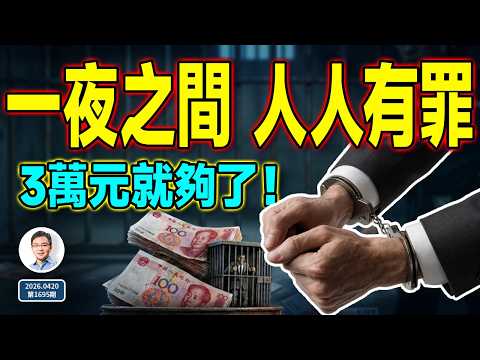
In April 2026, China's Supreme People's Procuratorate and Supreme Court issued a new judicial interpretation lowering the criminal thresholds for bribery and embezzlement among non-state personnel, including private enterprise managers and doctors. This shift protects state officials by raising their thresholds while targeting private sector and middle-class individuals, expanding anti-corruption enforcement to a broader social base with stricter penalties and broader definitions, including 'mot
In April 2026, China's highest judicial authorities—the Supreme People's Procuratorate and the Supreme Court—jointly issued a new judicial interpretation titled "Several Provisions on the Application of Law in Handling Criminal Cases of Corruption and Bribery (II)". This document, effective from May 1, 2026, contains 24 articles and marks a significant shift in China's anti-corruption enforcement.
The new interpretation specifically addresses crimes such as bribery, embezzlement, and misappropriation of funds committed by non-state personnel. It mandates that these crimes be judged by the same standards as those applied to state officials. At first glance, this might seem like a move toward equal treatment under the law, but legal experts have expressed serious concerns.
Previously, non-state personnel such as private enterprise managers and doctors faced higher thresholds for criminal liability in bribery and related crimes—often two to five times higher than those for state officials. For example, before this interpretation, bribery amounts between 60,000 to 150,000 RMB were typically the minimum for criminal prosecution in the private sector.
The new interpretation lowers this threshold to 30,000 RMB for non-state personnel, aligning it with the threshold for state officials. This means that if a private company manager accepts kickbacks exceeding 30,000 RMB, they can be criminally prosecuted. Similarly, doctors accepting bribes or "red envelopes" from patients exceeding this amount will also face criminal charges.
This change significantly expands the scope of anti-corruption enforcement to include a broad range of private sector employees and middle-class individuals. In large cities, gift-giving or bribery amounts of 30,000 RMB are not uncommon, especially in contexts such as promotions or job transfers.
Ordinary employees who offer bribes to supervisors to gain advantages may also be at risk. If a supervisor is investigated and implicates subordinates, those employees could also face criminal charges.
Conversely, the interpretation raises the thresholds for state officials regarding the classification of "large" and "especially large" amounts of illicit gains. For example, under the 2016 interpretation, state officials with illicit gains between 2 million to 3 million RMB were considered to have committed a "large amount" crime, and over 3 million RMB was "especially large".
The new interpretation raises these thresholds to 3 million to 10 million RMB for "large" and over 10 million RMB for "especially large" amounts. Additionally, hiding overseas deposits of over 3 million RMB is now considered a serious offense.
This effectively reduces the severity of punishment for many state officials compared to previous standards.
The new judicial interpretation has sparked widespread public debate and criticism. Many perceive it as a shift in anti-corruption efforts away from state officials toward private sector individuals and middle-class professionals such as doctors and private enterprise managers.
This shift is seen as a strategic move to protect the interests of state officials while intensifying scrutiny and penalties on private sector actors. The lowered thresholds and broadened definitions mean that many individuals with social status or certain positions in large cities may find it difficult to avoid legal risks related to unclear sources of assets exceeding 30,000 RMB.
Article 23 of the new interpretation introduces a controversial provision allowing prosecution even if the bribery transaction has not been completed or the bribe has been returned. Prosecutors can confiscate the "bribe" money regardless of whether it was actually delivered or accepted.
This provision enables authorities to convict individuals based on intent and agreements alone, without requiring concrete evidence of actual bribery transactions. For example, if a contractor promises a bribe to a government official to expedite payment but the money has not yet been paid, both parties can still be prosecuted.
Article 8 extends the treatment of "job-related embezzlement" crimes to non-state personnel, lowering the threshold to 30,000 RMB. This means private business owners and managers can be prosecuted for illegally appropriating company assets, even if the company is privately owned.
Common practices such as employing family members in the company with high salaries but little actual work may be scrutinized as fabricated expenses and illegal asset transfers.
Examples include:
These practices, common in many private enterprises, now carry significant legal risks under the new interpretation.
The 2026 judicial interpretation represents a major turning point in China's anti-corruption campaign. While it ostensibly applies equal standards to state and non-state personnel, in practice it raises the bar for prosecuting state officials while lowering it for private sector and middle-class individuals.
This shift signals a strategic reorientation of anti-corruption efforts, focusing on expanding the scope of enforcement to a broader social base, including private enterprise managers, doctors, and ordinary employees. The broadened definitions and lowered thresholds create a complex legal environment where many common social and business practices may become criminal liabilities.
Individuals and businesses in China, especially in large cities, should be aware of these changes and exercise caution in financial and interpersonal dealings to avoid falling into legal traps.
The new interpretation also raises concerns about the potential for abuse of prosecutorial discretion, given the possibility of convictions based on intent and incomplete transactions.
Overall, this judicial interpretation reflects the evolving landscape of anti-corruption enforcement in China, with significant implications for governance, business practices, and social relations.