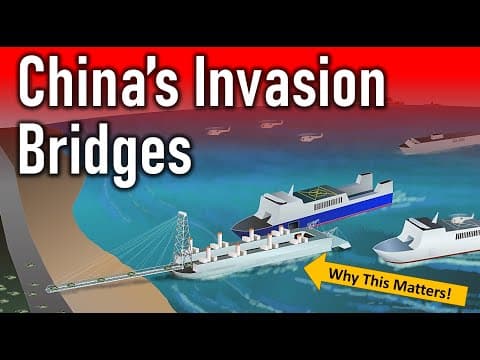
China is rapidly developing new types of landing barges that could significantly enhance its amphibious assault capabilities against Taiwan. These barges, designed for direct beach landings, indicate a shift in China's military strategy and preparations for a potential invasion.
The prospect of a Chinese invasion of Taiwan appears increasingly imminent, particularly with the recent developments in China's amphibious capabilities. This blog post delves into the significance of the new type of landing barges being constructed by China and what they imply for the future of Taiwan.
In recent weeks, reports have surfaced regarding the construction of new landing barges by China, which are believed to play a crucial role in any potential invasion of Taiwan. These barges, while seemingly unremarkable at first glance, represent a significant advancement in China's military capabilities.
Traditionally, the concept of a Chinese invasion of Taiwan has been characterized by the notion of a massive troop deployment across the Taiwan Strait. However, for many years, China lacked the necessary resources and equipment to conduct a credible amphibious assault. This has changed dramatically over the past decade, as China has modernized and expanded its naval fleet, particularly in the amphibious warfare domain.
China currently operates eight Type 071 landing platform docks and four Type 075 assault carriers, which are comparable to the U.S. Navy's amphibious assault ships. Additionally, there is at least one new, larger assault carrier equipped with an electromagnetic catapult, showcasing China's commitment to enhancing its naval capabilities.
The new landing barges being constructed are not just another addition to China's naval fleet; they are specifically designed for invasion purposes. Satellite imagery has revealed multiple barges under construction, indicating a focused effort to bolster amphibious assault capabilities.
These barges feature a distinctive road bridge that extends from the front, allowing for direct access to beaches. This design is reinforced to support heavy vehicles, making it clear that these vessels are intended for military use. At the stern, a self-supporting loading ramp facilitates the unloading of vehicles, including tanks, directly onto the beach.
While similar jack-up barges exist, the unique design of these new vessels sets them apart. They are not merely civilian vessels; their construction and rapid production suggest a military purpose. The technology employed in these barges is reminiscent of the Mulberry harbors used during World War II, which allowed Allied forces to land on beaches without the need for a captured port.
The introduction of these landing barges changes the landscape of potential military operations against Taiwan. With the ability to land troops and equipment on less accessible beaches, China could bypass traditional landing zones that are heavily fortified.
The presence of these barges suggests that China is preparing for a more versatile approach to amphibious assaults. Rather than relying solely on open beaches or ports, these vessels could enable landings in a variety of terrains, increasing the number of potential landing zones.
The rapid development of these invasion barges is a clear indicator of China's military intentions regarding Taiwan. As tensions continue to rise, the implications of these advancements cannot be understated. The construction of these vessels, coupled with China's ongoing military modernization, suggests that the threat of an invasion is becoming more tangible.
In summary, the new landing barges represent a significant shift in China's amphibious warfare strategy, allowing for greater flexibility and capability in potential military operations against Taiwan. As the situation evolves, it will be crucial to monitor these developments closely, as they may herald a new phase in cross-strait relations.