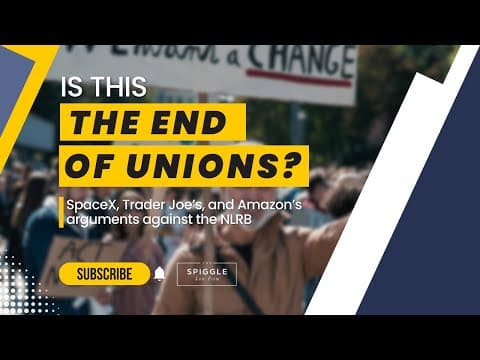
SpaceX, along with Amazon and Trader Joe's, has filed a lawsuit against the National Labor Relations Board (NLRB), challenging its constitutionality and potentially threatening workers' rights to unionize and engage in collective activities. This lawsuit is part of a broader movement against the administrative state, which could have significant implications for labor rights and protections in the workplace.
In a significant legal move, SpaceX, alongside Amazon and Trader Joe's, has initiated a lawsuit against the National Labor Relations Board (NLRB), a federal agency responsible for protecting workers' rights to unionize and engage in collective activities. This lawsuit raises critical questions about the future of labor rights in the United States and the constitutionality of the NLRB itself.
The National Labor Relations Board is a federal agency that safeguards the rights of employees to engage in activities such as forming unions and participating in what is known as concerted activities under the National Labor Relations Act. This includes the right of employees, whether unionized or not, to communicate about workplace issues such as wages, unsafe working conditions, and discrimination without fear of retaliation.
The lawsuit stems from an incident involving nine SpaceX employees who were terminated after voicing concerns about their working conditions. Following their dismissal, these employees filed a charge with the NLRB, which opened an investigation and scheduled a hearing. In response, SpaceX, supported by Amazon and Trader Joe's, filed a lawsuit challenging the constitutionality of the NLRB.
The companies argue that the structure of the NLRB violates Article 2 of the U.S. Constitution. They contend that the president should have the authority to remove NLRB judges, but the current system allows judges to be removed only for cause and by higher officials who also can only be removed for cause. This two-layered protection, they argue, undermines the president's ability to ensure that laws are faithfully executed, as required by the Constitution.
This lawsuit is part of a larger movement among various companies and conservative activists aimed at challenging what they term the "administrative state." This term refers to federal agencies like the NLRB, the Securities and Exchange Commission, and the Environmental Protection Agency, which have their own enforcement powers and regulatory authority. Critics argue that these agencies represent governmental overreach and have sought to roll back their powers since the New Deal era under President Franklin D. Roosevelt.
The administrative state has largely remained intact since its establishment, with the judiciary typically refraining from significant intervention. However, the current lawsuit represents a direct challenge to the NLRB's authority, which, if successful, could lead to a fundamental restructuring of the agency and its enforcement capabilities.
The outcome of this lawsuit could have profound implications for employees across various industries. The NLRB plays a crucial role in mediating disputes between unions and employers, ensuring that workers can voice their concerns without fear of retaliation. If the NLRB's authority is diminished or eliminated, the protections currently afforded to employees could be significantly weakened.
The lawsuit filed by SpaceX, Amazon, and Trader Joe's against the NLRB is a pivotal moment in the ongoing debate over labor rights and the role of federal agencies in regulating workplace conditions. As the case unfolds, it will be essential to monitor its implications for workers' rights and the future of unions in the United States. The outcome could reshape the landscape of labor relations and the protections available to employees in nearly every workplace.