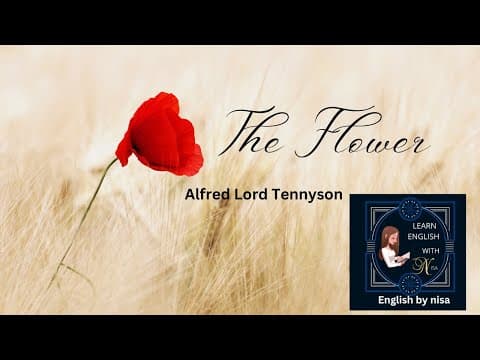
Alfred Lord Tennyson's poem 'The Flower' uses the metaphor of a flower to explore themes of creativity, societal criticism, and the fickle nature of public opinion. Through the journey of a poet's creation, Tennyson critiques how society often dismisses original work while quickly embracing imitation, highlighting the transient nature of appreciation and the challenges faced by creators.
In this blog post, we delve into the beautiful poem "The Flower" by Alfred Lord Tennyson, a prominent figure of the Victorian era and the longest-serving Poet Laureate in British history. Tennyson's work is known for its depth and richness, and this poem, first published in 1864, serves as a poignant commentary on the nature of creativity and societal criticism.
Alfred Lord Tennyson was one of the greatest English poets of the Victorian period. His literary career was marked by versatility and an extensive body of work that reflects profound themes and stylistic richness. Tennyson's poetry often explores the complexities of human experience, making him a significant figure in English literature.
The central theme of "The Flower" revolves around the idea of achievement and the criticism faced by those who create beauty. Tennyson uses the metaphor of a flower to represent personal acts of creation, discovery, and the writing process. The poem critiques how society often belittles the efforts of creators, showing a fickle character of human appreciation.
In the poem, Tennyson compares the act of growing a flower to the process of artistic creation. He illustrates how the poet sows a seed, nurturing it with hope for a beautiful bloom, only to face criticism from society. The poem suggests that while the poet's work is initially dismissed, it is later imitated and celebrated by others, highlighting the transient nature of public opinion.
The poem opens with the speaker reflecting on the act of planting a seed:
"Once in a golden hour, I cast to Earth a seed."
Here, the "golden hour" symbolizes a rare moment of inspiration, while the seed represents the poet's creative endeavor. Despite the initial hope, the flower that blooms is met with disdain, as people label it a weed, a metaphor for the undervaluation of original work.
In the second stanza, Tennyson describes how passersby in the garden express their discontent:
"To and fro they went through my garden bower, muttering discontent, curse me and my flower."
This illustrates the restlessness of society, which feels threatened by the poet's unique creation. Instead of appreciating the beauty of the flower, they criticize it, revealing their inability to recognize true artistry.
The third stanza highlights the flower's growth despite criticism:
"Then it grew so tall, it wore a crown of light."
This metaphor signifies the success of the poet's work, which shines brightly despite the negativity surrounding it. However, the narrative takes a turn as thieves steal the seeds, seeking to replicate the poet's success.
The fourth stanza reveals the irony of imitation:
"They sowed the seeds far and wide, till all the people cried, 'Splendid is the flower.'"
Here, the same flower that was once criticized is now celebrated when it is replicated by others. This shift in perception underscores the fickle nature of societal appreciation.
In the fifth stanza, Tennyson reflects on the accessibility of the poet's ideas:
"He that runs may read."
This biblical reference suggests that the poet's story is simple and understandable, yet it also highlights the ease with which others can now imitate his work. The original creator's unique contribution is overshadowed by the proliferation of similar creations.
The final stanza concludes with a reflection on the outcomes of imitation:
"Some are pretty enough, and some are poor indeed."
This line illustrates the mixed results of imitation, where not all who attempt to replicate the flower succeed. The poet's original creation, once admired, is again dismissed as a weed by those who fail to appreciate its true value.
In "The Flower," Alfred Lord Tennyson masterfully uses the metaphor of a flower to explore the challenges faced by creators in a critical society. The poem critiques the tendency of people to scorn original work while quickly embracing imitation, revealing the transient nature of popularity and appreciation. Tennyson's work serves as a reminder of the importance of recognizing and valuing individual creativity, even in the face of societal criticism. Through this exploration, Tennyson invites readers to reflect on their perceptions of art and the often fickle nature of public opinion.