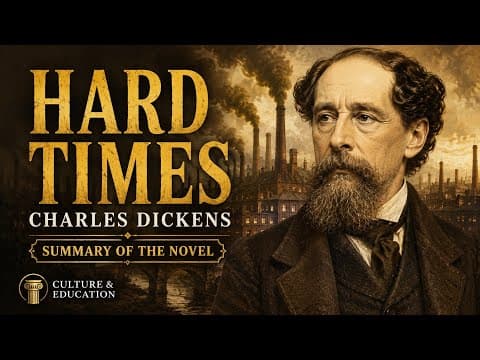
Charles Dickens' 'Hard Times' critiques the harsh realities of industrial society through the story of Thomas Gradgrind and his family, exploring themes of utilitarianism, materialism, and the struggles of the working class in a fictional industrial town.
Charles Dickens' novel Hard Times, published in 1854, is set in the fictional industrial town of Coketown, which is modeled after Manchester. The narrative is a poignant critique of the industrial age, particularly focusing on the exploitation of the working class and the shortcomings of utilitarian philosophy.
At the heart of Hard Times is the character of Thomas Gradgrind, who governs his family and school with a strict adherence to utilitarianism. This philosophy aims for the greatest happiness for the greatest number, yet Dickens critiques a form of utilitarianism that prioritizes materialism above all else. This perspective dismisses emotional and moral values, reducing human experience to mere facts and figures.
Thomas Gradgrind has two children, Louisa and Tom. Their upbringing is heavily influenced by their father's rigid beliefs. The children are raised in an environment that stifles imagination and emotional growth. When they encounter the circus, where the clown, Mr. Sleary, performs, they are drawn to the joy and creativity that their father’s philosophy denies them.
Louisa's character is particularly tragic; she is caught between her father's expectations and her own desires. Her relationship with Mr. Bounderby, a wealthy factory owner who proposes to her despite their age difference, further complicates her life. Bounderby embodies the self-made man ideal, yet his character is marred by arrogance and hypocrisy.
The novel also introduces Stephen Blackpool, a factory worker whose life is riddled with hardship. He faces personal challenges, including an alcoholic wife who has left him, and his love for Rachel, another factory worker. When a strike occurs, Stephen's refusal to join the trade union leads to his ostracization by his peers and ultimately results in his dismissal from the factory.
Stephen's plight highlights the struggles of the working class during the industrial revolution, showcasing the harsh realities they faced in a system that prioritized profit over people.
As the story progresses, the relationships between characters become increasingly strained. Louisa's marriage to Bounderby is fraught with unhappiness, and she finds herself the target of James Harthouse's advances, a politician who attempts to seduce her. Meanwhile, Tom Gradgrind, Louisa's brother, becomes embroiled in a criminal act when he robs Bounderby’s bank, leading to a series of tragic events.
The tension escalates when Stephen Blackpool is wrongfully accused of the bank robbery, despite his innocence. The betrayal and manipulation by characters like Mrs. Sparsit, Bounderby’s housekeeper, further illustrate the moral decay present in Coketown.
In a climactic turn of events, Stephen Blackpool, found dying in a disused mine shaft, implores Thomas Gradgrind to clear his name. Gradgrind's journey leads him to a painful realization about his parenting and the consequences of his utilitarian beliefs. He learns that his son Tom is the true bank robber, hiding in the circus disguised as a clown.
The novel concludes with Tom's demise abroad and Gradgrind's transformation. He ultimately rejects the principles of faith, hope, and charity that he had previously dismissed, suggesting a profound change in his understanding of human values.
Hard Times serves as a powerful commentary on the industrial age, exploring the impact of utilitarianism and materialism on human relationships and society. Through the struggles of the Gradgrind family and the working class, Dickens invites readers to reflect on the importance of compassion, imagination, and moral values in a world increasingly dominated by economic concerns. The novel remains a relevant critique of the societal structures that prioritize profit over people, making it a timeless piece of literature that resonates with contemporary issues.