This blog post delves into the vernacular works of Dante Alighieri, highlighting his contributions to poetry and prose, particularly focusing on 'Vita Nova' and 'Convivio', and the themes of love, philosophy, and spiritual guidance present in his writings.
Dante Alighieri is recognized as one of the first writers to create works in the vernacular language. This article aims to explore his contributions to literature, particularly focusing on his poetic and prose works.
Dante's writings in the vernacular can be categorized into two main types: verse and prose. Among his early verse works, we find the Detto d'Amore and Fiore. These pieces are of dubious attribution, as they have survived in a single anonymous manuscript. Both are short poems, with the first consisting of 480 seven-line stanzas and the second comprising 232 sonnets, centered around the theme of courtly love, inspired by the French romance Roman de la Rose from 1280.
Between 1280 and the early years of his exile, Dante composed a series of rhymes focused on amorous themes, heavily influenced by his friend Guido Cavalcanti, a prominent figure of the dolce stil novo. These poems were not compiled into a single book, except for those included in Vita Nova.
Vita Nova is an important work that Dante wrote between 1292 and 1293, shortly after the death of Beatrice in 1290. This work is a prosimetro, containing both verse and prose. It consists of 31 lyrical pieces, including 23 sonnets, two double sonnets, a ballad, a stanza of a song, a double stanza of a song, and three songs. The lyrical sections are interconnected through 42 prose chapters.
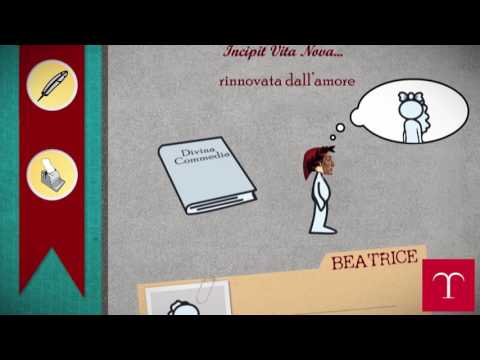
The title Vita Nova is derived from the first chapter, where Dante expresses his intention to recount events from his memory, starting with the phrase "incipit Vita Nova," a formula typical of ancient and medieval legal texts. Dante's life is portrayed as renewed through his love for Beatrice.
The narrative begins in 1274 when Dante, at the age of nine, first meets Beatrice. Nine years later, they encounter each other again, and Beatrice greets him. However, fearing that his love for her might be revealed, Dante courts other women, which offends Beatrice, leading her to deny him her greeting. This prompts Dante to express his feelings, but Beatrice and her companions mock him.
Dante's sorrow deepens with Beatrice's death in 1290, which he does not recount directly but reflects upon through his sense of loss. A year later, he meets a young, beautiful woman who comforts him, later revealed to be an allegorical representation of philosophy. At the end of Vita Nova, Beatrice appears to Dante as she did during their first meeting, and he resolves not to write about her until he can do so more appropriately, alluding to the Divine Comedy and his eventual reunion with her in paradise.
Beatrice is consistently associated with the number nine, which is the square of three, linking her to the Holy Trinity and Christian faith. She embodies a stylized love characterized by grace and humility, contrasting with the more superficial courtly love. Beatrice offers salvation and serves as Dante's spiritual guide, prompting him to express his elevated feelings through lyrical praise.
Dante's love for Beatrice evolves into a new lyrical form, influenced by the provençal tradition, where the poet seeks the woman's acknowledgment as a reward for his devotion. Through the stilnovisti, such as Guinizzelli and Cavalcanti, Dante redefines love as a divine connection, ultimately returning the sentiment to God through the figure of Beatrice.
In addition to Vita Nova, Dante's poetry from the 1290s includes doctrinal rhymes linked to his philosophical studies following Beatrice's death. These works also feature the Rime per la pargoletta and Rime di donna Petra, where the woman is depicted as hostile and threatening, reflecting the complexity of love.
Dante's later lyrical works include moralistic rhymes from his early years of exile, where he uses love poetry to critique the world's violence and advocate for justice.
A notable exchange in Dante's poetry is the tensione with Forese Donati, a friend despite being part of the opposing political faction, the Neri. This tensione consists of three sonnets by Dante and three responses from Donati, characterized by a playful yet aggressive tone, showcasing the camaraderie and rivalry between poets.
Another significant work by Dante is Convivio, written between 1303 and 1304, although the final treatise may have been completed later, between 1306 and 1308. Initially intended to consist of 15 treatises, Dante ultimately completed only four, maintaining the introduction and providing commentary on three songs.
The term convivio translates to banquet or symposium, where participants are offered a dish (a song) accompanied by bread (a commentary) to facilitate understanding. Dante's audience is broad, including those without formal education, which justifies his use of the vernacular language.
In Convivio, Dante constructs a defense against accusations from those who forced him into exile, creating a work infused with Aristotelian philosophy. The central figure in this work is again a woman, representing philosophy, which Dante praises for its beauty and divine nature.
Dante eventually abandons Convivio to focus on the Divine Comedy, leaving behind a legacy of profound reflections on love, philosophy, and the human experience.
Dante Alighieri's vernacular works, particularly Vita Nova and Convivio, showcase his innovative approach to literature, blending personal experience with philosophical inquiry. His exploration of love, loss, and spiritual guidance continues to resonate, establishing him as a pivotal figure in the literary canon.