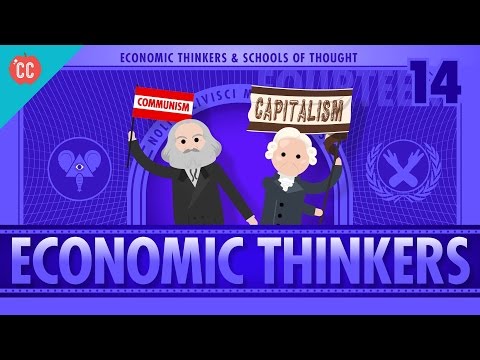
This blog post delves into the evolution of economic theories, from Malthus and Smith to Keynes and the Austrian School, highlighting how these ideas have shaped modern economics and continue to influence policy today.
Welcome to the fascinating world of economics, where theories evolve and shape our understanding of human behavior and societal structures. In this post, we will explore various economic ideologies, tracing their historical roots and examining their implications on modern economic policies.
The term "dismal science" often refers to economics, a label that can be traced back to British economist Thomas Malthus. In 1798, Malthus posited that population growth would inevitably outstrip food production, leading to widespread famine. While his predictions were dire, they were ultimately proven incorrect. The global population has surged from one billion during Malthus's time to over seven billion today, and famines have largely been attributed to manmade disasters rather than agricultural limitations.
Malthus's theories, however, sparked significant debate and led to the emergence of Social Darwinism, which incorrectly suggested that aiding the poor was immoral. This highlights a critical aspect of economics: theories can have profound real-world consequences, especially when they are flawed.
The foundation of modern economics was laid by Scottish philosopher Adam Smith, whose seminal work, The Wealth of Nations, was published in 1776. Smith introduced the idea that individuals pursuing their self-interest could inadvertently benefit society as a whole. He championed free trade, arguing against the heavy tariffs that stifled economic growth.
Following Smith, British economist David Ricardo expanded on his ideas with the theory of comparative advantage, which posits that trade can be mutually beneficial even if one party is more efficient in producing all goods. This laid the groundwork for classical economics, which emphasized private property and free markets.
In stark contrast to classical economics, Karl Marx and Friedrich Engels presented a different perspective in their Communist Manifesto (1848). They focused on the conflict between economic classes, predicting that workers would eventually overthrow their capitalist oppressors, leading to a classless society. Marx's critique of capitalism challenged the notion that individual self-interest serves the common good, creating a divide between free market capitalism and communism.
As the 20th century unfolded, the world faced significant economic turmoil, particularly during the Great Depression. Classical economics struggled to explain or remedy the crisis, prompting British economist John Maynard Keynes to propose a new framework in his 1936 work, A General Theory of Money, Interest, and Employment. Keynes argued that market economies do not self-correct quickly and that government intervention is necessary during recessions to stimulate demand and reduce unemployment.
Keynesian economics gained traction, especially as nations sought to recover from economic downturns. This marked a shift towards more government involvement in the economy, leading to the rise of socialist policies in various countries, particularly in Scandinavia.
In response to the growing acceptance of Keynesianism, the Austrian School of economics emerged, led by thinkers like Friedrich Hayek and Ludwig von Mises. They argued against government intervention, claiming that the economy is too complex for manipulation. Their ideas were further popularized in the United States by Milton Friedman, who advocated for privatization and deregulation, attributing the Great Depression to poor monetary policy rather than inherent flaws in capitalism.
Friedman's Chicago School of economics gained prominence in the 1970s, particularly during a period of stagflation, where inflation and stagnation coexisted. This led to the development of monetarism, which emphasizes controlling the money supply to ensure economic stability.
Today, mainstream economics incorporates elements from both classical and Keynesian theories, often referred to as the new neoclassical synthesis. However, debates about the appropriate economic policies continue, especially in response to crises like the 2008 global recession. Economists remain divided on whether to implement Keynesian deficit spending or austerity measures to address budget deficits.
As we look to the future, the landscape of economic thought continues to evolve. Many countries that once adhered strictly to communism, such as China and Cuba, have shifted towards more capitalist frameworks. However, Marxist ideas persist, influencing policies in various capitalist nations.
The convergence of economic ideologies suggests a complex future where predicting outcomes remains challenging. Just as Malthus could not foresee the advancements that would allow humanity to thrive, we too must acknowledge the unpredictability of economic evolution.
In conclusion, the study of economic schools of thought reveals a rich tapestry of ideas that have shaped our world. As we navigate the complexities of modern economies, it is essential to understand the historical context and implications of these theories, as they continue to influence policies that affect millions of lives.





