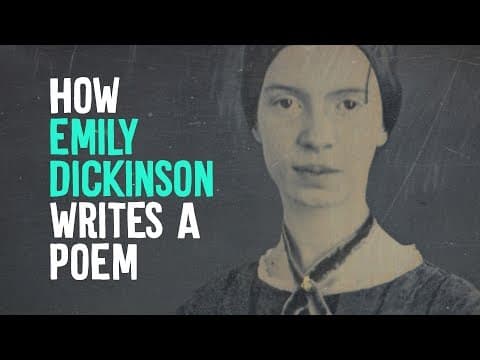
Emily Dickinson's poem 'Tell all the truth, but tell it slant' explores the complexities of truth-telling through metaphor and ambiguity, suggesting that truth must be approached indirectly to be understood and appreciated.
Emily Dickinson, one of America's most celebrated poets, is known for her unique approach to poetry, characterized by ambiguity, unconventional meter, and surprising imagery. One of her most intriguing poems, "Tell all the truth, but tell it slant," encapsulates her philosophy on truth and its presentation. This blog post delves into the layers of meaning within this poem, examining how Dickinson articulates her views on truth through metaphor and structure.
At first glance, Dickinson's poem appears straightforward. The opening line, "Tell all the truth, but tell it slant," seems to advocate for honesty. However, the use of the word "slant" introduces an immediate tension. The phrase suggests that while truth is essential, it must be conveyed indirectly. This paradox sets the stage for the poem's exploration of how truth can be both illuminating and blinding.
In the second line, "Success in Circuit lies," Dickinson employs the word "lie" in a way that invites multiple interpretations. While it can mean to reside or be found, it also hints at deception. This duality reflects Dickinson's complex relationship with truth. The term "Circuit" contrasts with "Circumference," representing the boundaries of human understanding versus the infinite nature of truth. Dickinson's ambivalence is evident as she navigates the tension between safety within one's limited understanding and the allure of the vast unknown.
As the poem progresses, Dickinson asserts that the truth is a "superb surprise" that is "too bright for our infirm Delight." Here, she suggests that the overwhelming nature of truth can be disorienting. The word "surprise" carries connotations of an unexpected attack, raising questions about how one can grasp such a powerful concept. If truth is indeed a surprise, how can it be effectively communicated?
Dickinson further complicates her argument with the metaphor of lightning. In the lines, "As Lightning to the Children eased / With explanation kind," she draws a parallel between explaining truth and explaining lightning to children. However, the grammar suggests that it is the lightning that is eased, not the children. This raises doubts about the effectiveness of explanations in mitigating the fear associated with such a dazzling force.
The phrase "dazzle gradually" is particularly striking, as it presents an oxymoron. Dazzling is an instantaneous experience, yet Dickinson suggests that understanding must occur over time. This contradiction highlights the challenges of comprehending truth in its entirety.
Ultimately, Dickinson's poem subverts its own premise. While it appears to advocate for a slant approach to truth, it simultaneously reveals the limitations of such an approach. The oscillation between clarity and ambiguity reflects Dickinson's understanding that language often fails to capture the essence of truth. By embodying her philosophy within the structure of the poem, she invites readers to experience the instability of meaning firsthand.
Emily Dickinson's "Tell all the truth, but tell it slant" serves as a profound meditation on the nature of truth and its complexities. Through her use of metaphor, ambiguity, and self-reflection, Dickinson challenges readers to reconsider how truth is conveyed and understood. The poem ultimately suggests that while truth is vital, it must be approached with care and nuance, lest it blind those who seek to grasp it. In this way, Dickinson not only articulates her philosophy but also exemplifies it through her artful manipulation of language and form.